
Google algorithms carry a reputation for being a moody black box that hands out rankings at random, and that picture stops plenty of beginners before they have published their third article. The previous chapter walked through what a results page genuinely puts on screen, with its stack of blocks sitting above the organic links. This chapter moves one level up, into the machinery that decides the order. The useful part for you is that Google documents a good chunk of what it runs, in fairly plain language. The goal here is not to turn you into an engineer, but to hand you a workable mental map so you stop hunting for the magic switch.
TL;DR
Google algorithms are not one engine but a collection of automated systems working together on every single search.
Older systems like Panda and Penguin were folded into core ranking, which made them invisible without making them inactive.
A core update is a broad change that targets neither your site nor any individual page, however personal the drop feels.
Thinking in families of systems beats chasing one isolated factor when you are starting out with no budget and no track record.
Summarize This Article with AI
ChatGPTContents
1. Why Google algorithms come in the plural
2. What each family of systems is trying to measure
3. The retired systems that still weigh on your rankings
Why Google algorithms come in the plural
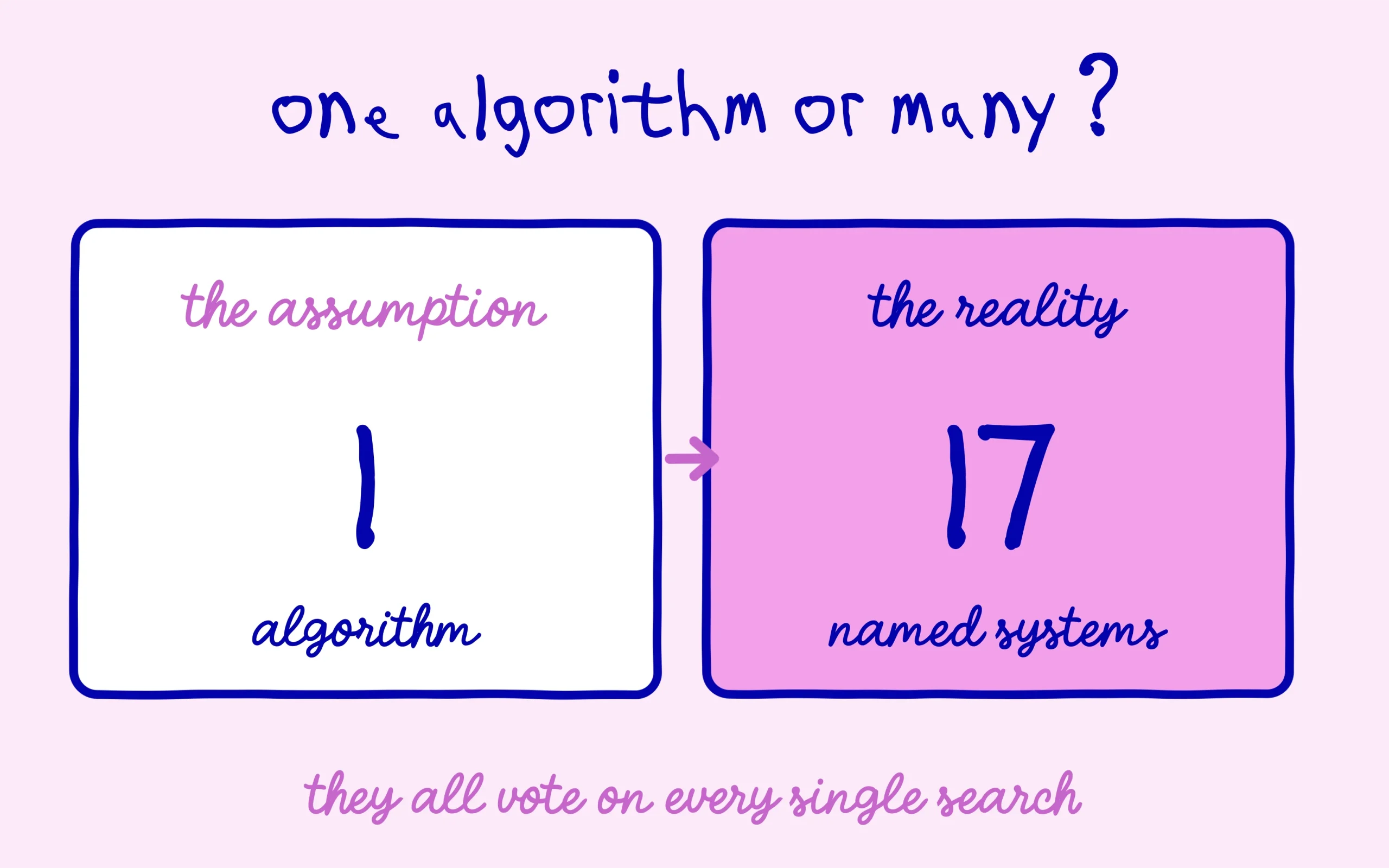
The singular misleads you from the first sentence. People say “the Google algorithm” the way they would say “the engine in a car”, picturing a single part that would unlock everything once understood. What the company documents looks closer to a workshop where several dozen machines run at the same time, each with its own speciality.
Google publishes the list of the main systems it uses to rank results, giving each one a name and a short description. The roster includes BERT and neural matching for language interpretation, RankBrain, link analysis and PageRank, freshness systems, the reviews system, passage ranking, deduplication, site diversity, spam detection and a handful of others. The full inventory sits in the official guide to Google Search ranking systems.
That plurality has an immediate practical consequence. When somebody sells you “the trick the algorithm loves”, they are describing one of those systems at best, while forgetting the sixteen others casting a vote at the same moment. No single lever drives rankings on its own, and that is worth absorbing before you buy anything.
What lands on screen is the finished product of that assembly. The blocks described last chapter, in what a Google results page really puts in front of you, come from different systems that agreed on a layout. The image carousel, the featured snippet and the ten blue links do not originate in the same place.
One honest caveat belongs here. Google names its systems and describes what each one does, without ever publishing how much weight it gives them or the formula that combines them. You get to know which families of questions the engine asks, never how much each answer counts. Anyone quoting a precise percentage for a given factor rebuilt that number from observation, never from an official source. Google algorithms stay partly open and partly closed.
What each family of systems is trying to measure
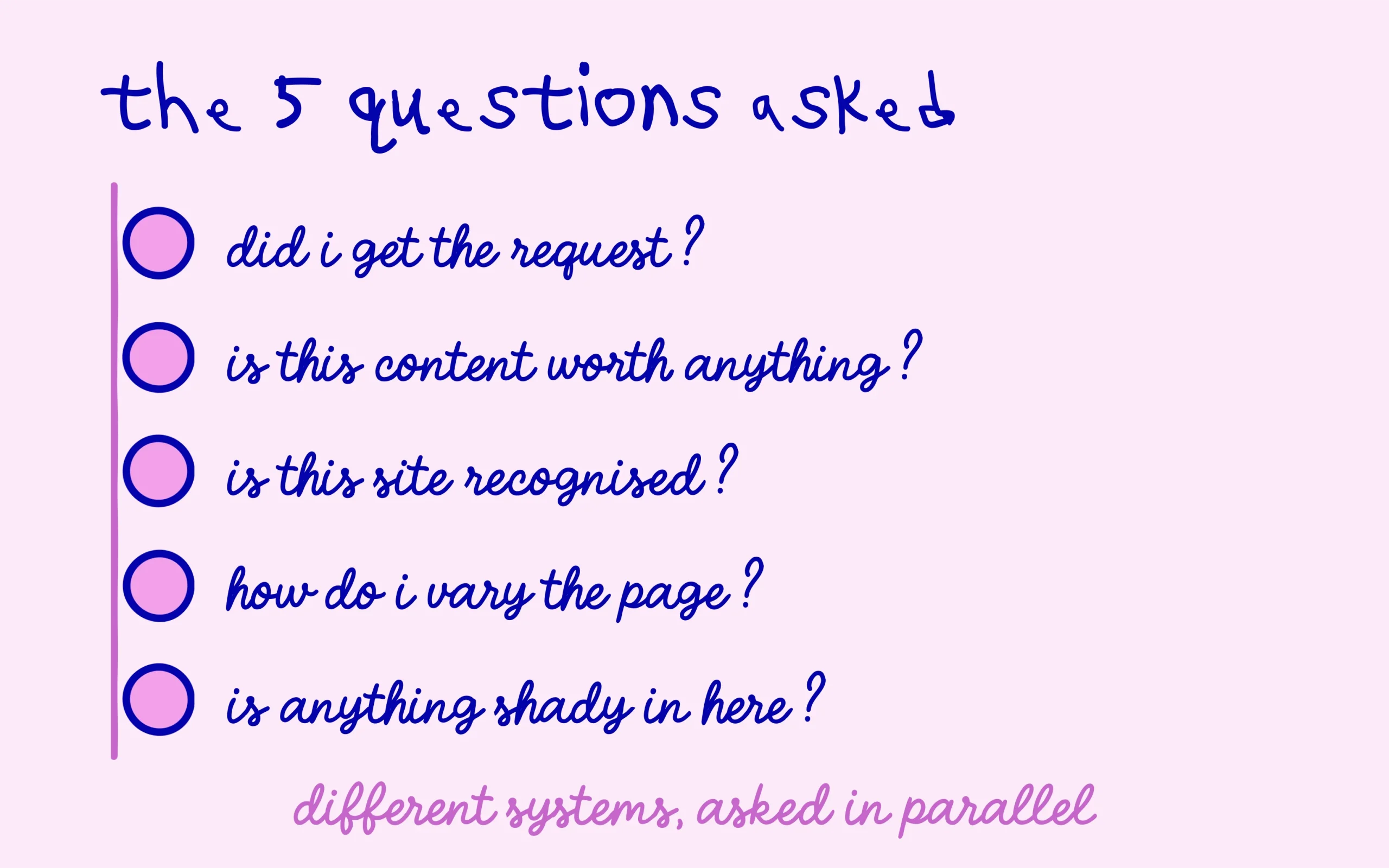
Memorising seventeen names gets you nowhere. Grouping them by intent makes the whole thing usable, because each family boils down to one plain question you can carry in your head while writing.
Working out what the searcher meant takes up the first of those families. BERT, neural matching and RankBrain deal with word meaning, clumsy phrasing and queries typed the way people speak. In practice the engine stopped matching strings of characters and now tries to reconstruct an intent. Stuffing a page with keyword variants to cover every possible phrasing was a useful tactic fifteen years ago, and it pays nothing today.
Next comes the judgement passed on the content itself. The original content system tries to surface whoever broke a piece of information rather than whoever copied it. The reviews system specifically targets tests and comparisons, favouring the ones showing genuine hands-on use. Passage ranking lets one precise paragraph surface even when the page as a whole covers a wider topic.
A third group ignores your text entirely and looks at what the rest of the web says about you. Link analysis and PageRank are among the oldest systems still running, and the principle fits in one line: a link from a recognised page counts as a form of endorsement. The backlinks module covers that mechanism properly, because it needs a full chapter to be handled without shortcuts.
Other systems again rate no page in particular and instead assemble the results page as a whole. Site diversity caps how many listings one domain can take, deduplication drops near-identical results, freshness systems lift recent content on topics that deserve it. This family explains why a solid page can sit below without carrying any flaw of its own. Beginners often rewrite a perfectly good article three times over a position that was never about the article.
Cleanup falls to the last family. Spam detection systems and removal-based demotions push aside manipulative practices and problematic content. Worth noting: none of these systems ever meet your page until it exists in the index. A page blocked upstream never reaches any of this machinery, which is exactly why the course took the detour through what indexing really means and why Google sometimes refuses your pages.
Seen that way the whole thing becomes readable again. Five questions, asked in parallel on every search: did I get the request, is this content worth anything, is this site recognised, how do I build a varied page, and is there anything shady in here. That reasoning extends the rules of the SEO game laid out in chapter one, with the mechanics filled in.

The retired systems that still weigh on your rankings
One detail creates lasting confusion the moment anyone reads the history of Google algorithms, and it deserves a stop. The engine flags some of its systems as retired, which reads like they were switched off. In practice most of them were absorbed into core ranking.
Panda, announced in 2011 to tackle thin content, became part of the core ranking systems in 2015. Penguin, launched in 2012 against link spam, was integrated in 2016. The helpful content system, the one that shook a lot of publishers between 2022 and 2023, followed the same path in March 2024. Hummingbird, introduced in 2013, was already described as an overhaul of overall ranking rather than a separate brick.
So “retired” means folded into the mix, never dropped. An absorbed system turns invisible without turning harmless, and it keeps assessing your pages continuously instead of waking up for an announced refresh.
What that absorption really changed is the tempo. Back when Panda ran as a separate filter, a hit site waited for the next pass to hope for a recovery, sometimes for months. Once the logic sits inside core ranking, assessment runs continuously and recoveries can happen with no announcement at all. The trade-off is that nobody can tell you which precise system caused your drop.
You will still run into plenty of articles reasoning in separate filters, with advice along the lines of “avoiding a Panda penalty”. They describe a state of the engine that stopped existing a decade ago. The historical sequence of those updates, from Panda through to the systems now handling generative answers, is traced in our recap of the major Google updates.
What a core update actually does to your site
Several times a year Google announces a major change to its ranking. The company describes these as significant, broad changes made to its systems, meant to keep serving helpful and reliable results, and it lays out the logic in its documentation on core updates to Google Search.
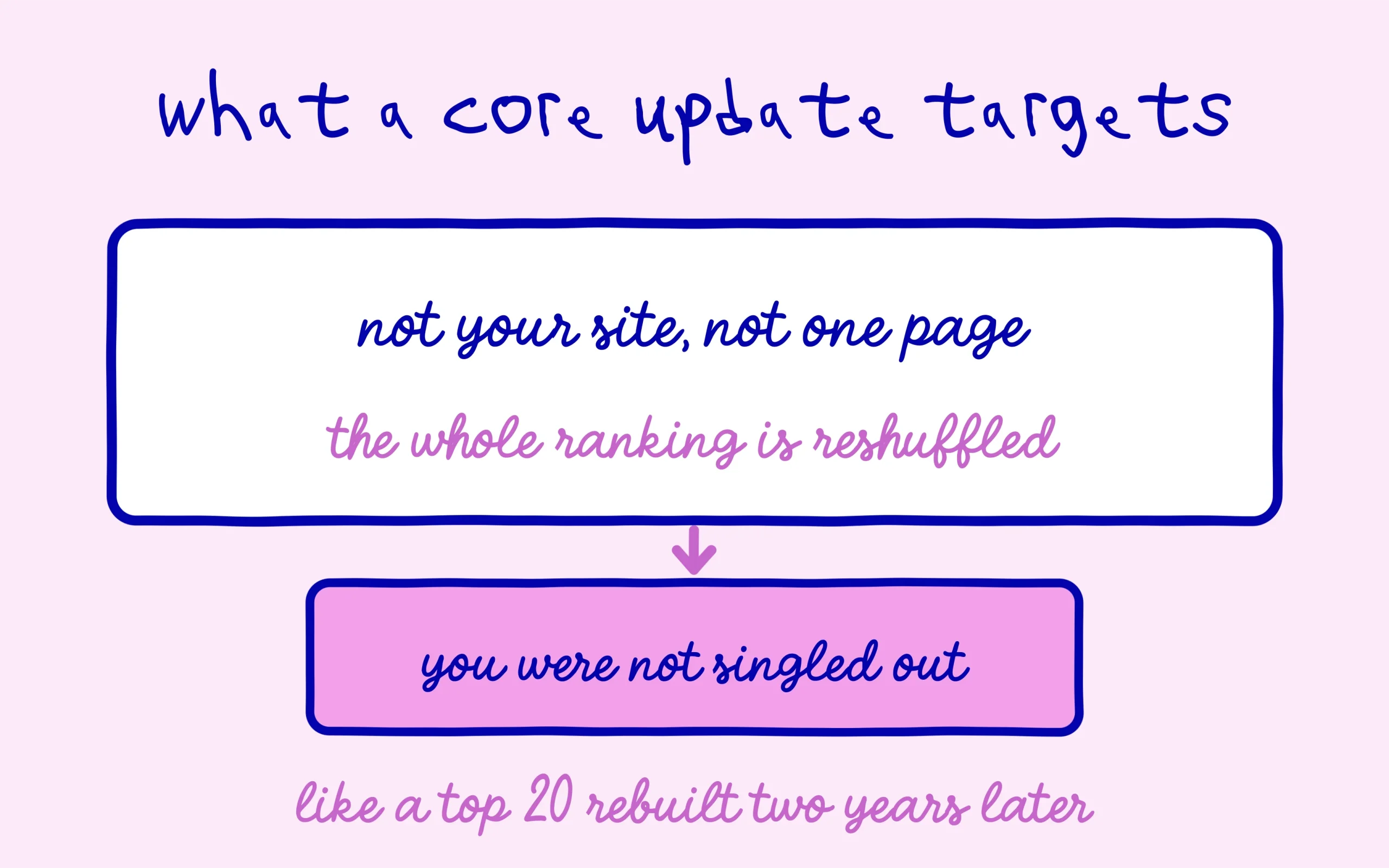
The most misread point fits in one line: these changes are broad by nature and target neither specific sites nor individual web pages. Losing twenty positions the day after a core update therefore does not mean the engine reviewed your site and punished it. The word “penalty” circulates widely in forums while describing something else entirely, namely the manual actions you would see reported in Search Console.
To explain the drops, Google reaches for the image of a list of the twenty best restaurants in a city. Rebuild that list two years later and it inevitably shifts: some places fall out of the ranking without having gone bad, simply because others fit the current top 20 better. Your page can have stayed exactly the same and still sit behind three pieces published since.
The advice that follows a drop lines up with that image. Google suggests assessing the whole site honestly, aiming for durable improvements rather than quick fixes, and treating content removal as a last resort reserved for pages written for search engines before they were written for readers. Nothing in there looks like a box to tick.
That absence of individual targeting also covers the loudest fear of the moment. The worry about an automatic sanction as soon as a text was drafted with an artificial intelligence rests on the same misunderstanding, and the official statements dismantling it are collected in what Google actually does with AI-generated content. The engine judges the published result, not the tool used to write it.
A method reflex to close this section. Before pinning a swing on a core update, check the dates. A decline that started three weeks before the announcement came from somewhere else, and the wrong diagnosis usually costs more than the decline itself, because it triggers pointless surgery on a site that never had that problem.

Thinking straight without chasing the algorithm
That leaves the practical question, the one that matters when you publish your fifth article and wonder what to improve. The answer sits in a change of altitude: aim at what Google algorithms collectively try to reward instead of the settings you assume behind each of them.
Translated into writing habits, that gives a page covering one identifiable topic rather than three halfway, an answer genuinely useful to the question asked, a structure that lets a clean passage be lifted out, and sources cited whenever a claim earns it. Those four habits speak to several families of systems at once, which is precisely the point.
The rest plays out over time. A site publishing consistently within a coherent perimeter ends up associated with that perimeter, which weighs both on classic rankings and on how generative engines pick their sources. That accumulation effect, detailed in our piece on topical authority in AI search, takes months rather than weeks.
An honest note on the generative side. Engines that write answers publish no equivalent to the ranking systems guide, so the reasoning rests on observed behaviour rather than documentation. What we know about generative engines stays shakier than what we know about Google, so anyone stating generative rules with total confidence is worth a second look. Watching how a handful of your own pages get cited across a few weeks will teach you more than most of what gets published on the subject.
The next chapter digs into E-E-A-T, meaning what Google concretely expects from a site in terms of experience, expertise, authoritativeness and trust. In the meantime, open the official ranking systems guide and sort each of the seventeen listed systems into one of the five families described above. The exercise takes twenty minutes and beats reading three more articles on the topic.

Keep learning on SEO Noobies.