Chapter 5 of the learn SEO course. E-E-A-T has been turning up in almost every SEO conversation for three years now, usually described as some secret grade Google quietly assigns to your website. The truth is both simpler and less mysterious: those four letters come from a public document Google hands to human evaluators, and they describe what makes a page worth trusting in the eyes of an ordinary reader. Getting clear on what E-E-A-T actually covers will stop you chasing a score that does not exist, and hand you a practical lens for reading your own pages. This chapter lays out the definition, the four pillars, and above all what a site starting from scratch can genuinely put in place.
TL;DR
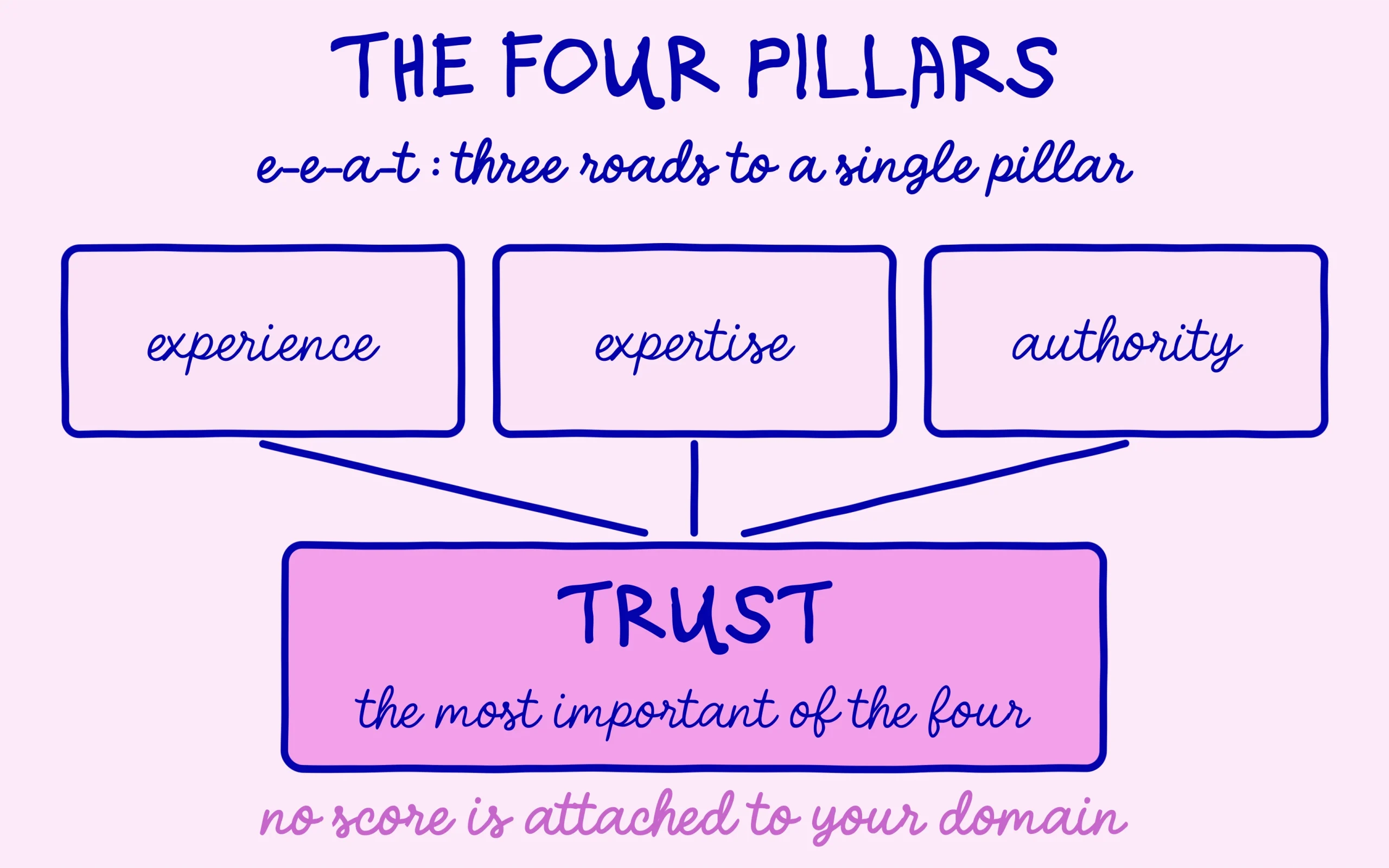
E-E-A-T stands for experience, expertise, authoritativeness and trust, four criteria drawn from the guidelines Google gives its quality raters.
Google states plainly that rater data is not used directly in its ranking algorithms.
Trust is named as the most important of the four, with the other three feeding into it.
Three questions are enough to audit any page: who wrote it, how it was produced, and why it exists.
Summarize This Article with AI
ChatGPTContents
What the previous chapter established
Where E-E-A-T comes from and what it covers
The four pillars seen from a brand new site
Why trust governs the other three
What the previous chapter established
Chapter 4 dismantled a stubborn myth, the one about a single algorithm sitting somewhere deciding every ranking on its own. We saw that Google runs many systems side by side, each measuring a different facet of a page, and that what you see on screen comes out of their combination. If that framing still feels hazy, it is worth revisiting before tackling this one: the whole thing is unpacked in our plain English explanation of how Google algorithms work.
One question stayed open at the end of that chapter. These systems try to measure quality, fine, but quality judged against what? A machine has no innate sense that a medical article written by a doctor beats a medical article written by nobody in particular. Someone, somewhere, had to define what “better” means. That is precisely the job of the document these four letters come from.
Where E-E-A-T comes from and what it covers
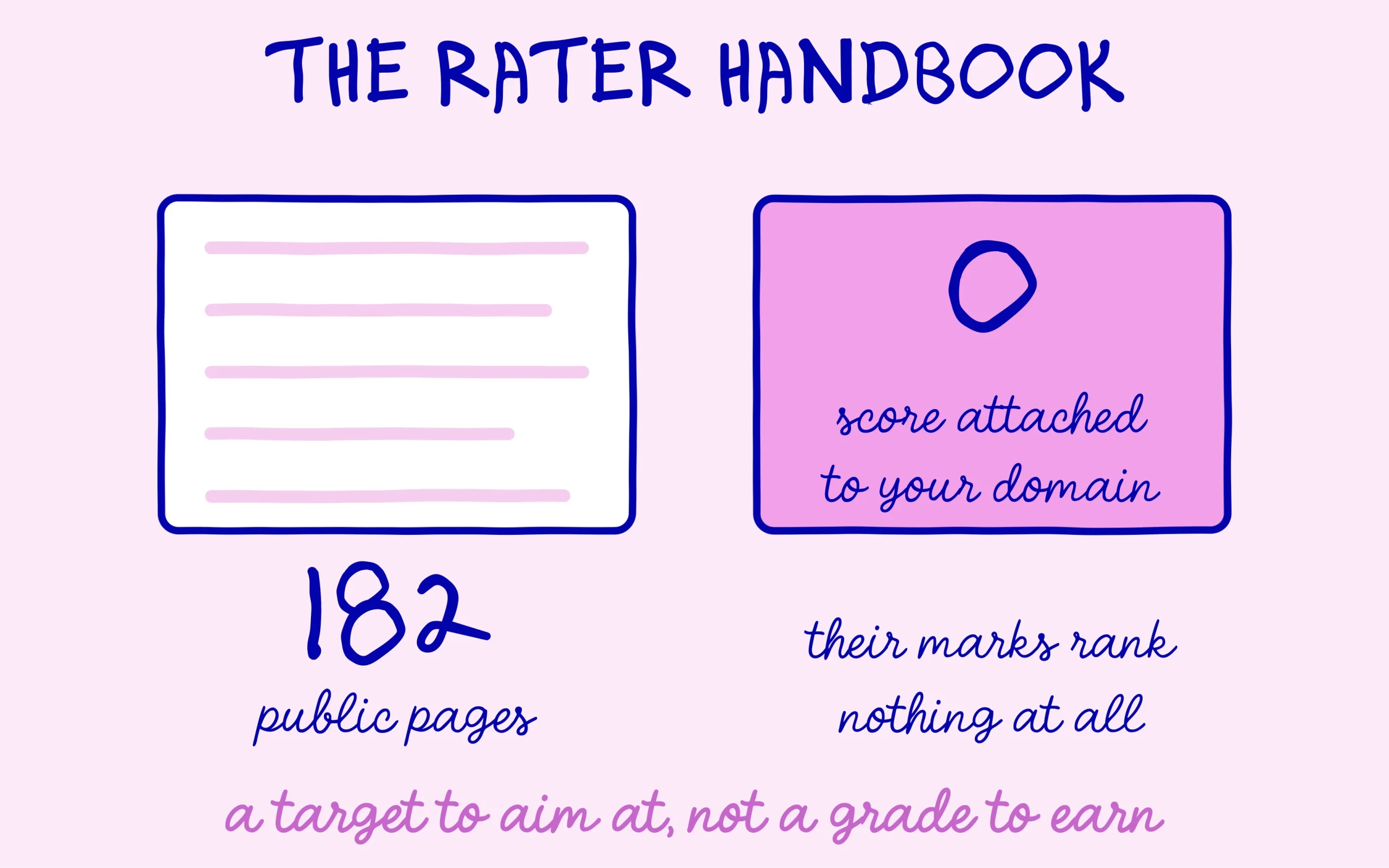
Google employs thousands of quality raters, real people spread across the world. Their job is to score pages and search results while following a very detailed manual, published openly by Google and refreshed regularly. The current edition runs to roughly 182 pages. That is where the four letters live, complete with definitions and dozens of worked examples.
Here is the bit most articles skip. Google says outright that rater data is not used directly in its ranking algorithms, comparing the exercise to a restaurant handing feedback cards to its diners. Their scores neither lift nor sink your site. What they do is let Google check whether a change to its systems improved or degraded the results. No E-E-A-T score is attached to your domain, and nobody at Google keeps a ledger with your name on it.
So why bother with any of it? Because that manual describes the target Google is aiming its algorithms at. Raters judge what the engine wishes it could recognise unaided. Working on the criteria they apply is not gaming a score, it is moving closer to what the machine is trying to measure. The distinction sounds academic and it completely changes how you approach the subject. It is the same reasoning laid out in the opening chapter on SEO in 2026: understand the target before chasing techniques.
A quick word on the acronym’s history, handy for making sense of older articles you will run into. It was called E-A-T for years, covering expertise, authoritativeness and trust. A second E, for experience, joined on 15 December 2022, acknowledging the value of first-hand practice. The full document remains readable in Google’s official overview of the search quality rater guidelines.
The four pillars seen from a brand new site
Experience, the E added in 2022, means having lived or practised whatever you are writing about. A lawnmower review by someone who actually mowed their lawn with it, a restaurant write-up by someone who ate there, a WordPress tutorial by someone who genuinely broke their own site trying. It is the most reachable pillar when you are starting out, because it asks for no credentials. It only asks that you do the thing before writing about it.
Expertise covers command of the subject, and it proves itself inside the text. Expert content answers the questions a reader genuinely holds, uses the right vocabulary without burying anyone in jargon, and does not duck the awkward cases. In sensitive fields, health and money above all, Google expects formal and checkable expertise. On a recipe or a product review, hands-on experience carries the weight comfortably.
Authoritativeness is the pillar built from the outside, and the slowest to arrive. It shows up as recognition from others: links pointing your way, citations, mentions inside articles in your field, the way your name travels through specialist conversations. Nobody becomes an authority by announcing it on their own about page. Authority is granted, never self-declared, which is exactly what makes it hard to fake.
Trust, finally, gathers everything that reassures a visitor the site is honest. The ingredients are unglamorous and concrete: proper legal pages, a way to reach you, checkable sources whenever you quote a figure, a clear policy on sponsored links, a secure connection. Nothing impressive, and yet this is where most amateur sites bleed points without ever noticing.
The order in which you tackle them matters more than people admit. Experience and trust are available to you this week, whatever your size or budget. Expertise builds over months of writing about the same territory until the depth becomes visible. Authority arrives last and largely outside your control, which is why chasing it first leaves so many beginners exhausted with nothing to show. Start with the two you own outright.
Worth noting that these four get judged page by page as much as site by site. An otherwise solid site can publish a weak page, and the reverse happens too. That page-level reading connects back to how results actually get assembled, which we walked through in our chapter on reading a search results page with its SERP, PAA and snippets.
Why trust governs the other three
Google is unambiguous about the pecking order. Its documentation for creators states that of these aspects, trust is most important. The other three pillars matter only through what they contribute to that one: experience, expertise and authority are routes towards trust rather than destinations in themselves.
That hierarchy carries an immediate practical consequence. A page written by a genuine expert, published on a site with no legal pages, no contact route and stuffed with disguised advertising, fails on the decisive pillar. Flip it around and a modest site that says plainly who it is, where its information comes from and how it earns money ticks the heaviest box on day one, with no budget and no reputation.
It is also the pillar a beginner can move fastest. Write an about page naming a real human, publish a contact address that works, date your articles and flag your updates, cite sources with a link rather than a vague nod, declare your commercial partnerships. An afternoon covers most of it, and the benefit spreads across every page on the site at once.
There is a further reason to take this pillar seriously in 2026, and it reaches past Google. Generative engines like ChatGPT, Perplexity and Gemini also decide which pages to cite, and the signals they appear to lean on look a lot like the ones described here: an identifiable author, dated information, traceable sources, a site whose intent is legible. None of these systems publishes its recipe, so treat confident claims on the subject with care. What we can observe so far is that E-E-A-T work pays on both sides, making it one of the rare SEO investments unlikely to be wasted.
A note on the so-called sensitive topics, the ones touching health, money, safety or major life decisions. Expectations climb sharply there, because bad advice can cause genuine harm. If your site covers that territory, a named author, stated qualifications and traceable sourcing stop being nice extras. They become the price of admission.
Three questions to put to every page you own
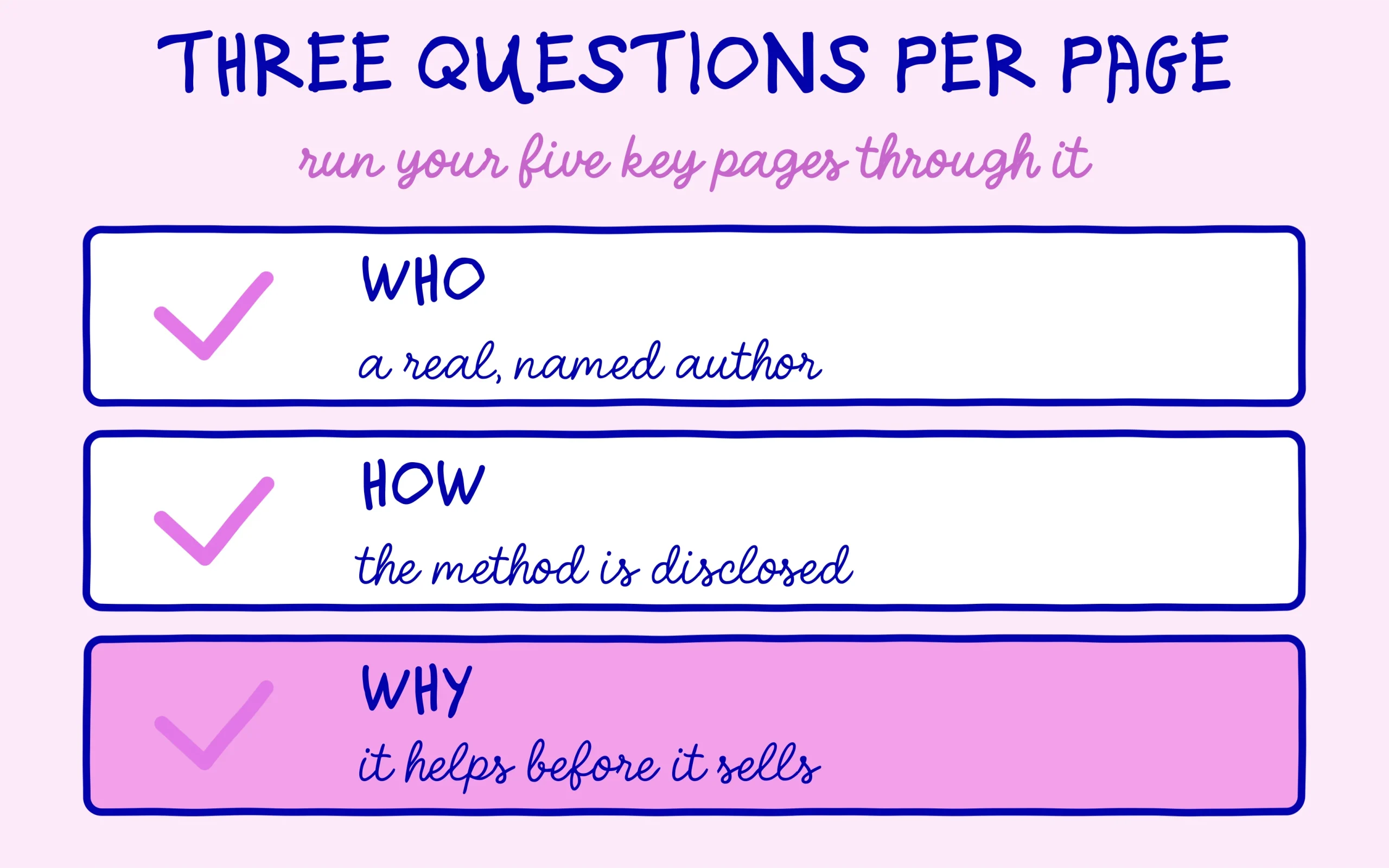
Google offers a far simpler grid than the acronym itself, built on three questions. Who wrote the content, how it was produced, and why it exists at all. Those three words are enough to audit any page in a few minutes, with no tooling and no technical background required, and they are spelled out in Google’s documentation on creating helpful, reliable content.
The “who” asks whether the author is self-evident to a visitor. A real name, a short biography explaining why this person is credible on this subject, a link through to an author page. A piece signed “Admin” or “The team” reads badly, especially on a topic where competence is expected. This is not a markup question, it is a question of what the reader sees on arrival.
The “how” covers the production process, and Google points explicitly at automation. Content generated or assisted by artificial intelligence is not condemned on principle, provided the method is disclosed where it matters to the reader. A product comparison assembled automatically, a test genuinely carried out by hand, an article reviewed by a professional: those three things do not hold equal value, and readers are entitled to know which one they are looking at.
The “why” cuts deepest of the three. Google writes that the answer should be that you are creating content primarily to help people. A page built mainly to capture a query and funnel readers towards an offer fails here, however well written it is. Run the test cold: mentally strip traffic and monetisation out of the picture, then ask whether the page would still have a reason to exist. A page that fails that test is already on borrowed time, however polished it looks.
One warning before you dive in, because it heads off a familiar mistake. Ticking these boxes mechanically achieves nothing useful: an invented author biography, an updated date on a text where not a word moved, a source added that does not say what you claim it says. Cosmetic gestures like these get spotted, and they damage the very pillar they pretend to reinforce. The grid exists to expose what is genuinely missing, not to paper over it.
Run your five most important pages through this grid this week, one page at a time. You will notice soon enough that the fixes needed are rarely editorial: a signature is missing, or a date, or a source, or a disclosure of a partnership. Those gaps cost far more than the keyword density someone will try to sell you elsewhere, and each one takes minutes to repair.
Where we go in the next chapter
This chapter covered what Google is trying to recognise when it weighs a page. What is still missing is the tool that shows you what Google actually sees of your site: the queries bringing you visitors, the pages indexed or refused, the errors it picked up. Chapter 6 is given over to Google Search Console, the free tool that opens that window, and it deserves proper time because it is the dashboard you will keep open for years.
In the meantime, two revisits are worth the detour if the basics feel shaky. Getting into the index remains the precondition for everything else, explained in the chapter on indexing and why Google sometimes refuses your pages. That mechanism stays the precondition for everything this chapter described, since a page missing from the index never gets weighed on its E-E-A-T at all.
Keep learning on SEO Noobies.