
GEO practices, meaning everything a site does to get cited in answers from ChatGPT, Gemini or Google’s AI Overviews, finally have a solid set of numbers behind them, at least for the French market. The French SEO publication Abondance and the company Getfluence surveyed 194 search professionals between August 19 and September 22, 2026, and released the results on October 19. Agencies, consultants, in-house marketers and freelancers describe what they actually do to show up in AI answers, how much they spend on it, and what they get back. For anyone who has just launched a site, it is a useful look at where experienced people put their effort, and at the exact point where most of them still get stuck. Here is what the survey found, and what a small site can take from it.
TL;DR
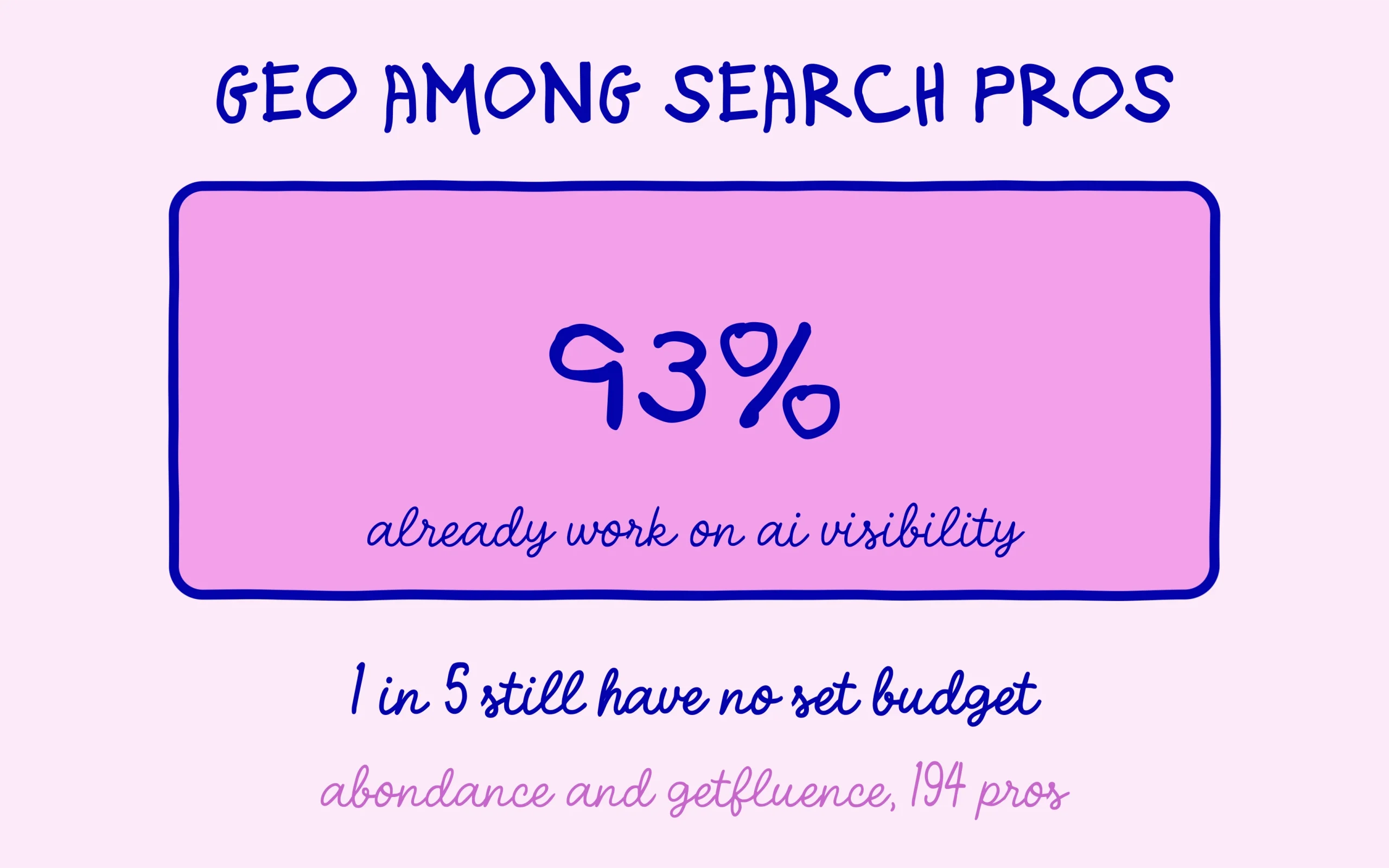
93% of the 194 professionals surveyed by Abondance and Getfluence already work on their visibility in AI answers, and half of them started between March 2025 and March 2026.
60% see an impact from that work, yet only 31% can actually measure it, and the lack of reliable tools is the first obstacle, cited by 43% of respondents.
Content on the site itself is the most common lever at 69%, while only 18% work on getting covered by third-party media.
People who track their AI visibility continuously report a measurable impact more than twice as often as those who check now and then.
Get an AI summary of this article
What 194 French Search Professionals Told Abondance and Getfluence
The panel breaks down into 35% agencies and consultants, 32% advertisers, meaning companies that handle their own visibility in-house, and 30% freelancers. Of those, 179 have already taken at least one action to appear in AI answers, and the impact figures are calculated on that group. Victor Lerat, a partner at Abondance, walked through the main findings in the French-language presentation of the study, and the full 22-page report is a free download after signing up.
The first finding is that the topic has already settled in: 93% of respondents work on their visibility in AI tools. For three quarters of them, the shift happened less than eighteen months ago, and half of the panel got started between March 2025 and March 2026. Monitoring follows the same curve, since 81% already check how their brand shows up in AI answers, and 46% do it on a regular schedule.
Money is moving in the same direction. 49% of respondents plan to raise their GEO budget over the next twelve months, 16% of them sharply, and only 1% expect to cut it. Advertisers are the keenest, with 66% planning an increase, compared with 46% of agencies and consultants and 34% of freelancers. Put plainly, companies handling their own visibility are putting money in faster than the specialists they would hire to do the work. One respondent in five still works on GEO with no dedicated budget. For 79% of the panel, GEO is an extension of SEO, which matches a trend already visible among independents, where GEO requests are now growing faster than Google ranking requests.
One caveat is worth keeping in mind before going further. This is a self-reported survey: professionals describe their GEO practices and how they feel about the results, and nobody audits those results site by site. The panel is also made of specialists working in France, who are far ahead of a typical small business owner. So the numbers show where people in the trade stand today, and that makes them a handy benchmark when you are starting out and wondering whether you are doing enough.
GEO Practices Still Start With the Content on Your Own Site
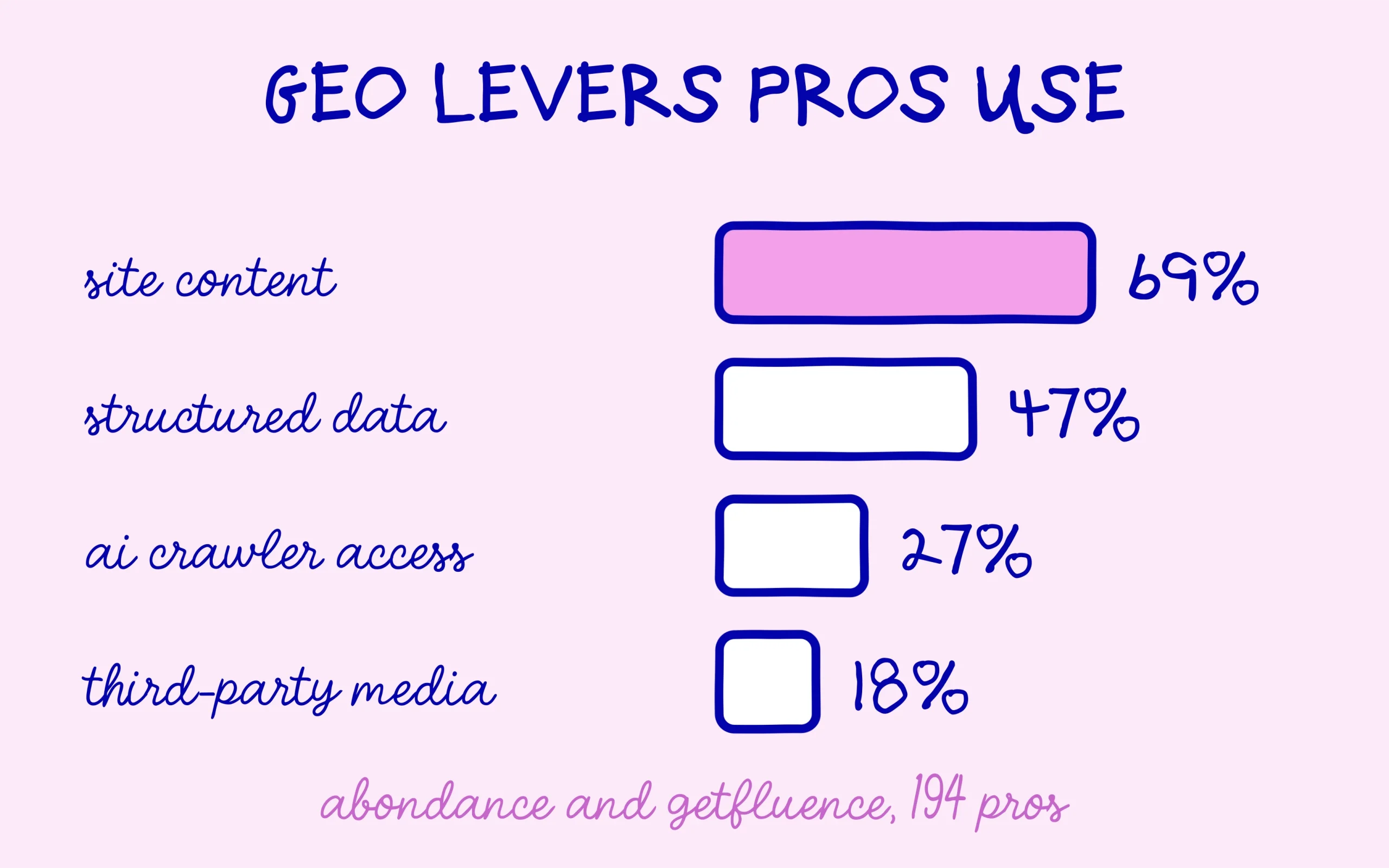
On the question of levers, the survey paints GEO practices that stay very close to home. Page content is worked on by 69% of respondents. Structured data, the invisible markup that describes a page to search engines (a price, an author, a list of questions), comes next at 47%. Access for AI crawlers, which means letting the bots behind ChatGPT or Perplexity read your site through the robots.txt file, is something only 27% of respondents actively work on.
The rest of the web gets far less attention. 44% of professionals act on their own site and nowhere else, 23% work on backlinks, the links pointing to a site from other sites, 21% on community platforms such as forums, and only 18% on third-party media. That last figure stands out, because AI answers happily draw on sources other than the brand itself, and SEO Noobies has already looked at why comparison lists earn more AI citations than your own site. AI tools also quote what other people write about you.
A quick word on formats. The FAQ, a list of questions each followed by a short answer, is rated effective by 45% of respondents, which makes it the most widespread format for showing up in AI answers. The study adds that a different format goes hand in hand with measurable impact more often, and that only a quarter of respondents mention that one. Its name only appears in the full report, which the presentation article keeps for readers who sign up.
For a brand-new site, the order the professionals follow makes a fairly simple roadmap, and it mostly asks for method and very little money. Pages that answer your customers’ questions clearly come first, which is also what Google has always asked for. A local plumber, for example, can start with one page that answers the price questions customers ask on the phone every week. Structured data can be added next without writing code, since most SEO plugins for WordPress handle it. Finally, a quick look at your robots.txt file confirms that AI crawlers are still allowed to read your pages, a two-minute check that protects all the work you put into the content.
Discover the SEO Noobies agency
Measuring GEO Results Is Where Most Pros Struggle
The section on measurement is the most telling part of the survey. 60% of respondents see an impact from their GEO practices, and only 31% can put a number on it. The traffic sent by AI tools stays small, under 2.5% of total traffic for 59% of respondents, and 29% cannot tell which of their conversions come from AI. The first obstacle respondents name is a lack of reliable measurement tools, at 43%, well ahead of budget at 25%.
That blur makes sense once you look at the free tools. In Google Search Console, searches made in AI Mode land in the performance report with no specific label, which muddies the reading of your positions, as explained in the piece on AI Mode queries mixed in with the rest of your Search Console data. For a small site, measurement therefore means cross-checking several sources by hand, and accepting that one clean number will not show up on its own.
The most useful finding for a beginner is about how often people check. 49% of those who track their visibility continuously report a measurable impact, compared with 22% of those who check now and then. The same group is also ten times more likely to plan a sharp budget increase, 30% against 3%. Checking the same signals often makes changes easier to spot. The survey records the link between the two and leaves open which one drives the other, since teams that get results also have more reason to watch them closely.
In practice, the routine fits in a few lines. Pick five or six questions your customers might ask ChatGPT or Gemini, ask them again on a fixed date, once a month for example, and write down whether your site appears in the answers. A simple spreadsheet with the date, the question, the tool and whether your site was cited is enough to get going, and after three months it already shows a trend. Alongside that, keep an eye on the traffic coming from AI tools in your analytics, at the same rhythm. This small, steady habit is close to the GEO practices of the professionals who measure best, and it costs nothing beyond a little time each month.
Keep learning on SEO Noobies.