
A ChatGPT watermark is coming to text written in the European Union, and anyone who publishes AI-assisted content on their website should pay attention. OpenAI has announced that over the coming weeks, an invisible mark will be added to text produced by ChatGPT and Codex for users based in the EU. The move follows Article 50 of the EU AI Act, whose transparency rules started applying on August 2, 2026. For a beginner who drafts blog posts with ChatGPT, the practical question is simple: text pasted straight from the chatbot can now be identified as machine-written, at least under some conditions.
TL;DR
OpenAI is rolling out an invisible ChatGPT watermark on ChatGPT and Codex text in the European Union over the coming weeks.
The mark lives in word choice, with no hidden characters, and OpenAI detects it in about 80% of 200-token passages and about 95% of 400-token passages.
Swapping a quarter of the words for synonyms drops detection to 17%, and only approved researchers and expert organizations can use the detector.
For your site, Google’s rule stays the same: AI-assisted text needs a real human review before it goes live.
Get an AI summary of this article
How the ChatGPT watermark works
The details sit in a page OpenAI published in early October 2026, titled “Our approach to EU text provenance rules”. In short, an invisible mark will be added to text generated by ChatGPT and by Codex, OpenAI’s coding tool, for users located in the European Union. The rollout happens gradually over the next few weeks. On the API side, meaning for businesses that plug OpenAI models into their own products, watermarking stays off by default and can be switched on worldwide for a selection of models.
OpenAI calls the method textGrain. The ChatGPT watermark lives inside the words themselves: as the model writes, it slightly nudges how it picks between several plausible words. The text reads exactly like any other ChatGPT answer, and nothing in its layout gives the ChatGPT watermark away. Only a detector that knows the statistical signature can find it again.
The timing comes straight from Brussels. Article 50 of the EU AI Act requires providers of text-generating systems to mark their output in a machine-readable format that can be detected as artificial. Those transparency rules have applied since August 2, 2026, and systems already on the market before that date have until December 2 to comply. OpenAI is limiting the ChatGPT rollout to Europe, where the law requires it.
Reliable in the lab, fragile once someone edits the text
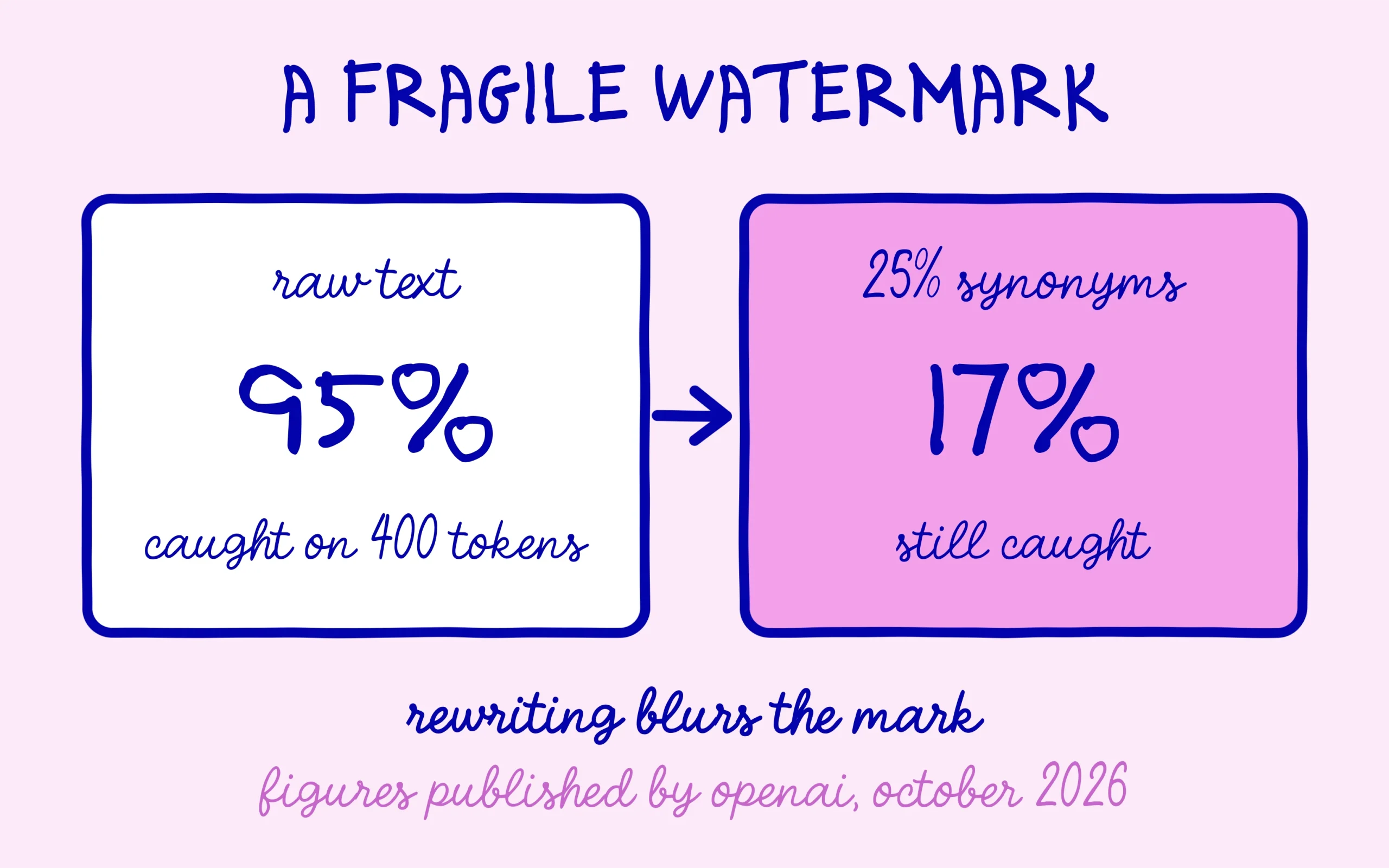
The figures OpenAI shared are worth reading in full, because they tell two stories at once. On psychology texts, the detector found the ChatGPT watermark in about 80% of 200-token passages, roughly 150 words, and in about 95% of 400-token passages. The target false positive rate is 1%, so a text written by a person has very little chance of being flagged as AI.
That reliability fades quickly once a human rewrites the draft. In OpenAI’s own tests, replacing 10% of the words with synonyms pushed detection down from about 92% to 66%. At 25% of words replaced, it fell to 17%. Topics where word choice is tightly constrained, like math, also produced much lower rates, simply because the model has less room to hide its signature.
Access is the other limit to keep in mind. The detector is closed to the public: approved researchers and expert organizations can request it case by case, and the tool keeps user identities and conversations private. A client, a competitor or a search engine cannot, today, run an article through an OpenAI tool to find out whether it came from ChatGPT.
One more detail matters for sites that rely on a writing tool built on OpenAI. Those tools usually go through the API, where watermarking stays off until the tool’s maker switches it on. The same model can therefore produce marked text inside ChatGPT and unmarked text inside a third-party app, which makes the watermark a partial signal to read with care.
Discover the SEO Noobies agency

What it means for a site that publishes with AI
For search rankings, the principle holds. Google acts against mass-produced pages that add nothing for readers, whatever tool was used to write them. The SEO Noobies breakdown of what Google actually penalizes in AI content explains that line, and it remains the right way to think about this, watermark or not.
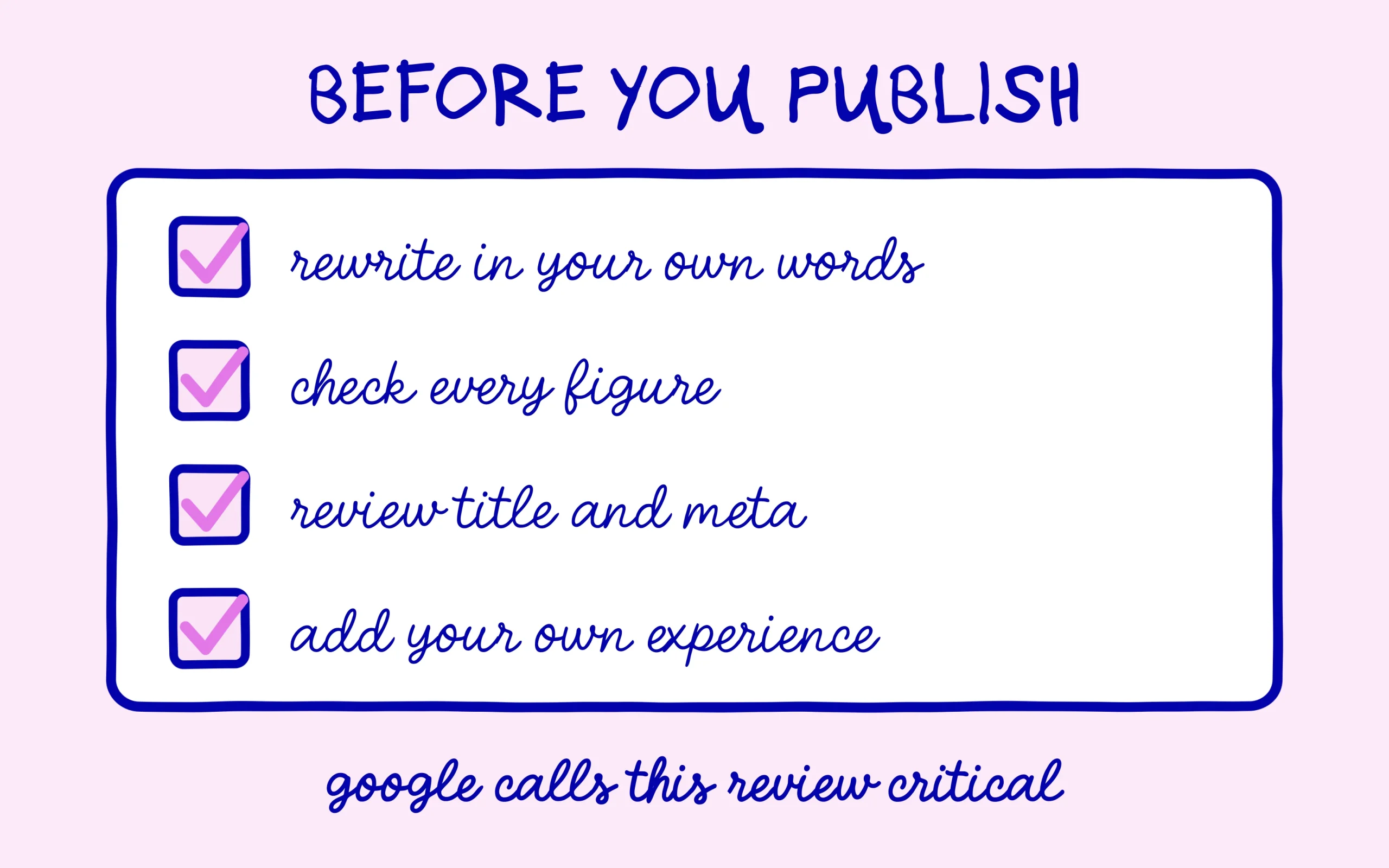
Google has also tightened the wording of its own guidance. Its page on using generative AI content, updated on October 1, 2026, now calls it “critical” to manually fact-check and review all AI-generated content before publishing. That review covers the body text, but also the title tag, the meta description, structured data and image alt text.
Put side by side, the two moves point the same way. The ChatGPT watermark makes a raw paste detectable in theory, and Google asks for a serious human review. A draft that a person has reread, fixed and expanded meets both expectations at once. The AI Act follows the same logic: the duty to tell the public that a text on a matter of public interest was AI-generated falls away when the content goes through human review and someone takes editorial responsibility for it.
The scope of the ChatGPT watermark deserves a clear statement too. It flags where some of the words came from, and the human work around the text stays invisible to it. Judging an article’s quality is still the job of readers and search engines. Europe had already put ChatGPT in a category of its own, as covered in ChatGPT being treated as a search engine under EU law, and this watermark belongs to the same wave of regulation.
In practice, the habit worth building right now is a modest one. Using ChatGPT for a first draft or an outline is perfectly fine, as long as you rewrite in your own words, check every figure against its source and add what an AI cannot know: something you lived, an example from your own business, an argued opinion. A post that goes through those steps loses both its statistical signature and its generic feel, and readers notice the difference long before search engines do.
Keep learning on SEO Noobies.