
The question keeps coming back from anyone launching a site: does writing articles with ChatGPT doom your rankings? The fear makes sense, caught between stories of sites collapsing after a Google update and the opposite claims from people publishing AI content with no visible problem. Google’s official answer is more nuanced than either camp suggests: the engine does not penalize AI content as such, it penalizes worthless content, however it was produced. The catch is that behind this formula sit numbers worth facing squarely, starting with the massive traffic losses of sites that went all-in on automated generation. Here is what the facts actually say, and how to use AI without putting your site at risk.
TL;DR
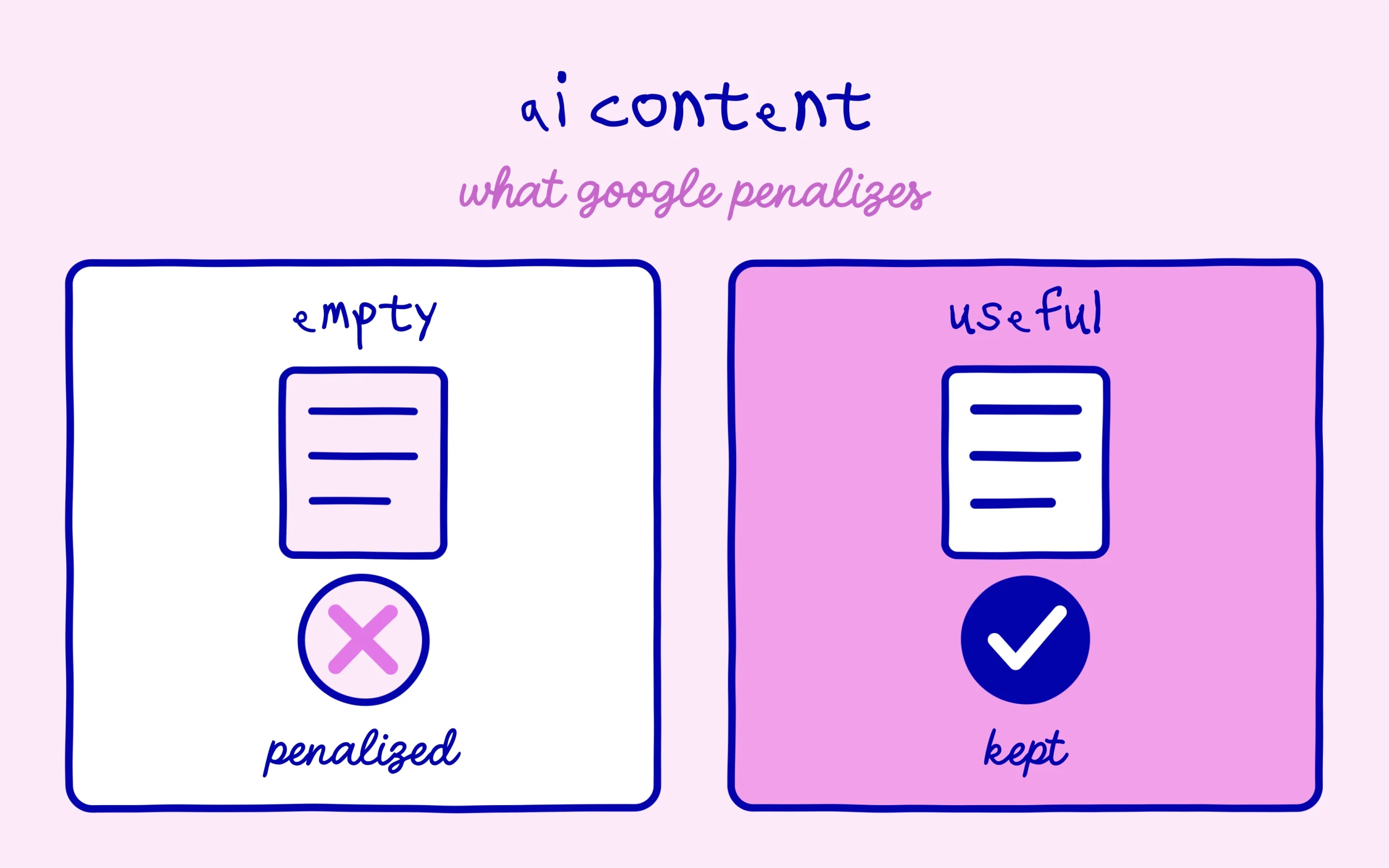
Google does not penalize content for being AI-generated, but for lacking quality, originality or reader value.
Sites running on 100% AI content lost between 30 and 90% of their traffic after the 2022-2024 Helpful Content updates.
The official target is called scaled content abuse: industrial page production without real expertise, detected by SpamBrain.
AI remains usable as an assistant, provided you add genuine human input and data nobody else owns.
Summarize This Article with AI
ChatGPTWhat Google Actually Targets Behind the Word Quality
The engine’s position has been publicly documented since early 2023 in the official Google Search Central post on AI-generated content: rewards go to quality content, however it is produced. The criterion is the output, never the tool. An article drafted with AI assistance then enriched, fact-checked and reworked by someone who knows the subject remains fully eligible for strong rankings.
What the engine targets has a precise name: scaled content abuse, the industrial-scale production of content with no real expertise behind it. The typical signals are identifiable: structures repeating from page to page, generic phrasing you could paste onto any site in the same niche, zero proprietary data, and factual hallucinations slipping through for lack of review. Detection runs on SpamBrain, the engine’s anti-spam system, reinforced since 2025. The hunted problem is valueless industrialization, never the tool itself.
This line matches other recent clarifications from the engine on how it treats content in the generative era, like John Mueller’s reminder that no separate site is needed for AI: quality rules stay identical for everyone, on the same web.
A detail worth registering to read this position correctly: the sanction targets a pattern, never an isolated page. A site publishing one mediocre article among solid content risks little, the engine will simply demote that page in the results. What triggers the heavy consequences is the same scheme repeating across dozens or hundreds of pages, because that industrial pattern is precisely what the detection systems are trained to recognize. The nuance is reassuring for a beginner who experiments, and far less so for anyone planning to generate an entire site in a week. Scale is the tripwire, and it always has been in Google’s spam policies.
The Numbers Framing the Debate, on Both Sides
Volume first. Around 50% of content published online now involves AI generation, per an October 2025 Graphite study. The shift already happened, and Google knows it perfectly well: blanket-penalizing AI content would mean penalizing half the web, an absurd proposition for a search engine whose product depends on having results to show. On the practitioner side, a Semrush study puts at 72% the share of SEO professionals using AI content who report rankings as good as or better than human-written content. Two data points, one conclusion: the tool is mainstream, on both sides of the results page.

The other side of the ledger is harsher. Sites running entirely on generated content lost between 30 and 90% of their traffic in the wake of the Helpful Content updates rolled out from 2022 to 2024. The range is wide, but even its low end means a third of the traffic gone. Both realities coexist without contradiction: well-supervised AI performs, AI left alone at the wheel eventually costs dearly. The difference plays out in what gets added between generation and publication.
What stands out when crossing these numbers is the gulf between the two populations. The 72% of satisfied professionals work with a method: review passes, enrichment, proprietary data. The sites that lost up to 90% of their traffic made the opposite bet, raw volume with no supervision. The same tool produces both extremes of the spectrum, which proves the decisive variable has nothing to do with the technology itself. It sits entirely in the editorial process wrapped around it. And that process is exactly what a beginner controls from day one, budget or no budget.
A neighboring phenomenon deserves attention too: low-value or outdated pages do not always disappear, and AI search can revive old content long after publication by citing it in generated answers. Publishing volume without value leaves durable traces, including outside Google.
Using ChatGPT for Writing Without Entering the Red Zone
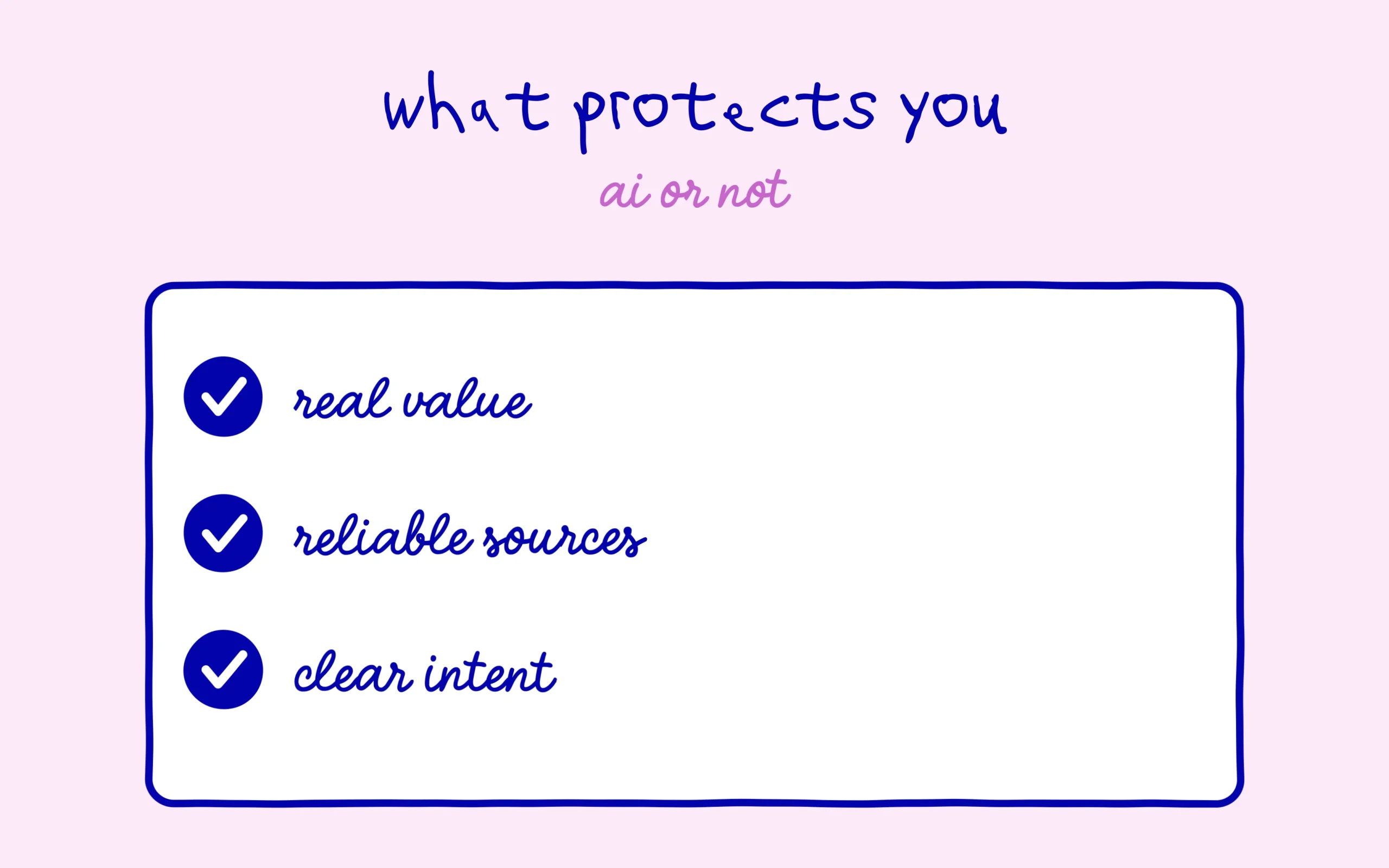
The method emerging from the recommendations fits in three practices. First: keep AI in the assistant seat, never as sole producer. Use generation to structure, rephrase or speed up a draft, then take back control of the substance. Second: genuine human intervention, meaning precise prompts fed with your own subject knowledge and a systematic review of every factual claim. A hallucination published under your name stakes your credibility, and detection systems pick up recurring factual errors. In practice, the review pass often takes as long as the generation saved, and that is fine: the time shifts from typing to thinking, which is where the value was supposed to come from anyway.
The third practice makes the real difference: injecting data nobody else owns. Your numbers, your client cases, your field observations, your tests. It is the RAG approach applied to editorial work, where generation leans on a proprietary knowledge base rather than the statistical average of the web. An article fed with proprietary data mechanically cannot resemble the thousand other generated articles on the same topic. Human added value stays the only durable differentiator against competitors with access to the exact same models as you.
The generative angle extends the question beyond Google itself. Answer engines like ChatGPT and Perplexity select their sources on reliability and originality criteria close to those of classic search, and generic content with no identifiable signature stands little chance of being picked as a reference. It is reasonable to expect the premium on embodied, first-hand content to strengthen as these engines take up more room in daily usage, even if the exact tempo remains hard to call. Working on human added value therefore prepares both battlegrounds at once, the ranking one and the citation one. That shift is measurable, 68% of Google searches ending without a click in early 2026.
For a beginner launching a site, the takeaway is fundamentally reassuring. Still, it demands discipline: every article must bring something the reader will not find elsewhere, an experience, an angle, a data point, a lived example. If AI helps say it faster and more clearly, everyone wins, the engine included. If it serves to push out twenty empty pages a day, the traffic loss figures quoted above describe exactly what awaits the site. The question to ask before hitting publish stays the simplest one: would this page help someone if Google did not exist?




[…] that add nothing for readers, whatever tool was used to write them. The SEO Noobies breakdown of what Google actually penalizes in AI content explains that line, and it remains the right way to think about this, watermark or […]