The big Google updates form a fifteen-year story that explains rather well what just happened in France. AI Overviews landed on 22 July 2026, and many people experience it as a sudden shock. Yet when you trace the thread back, this shift toward a search engine that answers in your place is the logical endpoint of a long series of updates. After ten years following these updates day to day, I find it useful to walk the timeline from the start, because it tells a surprisingly consistent direction. Understanding where Google comes from helps you feel less at the mercy of where it is going.
TL;DR
Since Panda in 2011, Google has chased the same obsession: serving the best answer, not necessarily the best page.
Google updates fall into three big eras: judging content, understanding language, then answering directly with AI.
AI Overviews is not a rupture out of nowhere, it is the continuation of a path that began fifteen years ago.
Good news: the fundamentals rewarded back in 2011, useful content and real authority, are exactly the ones that matter in 2026.
Summarize This Article with AI
ChatGPTContents
1. From Panda to BERT: when Google learned to judge content
2. Helpful Content and the era of back-to-back Core Updates
From Panda to BERT: when Google learned to judge content
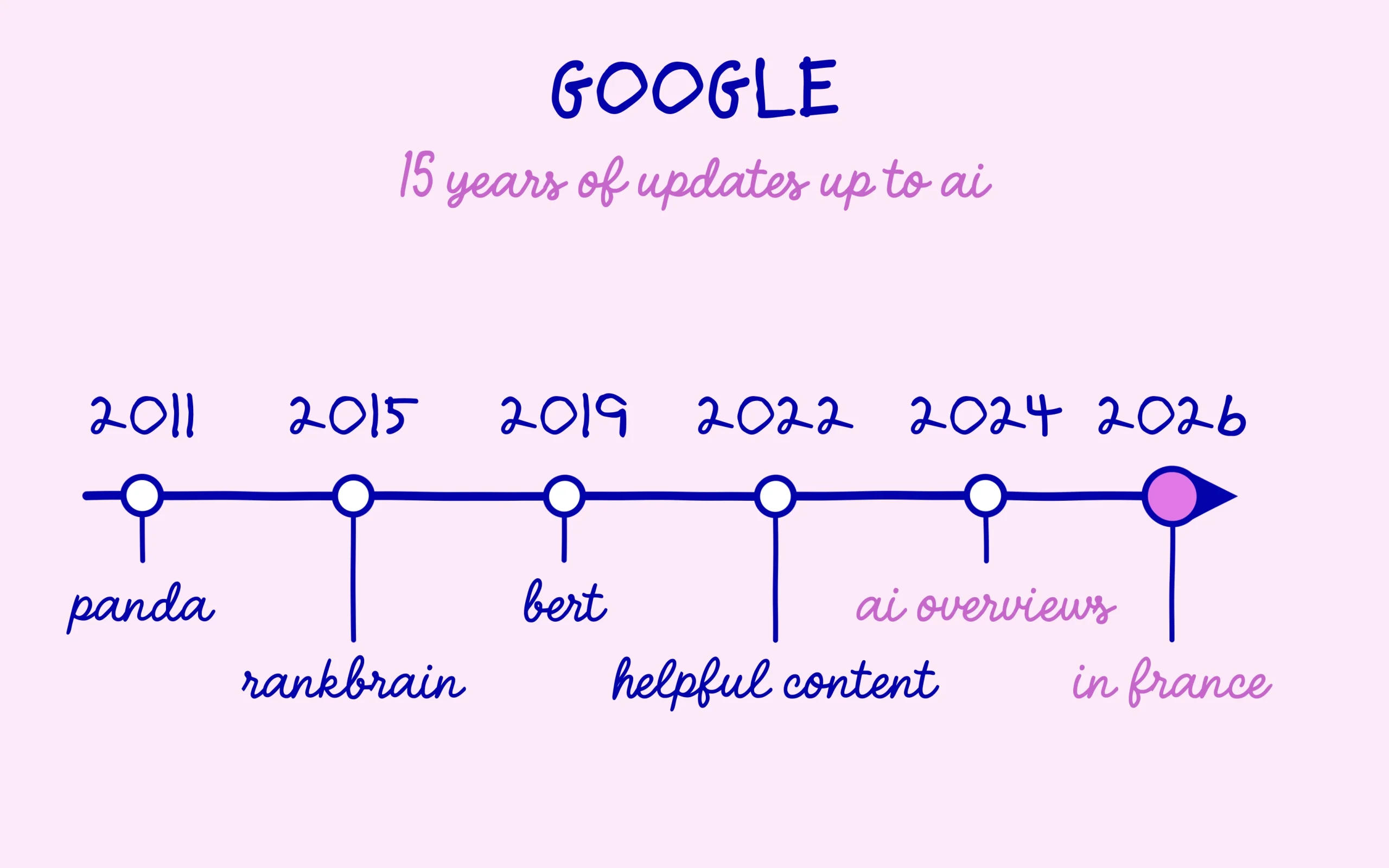
It all starts in February 2011 with Panda, the first update to hit thin content hard, the article farms and the pages written for the machine rather than for humans. The following year, Penguin goes after artificial links and exchange networks, the ones that inflated a ranking without earning trust. These two updates set a rule that never moves again: quality and honesty beat the trick. That is already the whole logic of how SEO and GEO play out today, fifteen years early.
Then Google starts to understand, not just to compare words. Hummingbird in 2013 teaches it to grasp the meaning of a whole sentence, RankBrain in 2015 brings machine learning into ranking to guess the intent behind a query, and BERT in 2019 pushes natural-language understanding further still. In eight years, the engine goes from a keyword machine to a meaning machine. Google itself documents this thread of changes in its official history of ranking updates. In hindsight, each update brought Google closer to the moment it could write the answer itself.
To measure how far we have come, take a plain query like “how to remove a wine stain”. In the early 2010s, Google mostly looked for pages containing those words. After Hummingbird and BERT, it understands you are talking about cleaning, that wine is a liquid that stains, and it can tell that apart from a page selling wine. That invisible work on meaning is exactly what makes it possible, today, for a summary to pull from several sources and answer you in two sentences.
Helpful Content and the era of back-to-back Core Updates
2022 marks a turning point with the Helpful Content Update, which explicitly rewards content written first to help people, and penalizes content produced only to rank. It is the modern translation of Panda, with a new vocabulary: experience, expertise, authoritativeness and trust, what Google sums up as E-E-A-T. The question is no longer only “is this well written”, but “who is speaking, and why trust them”.
From there, Google runs Core Updates at a steady pace, several a year, each one re-evaluating the perceived quality of millions of sites at once. For a beginner, these regular tremors are unsettling, but they always follow the same compass. Mass-produced content becomes a central topic, and I broke down elsewhere what Google actually penalizes in content in the AI era: the problem is not the tool used, it is the lack of real added value.
In practice, when a Core Update costs you positions, the useful reflex is not to hunt for the small technical setting that supposedly broke everything. It is to ask yourself honestly whether your pages truly deserve their spot against the current competition. I have seen sites panic and change everything in a rush, when the only durable answer was to strengthen the weak pages one by one. A Core Update does not punish you, it recalculates everyone’s value at once.
SGE then AI Overviews: Google starts answering itself
The real leap comes on 10 May 2023, when Google announces SGE, its Search Generative Experience, an experimental AI layer laid on top of search. A year later, on 14 May 2024, that experiment leaves the lab, changes its name to AI Overviews, and shows up for every user in the United States. In two years, the engine moves from a link-sorting directory to an answer writer. What fifteen years of updates were preparing suddenly becomes visible on every results page.
France, for its part, stays out of it two more years, because of the dispute over press neighboring rights, before the 22 July 2026 rollout. If you want the detail of what it concretely changes for your site, it is all covered in our complete guide to AI Overviews, and the precise launch timeline sits in our coverage of the AI Overviews rollout. The key takeaway from the timeline is that France is not living an isolated event, it is simply catching up to a story already written elsewhere.
Concretely, on an informational search you now see a summary block at the top of the page, with three or four source links underneath. The classic results still exist, but lower down, after the generated answer. For a site, the goal shifts: it is no longer only about being first, but about being one of the sources Google deems worthy of feeding its summary. That is a shift of target, not the end of SEO, and the whole timeline shows this kind of shift is something you anticipate rather than endure.
What fifteen years of Google updates tell you today
The lesson I draw from this whole timeline is almost reassuring. At every step, Google rewarded the same thing under different names: genuinely useful content, written by someone legitimate on their subject, that truly answers the question asked. Panda said it already, Helpful Content said it again, and generative AI merely applies it its own way by choosing whom to cite in its answers. Betting on technical tricks always ended up turning against those who clung to them.
Concretely, what you build to become a solid reference on a theme is exactly what protects you from the next tremors, as we saw with topical authority in AI search. The form changes, the substance does not. Those who came through Panda, BERT and Helpful Content without panicking share one trait: they worked their subject for real. That is still the best plan for the decade now opening.
If I had to boil fifteen years of updates down to three workable reflexes, these would be them. Write to genuinely answer a question, not to tick an algorithmic box. Show clearly who you are and why you are legitimate on your subject. And publish regularly, to stay a living source rather than a forgotten archive. No update of the next fifteen years should penalize that, because it is exactly what Google has been trying to reward since day one.