
Chapter 7 of the Learn SEO Step by Step course. The first six chapters covered the machinery: how Google crawls and indexes a site, how to read a results page, what the broad algorithm principles are worth, what E-E-A-T actually covers, and how to read Search Console. This chapter opens the module on keywords, where the work stops being theoretical. A keyword has nothing to do with a magic word sprinkled through a text. It is the exact phrasing someone types or speaks when they have a need, and everything that follows consists of matching your pages to those phrasings.
TL;DR
A keyword is the phrasing someone enters into a search engine, rarely a single word and most often an expression of three to eight words.
The value of a keyword rests on the intent it reveals, not on how many people type it.
One need gets expressed through dozens of different phrasings that engines now group together.
With no tool budget, the results page itself, engine suggestions and Search Console are enough to start working seriously.
Summarize This Article with AI
ChatGPTContents
What a keyword really is
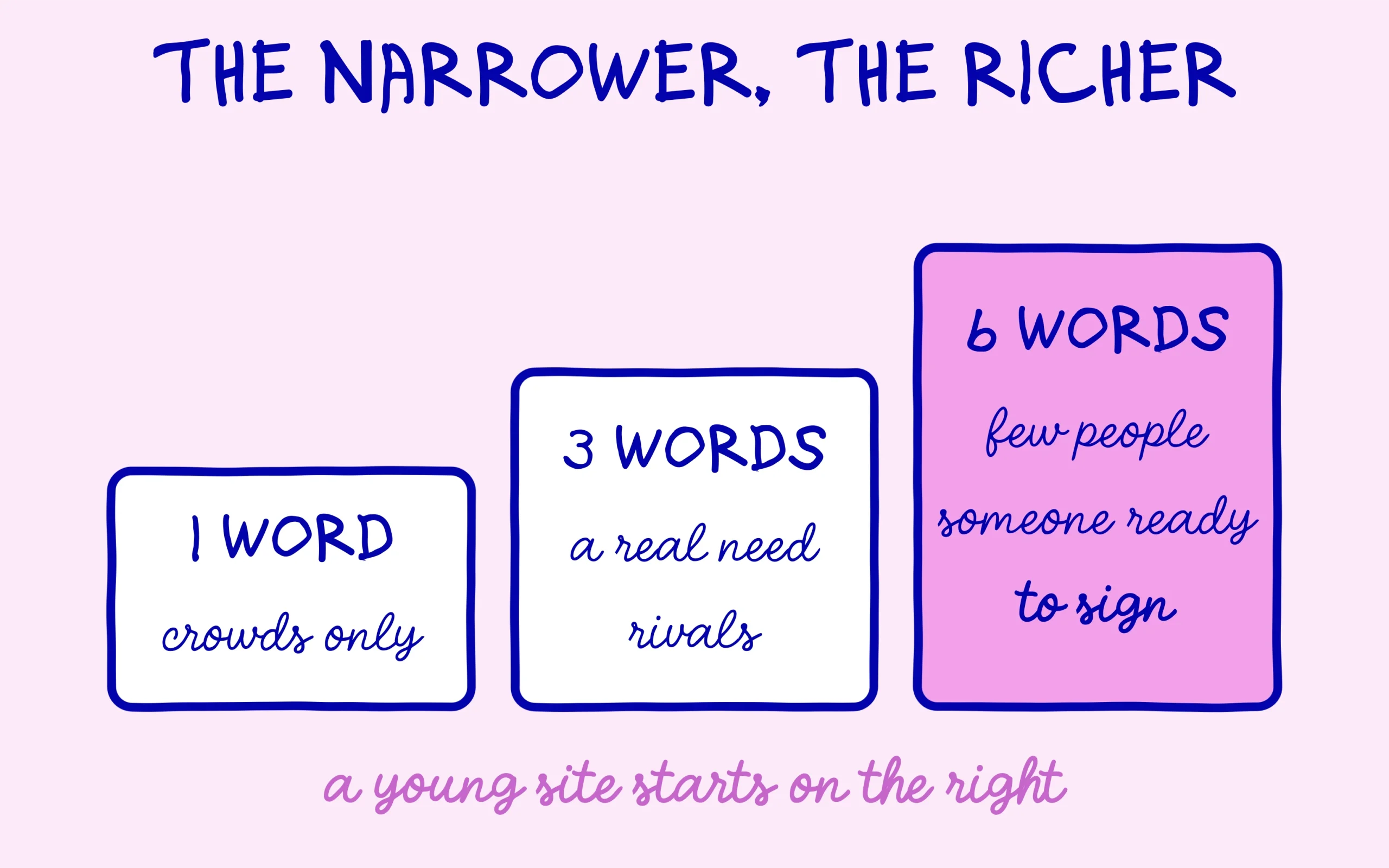
A keyword is the string of words a person enters into a search engine to find something. The term has misled people for twenty years, since it says word in the singular while measured reality looks quite different. Single-word queries exist but stay in the minority, mostly serving to navigate toward a known brand. The bulk of traffic plays out on multi-word expressions describing a precise situation.
Take a concrete example you can verify yourself within the minute. Someone whose washing machine is leaking does not type “washing machine”. They type “washing machine leaking from underneath”, or “washer leaks during spin cycle”, or “emergency appliance repair Manchester Sunday”. Those three phrasings concern the same appliance and call for three completely different answers: a technical diagnosis, a repair walkthrough, an available tradesperson.
A stubborn beginner confusion needs clearing up too. Your visitor writes the keyword before ever reaching your page. You come along afterwards and observe it. The direction of that arrow matters enormously. You do not choose keywords, you observe them, then decide which ones you want to serve. Plenty of sites fail because they invented their trade’s vocabulary instead of watching their customers’.
Professional vocabulary and customer vocabulary rarely overlap, and that gap is expensive. An optician thinks “progressive lenses”, the customer types “glasses for seeing far and near”. A solicitor thinks “settlement agreement”, the customer types “leaving my job without losing benefits”. A roofer thinks “flat roof waterproofing”, the customer types “water coming through ceiling after rain”. In all three cases, a site written in trade language misses most real queries.
Voice search and assistants push this further still. Someone speaking to a phone produces a full sentence, with its hesitations and spoken syntax, where they would have typed three blunt words on a keyboard. “Where can I get a washing machine repaired near me on a Sunday” is an entirely ordinary query today. Pages answering questions the way people actually ask them out loud capture a growing share of these searches.
Spelling variants deserve a mention while we are here, because beginners waste real effort on them. Singular against plural, a hyphen present or missing, a common misspelling, an abbreviation: engines treat most of these as the same query and serve near-identical results. Building separate pages for “ecommerce”, “e-commerce” and “e commerce” achieves nothing beyond splitting your own signals across three weaker pages. Pick the spelling most people actually use and move on.
One technical point belongs here because it changes how you work. Engines stopped reasoning on character strings a long time ago. They group phrasings expressing the same need, which explains how a single page can rank on dozens of different queries without containing them all word for word. That mechanism extends what the chapter on Google algorithms explained in plain English covered about meaning.
Why intent beats volume
Every beginner’s first mistake involves sorting keywords by search count and aiming at the top of the list. It is understandable and it is a dead end. A heavily searched query is heavily searched by everyone, so it gets fought over by sites established for years, with teams and budgets behind them. A new site aiming there works for months toward visibility that never arrives.
Intent describes what the person is genuinely trying to accomplish by typing their query. The next chapter covers it entirely, though the principle belongs here because it governs everything else. Two queries can concern the same product and call for radically different pages. “What is a robot vacuum” calls for an explainer. “Cheap robot vacuum for dog hair” calls for a page that sells.
An honest caveat belongs here, and it applies to everything you will read elsewhere on the subject. Nobody can state the search volume of an expression without a tool that measures it, and those tools cost money. Figures thrown around for free are estimates, sometimes wildly off. Working without them stays perfectly possible, provided you look at what is observable: who ranks today, and with what kind of page.
There is a classic trap nobody discusses enough: a query can be heavily searched and bring your business nothing at all. A mattress maker ranking on “how many hours of sleep per night” will attract crowds, and not one buyer. Traffic flatters dashboards, it does not fill an order book. This distinction between volume and commercial relevance is probably the most profitable lesson in the whole module.
Seasonality adds another layer worth understanding early. Plenty of queries live on a yearly cycle: heating repairs climb in October, tax questions peak before the filing deadline, gift searches collapse on December 26. A business judging a keyword on a single month’s observation can badly misread its worth in either direction. Anything tied to a season needs its page published well ahead of the peak, since ranking takes time the calendar will not grant you retroactively.
Simple reasoning settles the matter without any figures. Ask yourself what the person does immediately after reading your page. If the answer is “they close the tab, curiosity satisfied”, the query holds little commercial value even when it brings crowds. If the answer is “they call you” or “they add to basket”, the query is worth gold even at ten visitors a month.
The main families of keywords
People usually separate head terms from long tail queries. A head term runs to one or two words and covers a whole field: “insurance”, “cake recipe”, “running shoes”. It attracts crowds with scattered intentions, and its competition is at maximum. These are the expressions everyone targets and almost nobody reaches starting from zero.
The long tail gathers the long, precise phrasings. “Women’s running shoes overpronation first marathon” carries five more words than “running shoes”, attracts far fewer people, and describes someone who knows exactly what they want. These expressions number in the thousands in any sector, and their combined traffic comfortably exceeds that of the handful of head terms in the same field.
Chapter 10 returns to the trade-off between those two families in detail. For now, hold on to the starting rule that applies to every young site: credibility gets built on precise expressions, then you climb gradually toward broad queries as the site earns authority. The reverse order does not work, and it is the wall most new sites hit.
A third family slips past unnoticed and deserves a stop: brand queries. These contain a company name, yours or a competitor’s. They convert extraordinarily well because the person already knows you. A site that fails to surface on its own name has a structural problem, separate from keyword work, and that check comes before anything else.
Question queries form their own useful category, sitting across the families above. Anything opening with how, why, what, when or whether tends to surface the frequently asked questions block, and increasingly feeds the generated answer at the top of the page. These queries build trust and topical coverage rather than immediate revenue. They remain worth writing for, on one condition: the page has to answer the question properly in its opening lines, rather than making the reader hunt through six paragraphs of preamble.
Worth mentioning finally are local queries, which follow rules of their own. “Plumber”, typed from a phone in Leeds, triggers a completely different display from the same query typed in Bristol. The engine adds geography the searcher never wrote. For a local trade, these queries often make up the entire realistically reachable pool.
Why some keywords are worth gold
The value of a keyword works out fairly simply, even without a paid tool. It combines the odds a visit turns into a customer, the worth of that customer, and how hard the first page is to reach. An expression bringing a thousand browsers is worthless to a tradesperson. An expression bringing three people ready to sign a four thousand pound quote easily justifies months of work.
Buying markers inside a query are observable without instruments. A price, a brand, a model number, a town, a word like quote, pricing, reviews, comparison, best, or urgency such as emergency, Sunday, today, all signal someone well into a decision. Phrasings opening with “what is”, “why” or “how does” point to a discovery phase, useful for reputation and rarely for immediate revenue.
The arrival of AI-generated answers shifts this balance, and dodging it in a course written in 2026 would be dishonest. Short definition queries get absorbed by the answer blocks sitting at the top of the page: the engine answers, the searcher stops clicking. Queries demanding a choice, a quote, an appointment or local expertise hold up far better, because a summary cannot repair your roof.
A keyword worth gold is one whose answer does not fit in three lines. That formulation sums up where the trade has moved over two years. Anything a model can summarise cleanly will end up summarised. What demands a costed quote, a detailed method, a reasoned comparison or a human turning up keeps its reason to exist, and that is where the value of the work is heading.
A practical way to rank candidates uses two axes only, scored one to five. The first measures closeness to purchase: is this person choosing a supplier, or reading up for later? The second measures your legitimacy: do you have something genuinely sharper to say than the pages already ranking? Expressions scoring four or five on both form your first working list, and they rarely exceed twenty.
Keep difficulty in mind last, since it weights everything else. A keyword perfect on paper but held by five national sites established for fifteen years will return nothing for a long while. The realistic trade-off crosses potential value against your odds of reaching page one within a sensible timeframe, which means accepting the timescales search work runs on, the same ones that make recovering a ranking take several months.
Finding your first keywords on no budget
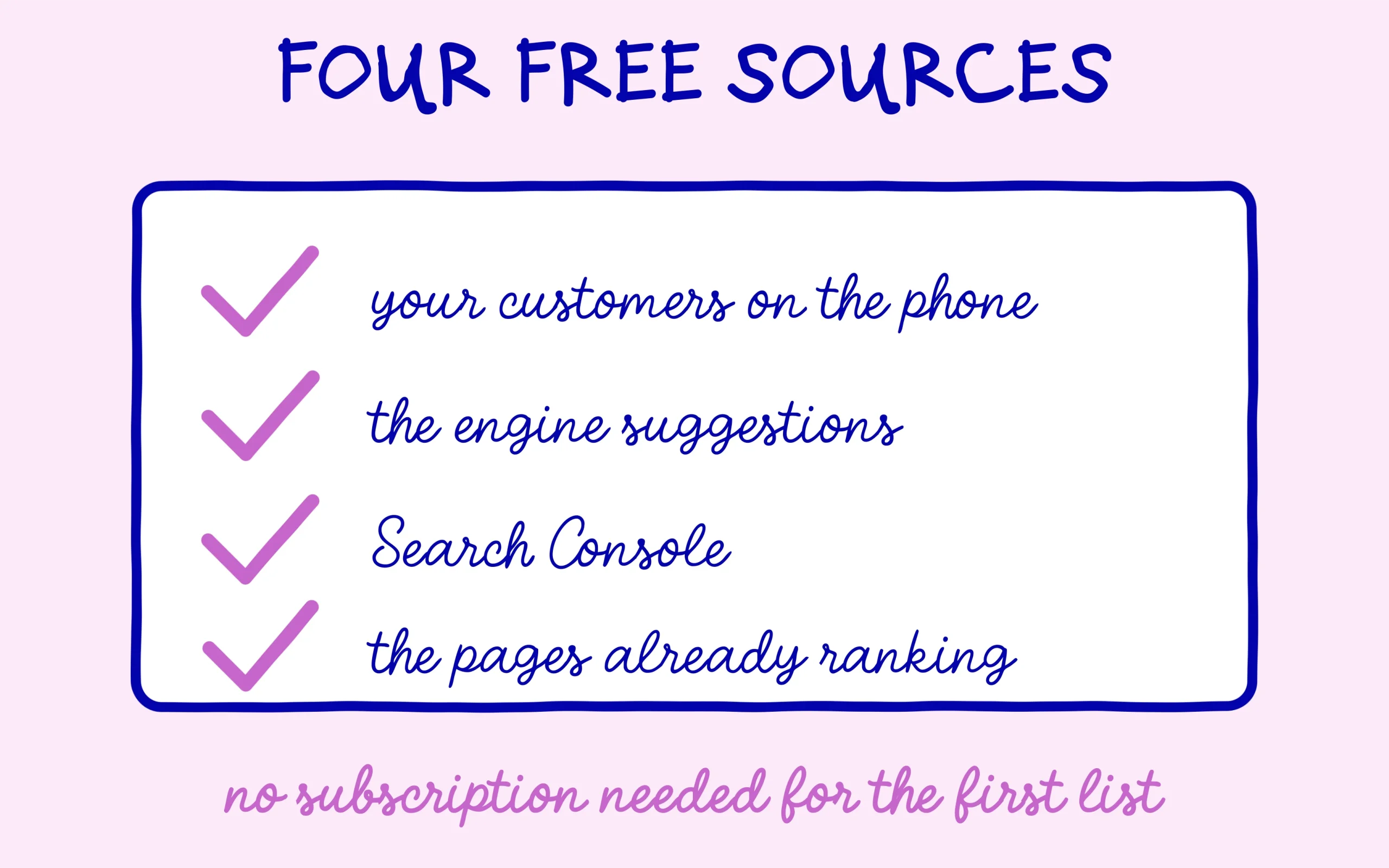
Start with the most reliable and most neglected source: your current customers. The questions they ask on the phone, the phrasings in their emails, the objections recurring in meetings make better raw material than any purchased list. Write those sentences down verbatim for two weeks, without translating them into professional language, and you will already hold a solid base.
The engine itself makes up the second source, entirely free. Type the start of a query and watch the autocomplete suggestions: they come from real searches. Then scroll to the bottom of the results page to read related searches, and open the frequently asked questions block when it appears. Those three spots yield authentic phrasings, and reading them builds on what the chapter about the makeup of a results page laid out.
Search Console comes next, turning into your best tool once the site has a few months behind it. The performance report lists the real queries your pages appear on, including ones you never considered. Expressions showing at position fifteen to thirty deserve particular attention: they flag topics Google already associates with you, where targeted improvement often pays quickly. Chapter 6 covers getting to grips with this free tool.
Watching competitors rounds off the kit without spending anything. Type the queries you care about, open the pages that surface, and read their titles, subheadings and opening paragraphs. That reading shows both the vocabulary chosen by those succeeding and the page type the engine rewards on that query. An engine showing nothing but comparison pages is telling you plainly that a sales page has no place there.
Forums and question sites offer one last seam, often the richest in authentic phrasing. Public threads where people lay out their problem in their own words hand you exactly the vocabulary you are after, with no marketing filter. Engines themselves give these contents a growing place in results, which confirms the value of that register. Read those threads noting repeated turns of phrase, not the answers given.
Keep all of this somewhere structured rather than scattered across notebooks. A simple spreadsheet does the job: one row per expression, with columns for the phrasing exactly as written, the apparent intent, the page meant to answer it, and the date you last checked the results page. That last column matters more than it looks, because results pages shift and an observation from eight months ago describes a search landscape that may no longer exist.
One warning to close this section, because it heads off a costly mistake. Never target several competing keywords with several different pages on one subject. Two pages covering nearly the same thing get in each other’s way, and the engine ends up ranking neither properly. One intent, one page. That simple principle rescues more sites than any technical trick.
Where we go in the next chapter
This chapter laid down the raw material. You now know a keyword is a real phrasing, that its value depends on what the person wants to accomplish, and that first lists get built without spending a penny. The work ahead involves sorting those phrasings to know which kind of page answers each one.
Worth restating one idea before moving on, since everything downstream leans on it. The whole discipline rests on a gap between what people search for and what businesses publish. Every technique in the remaining chapters, from page structure to internal linking to earning citations in AI answers, exists to close that gap. Someone who genuinely understands their customers’ vocabulary already holds the hardest part, and the rest becomes execution rather than guesswork.
Chapter 8 covers exactly that sorting, through the four major search intents: informational, commercial, transactional and navigational. It is the grid turning a list of expressions into a content plan, and it explains why a beautifully written page may never rank if it answers beside the intent. Before getting there, take the time to build your own list with the four methods above: the next chapter lands far better with real material in front of you.
Keep learning on SEO Noobies.



[…] A query almost always carries one dominant intent, sometimes two. “Best robot vacuum” blends looking for information with getting ready to buy. The job is to spot the search intent that dominates, build the page that serves it best, and cover the secondary intent afterwards. This habit extends what the previous chapter said about what makes a keyword valuable, which has more to do with intent than with volume. […]