
The previous chapter covered how a page enters Google’s index and why the engine sometimes refuses to keep it. Once that hurdle is cleared your page becomes eligible for display, and that is where the real playing field starts: the SERP, short for search engine results page. Plenty of beginners still picture it as a numbered list of ten blue links, when it has turned into an assembly of very different blocks all competing for attention and clicks. Understanding that assembly changes how you pick a topic, write a title or structure a paragraph. This chapter breaks down what is genuinely on screen when you type a query, and what each block tells you before you write a single line.
TL;DR
A SERP mixes organic listings, paid ads and a set of specific blocks that frequently own the top of the screen.
Featured snippets are awarded by Google’s systems, cannot be requested, and the only reliable way out is the nosnippet rule.
The People Also Ask box hands you, for free, the related questions Google associates with your topic.
Reading the layout of a results page before writing tells you which format Google expects, which beats guessing.
Summarize This Article with AI
ChatGPTContents
1. What is actually sitting on a results page
2. The featured snippet, a slot you cannot ask for
3. People Also Ask, the questions Google hands you
What is actually sitting on a results page
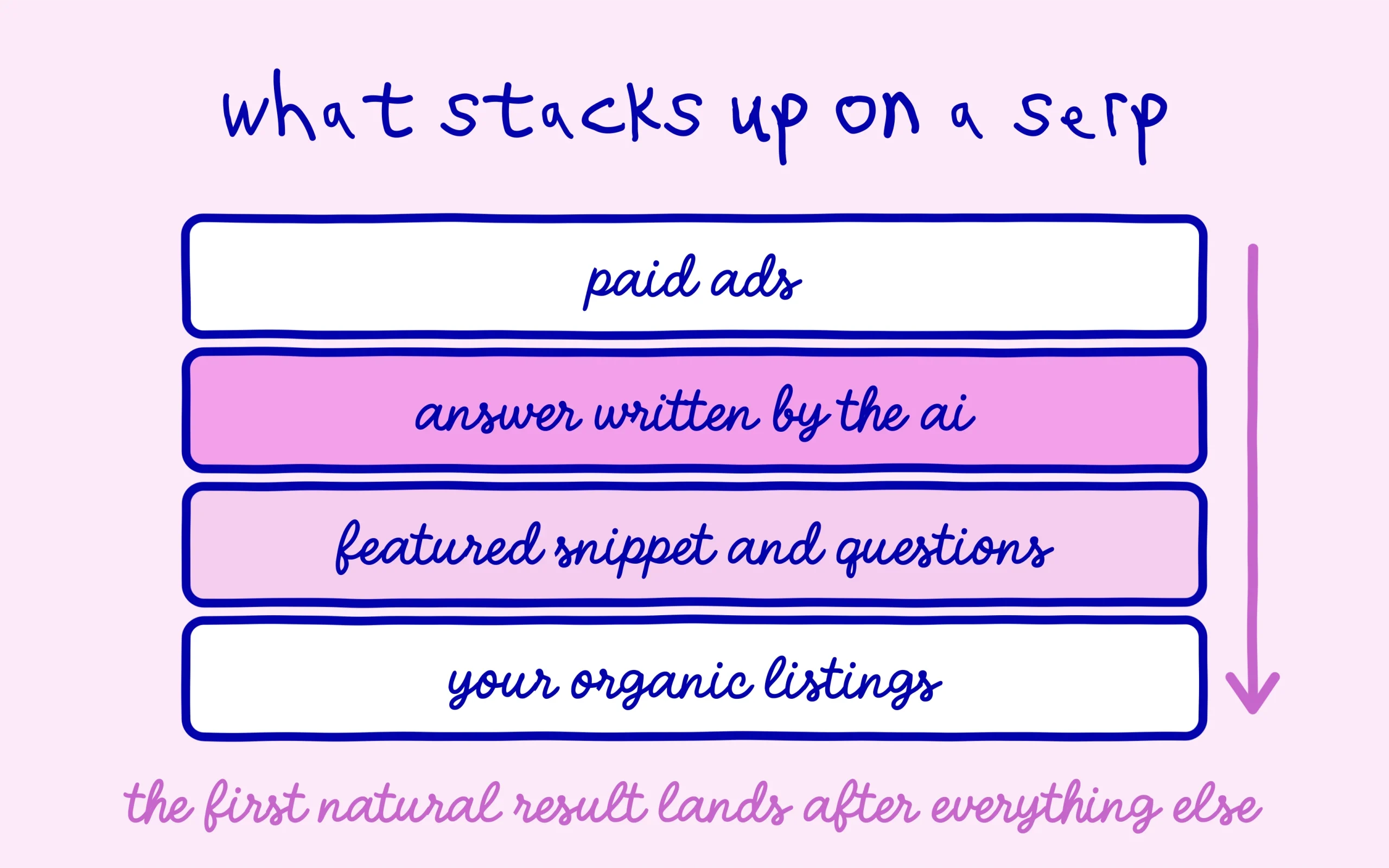
Type any reasonably mainstream query and look at the screen calmly before clicking anything. A plain column of links is rare. Depending on the question, Google assembles the page from a library of blocks, and that assembly shifts from one query to the next.
Paid ads usually hold the first slots, marked by a small label. Organic results follow, and those are the ones SEO work can reach. Woven between them sit the specific blocks: featured snippet, related questions, image carousel, video results, a local map showing three nearby businesses, an information panel about a known entity.
The split between ads and organic deserves a moment, because beginners often blur the two while studying a SERP. Paid slots are bought per click and vanish the moment the budget stops. Organic listings cannot be bought and hold their place for as long as the engine finds them relevant. Everything in this course concerns the second category, which is why the work pays off slowly but keeps paying.
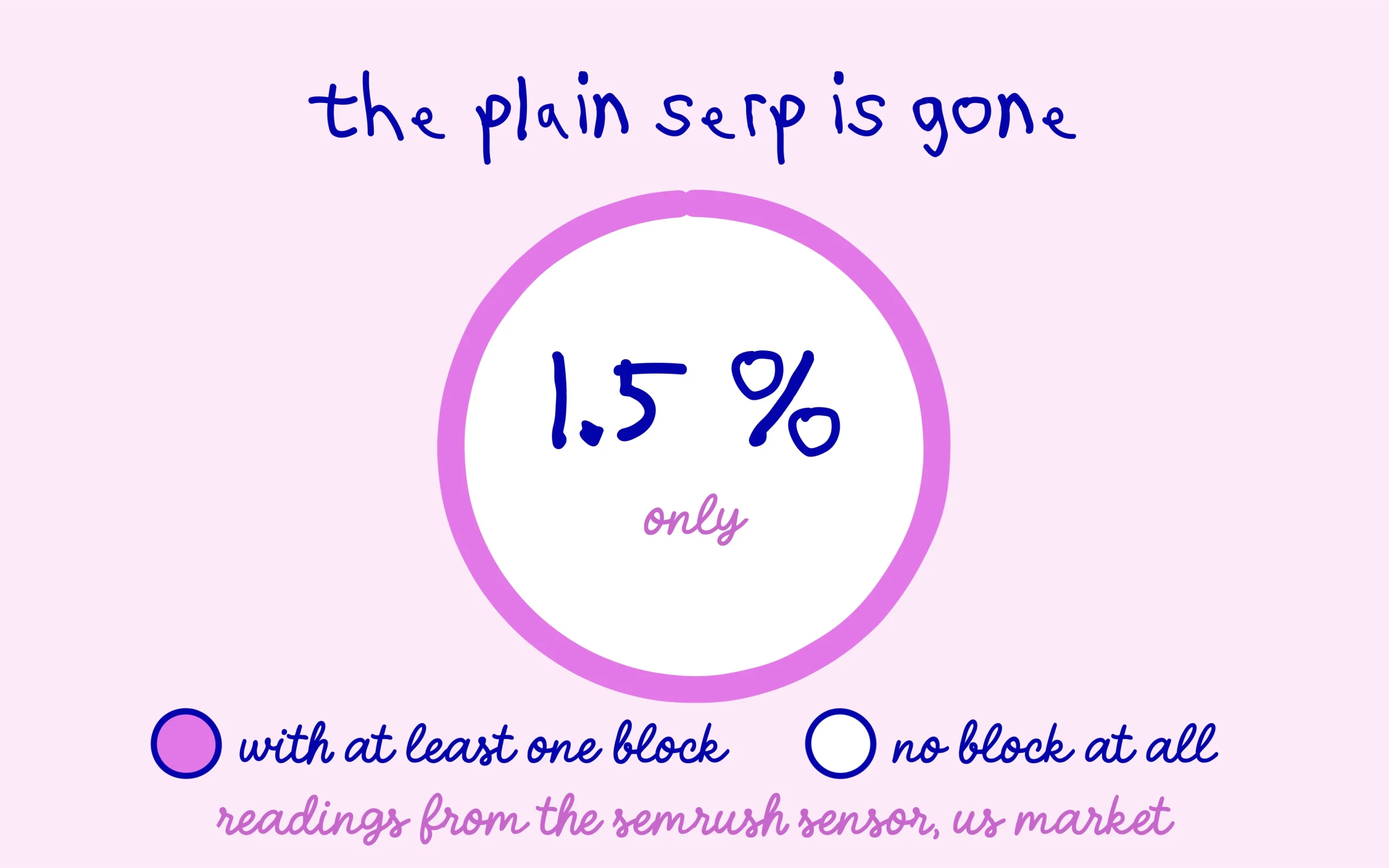
These blocks are now the norm rather than the exception. Across US readings from the Semrush sensor, barely more than 1.5% of results pages showed up with no specific block at all, an order of magnitude laid out in the Semrush guide to SERP features. A results page made purely of blue links has become an oddity.
How people read that page moved along with it. Eye-tracking work from the Nielsen Norman Group describes a scattered scan they call the pinball pattern: the eye bounces between blocks instead of running down line by line. Their observations are set out in their study of three key search results features.
That bouncing has a direct consequence for you. Ranking first no longer means being seen first, because a block placed above catches the eye before your listing does. Which is exactly why a growing share of searches ends without any click at all, something documented in the figures on zero-click Google searches.
Two blocks deserve a quick note because beginners regularly misread them. The local map, often called the local pack, only shows businesses with a verified profile and a physical address, so no amount of content work puts a purely online site inside it. The knowledge panel on the right covers entities the engine already recognises, which is why it appears for a brand or a public figure and stays absent for an unknown site. Neither is a ranking you can chase in the ordinary sense.
One more thing before the block-by-block detail. A SERP layout depends on the query, but also on language, country, device and timing. Two people typing the same words at the same moment from different cities can see noticeably different pages. Get in the habit of checking more than once rather than building a rule from a single screenshot.
The featured snippet, a slot you cannot ask for
The featured snippet is that box at the very top answering the question directly. It can appear as a paragraph, a list, a table or a video, and it shows the address of the site the answer came from.
First thing to accept: the slot cannot be claimed. Google’s systems decide whether a page would make a good snippet for a given search and elevate it accordingly. No form, no tag, no setting lets you apply, and the engine says so plainly in its official documentation on featured snippets.
Going the other way is possible though. The nosnippet rule blocks every snippet for a page, which also removes the ordinary description under your title. The max-snippet rule caps how many characters can be shown: the lower the cap, the less likely the page feeds a featured snippet, without any guarantee attached. Only nosnippet is a sure exit.
Should you want out? For a young site, rarely. Publishers argue the box answers on the site’s behalf and eats the click, which is fair, yet when nobody knows you yet, sitting at the top of a results page is exposure worth having. Note too that clicking a snippet drops the visitor straight into the relevant part of the page, which makes for a better arrival.
Learning the four snippet formats helps you read what the engine wants. Paragraphs answer definitions and explanations. Numbered lists carry procedures and rankings. Tables handle comparisons of prices or specifications. Video shows up when a demonstration beats prose. Spotting the format already in place on your query tells you the mould your own answer needs to fit.
What you can genuinely work on is how easy your answer is to lift. A question as a subheading followed by a clean two or three sentence reply hands the engine a block it can cut out. A tidy table for comparisons, a numbered list for a procedure. You never request the slot, you make the answer easy to extract, and that is the whole of your leverage here.
People Also Ask, the questions Google hands you
The People Also Ask box shows a run of questions related to your search, each folded into an accordion. Click one and the answer unfolds in place, usually pulled from a third-party page, while fresh questions get appended at the bottom of the list.
This box earns your attention for one simple reason: it gives away the mental map Google associates with your topic. The questions on display are the ones the engine judges connected to the original query, which is worth as much as a keyword tool when you are starting with no budget.
The method takes three steps. Type your main query, unfold each question so more appear, and drop everything into a plain document. A few minutes gets you twenty or thirty real phrasings, reflecting how people actually ask rather than how you would have worded it.
Those questions then become your outline. Each one can serve as a subheading with a short answer beneath it. You cover the subject in the reader’s own terms and multiply the entry points into your page. Working from real questions is one of the most reliable ways to increase traffic on a site that is just starting out.
Careful not to turn the material into a catalogue though. Dumping all twenty questions into one article produces a scattered page that answers nothing well. Group them by theme, keep the ones that truly belong to the page’s subject, and park the rest for future articles. A question that drifts too far deserves its own page rather than a stranded paragraph.
One honest caveat. The box feeds on-page reading and does not always send traffic, since the visitor gets an answer without leaving the results page. Its value to you is therefore double: a little direct visibility, and above all an extremely dependable source of content ideas.
What the generative blocks stacked on top
For two years now an extra layer has settled at the top of many results pages: an answer written by the engine’s own AI, with a handful of source links beside it or below. That surface went mainstream in France during 2026.
How that block works, what it does to traffic and how it selects sources are covered in our full guide to AI Overviews. For this chapter, remember the position above all: it lands before everything else, so before your organic listing, whatever rank you hold.
A fully conversational mode exists as well, where the visitor talks to the engine and strings follow-up questions together. It runs on its own selection logic, and it sometimes pushes Google’s material ahead of outside sites, as seen when AI Mode started citing Google’s own listings.
Cause for panic as a beginner? Not really, though expectations need adjusting. A flatly factual query like “how tall is the Eiffel Tower” stands a strong chance of being swallowed whole by the generative block. A query calling for an opinion, a comparison, a detailed method or lived experience keeps sending people through to pages.
That steers topic choice for a young site quite naturally. Targeting questions answerable in one sentence means feeding the engine’s box for nothing in return. Subjects that need developing keep their click value, and those are where a small site can still build an audience.
Reading a SERP before you write the page
Here is the habit to take away from this chapter, the one to repeat before every new article. Before writing, type the query you are targeting and spend three minutes studying what Google puts on screen. That page tells you precisely what the engine treats as a good answer.
Look first at the dominant format. If the top ten are all comparison pieces, a product presentation page will get nowhere on that query. If videos fill the upper screen, your text article starts with a handicap that has to be made up elsewhere.
Look next at which sites are there. A results page packed with major media and institutional sites flags a query that is hard to reach for a new domain. Forums, personal blogs and small specialist sites signal a door left ajar.
Look finally at the blocks in play. A featured snippet shows you the expected answer format, which you can then do better. A related questions box gives you your outline. A local map signals proximity intent that only a physical business can seriously chase.
One methodological warning to close the exercise. Your browsing history and location shape what Google shows you, so an observation made in your usual browser partly reflects your own habits. Switch to private browsing, and if your subject concerns another region or country, remember the page you see is not the one your audience gets. Analysis done in poor conditions is sometimes worse than none.
All of this rests on what came before in the course. It assumes you already hold the rules of the SEO game in 2026 and that your pages clear the stage covered last time, namely what indexing really means and why Google sometimes refuses your pages. An unindexed page appears on no SERP whatsoever, however good it is.
Keep a note of what you find, too. A short document listing each target query, the blocks it shows and the type of sites ranking gives you a reference you can revisit in six months. SERP layouts drift as the engine tests new arrangements, and having your own before-and-after beats relying on memory when a page suddenly loses traffic for reasons nothing in your content explains.
The next chapter takes on Google’s ranking principles in plain English, to understand what the engine weighs once it has your page in hand. Meanwhile, practise on five queries from your own niche and note the blocks present on each. That small drill is worth more than any paid tool at this stage.
Keep learning on SEO Noobies.



[…] is not bolted shut by design. If the various zones of a results page are still a blur, our piece on how to read a search results page and its building blocks covers the […]
[…] carousels, the classic blue links have drifted far below the fold. If that anatomy feels blurry, the breakdown of every block on a Google results page covers the […]