AI referrals to Shopify storefronts grew 197% year over year in the second quarter of 2026, and the numbers the platform published this week land right in the middle of a debate that has been going in circles for a year. Organic search kept growing over the same stretch, more slowly, and it still sends far more visits than every AI assistant combined. So if you are wondering whether to walk away from Google and chase ChatGPT instead, those two lines already answer the question. Here is what the data actually says and what a small site can take from it.
TL;DR
AI referrals to Shopify merchants grew 197% year over year in the second quarter of 2026, and orders from that channel tripled.
Organic search grew 12% over the same period on a much larger base and remains the biggest source of visits.
Shoppers arriving from an assistant buy roughly 80% more often than shoppers arriving from organic search, with wider gaps on spec-heavy products.
For a site starting out, the useful reading is to work both channels together rather than trade one for the other.
Summarize This Article with AI
ChatGPTWhat the Shopify traffic numbers actually show
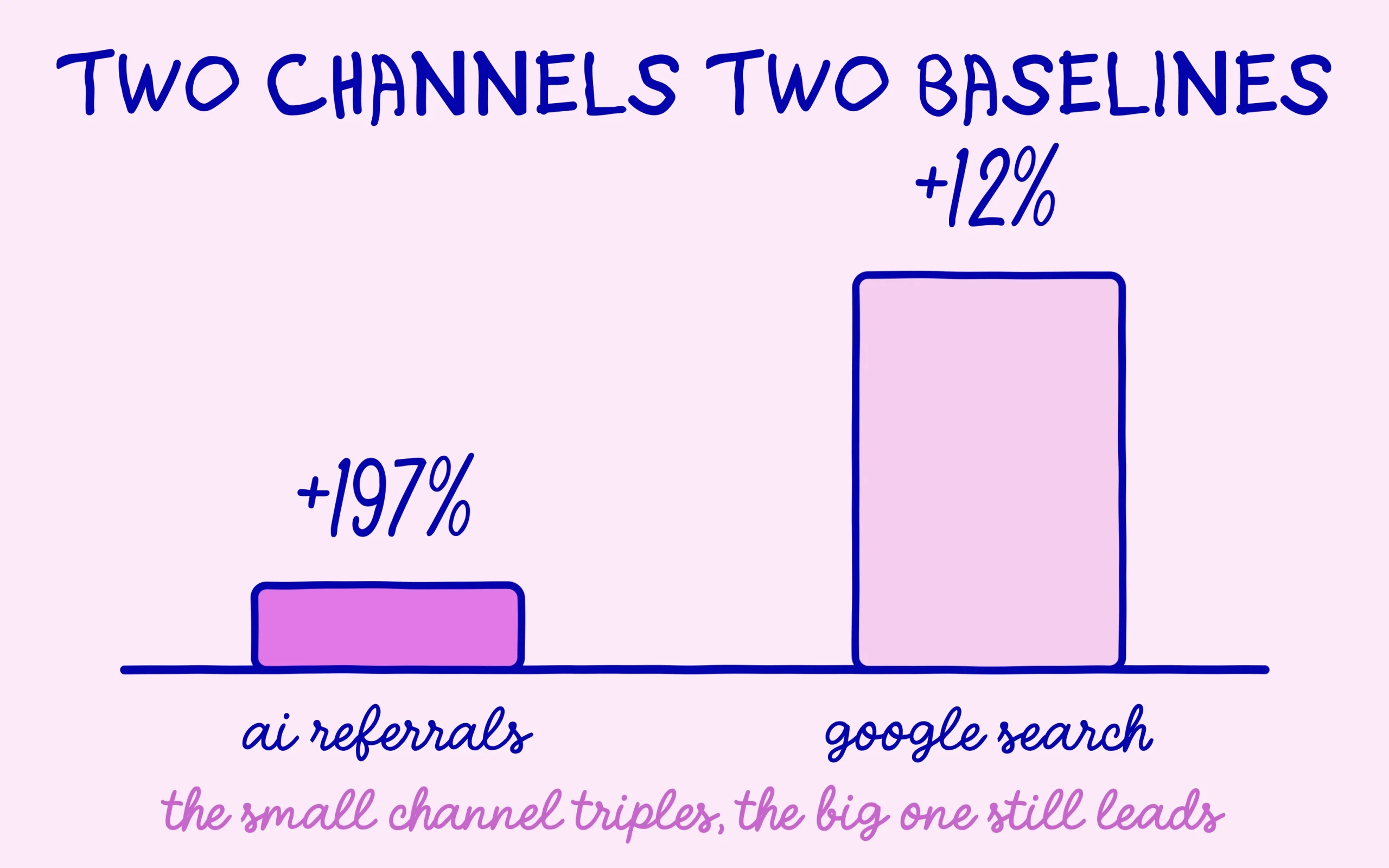
The platform pulled together how visitors behaved on its merchants’ storefronts between April and June 2026, then compared those volumes with the same window a year earlier. On the assistant side the picture is unambiguous: sessions arriving from an AI tool almost tripled, and the orders tied to them moved the same way.
The number that matters sits right next to it. Organic search grew 12% over the same period, which looks tame against 197%, except that the smaller percentage applies to a base of a completely different size. Add up every AI platform the company tracks and you are still well behind what classic search engines deliver. That lines up with what Google argued earlier this summer when it claimed AI search was still sending billions of clicks out to websites.
One more detail deserves attention. Half of all AI referrals land straight on a product detail page. The shopper skips the homepage, skips the category page, and arrives on the exact page the assistant quoted. The product page becomes the entry point, which quietly retires a few habits inherited from classic search optimisation.
The full breakdown, category by category, sits in the Shopify analysis of how AI-referred shoppers behave. First-party data on this topic is rare, and most figures floating around come from far smaller samples.
Why AI referrals convert better than classic search
The most striking part of the report has nothing to do with volume. A visitor arriving from an assistant buys roughly 80% more often than one arriving from organic search. On certain product families the gap widens further, to around two and a half times for watches and necklaces.
Most of the explanation comes down to where the decision happens. Someone who asks an assistant to compare three models has already done half the work by the time they click. The filtering, the comparison, the ruling out of options all happened inside the conversation instead of on your site. You inherit a shopper at the end of the journey, while classic search sends you plenty of people at the very start of one.
A second factor shows up in the data and this one you can act on. When the assistant works from structured product data rather than content scraped along the way, conversion doubles. How readable your catalogue is to a machine therefore moves the commercial result directly. A product page a machine can parse earns more than a page that only looks good, and nothing forces you to pick between the two.
That said, AI referrals remain small in raw volume. Celebrating a better conversion rate across a few hundred visits carries nowhere near the weight of the same rate across tens of thousands. The sensible reading is a young channel, unusually well qualified, still modest in size, rather than a replacement for classic search. Anyone following the topic also knows that the share of Google searches ending without a click keeps pulling in the opposite direction.
What this changes for a site that is just starting
First practical takeaway: nothing here justifies dropping classic search work. The channel sending the most people is still the search engine, by a wide margin. A poorly indexed site will be picked up by neither Google nor an assistant anyway, since both read the same pages.
Next, page structure carries more weight than it used to. A price written in the text, a clear availability line, specifications spelled out instead of buried in an image: those are the elements a machine can lift and reuse inside an answer. None of it requires a redesign, only some discipline when the page gets written.
Third useful habit, measure. Plenty of site owners discover their AI referrals by accident while poking around in their analytics one evening. Getting into the habit of checking where visits come from, even manually at first, keeps you from flying blind. The routine for checking whether AI tools cite your site without paying for anything already gives a decent read on your presence there.
One caution about the figures themselves. They come from a purely commercial ecosystem. A blog, a services site or a local shopfront will not see the same dynamic, because buying intent simply is not sitting there in the same way. The underlying direction holds, the intensity does not.
This quarter will stay useful as a reference point. It shows one channel tripling without the other collapsing, which undercuts the doom takes and the promises of an instant switch to AI in equal measure. What happens next depends mostly on how fast assistants become able to close a purchase themselves, and on that front there is very little hindsight to lean on.
Keep learning on SEO Noobies.

[…] However, the survey also shows the upside. 59.27% of respondents report discovering brands they had never heard of through AI chatbots, and 81.24% believe a chatbot can genuinely point to the best brands in a category. For a young site that entry point counts, because it does not hinge on domain age the way a first position on Google does. A brand nobody searches by name can still surface in a generated answer, much like the Shopify merchants whose AI referrals jumped while their organic numbers barely moved. […]