
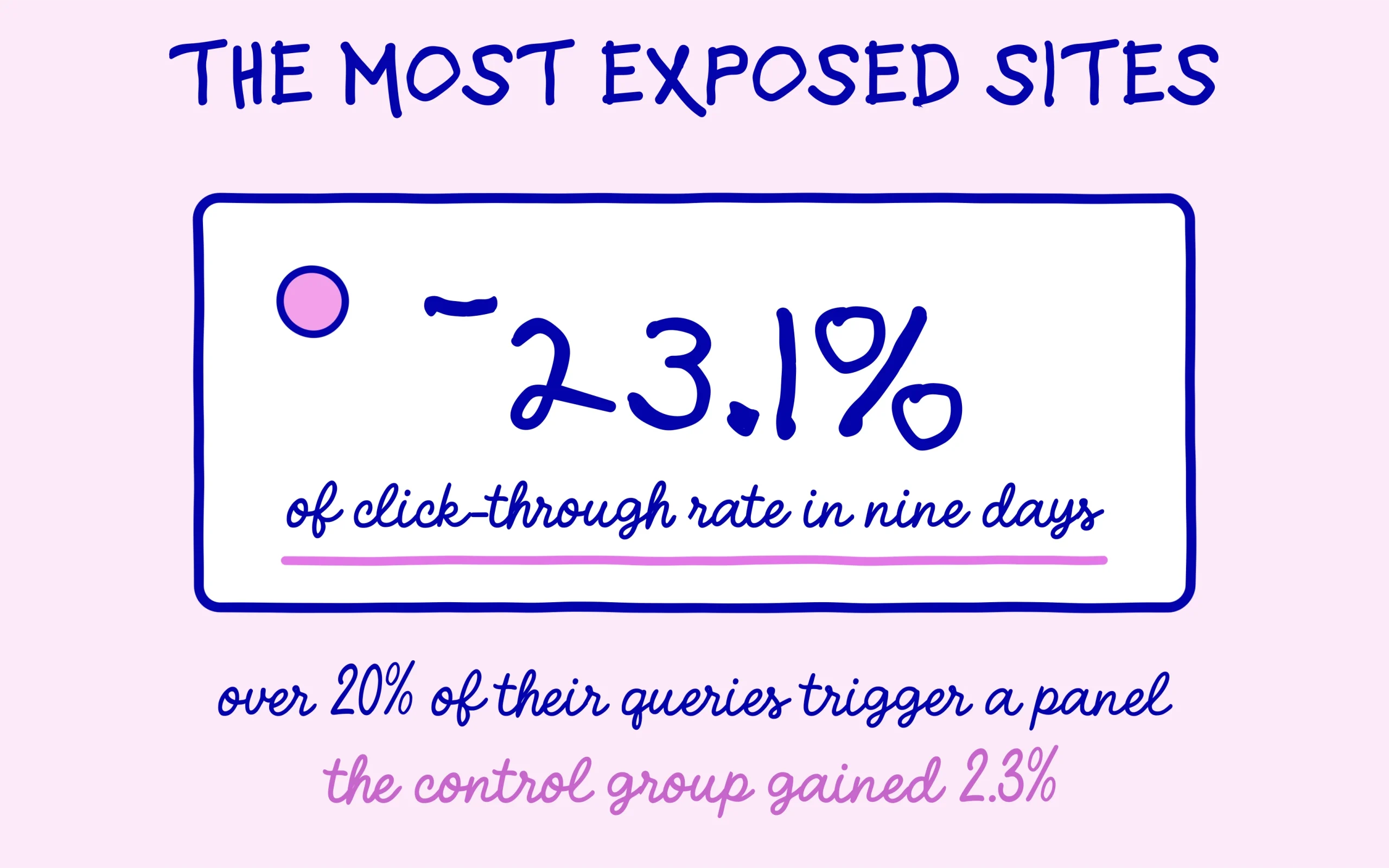
AI Overviews in France started showing up on July 22, and there is already a serious measurement of what they did. Ahrefs tracked 963 French domains through Google Search Console, twenty-eight days before the launch and nine days after. The most exposed sites lost 23.1% of their click-through rate over that short window, while a control group almost never affected gained 2.3%. The number getting quoted everywhere is also the one covering the fewest sites, and the useful reading sits one level down in the study. Here is what was measured, what was not, and how to work out your own exposure in about ten minutes.
TL;DR
Nine days after AI Overviews in France went live, 963 domains tracked in Search Console delivered the first hard verdict.
Sites where over 20% of queries trigger a panel lost 23.1% of click-through rate, though the panel median holds at 5.7%.
Impressions did not fall and sometimes rose. One site in the panel posted 183% more impressions for 1.9% fewer clicks.
Exposure and loss move together in a steady line: one point of exposure costs roughly one point of click-through rate.
Summarize This Article with AI
ChatGPTWhat the study measured about AI Overviews in France
The study went out on August 17, written by Juliette Begue, France marketing manager at Ahrefs, on data pulled and analysed by Xibeijia Guan, a data scientist at the company. The protocol is worth spelling out because it is what makes the result hold up. The thousand domains generating the most clicks in France between April and July 2026 were taken as a starting point, then any domain whose history did not cover the full period was dropped, leaving 963. For each one, daily averages for clicks, impressions and click-through rate were computed over the twenty-eight days before July 22, then over the nine days after.
What sets this apart from most readings published over the past month is the control group. Two populations were compared: heavily exposed domains, where more than 20% of queries trigger a panel, and a group barely touched at all, under 2%. Whatever the control loses is what everyone would have lost anyway, late-July seasonality included. Except the control did not lose anything. It gained 2.3% of click-through rate over the same window, which puts the real gap between the two groups at 24.8%. The full breakdown sits in the Ahrefs study on click loss after the French AI Overviews rollout, published on the company’s French blog.
The finding does not rest on a handful of badly hit sites dragging an average either. Among heavily exposed domains, 82.2% lost click-through rate. At that level of exposure, getting away with it is the exception. An average always hides a distribution, and the distribution is what matters when you are trying to place yourself. The timeline of how the feature reached the country is covered in our tracker on the AI Overviews rollout in the French market.

Impressions hold, clicks walk away
The mechanism behind AI Overviews in France deserves a pause, because it quietly corrupts dashboard readings. Pages are not losing rankings. They still appear, as often as before and sometimes more, since the panel pulls in queries that used to trigger nothing. They just get clicked less. The most striking case in the panel shows 183% more impressions alongside 1.9% fewer clicks, a click-through rate cut by more than three. A site in that position steering by impressions congratulates itself on growth while its traffic quietly shrinks.
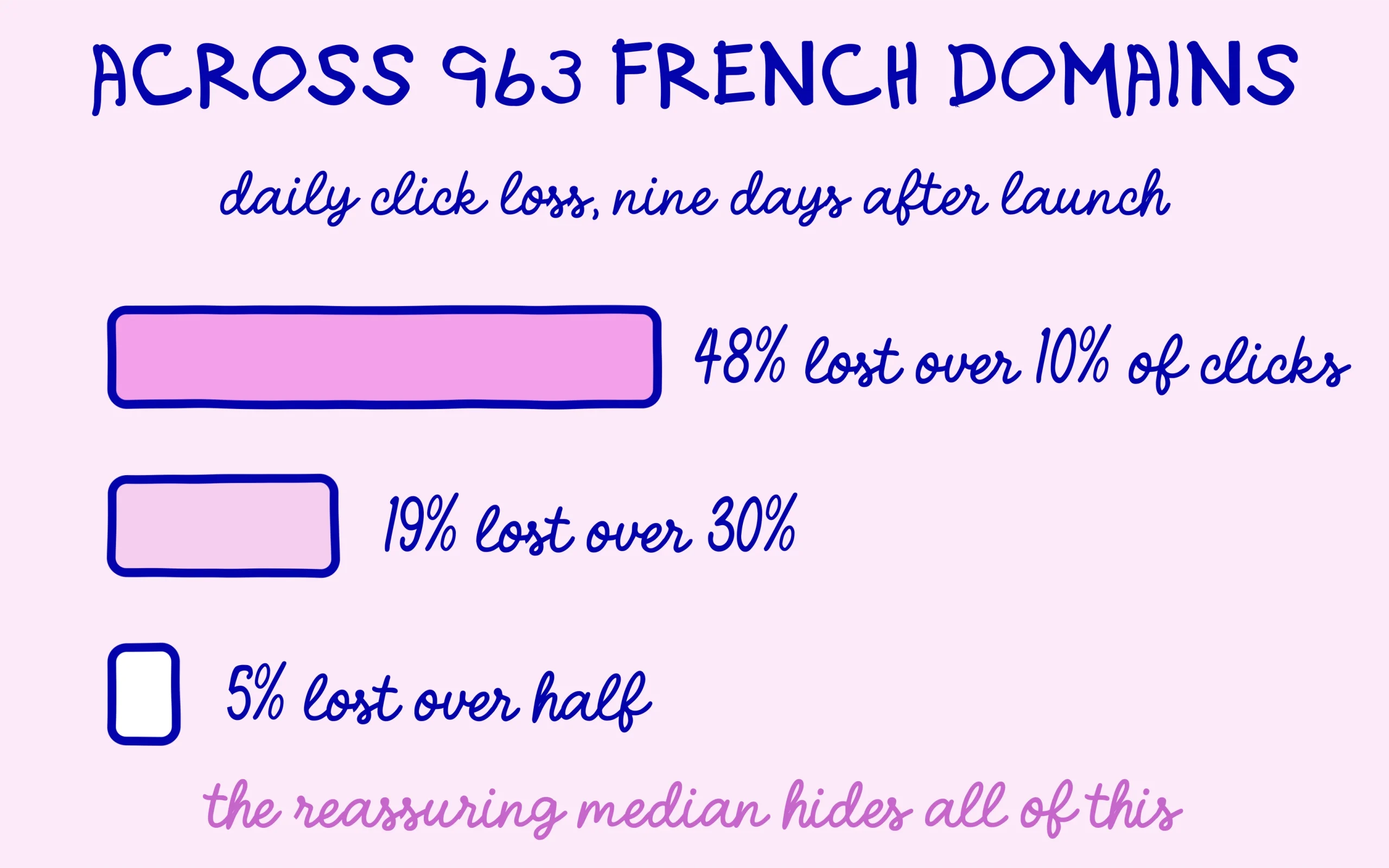
Zoom out to the whole market and the scale calms down, which is worth saying plainly to keep the panic out. The panel median comes in at 5.7% less click-through rate and 8.8% fewer clicks. That reassuring median covers a very wide spread though: 48% of domains lost more than 10% of their daily clicks, 19% lost more than 30%, and 5% lost more than half. In nine days. One site in twenty watched its organic traffic halve in a little over a week.
Two cuts of the panel add something on top. Domains on a .fr address lost 12.3% of clicks at the median against 8.8% overall, which points to French players taking more of the hit than international ones operating on the same market. On verticals, health stands apart with a panel trigger rate of 22.2%, the highest in the study, and 20.4% less click-through rate. The reason has more to do with query intent than with industry: a question a single paragraph can answer is a question the panel absorbs whole. How French publishers responded is laid out in our article on the complaint French publishers filed with the competition regulator.
Then there is the trajectory, and for any site exposed to AI Overviews in France it points the wrong way. The global study run by the same team shows the effect on first-position click-through rate moving from 34.5% in spring 2025 to 58% by the end of that year. The impact sharpens over time rather than fading, as the panel fires on more queries and the habit of not clicking settles in. The median trigger rate across the studied sites currently sits at 5.4%, and 29% of them are already above 10%.
How to work out your own exposure
The most useful figure in the study is not a percentage, it is a slope. Comparing click-through variation against trigger rate across every domain gives a relationship of minus 0.9. Each additional point of queries firing a panel costs roughly one point of click-through rate. If 15% of your queries trigger one, expect to lose somewhere around 15% of your click-through rate. It is crude, the study says so itself, and a slope is not an individual forecast. It remains the most honest order of magnitude available right now.
For a site in its early days, the calculation needs no subscription. Take the twenty or thirty queries bringing you the most clicks in Search Console, run them one at a time in Google using a private window, and count how many return a panel at the top. That ratio is your rough exposure rate. Paid tools automate the same count across thousands of queries, but on a small site counting by hand gives you enough to decide what to do, and it costs half an hour.
What your exposure rate to AI Overviews in France unlocks is the ability to sort your pages instead of treating them as one block. A page answering a closed question in three lines gets absorbed, and very little can be done to stop it. A page that requires a tool, an account, a price, a comparison or a human judgement holds up far better, because the panel cannot deliver the service in the site’s place. Look at your twenty best pages through that lens before looking at your industry.
One last marker before wrapping up. The orders of magnitude measured in France line up with what other teams found elsewhere: Seer Interactive puts the organic click-through drop between 49.4% and 65.2%, Authoritas at 47.5%. No published measurement runs the other way. Zero-click search stopped being a hypothesis in France, and the underlying shift was already documented in our article on the 68% of Google searches ending without a click in early 2026.

Keep learning on SEO Noobies.



[…] markets where generated answers landed later have been reporting the same direction of travel, and the early click measurements from the French rollout pointed that way months ago. What the Washington team adds is a controlled comparison where the […]
[…] still gives you something useful: a question to test against your own numbers, which is exactly how the first click-through readings after an AI Overviews launch were handled, with rankings holding steady while clicks […]
[…] A second, more senior engineering listing repeats the idea in almost the same words: AI-generated content recommendation systems and agentic flows for Discover and notifications. It adds that the team serves more than 4 billion users. Google now describes a feed that writes some of its own stories. That shift in wording matters for every site that feeds Discover today, many of which have already watched their clicks move since AI answers started showing up above the results, as covered in the look at AI Overviews cutting clicks in France. […]