
A sitemap is the file that lists your site’s addresses so Google knows where to look. A trick has been going around SEO circles this week: bolt a constantly changing parameter onto that file’s address so search engines are forced to download it again every single day. The appeal is obvious, since it feels like taking back control over a schedule nobody hands you. John Mueller, speaking for Google Search, answered publicly on September 2 and his answer left little room for debate. Here is what the trick actually does, why it sends the wrong signal, and what genuinely brings Google back to your pages.
TL;DR
A sitemap whose address changes on every request will not make Google visit more often.
John Mueller called it a bad idea because it signals that the canonical address of your content keeps moving.
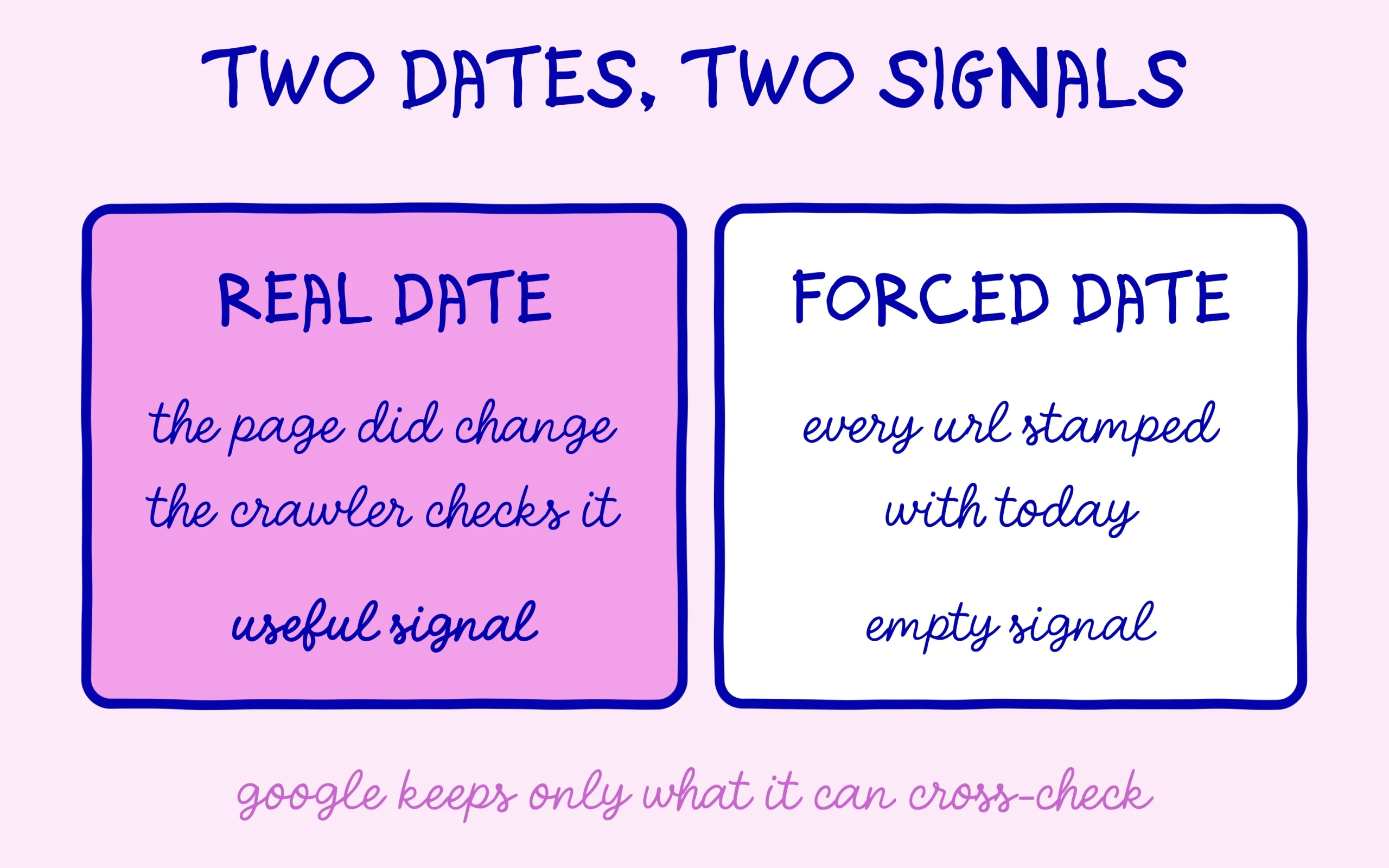
Google leans on the last-modified date when that date is consistent and verifiable, not when it resets to today across the whole site.
Publishing for real, linking your pages to each other and watching Search Console all outweigh any file-level trick.
Summarize This Article with AI
ChatGPTThe Sitemap Trick That Changes Address Every Day
The question came from SEO Harbour, an SEO monitoring account, in a Bluesky thread about how often crawlers come back. The poster described a habit spreading among practitioners: appending something like “?v=” followed by a timestamp to every address listed inside a sitemap index, so those addresses differ from one day to the next.
Worth clarifying what a sitemap index is, since that is the file being targeted. On a small site, one sitemap lists every page and that is the end of it. Once a site grows, the list gets split into several files, one for posts, one for pages, one for images, with a parent file that points at all of them. That parent file is what the trick tries to refresh, on the assumption that everything downstream follows.
The thinking behind it borrows from ordinary web development. When a browser holds an old stylesheet in memory, developers change its address to force a fresh download. Carried over to search, the logic looks sound: a file at a brand new address cannot be served from an old copy, so the crawler has to fetch it again.
What really drives the trick is impatience. On a young site, the wait between publishing a page and seeing it surface in search is the single biggest source of frustration. If yours is not set up yet, our walkthrough on building an XML sitemap on WordPress covers the five-minute version. Once the file exists, the natural next move is to look for a speed lever, and one line of configuration always looks faster than months of work. A file-level trick never stands in for a site that actually moves, which is precisely what Google’s answer came to restate.

What Google Actually Reads In A Last-Modified Date
Mueller opened by turning the question around, asking why anyone would want cache-busting on a sitemap in the first place. Then he settled it: the approach is a bad idea, because it signals that the canonical address of a piece of content is constantly changing.
That word canonical deserves unpacking, because it sits at the centre of the problem. For every piece of content, Google keeps one official address, the one it will show in results. When several addresses lead to the same content, it picks one and treats the rest as variants. A site rewriting its addresses nightly asks the engine to redo that pick over and over, on a file whose entire job is to be a stable reference point.
Google’s documentation on building sitemaps makes the same point from the other side. The last-modified value, the one most plugins fill in automatically, gets used when it is consistent and verifiable, meaning the crawler can cross-check it against what it finds on the page. An accurate date on a genuinely edited page is a useful signal. A date reset to today across every URL says nothing at all, because it no longer separates anything from anything.
Mueller closed the exchange by pointing at an old Tim Berners-Lee note on why good addresses should not change. The idea fits in one line: an address that keeps moving is an address people eventually lose.
What Really Brings Google Back To A Page
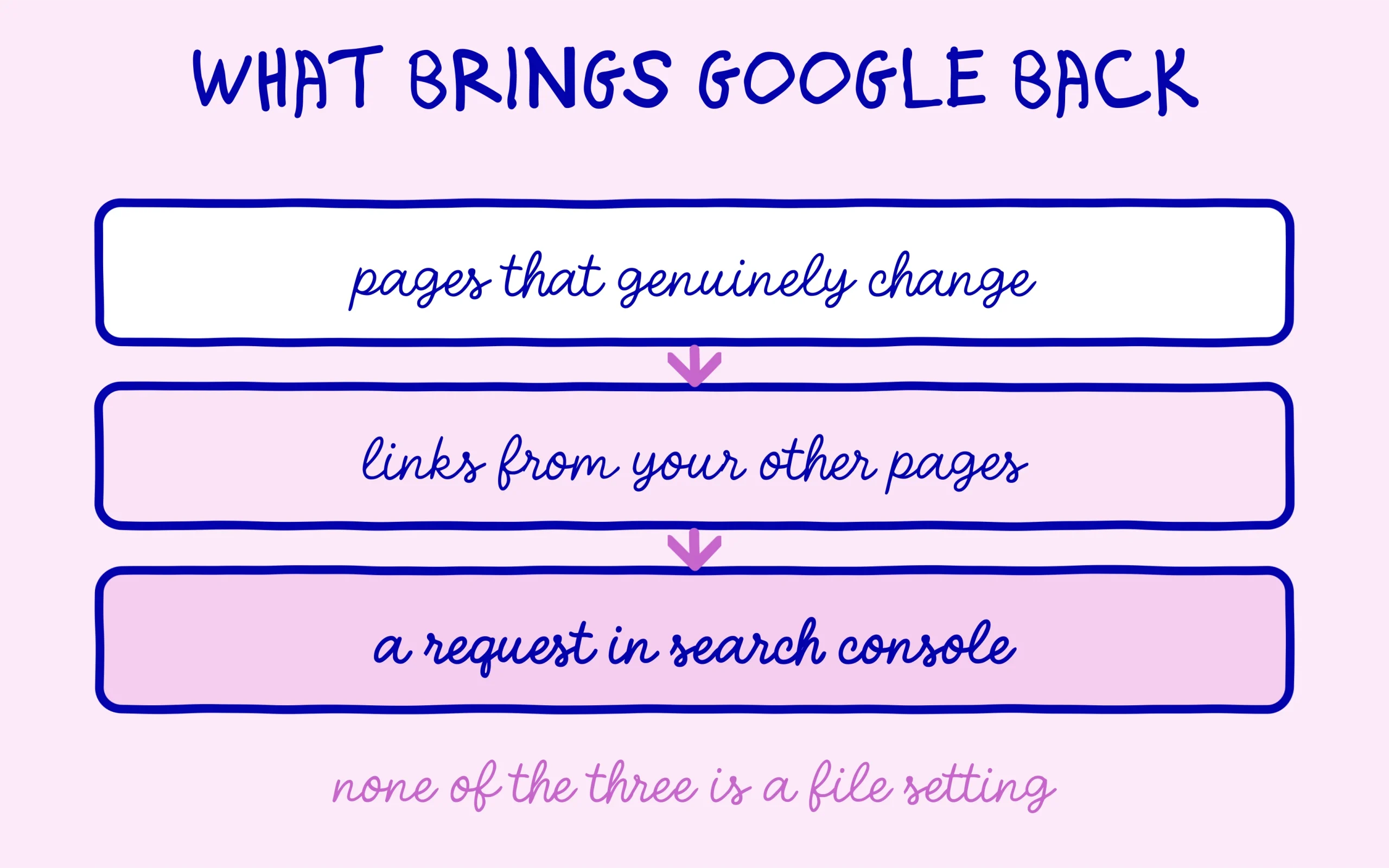
How often a crawler returns depends mostly on what it found the previous times. A site publishing twice a month, with older pages that never change, gets visited at a calm pace no matter what its sitemap claims. A site publishing steadily, where pages genuinely evolve, sees that pace climb on its own with no configuration involved.
Two levers stay within reach. The first is internal linking, the links your articles pass to each other: a page reached from several others gets found faster than one sitting alone at the bottom of the site. The second is URL inspection in Search Console, where you can ask for one specific address to be looked at. When a page refuses to budge, our piece on what “discovered, currently not indexed” really means decodes the label, and the routine for checking your indexing covers the basic tests.
There is a cost nobody brings up either. Every address the parameter invents is one more address the crawler discovers, evaluates and files away. On a forty-page site nobody will ever notice. On a catalogue of several thousand URLs, the trick multiplies the work without teaching the engine anything, and that work comes out of the budget the pages that matter would have received.
None of this is specific to Google, by the way. The crawlers feeding generative engines like ChatGPT or Perplexity run on their own schedules, and nothing suggests a doctored file impresses them any more than it does Googlebot. What pulls a crawler back is a site that changes, not a file claiming it changed.

Keep learning on SEO Noobies.



[…] is the same logic covered in the piece on why a sitemap will not bring Google back more often. A sitemap tells Google where your pages are, while the number of visits your site gets is decided […]