
Whether ChatGPT or Perplexity mentions your site is the question that comes up in nearly every audit right now, and it sounds far more intimidating than it turns out to be. Tracking your AI citations relies on three sources you already have: the engines themselves, your server logs, and your traffic reports. No subscription is required to build a reliable first picture. The output lives in a spreadsheet rather than a dashboard, takes about an hour per quarter, and covers what a young site actually needs. Here is the full protocol, blind spots included.
TL;DR
AI citations can be tested by hand in ChatGPT, Perplexity, Claude and Gemini, for free.
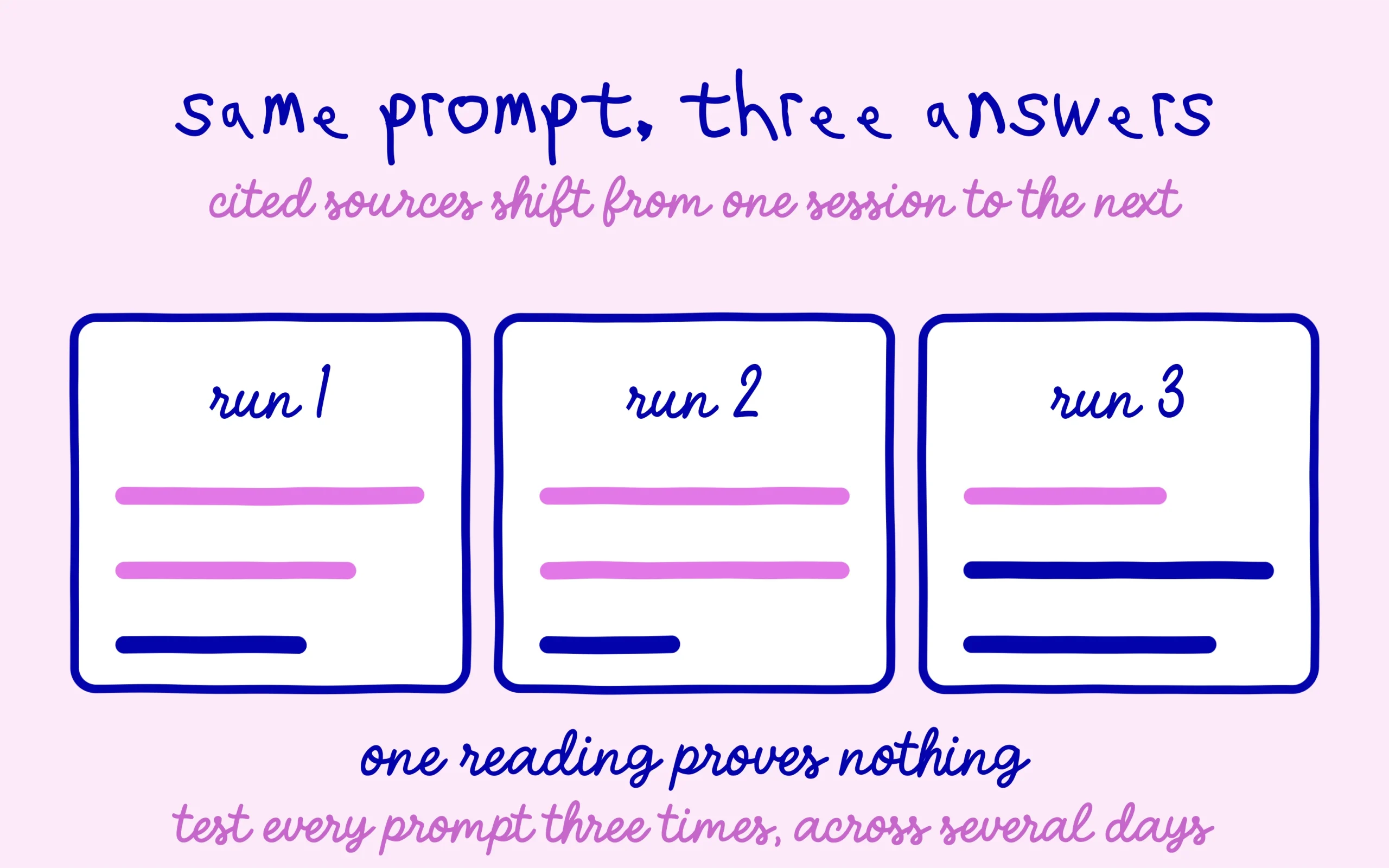
A single answer proves nothing, since the same prompt returns different sources from one session to the next.
Server logs reveal which AI crawlers genuinely reach your pages.
Paid platforms automate those tests, they measure nothing you cannot observe yourself.
Summarize This Article with AI
ChatGPTWhat AI citations actually cover
AI citations come in two shapes, and mixing them up wrecks the whole measurement. The first is a mention: the engine names your brand or your site inside its answer, with no link attached. The second is a source link, displayed beside the answer or in a footnote, which a reader can click.
Those two are worth very different things. A mention builds awareness while sending nobody your way. A source link produces measurable traffic, usually small in volume but carrying far stronger buying intent than your average visit. A site can be named twenty times a week without seeing a single session arrive, and that situation is entirely normal.
Another factor makes measurement harder: the engine does not pull from one fixed index. Depending on the question, it fetches fresh pages from the live web, leans on what the model absorbed during training, or blends both. The selection logic is unpacked in our piece on how the ChatGPT index picks the pages it cites, and it explains why a brand new page can surface within days while another waits for months.
Then comes the variable that surprises most beginners, which is the topic itself. Some verticals send readers straight to community forums, others to official documentation, others again to comparison sites. The type of question decides which family of sources the engine goes looking for, a pattern documented in our article on why ChatGPT citations depend on your topic. A niche technical site and a fashion store therefore start from different odds, and your readings should be interpreted with that gap in mind.
Running the manual test without fooling yourself
The core method fits in one sentence: ask the engines the questions your visitors ask, and watch what comes back. Open ChatGPT, Perplexity, Claude and Gemini, then query them the way a customer would, in plain sentences rather than raw keywords.
Write your list before you start, otherwise the test wanders. Ten prompts are enough: three phrasings around your main offer, three around a problem your content solves, two comparisons against direct competitors, two purely informational questions about your field. Keep that list in a spreadsheet, because it becomes your baseline for every round that follows.
Then comes the rule almost nobody applies, and it decides whether the test is worth anything. Repeat every prompt at least three times, in separate sessions, across several days. Generative engines never return the same answer twice, and a source quoted on Monday can vanish by Wednesday. One observation is noise, and only the frequency across several runs gives an honest read on your AI citations.
Two precautions keep the results clean. Switch off memory and chat history, or run everything in a private window, otherwise the engine tailors its answers to what you looked at earlier. And note the location it detects, since answers shift by country, which accounts for much of the gap between what you see and what a prospect sees.
Perplexity deserves a separate mention as the most readable testing ground of the four. Every answer lists numbered sources in plain sight, so ten prompts take a couple of minutes to review. Start there when time is short, then widen to the other three once the routine feels natural.
One last thing about Search Console, so you stop looking there for an answer it does not hold. Queries coming from Google’s generative features sit blended with everything else, with no filter to isolate them, a situation covered in our article on Search Console mixing AI Mode queries with yours. The tool stays essential for classic search, and it replaces none of this manual work.
The trail AI crawlers leave on your server
The second layer of verification lives on the technical side and answers a different question. The manual test measures your AI citations as a user sees them; server logs show whether the crawlers reach your pages at all, which remains the precondition for any citation.
Those logs sit in your hosting control panel, usually under a section named logs or raw statistics. Every line records one visit and carries the visitor’s identifier string, known as the user agent. All you need to do is search that file for the crawler names you care about.
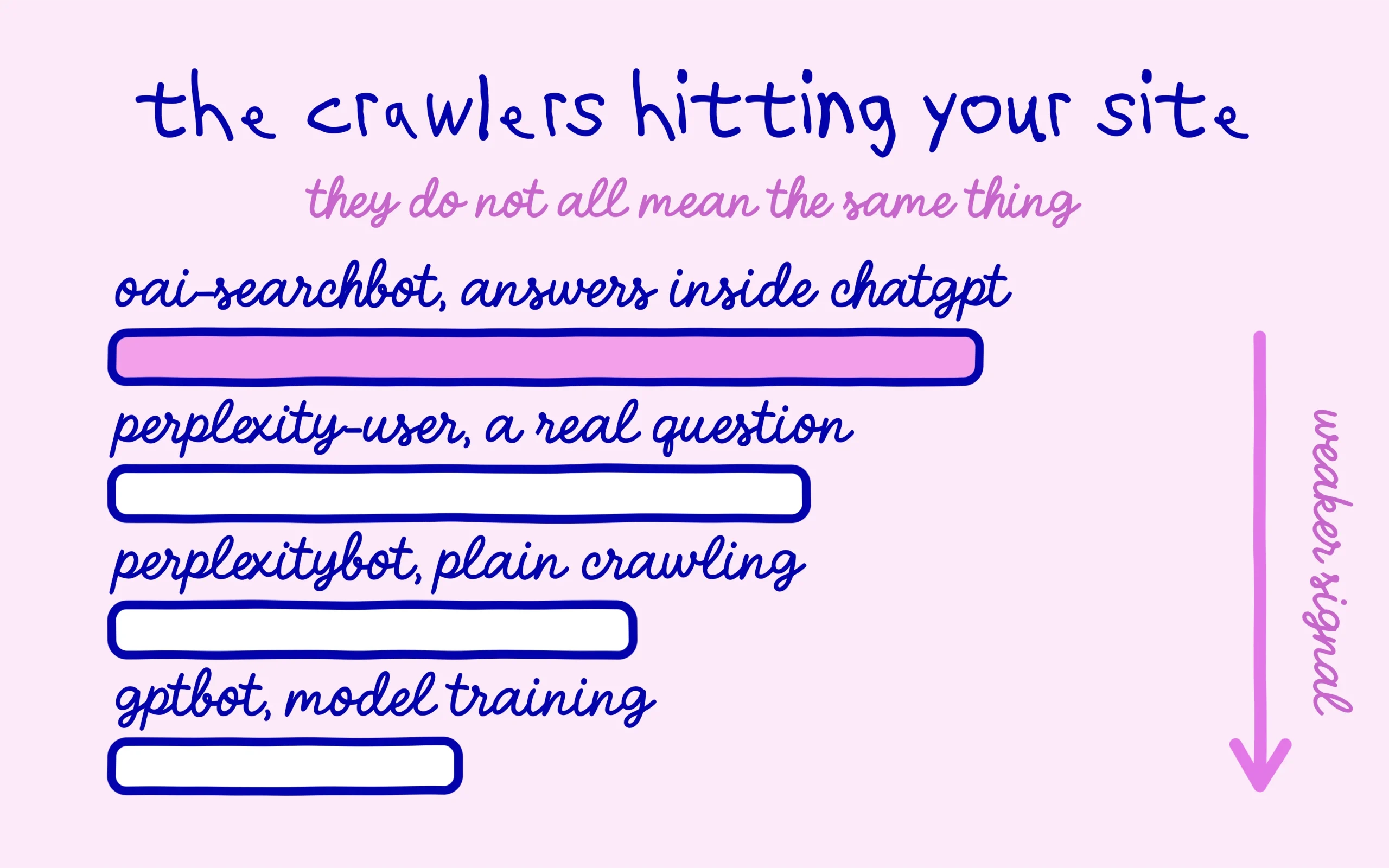
OpenAI runs four separate crawlers, and each one tells a different story. GPTBot gathers data for training foundation models, OAI-SearchBot feeds the search results shown inside ChatGPT, ChatGPT-User fires when a person explicitly asks for a page, and OAI-AdsBot checks pages submitted as ads. Each role is spelled out in the official OpenAI documentation on its crawlers, and the distinction matters: seeing OAI-SearchBot in your logs is a far more useful signal than seeing GPTBot.
Perplexity keeps things simpler with two agents, described in its documentation for site owners. PerplexityBot crawls the web to feed the results displayed in the engine, while Perplexity-User fetches a page when someone asks a question that leads to it. The first proves your site is in the pipeline, the second proves a real question reached you.
Google needs extra care because its setup is the trickiest. The crawlers tied to its generative products are listed on the official page covering its various crawlers, and blocking one of them can dent your presence in ordinary search results. Check exactly which agent does what before touching a single line of configuration on that side.
Your analytics give you a third free source. In the referral report, look for the assistant domains: the one for ChatGPT, the one for Perplexity, the one for Claude. Every session arriving from there means somebody clicked a citation, which is direct, timestamped proof. Volumes stay modest at first, often a handful of visits per week, and the three-month trend beats any single number.
When a paid platform finally earns its price
Specialised tracking platforms run on exactly the protocol described above. They automate what you just did by hand: firing hundreds of prompts every week, across several engines, and counting the appearances. The price tag comes from the volume of model API calls, which costs real money on every single request.
What they buy you comes down to three things. Consistency, because the test runs without you. Volume, with hundreds of phrasings where you manage ten. And history, which turns a one-off observation into a curve you can read over several months. For a brand tracking visibility across dozens of markets, the maths adds up quickly.
One thing to watch before any purchase. Comparisons published this year show wide gaps between platforms on identical prompts, with some catching noticeably more real citations than others. The margin of error, meanwhile, appears in no interface at all. Ask for a trial and match its output against your own manual readings before committing.
The verdict therefore depends on your situation. For a site in its first year, ten prompts tested three times a quarter, a quarterly look at the server logs, and a standing filter on assistant referrals cover the need. A subscription starts making sense once generative visibility moves your revenue, or once the manual routine costs you more than half a day a month.
What the readings won’t tell you deserves a closing note. Finding no citation signals that something needs fixing, without pointing at what. The work that follows sits in page clarity, depth of topic coverage, and mentions of your brand elsewhere on the web, three projects measured in months that no tracking tool replaces.
Keep learning on SEO Noobies.



[…] comes back, and write down who gets cited. It costs nothing, it takes about fifteen minutes, and your AI citations show up without a paid tool. You will find out quickly whether answers in your field rest on independent sites or on three […]
[…] What stays actionable comes down to one habit: measure your own presence instead of tracking someone else’s. Published shares, Reddit citations included, cover broad panels and say nothing about your sector or your queries. Running ten key questions manually through ChatGPT, Perplexity and Gemini every two or three weeks, logged in a spreadsheet, beats any market average. The full routine sits in our guide to checking your AI citations without paying for a tool. […]
[…] followed by your domain name into Google, with no space, and scroll through the list. Our guide on checking your AI citations for free covers the next step, once your own pages are […]
[…] your customers ask before buying, and write down whether your site appears. This manual way of checking your AI citations for free takes half an hour and already tells you where you stand. A subscription earns its place when you […]
[…] The first check takes five minutes. Open a private browsing window, type your exact company name, then the same name followed by “reviews” and “pricing”. A cold branded search like this one mirrors the path of a customer who is still making up their mind. If an AI summary appears, read it in full and write down three things: what it claims, what is wrong or outdated, and which sources it links to. Those sources are what you will need to fix or complete if something is off. The same check works on ChatGPT and Perplexity with the method to check your AI citations without paying for a tool. […]
[…] bookmarks, typed-in URLs, and clicks from a private messaging app. Hard to justify time spent on checking your AI citations without at least some traffic numbers to back it […]