
Ranking recovery after a fix takes months, and that estimate comes from Google itself. John Mueller said so on a Reddit thread where a site owner explained he had disavowed more than 800 backlinks and then watched his rankings collapse within two weeks. The answer reaches well beyond that single case, because it puts a number on something nobody wants to hear after a weekend spent repairing a site. If you have been refreshing Search Console every morning since you made your changes, what follows will save you from a second mistake. Here is what Mueller actually said, why the delay swings so widely depending on what was broken, and what Google spells out in its own documentation.
TL;DR
Google’s John Mueller replied on September 2 to a site owner who had disavowed more than 800 backlinks before his rankings dropped.
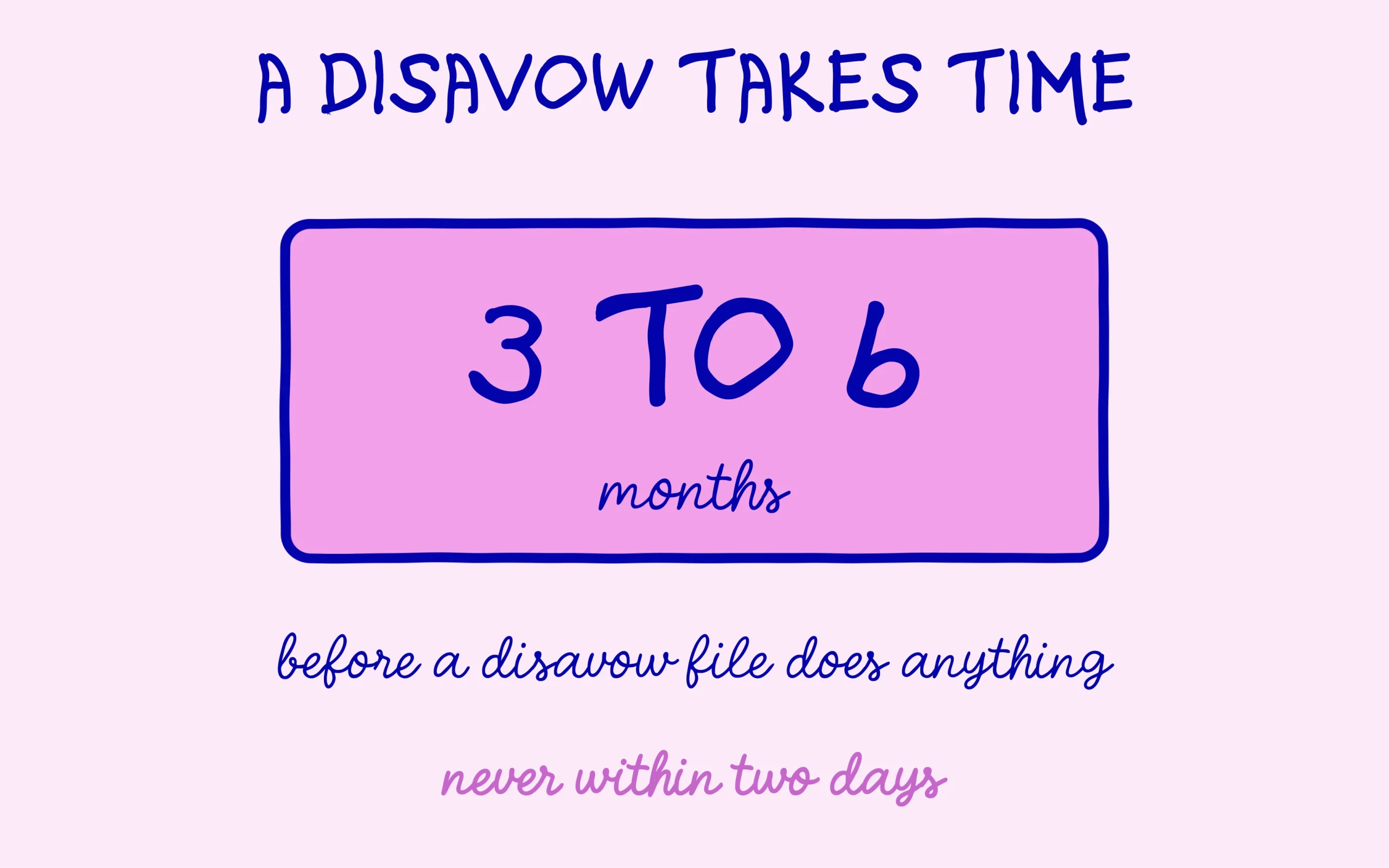
A disavow file takes three to six months to have an effect, and it does not push a site out of search within two days.
Ranking recovery from a quality problem often runs into months, while a technical error such as a stray noindex clears up far faster.
Log every change with a date, then wait a full week after an update finishes rolling out before you read anything into your data.
Summarize This Article with AI
ChatGPTWhat Mueller told the site that collapsed after a disavow
The thread starts from a situation that is common among impatient beginners. A site owner bought guest posts on Fiverr, panicked, and then disavowed more than 800 domains in one go to erase the trail. His organic rankings fell shortly afterwards, his business profile was suspended at the same time, and he came to ask whether the disavow was to blame. The thread posted on the SEO forum on Reddit carries the full exchange, Mueller’s reply included.
His answer rules out the obvious suspect straight away. Disavowing a handful of links is not going to make a site drop out of search, Mueller writes, and he adds that the tool works incrementally over three, four, five or six months. A drop that happened in two days therefore cannot be traced to a file uploaded the day before. the timing does not line up, so the cause sits elsewhere, and that piece of reasoning is exactly what a beginner should learn to run before naming a culprit.
That leaves the real question, the one the site owner never asked. Guest posts bought in bulk fall squarely into what Google calls unnatural links, and August happened to bring a spam update that we covered when it landed, including the way it reached every language rather than English alone. A site that falls apart while an operation of that size is rolling out has a far simpler explanation available than its disavow file. The order of events matters here too, since the profile suspension and the ranking drop arrived together, and two symptoms appearing at once usually point to one shared cause rather than to the last button somebody pressed.

The delay depends entirely on what you fixed
Mueller draws a distinction in the same exchange, and it deserves to be kept as it stands. Technical problems clear up quickly. A noindex tag left behind by mistake, a robots.txt block, a broken redirect: as soon as the page becomes reachable again, the crawler picks it back up within days. We described that mechanism in detail when we looked at the pages Google discovers without ever indexing them, which sit firmly in this category.
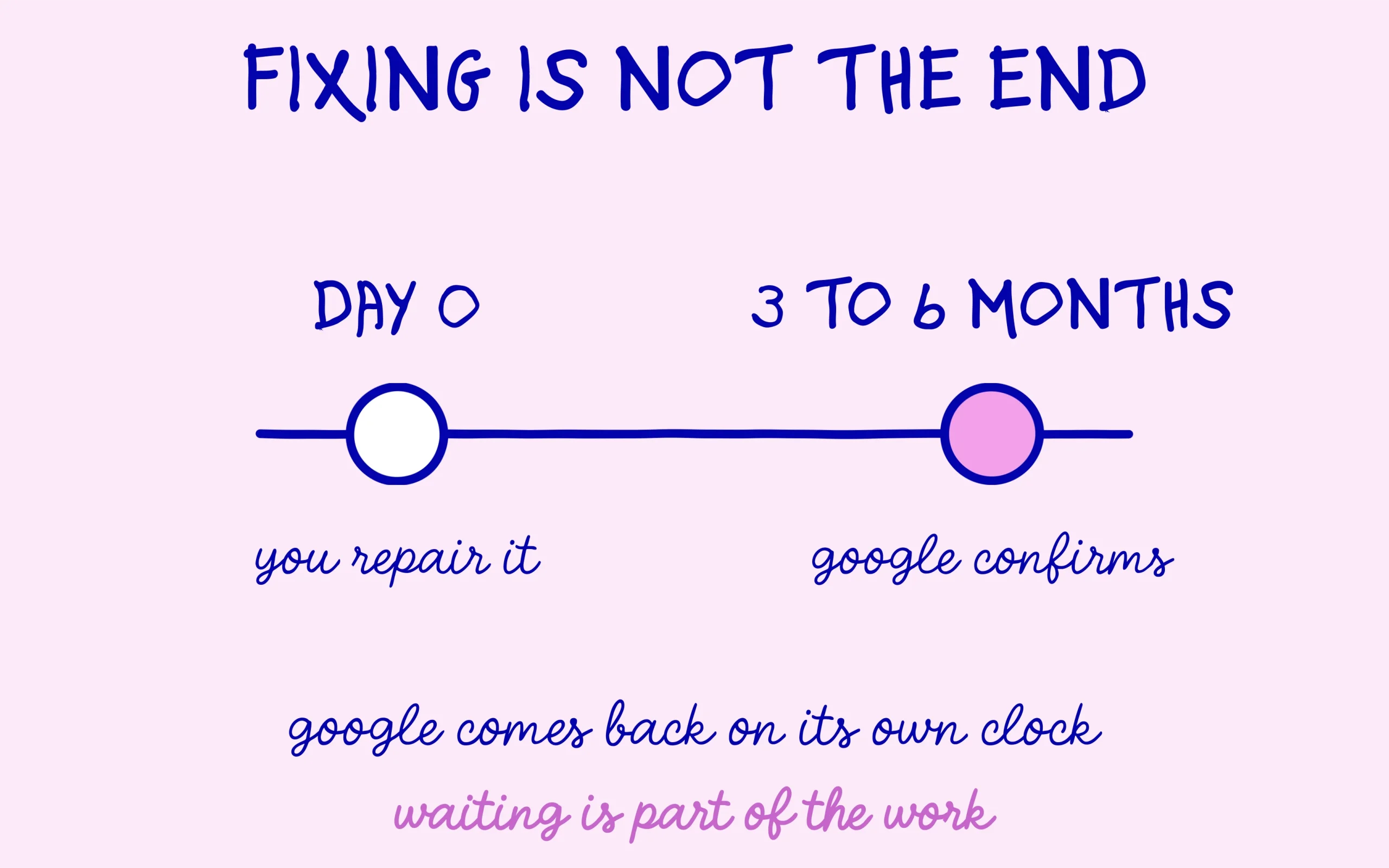
Quality problems run on a different clock. Fixing issues tied to a larger algorithmic change can take quite some time, sometimes many months, Mueller says. Google’s own documentation lands in the same place and sets an uncomfortable boundary: some changes take effect within days, but it can take several months for its systems to learn and confirm that a site now produces helpful content. The page covering core updates is published in the Google Search documentation, and it goes on to say that if nothing has moved after a few months, you are probably waiting for the next update.
That sentence is the hardest one to swallow early on, and it explains a great deal of discouragement. Ranking recovery assumes the engine comes back around, reassesses the whole site and confirms the change, which happens on its schedule rather than yours. Between your fix and that moment sits a wait nobody has any grip on. the fix opens the door, it triggers nothing, and mixing up the two leads straight into weeks of pointless tinkering.
Ranking recovery mostly means adding no new errors
Google spells out one recommendation for this waiting period, and it fits on a single line: avoid quick fix changes, such as removing a page element because you heard it was bad for SEO. That is precisely what the Reddit poster does by disavowing 800 domains at once. He ends up with two problems instead of one, and he has made his own diagnosis considerably harder. However, waiting is not an instruction to sit on your hands: it applies to panic moves, not to steady work.
The method that avoids the trap comes down to three plain habits. Open a file and date every intervention, one line per change. Touch one thing at a time, leaving at least two weeks between two substantial moves. And wait a full week after an update finishes rolling out before analysing your data, exactly as Google advises. without a dated log you are left guessing three months from now, when something finally moves and nothing lets you tie it back to a specific action.
That patience only pays off if the starting diagnosis was sound. Plenty of drops blamed on the algorithm come from something far more ordinary, and the free tool that shows you which pages actually lost impressions is the one we walked through in our guide to reading Google Search Console properly. Ranking recovery starts with knowing what really broke, and the rest is a matter of calendar.

Keep learning on SEO Noobies.