
AI search runs on a two-stage mechanism almost nobody explains to beginners: a first pass sweeps wide and pulls a few hundred pages, then a second pass reads them one by one to settle the final order. Researchers from Google DeepMind, the University of Massachusetts Amherst and the University of Texas at Austin now propose replacing that chain with a single language model. The paper is called Autoregressive Ranking and it went public a few days ago. None of it runs inside Google today, which is precisely why it is worth looking at now rather than on the day it ships.
TL;DR
Researchers from Google DeepMind and two American universities propose a ranking system called Autoregressive Ranking, or ARR.
It replaces the two stages behind AI search today, a fast sort then a precise one, with a single language model that outputs a ranked list directly.
In published tests ARR matches the quality of the precise stage while avoiding its compute cost, with weaker results on product search.
No deployment inside Google Search has been announced. This is research published on arXiv, nothing more.
Summarize This Article with AI
ChatGPTHow AI search ranks pages right now
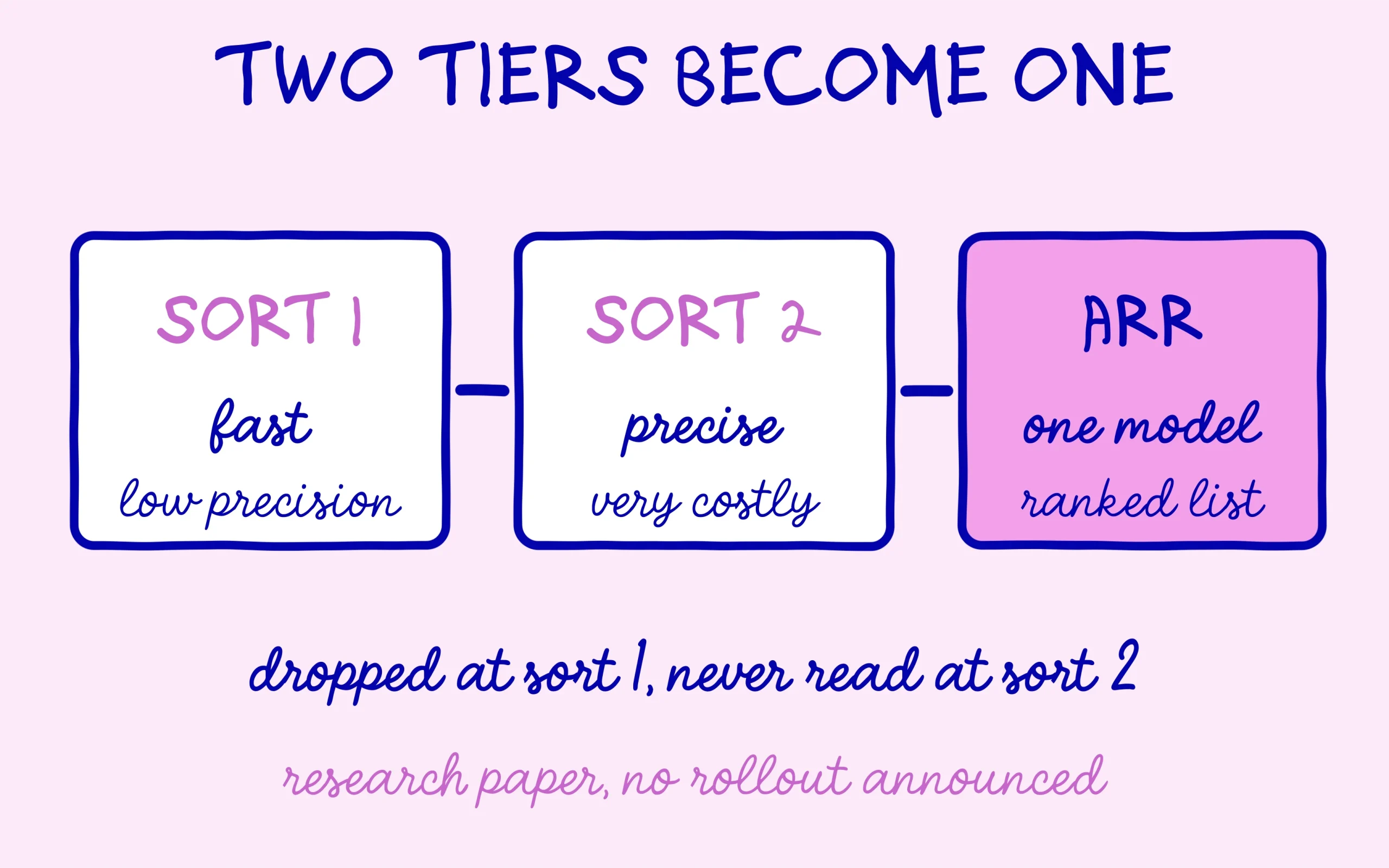
The current setup runs on two tiers, because neither can do the whole job alone. The first relies on what gets called a dual encoder. It turns your page into a series of numbers, does the same with the query, and compares the two. The operation is very fast, which makes sweeping millions of documents possible, though it loses nuance since page and question never genuinely meet.
The second tier fixes that weakness. A cross encoder takes the query and one page, reads them together, and scores the match with far greater precision. The price is compute time, heavy enough to rule out running it across a whole index. So it only touches the shortlist handed over by the first tier, typically a few dozen or a few hundred documents.
This architecture carries a consequence site owners routinely underestimate. A page dropped at the first tier never gets read by the second, whatever its actual quality. The rough sort decides who earns the right to be judged carefully. That is one reason basic signals such as a clearly stated topic still matter so much, well ahead of writing finesse.
Worth clearing up a common confusion among beginners: this two-stage ranking does not stop at classic results. It feeds the answer blocks written by models too. When a generated answer cites three sources, those three were selected and ordered by a chain of exactly this kind. AI search does not conjure its sources from nowhere, it draws from a ranking built upstream, and the detailed workings of AI Overviews and their sources show that continuity with ordinary search.
To picture it without jargon, a hiring process works well enough. A quick first read of applications cuts the bulk on simple criteria, then a panel reads the shortlisted files properly. The panel reaches better decisions, it simply cannot read ten thousand files.

What Autoregressive Ranking actually proposes
The researchers hand both jobs to one language model, trained to output a ranked list of documents directly. The system goes by Autoregressive Ranking, shortened to ARR, and the matching training method is called SToICaL. That method weights each document by relevance and pushes probability toward the higher positions, so the model learns to care about the whole top of the list.
The technical claim centres on handling any number of documents without resources blowing up. A dual encoder needs its embedding dimensions to grow as the document count rises, which caps its precision in practice. ARR claims to hold that load at constant dimensions, which would explain why it reaches cross encoder quality in the published tests.
Those results deserve reading alongside their limits, which the authors do not hide. On experiments built from the WordNet lexical database, ARR clearly beats the dual encoder and lands level with the cross encoder. SToICaL training noticeably improves quality beyond the single top result, which matters for anything shaped like a list. On product search tests, however, one variant degraded the very first result despite gains elsewhere.
That commerce caveat matters for anyone selling online. The first slot in a product list absorbs a huge share of clicks, and a system improving the list overall while weakening its peak would not suit a shopping engine as it stands. A ranking model is never good or bad in the abstract, only for a given type of query.
The full work is freely available, and reading it closely beats the rough summaries about to circulate. It is published as Autoregressive Ranking: Bridging the Gap Between Dual and Cross Encoders on arXiv. The title says plainly what the authors are after: closing the gap between the two encoder families rather than pitting them against each other.
What it changes for a beginner site
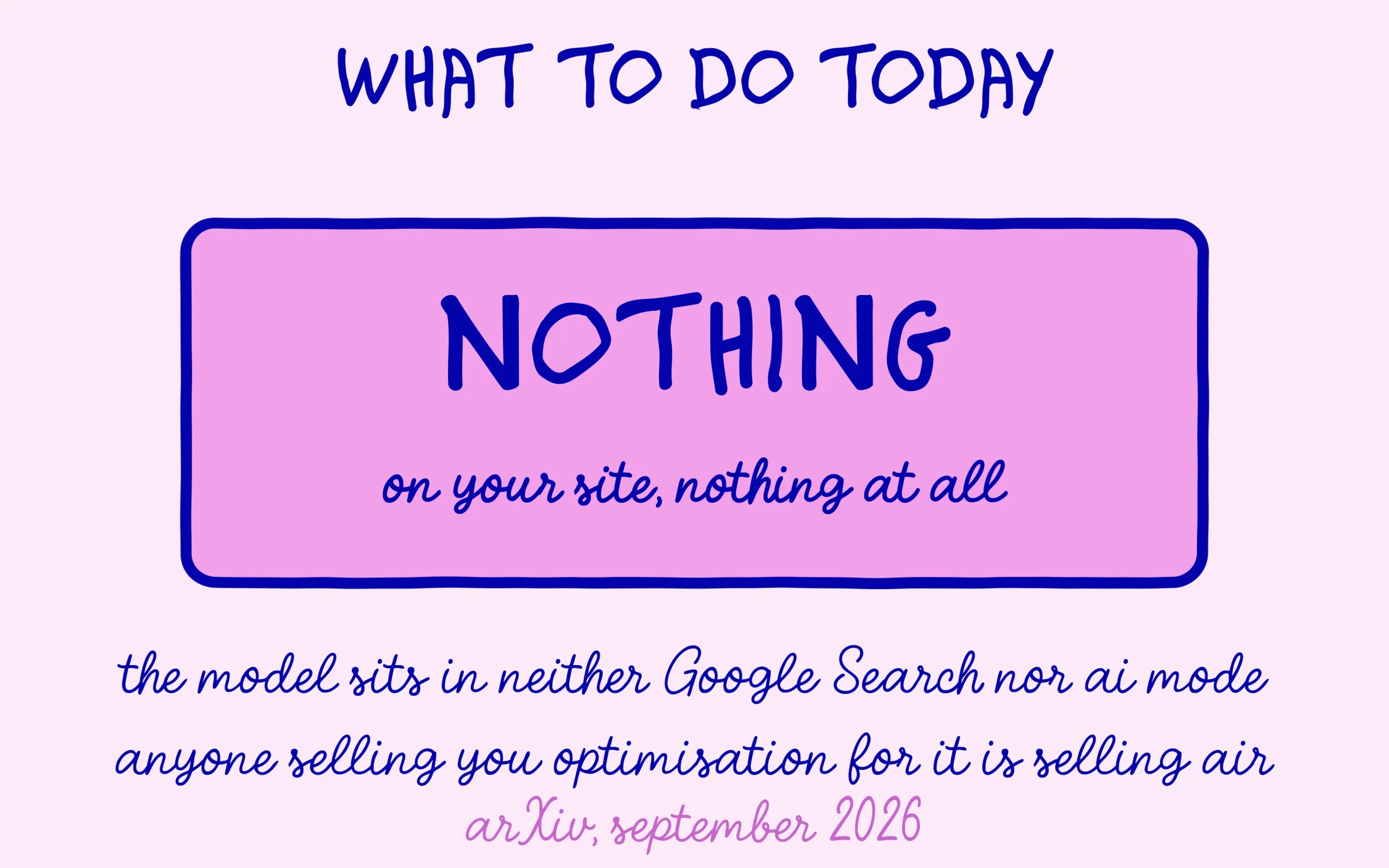
Start with the part that matters most, and it fits on one line. Nothing on your site needs changing because of this paper. It is a research publication, with no sign whatsoever of a rollout into Google Search, AI Mode or AI Overviews. Anyone selling you ARR optimisation over the coming months would be selling air.
That said, the direction of this research deserves attention. Ranking systems increasingly lean on models that genuinely read content, instead of reducing it to a numeric fingerprint compared against another. A page with a clear point, an answer arriving early, and a topic covered properly sits well with that direction. Those are the same qualities behind structuring a page so a generated answer picks it up.
The second reading is more strategic and turns on compute cost. Should one model handle both tiers without burning excess resources, fine-grained sorting becomes viable across far more documents than today. A modest site currently cut in the first round on rough criteria would stand a better chance of being genuinely read. That is a hypothesis rather than a promise, and it rests entirely on what AI search engines choose to industrialise.
Some common sense about how slowly research turns into product helps here. Plenty of papers never leave the lab, and those that do often take years, in a form distant from the original. BlockRank, another DeepMind effort on ranking inside language models, still sits unused across Google products.
So the practical takeaway is deliberately unglamorous, and that is fine. Keep covering your topics properly, answering early on the page, watching your queries in Search Console. Those fundamentals survive architecture changes because they describe what every AI search system tries to measure, whatever its internal plumbing. For a sense of what practitioners currently rate as decisive, the 2026 survey on ranking factors offers a useful comparison point.

Keep learning on SEO Noobies.