
The Rank Math vs Yoast question lands on my desk almost every time a consulting client sets up a new site, and it always shows up at the worst possible moment, right when you would rather be building than reading feature tables. Both plugins handle the same groundwork: they walk you through your tags, generate your sitemap and stop you forgetting the basics. That said, one of them gives away far more in its free tier, and the other charges considerably more for its paid one. Here is how the comparison actually shakes out when you look at it as a beginner rather than as a consultant.
TL;DR
Free Yoast caps you at one keyphrase per piece of content, while free Rank Math accepts an unlimited number.
Redirects, 404 monitoring and the Search Console connection sit in the free tier at Rank Math and behind the paywall at Yoast.
Yoast Premium is licensed per site per year, while a single Rank Math PRO subscription covers unlimited personal sites.
Yoast stays gentler to learn, Rank Math hands you more levers from day one.
Summarize This Article with AI
ChatGPTWhat each plugin lets you do before paying anything
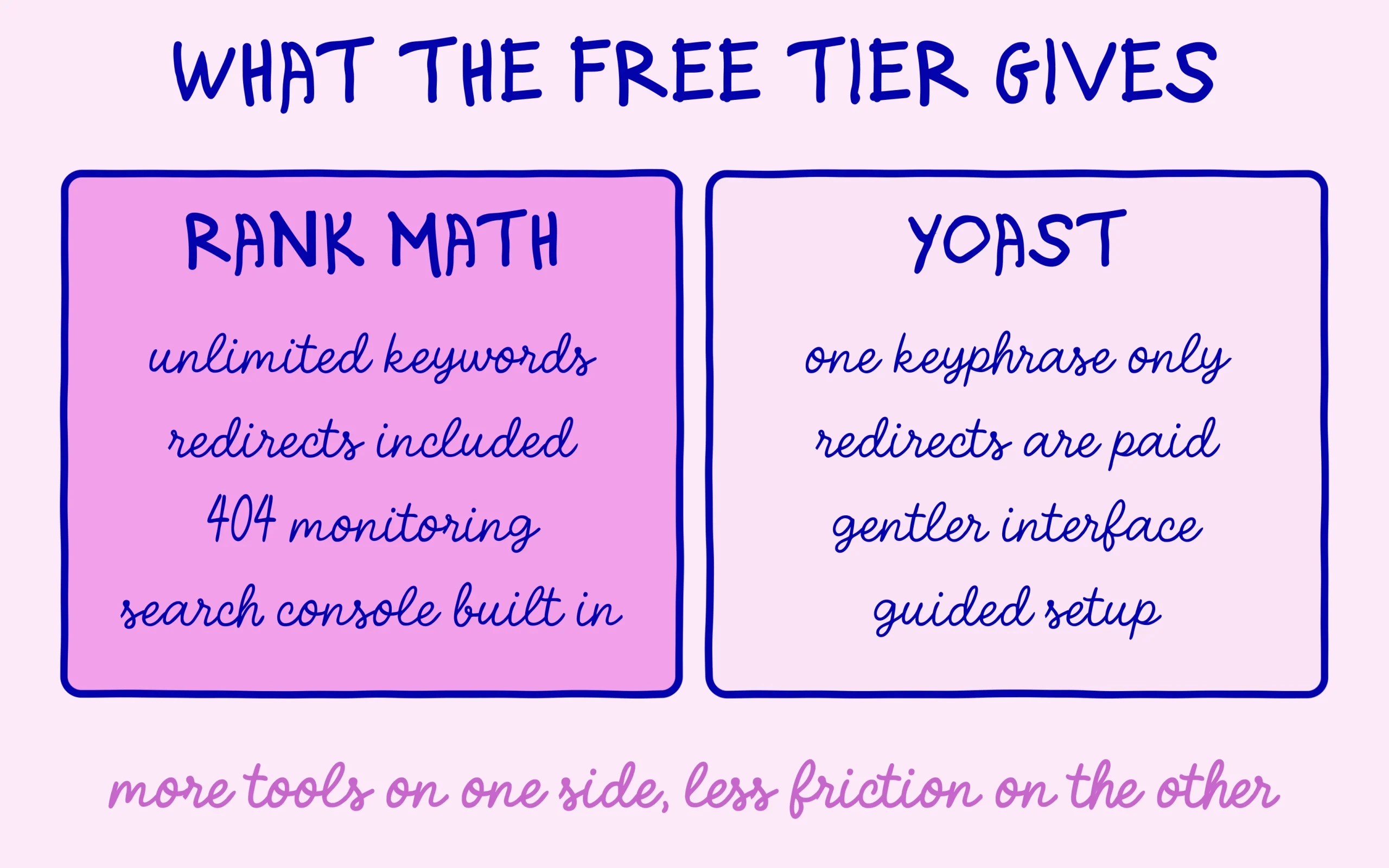
This is where the gap opens widest, and plenty of beginners find out too late. The free build of Rank Math in its free version hands you unlimited keyword optimisation per piece of content, a full redirection manager, a 404 monitor, Google Search Console piped straight into WordPress, eighteen structured data types and an XML sitemap. On paper and in daily use alike, that is a lot to hand over for nothing.
Free Yoast, by contrast, holds you to a single keyphrase per article. That sounds harmless while you are drafting your first post, and it turns awkward the moment a piece targets two or three closely related phrasings. Redirects are not in the free tier either. In practice, changing a page address leaves you three options: upgrade, install a second redirection plugin, or walk away and leave a broken link behind you. The full split is documented on the official page comparing the free and Premium builds of Yoast.
That redirect point deserves a proper pause, because most people file it under “big site problem”. Everyone hits it eventually. You rename a category, you merge two posts that were competing with each other, you fix a slug you typed in a hurry. Each time, an address dies and someone needs sending elsewhere. A beginner creates more redirects than an established site, simply because the structure is still moving around underneath them.
Everywhere else, the free versions genuinely match each other. You get your title tag, your meta description, your Google result preview, your sitemap, your noindex controls and your social sharing settings. Neither one will stop you shipping a clean article. And if your current headache is simply getting pages indexed, the plugin matters far less than the routine laid out in our walkthrough on building an XML sitemap on WordPress.

Rank Math vs Yoast when you have never touched an SEO setting
On first contact, the advantage flips. simplicity is a feature in its own right when you are starting out. Yoast built its name on an interface that intimidates nobody. The green, orange and red traffic light gives instant feedback, the explanations are written for someone discovering all this, and the setup wizard asks very little of you. Install, follow along, publish. There is real comfort in that when fifteen other parts of your site still confuse you.
Rank Math asks more of you up front. Its wizard offers an easy mode that limits the damage, yet the whole thing stays denser: more modules to switch on or off, more structured data options, more screens to get lost in. On the sites I run day to day, that extra setup time pays for itself quickly. For someone building a first blog on a Sunday afternoon, it can be exactly what makes them give up.
One shared trait is worth saying bluntly, since it applies to both. The score the plugin shows you is not a grade handed down by Google. It is an in-house checklist, useful for catching omissions, completely blind to whether your writing is any good. I have watched pages sitting at 100 out of 100 go nowhere for a year, and pages stuck at 62 perform steadily. Google weighs a far wider set of signals, as we broke down in our plain English explanation of how Google algorithms work.
Then there is the weight argument, endlessly repeated in comparisons and rarely measured properly. Both plugins add database queries and extra work inside the WordPress admin. On entry-level shared hosting you will feel it in your dashboard long before any visitor notices anything on the public side. This should not be the criterion that decides your choice today.
What the paid tiers really cost over time
The two licences tell fairly different commercial stories, and the structure matters more than the sticker. Yoast Premium is sold per site or domain, billed yearly. Rank Math PRO is billed monthly on an annual commitment, renews at a higher monthly rate once the first term ends, and covers unlimited personal sites on that one subscription. On a single site the gap is already visible. Across three sites it becomes hard to argue with. Both vendors display prices in your local currency, so check the figure on their own pricing page rather than trusting a number quoted in a review.
You are also buying different things. Yoast Premium unlocks five keyphrases per piece, redirect management, internal linking suggestions with orphaned content detection, support, and several side extensions. Rank Math PRO mostly adds tracking: rank positions across five hundred keywords, deeper analytics integration, an advanced image module, daily data pulls from Google. The foundational pieces were already sitting in the free tier.
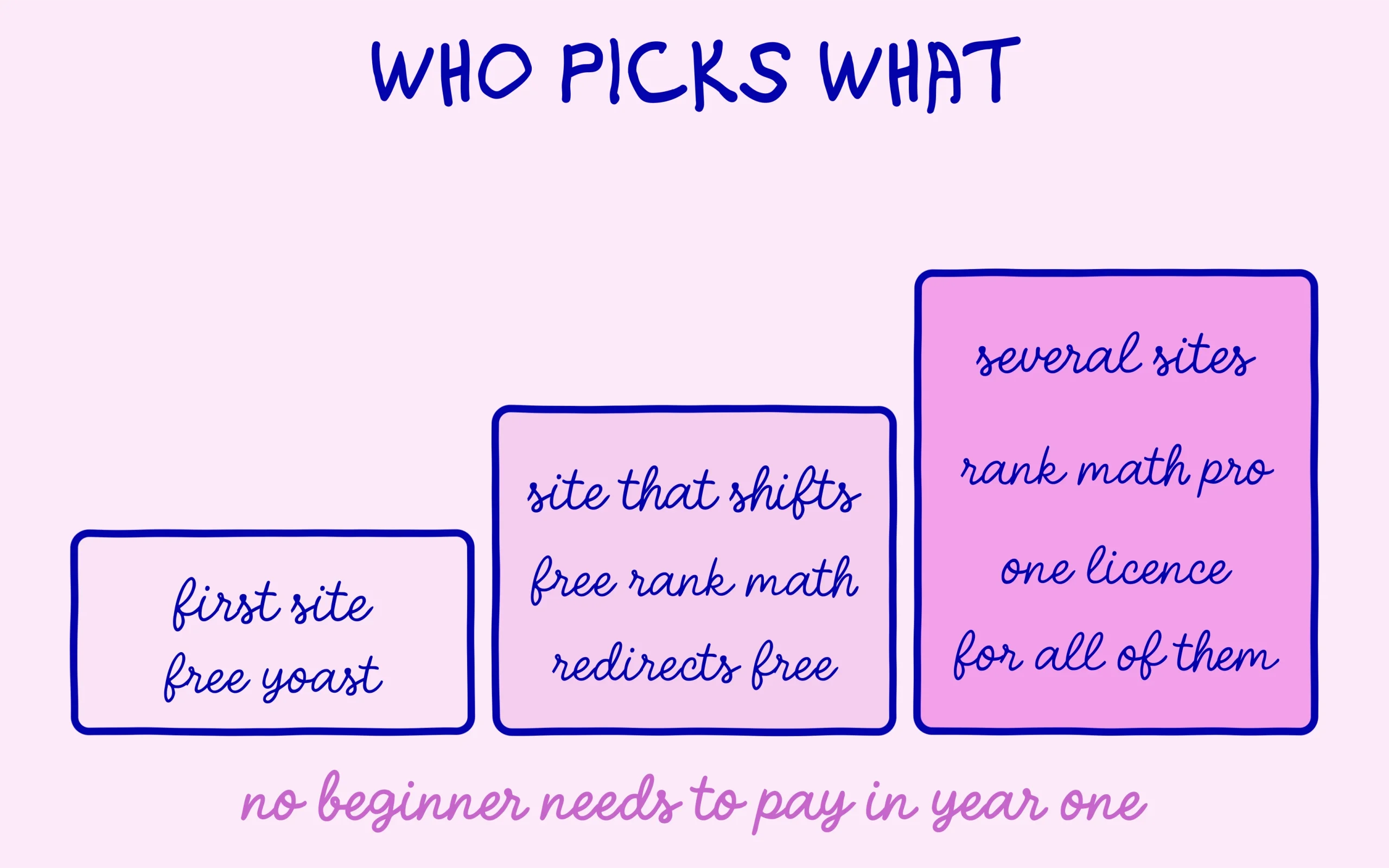
My view here is simple and slightly deflating. No beginner needs a paid tier in year one, whichever plugin they land on. Rank tracking does nothing for you until you hold rankings worth tracking, and internal linking suggestions only earn their keep past thirty or so published articles. That money does more good in decent hosting or in writing time.
One caveat for anyone running sites on behalf of clients. Multi-site licensing rewrites the whole calculation, and that is where Rank Math becomes genuinely hard to beat on price per feature. A freelancer holding eight sites is weighing one licence against eight. At that point the debate has drifted quite far from SEO itself.
The call I would make in your position
Starting your very first site and slightly anxious about anything technical? Take free Yoast and stop thinking about it. The interface will hold your hand, you will publish without second-guessing every field, and you will spend your energy on what actually counts at this stage, which is writing useful pages on a regular basis. Migrating later stays easy, since both plugins import each other’s settings.
Anyone who has already tinkered a little, or who knows their site will shift around over the coming months, should lean the Rank Math vs Yoast call towards Rank Math. You pick up redirects and 404 tracking for free, and you will need both sooner than you expect. Those same settings prevent the kind of quiet disaster described in our piece on the bad canonical tag that hides your pages.
Running an online store or a multilingual site? Check compatibility with your other extensions before you settle the plugin question. A clash between your translation layer and your sitemap generator will cost you far more lost evenings than any feature difference between these two. Test on a copy, never live.
A closing word to defuse the fear of choosing wrong, because it paralyses more people than it protects. this setting takes half an hour to change, and it will never weigh as much as how often you publish. Neither plugin will rank for you, neither will penalise you. Pick whichever interface does not put you off and get back to writing.

Keep learning on SEO Noobies.
This article contains affiliate links: if you subscribe through one of them, SEO Noobies earns a commission at no extra cost to you.



[…] changes. That is why an SEO plugin choice deserves proper thought rather than a quick pick, and why comparing the free tiers of Rank Math and Yoast still earns its […]