
Chapter 8 of the Learn SEO Step by Step course. The previous chapter laid down the raw material: a keyword is a real phrase, typed or spoken by someone with a need, and its value depends on what that person is trying to get done. This chapter gives you the grid for sorting those phrases, search intent, split into four broad families: informational, commercial, transactional and navigational. It is the idea that explains why a beautifully written page can stay invisible simply because it answers a different question from the one the search engine expects. By the end, you will be able to read the search intent behind a query in a few seconds and pick the right kind of page to answer it.
TL;DR
Search intent is what a person wants to get done when they type a query, and Google works it out before choosing which results to show.
Four families cover most queries: learning, comparing, acting or buying, and reaching one specific site.
The results page Google shows for a query reveals the intent it detected, which makes it your best free diagnostic tool.
A page that answers beside the dominant intent struggles to rank, however well it is written.
Get an AI summary of this article
Contents
What Google Means by Search Intent
Informational Intent, When People Want to Understand
Commercial Intent, When People Compare Before Choosing
Transactional Intent, When People Are Ready to Act
Navigational Intent, When People Want One Specific Site
What Google Means by Search Intent
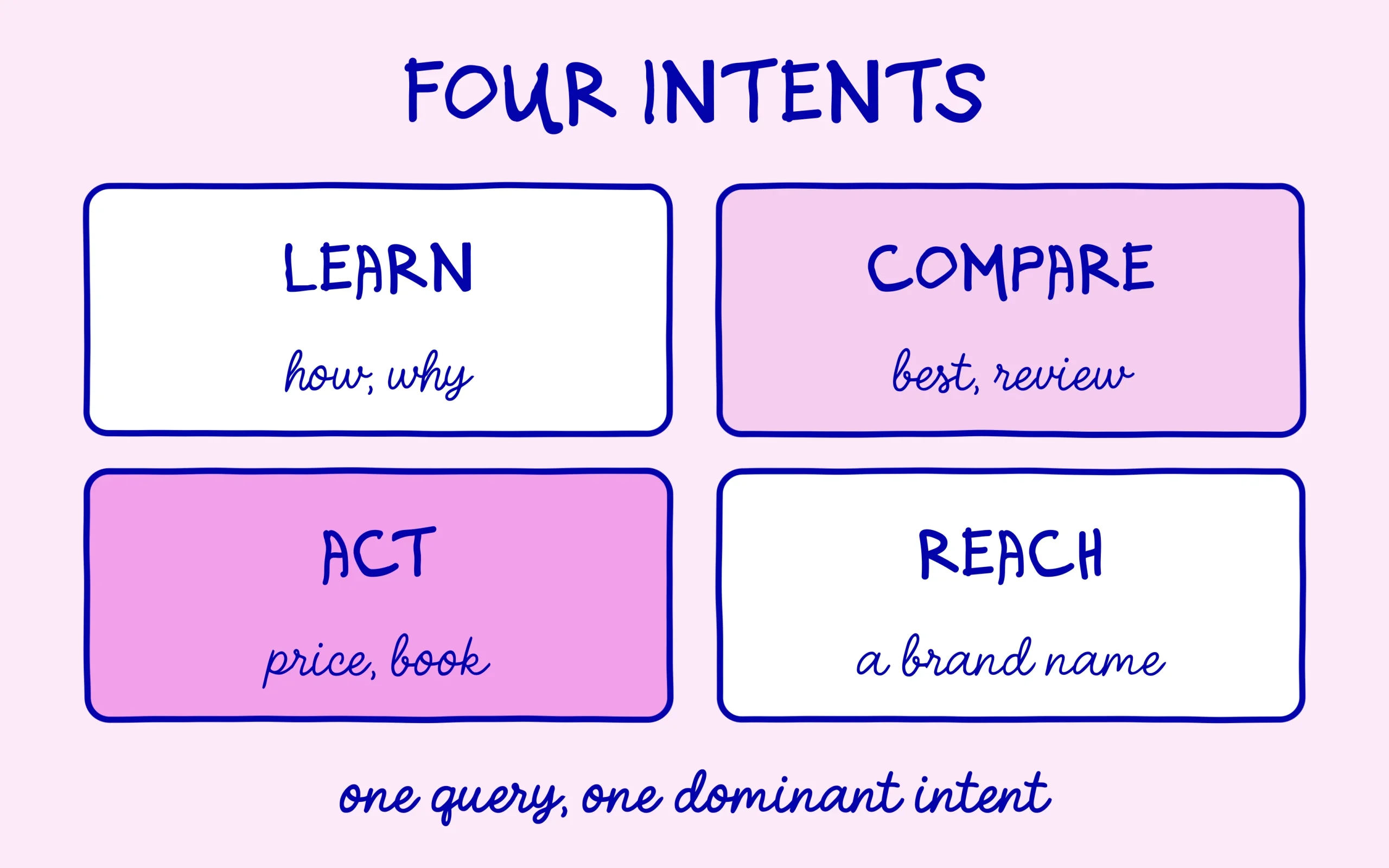
Search intent is the goal hiding behind a query. Two people can type almost the same words and want two very different things: one wants to understand, the other wants to buy. Google puts it in its own words on its page about how it ranks results: to return relevant results, it first needs to establish what you are looking for, meaning the intent behind your query.
That same page gives a telling example. When a query contains words like “cook” or “pictures”, Google’s systems infer that recipes or images are probably the best match for the intent. In other words, a single extra word changes the kind of page people expect, and therefore the kind of page that stands a chance on the first page of results.
Google also publishes a more technical document, the guidelines written for its search quality raters. Those raters are people who manually score results pages to help Google improve its systems, and their guidelines sort queries into four categories: Know for finding information, Do for getting something done, Website for reaching a particular site, and Visit-in-person for finding a place nearby.
The SEO industry uses an older and far more widespread grid, the one you will meet in every tool and every course: informational, commercial, transactional and navigational. The two systems overlap a lot. Informational search intent sits close to Know, transactional to Do, navigational to Website. Commercial intent lives in the space between the first two, the person researching ahead of a purchase, while Visit-in-person matches what most people call local search.
A query almost always carries one dominant intent, sometimes two. “Best robot vacuum” blends looking for information with getting ready to buy. The job is to spot the search intent that dominates, build the page that serves it best, and cover the secondary intent afterwards. This habit extends what the previous chapter said about what makes a keyword valuable, which has more to do with intent than with volume.
Discover the SEO Noobies agency
Informational Intent, When People Want to Understand
This is the most common search intent. The person wants to learn, understand, check a fact or fix a problem on their own. The wording usually gives it away: “how”, “why”, “what is”, “definition”, “tutorial”, “example”. A query like “why isn’t my site showing up on Google” has an informational search intent, even if that person may end up buying a service later on.
For this search intent, the expected page is one that explains: a guide, an in-depth article, a step-by-step tutorial, an FAQ page. A sales page aimed at an informational query almost always hits a wall, because the person did not come to buy and Google knows it. On the other hand, an excellent guide can bring in thousands of readers who discover your brand at the exact moment they are trying to make sense of their problem.
One important caveat for a course written in 2026: this is also the family most exposed to AI-generated answers. Short definition queries often get answered directly in the summary shown at the top of the results page, as explained in our guide to AI Overviews. A simple informational query gets absorbed by the AI summary, while a question that calls for a detailed method, a concrete example or real expertise keeps all its value for a website.
The right reflex is to aim for informational questions that cannot be answered in three lines. “What is a sitemap” will be summed up in two sentences. “Why does Google ignore the pages in my sitemap” needs a real diagnosis, and that is exactly the kind of query where a well-built article keeps attracting visits and getting cited as a source.
Commercial Intent, When People Compare Before Choosing
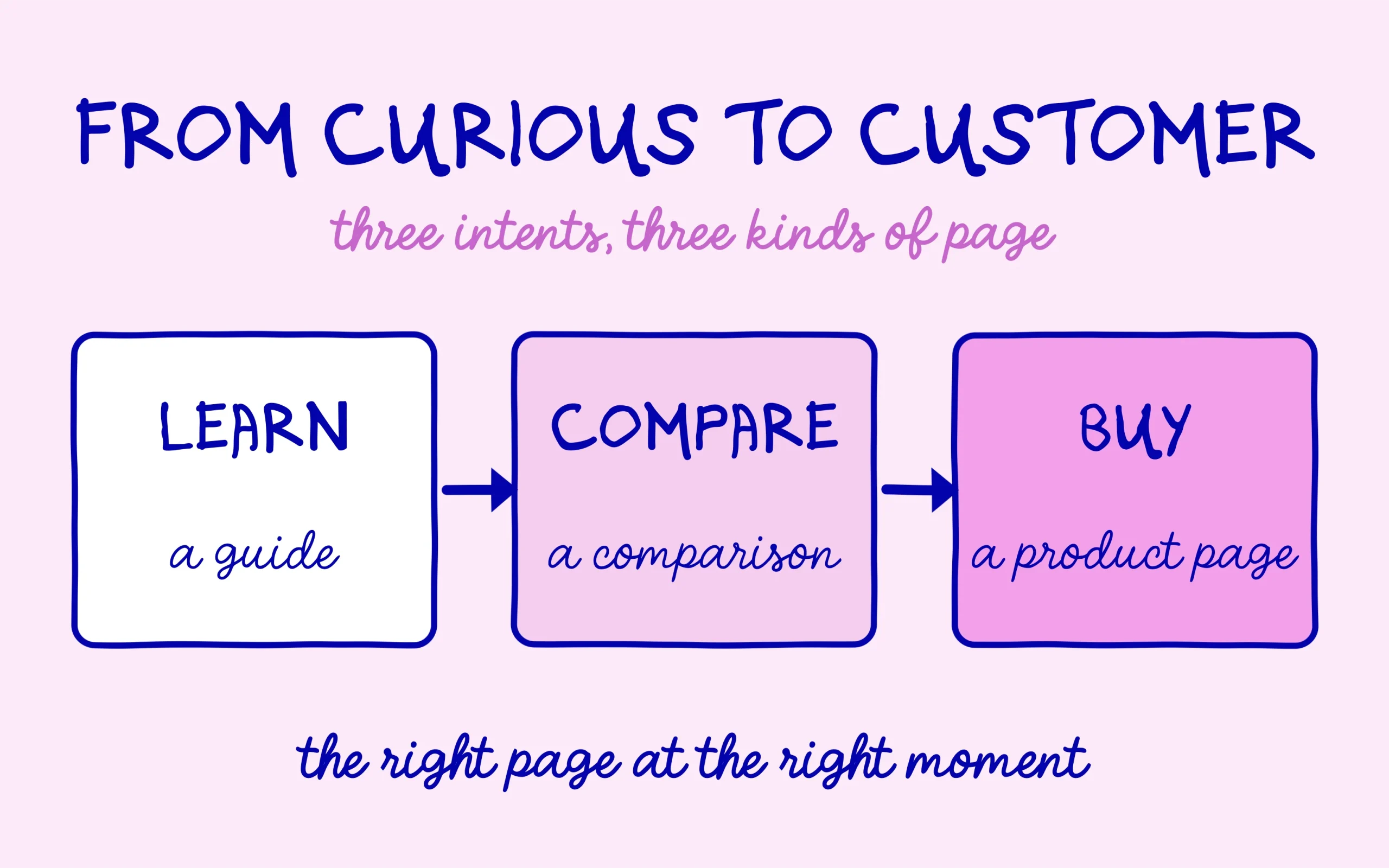
Commercial search intent describes someone who knows they are going to buy and is still weighing both the product and the seller. They compare, read reviews, look for the best value. Typical markers are “best”, “comparison”, “review”, “versus”, “alternative to”, “top”. “Best invoicing software for freelancers” is close to a textbook commercial query.
The pages that win on this search intent are comparisons, detailed tests, well-argued lists and review pages. A single brand’s product page rarely ranks for these queries, because the person specifically wants to see several options side by side. If you sell a product, this family asks for a certain honesty: a comparison that only shows your own offer misses what the reader came for.
It is often the most profitable family for a young site, for a simple reason. The reader is close to a decision, so each visit is worth more than an informational one, and competition on very precise phrasings stays within reach. A precise commercial query beats a broad, crowded one. “Best invoicing software” is held by big players, “invoicing software for a sole trader who bills clients abroad” much less so.
Transactional Intent, When People Are Ready to Act
With a transactional search intent, the person has made up their mind, or nearly, and wants to act now: buy, book, sign up, download, ask for a quote, make an appointment. The wording carries action verbs and concrete details: “buy”, “price”, “quote”, “book”, “order”, “delivery”, “discount code”, a precise model name or a city. “Book plumber Manchester Saturday morning” leaves no doubt about the search intent.
For this search intent, the expected pages let people act straight away: a product page with the price and a buy button, a service page with a visible contact form, a booking page. A long explanatory article that makes the visitor hunt for the button at the bottom of two thousand words misses this intent, even with all the right words in it. For a local business, transactional intent very often comes with a location, and the company’s Business Profile on Google becomes as important as the website itself.
These queries hold up much better against generative AI than definition questions do. A summary can describe a plumber, and the leak still needs someone at the door. Transactional intent is served by a page that lets people act in one click. Visible price, clear availability, an obvious way to get in touch: on these pages, the clarity of the next step counts for more than the length of the text.
Discover the SEO Noobies agency
Navigational Intent, When People Want One Specific Site
The last search intent belongs to people who already know where they are going. They type the name of a brand, a site or a service to get there without typing the address: “Amazon”, “Search Console login”, “IKEA opening hours”. Navigational search intent matches the Website category in Google’s guidelines, and it leaves almost no room for any site other than the one being looked for.
Targeting another brand’s navigational search intent is therefore almost always wasted effort. Your own name, however, deserves your full attention: someone typing your company name already knows you and is very likely to become a customer. If your site does not come first for its own name, fix that before anything else, as it usually points to an indexing problem or a name too close to someone else’s.
This family is changing too. On searches for a company name, Google now shows its AI summary further down the page more and more often, as covered in our piece on branded search and Google’s AI Overviews. The first result stays your website if all is well, yet what the web says about you now matters for the visitor who keeps scrolling.
Reading Intent Straight From the Results Page
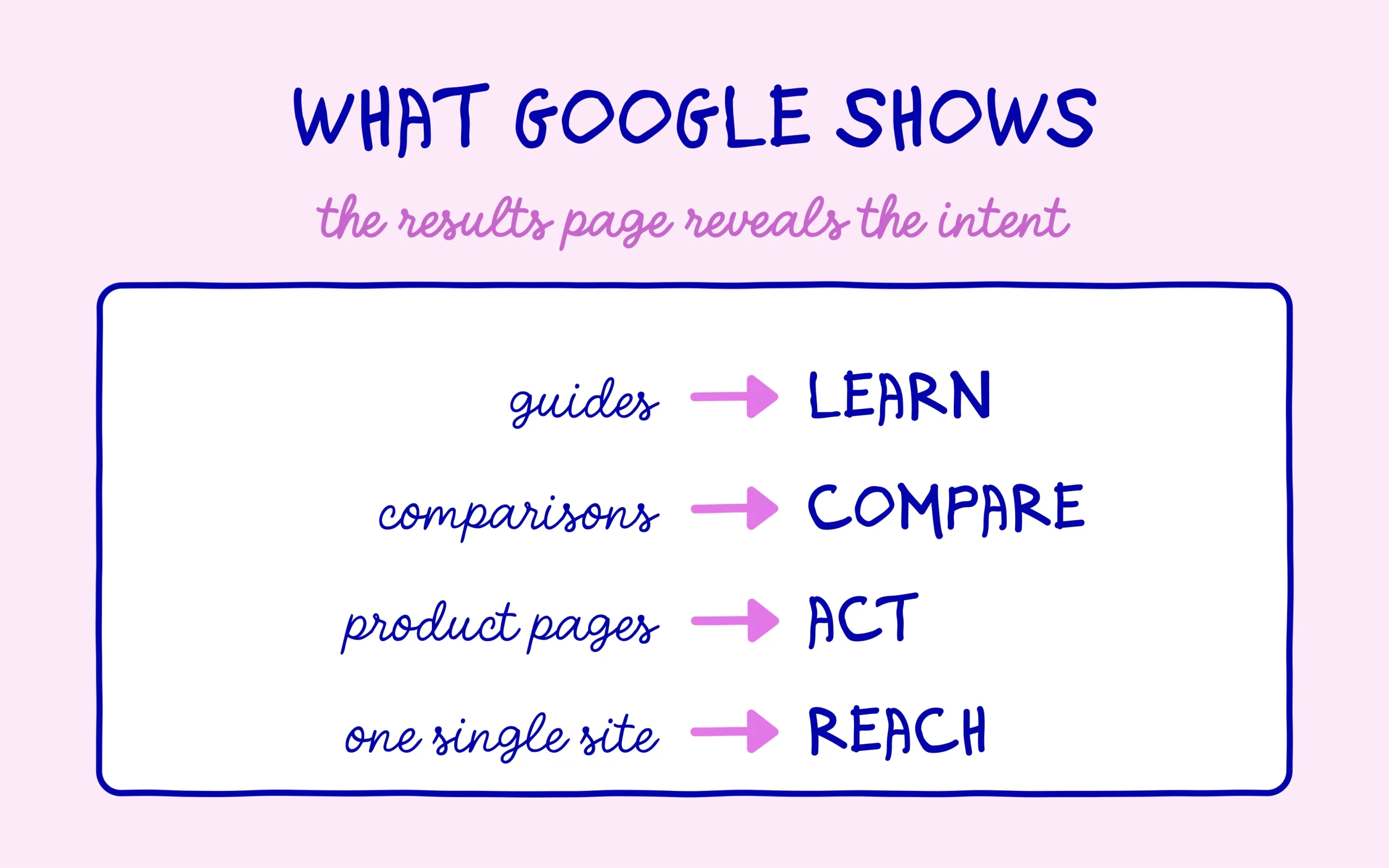
Spotting the search intent of a query takes no paid tool at all, because Google shows it to you. Type the query in a private window and simply look at what fills the first page. The chapter on reading a Google results page walked through the different blocks, and each one signals a different search intent, which makes the reading quick once you know the codes.
Articles and guides with a block of related questions point to informational intent. Comparisons, “best of” lists and review sites point to commercial intent. Product pages, sponsored ads and Shopping results point to transactional intent. A single site holding the top of the page with its sitelinks points to navigational intent, and a map with three businesses points to local search.
The rule that follows is simple: build the kind of page Google already shows for the query. If the top ten results are comparisons, a sales page will struggle to find a spot, however well written. If they are product pages, a blog post will be off target. The exercise takes two minutes per query and saves weeks of work on a page that was doomed from the start.
Sometimes the first page mixes several kinds of results: a few guides, two comparisons, one product page. That mix is information in itself, because it means people typing this query have different search intents and Google has not settled on one. On these open queries, the format at the top of the page shows the dominant tendency, and a page that covers that majority intent properly while briefly answering the second one has a fair chance. Watch for an AI summary at the top as well: when it is there, the purely informative part of the query is already served, and your page gains by bringing what the summary cannot.
For a site that already exists, Search Console completes the picture. The performance report lists the queries your pages actually show up for, and it is common to find a service page appearing on informational queries, or the reverse. Chapter 6 explains how to get started with this free tool. Spotting those mismatches tells you whether to adjust the existing page or create a second one built for the other intent.
One last practical tip for your keyword list. Add a “search intent” column next to each phrase, fill it in after looking at the results page, then group the phrases that share the same intent and the same topic. Each group becomes one page to create or improve. That is how a plain list of phrases turns into a coherent content plan, where every page has a reason to exist.
Where We Go in the Next Chapter
This chapter gave you the reading grid that was missing. You now know that a query carries one dominant search intent, that this intent belongs to one of four broad families, and that the results page itself tells you which type of content Google expects. That grid is what turns a list of phrases into content decisions.
Chapter 9 moves to practice with keyword research on zero budget: the free tools available, the method to turn them into a real working list, and how to apply the search intent grid you just learned. Until then, take five phrases from your list, search them one by one and write down the intent each results page reveals: the exercise will prepare you better than any reading.
Check You Can Read Search Intent
What are the four main families of search intent?
Show answer
Informational (understanding), commercial (comparing before choosing), transactional (acting or buying) and navigational (reaching a specific site). Google’s search quality rater guidelines use a close grid: Know, Do, Website and Visit-in-person.
What kind of page fits a query like “best invoicing software for freelancers”?
Show answer
A page that compares several options: a comparison, a detailed test, a well-argued list. A single brand’s product page rarely ranks for this kind of commercial query.
How can you identify the intent of a query without a paid tool?
Show answer
Search it in a private window and look at what fills the first page: guides, comparisons, product pages, one single site or a local map. The type of page shown reveals the intent Google detected.
Which intent family is most exposed to AI-generated summaries?
Show answer
Simple informational intent, such as a short definition, often answered directly by the summary at the top of the results. Questions that call for a detailed method or real expertise keep their value.
Sources Behind This Chapter on Intent
Keep learning on SEO Noobies.