
How long is the real indexing delay on Google, from the moment a page goes live to the moment it actually shows up in results? Anyone who just published their first article and keeps refreshing Search Console hoping the indexed-pages counter will move has asked this question. At the Search Central Live Deep Dive Europe event, held in Barcelona on October 2, 2026, Google analyst Gary Illyes laid out a full table of real timeframes, from the discovery of a new page all the way to full recovery after a major algorithm update. Here is what Google now admits about its own delays, and why they stack on top of each other instead of cancelling out.
TL;DR
At Search Central Live Deep Dive Europe in Barcelona, Gary Illyes gave precise ranges for every stage of the indexing delay.
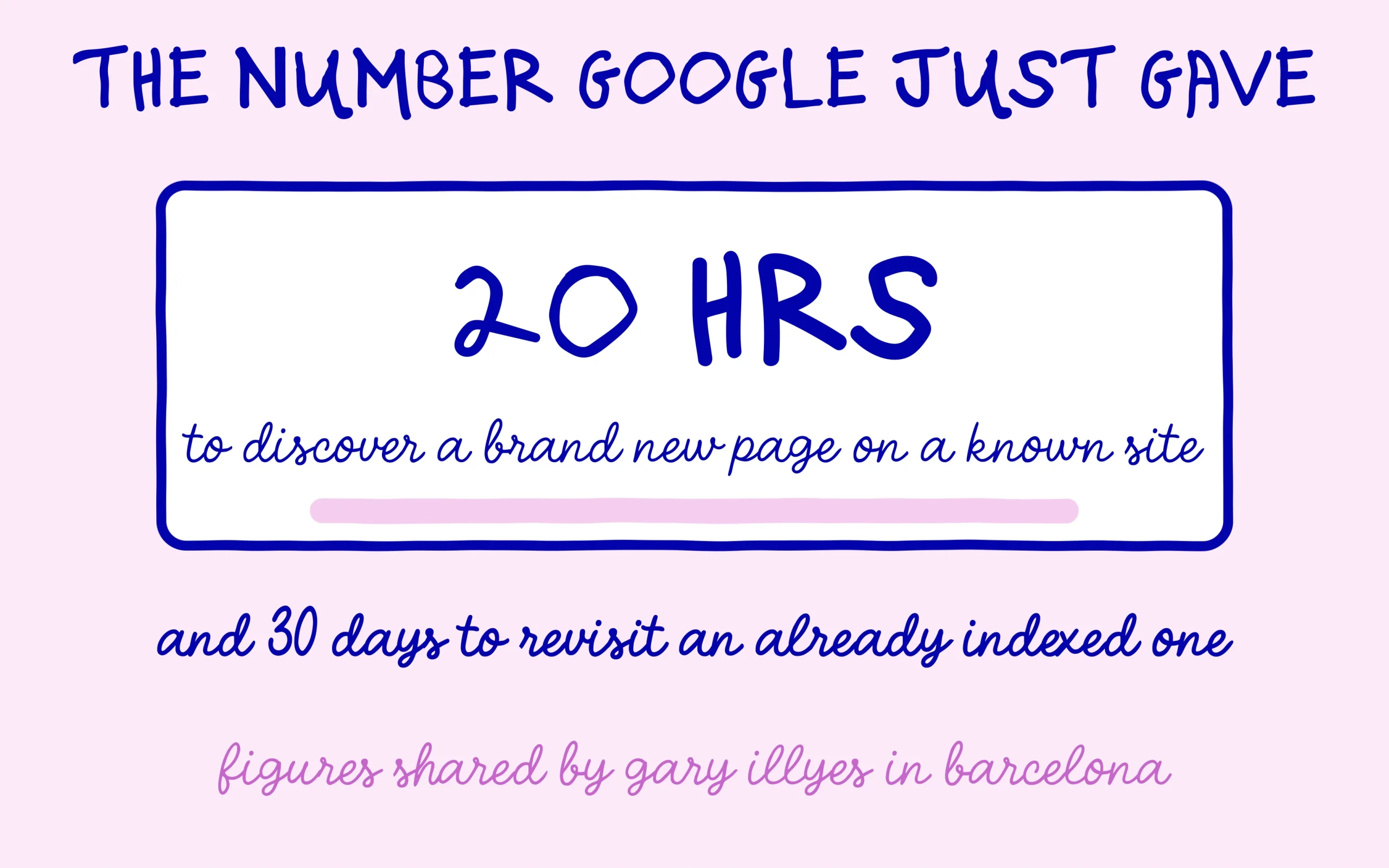
A brand new page on an already established site is typically discovered in about 20 hours, while an already-known URL only gets revisited after roughly 30 days.
Delays at each stage stack up: a domain name change typically takes 1 to 3 months, and up to a year or more in the longest cases.
The useful move today: open the URL Inspection report in Search Console and check the last crawl date on your own page.
Get an AI summary of this article
The indexing delay Google just put real numbers on
The event took place in Barcelona on October 2, 2026, as part of Google’s Search Central Live Deep Dive Europe. Gary Illyes, an analyst on Google’s Search team, presented a table splitting the indexing delay into three phases: crawling, indexing itself, and what Google calls serving, meaning the page’s actual appearance in results. No official recording of the talk was available at the time of writing, so the figures below come from the detailed recap written by John Campbell, a consultant at the agency ROAST, who was in the room that day.
On crawling, Illyes places discovery of a new page on a site Google already knows at roughly 20 hours, against about 30 days for an already-indexed URL to simply get revisited. Sitemap processing takes around 24 hours. On the indexing side, the full delay, from crawl to appearing in the index, typically runs about an hour and a half.
Changes made to a site that is already live follow a different scale. A canonical tag change takes 1 to 3 weeks to ripple through, a new page title 1 to 2 days. A full site move, whether a domain name change or a platform migration, takes 1 to 3 months in a typical case, and from 6 months to over a year in the longest cases. The same logic applies to recovery after a major algorithm update: 3 to 6 months in the general case, up to a year in the worst one. Illyes also flagged removing a page from results, which takes about 2 hours.
For a beginner, the value of this table comes from its source. Most indexing delay ranges floating around online come from blogs and forums with no stated method, while these were presented by a Google employee to a room of professionals. They are typical values and maximums, to be read as orders of magnitude, never as a commitment from Google about any given site.
Why these delays stack instead of cancelling out
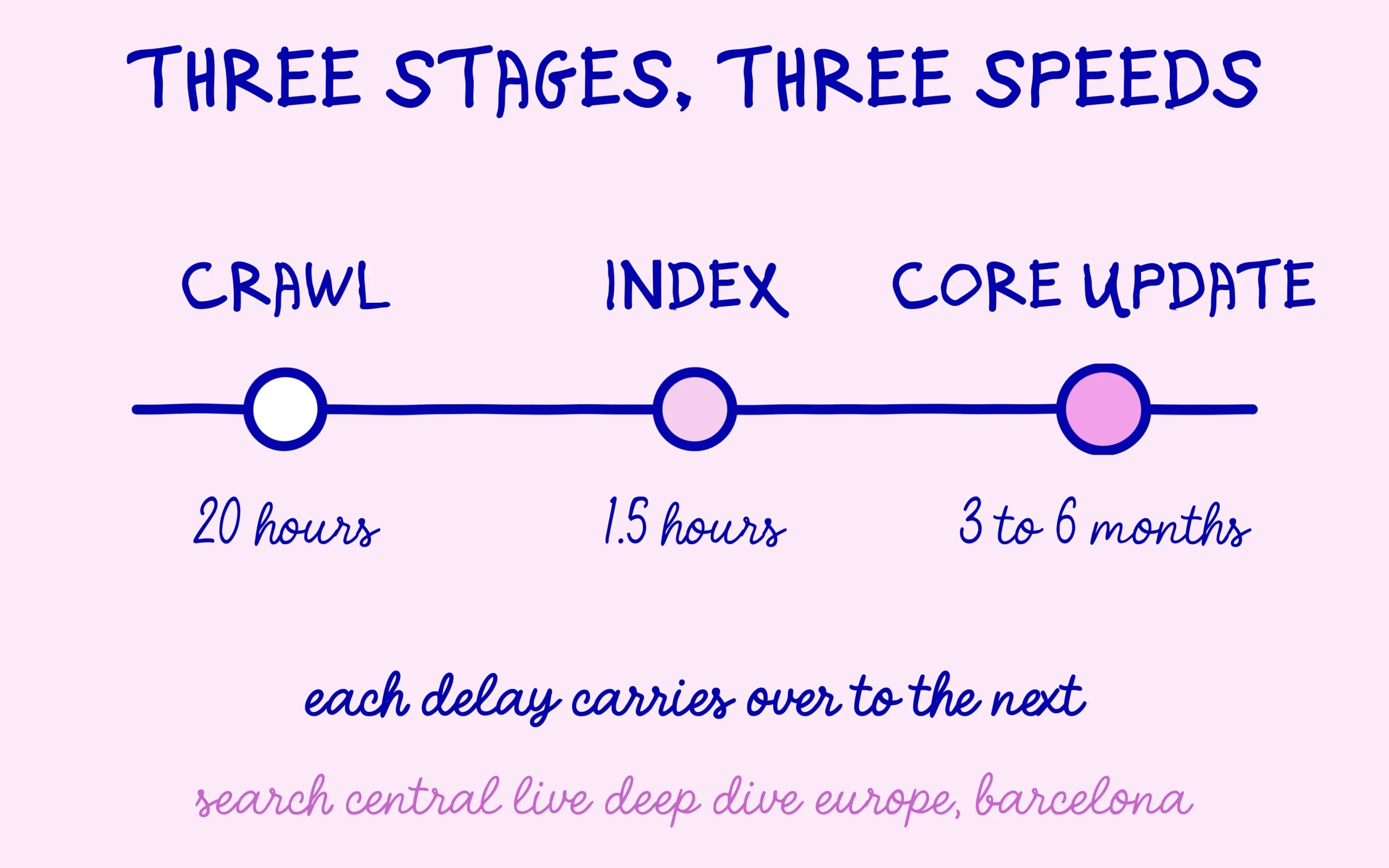
The most concrete point of the talk comes down to one idea: delays from earlier stages carry over to the stages that follow. A page that takes longer than expected to get crawled mechanically delays its own indexing, which in turn delays its appearance in results. A brand new site that stacks up several of these delays can end up with a total range far wider than the sum of the averages listed above.
That is exactly what explains why a site that just launched can look invisible for weeks without a single error on its end. The course chapter on what indexing really means, and why Google sometimes refuses your pages walks through the most common causes of a delay, on top of this simple stacking effect.
Hypothesis, not officially confirmed by Google: if generative engines lean in part on the same index as classic search, a page that takes weeks to get indexed likely takes just as long to become visible to ChatGPT or Perplexity. Nothing in the Barcelona talk confirms that link directly, but the stacking logic Illyes described holds regardless of which engine queries the index afterward.
Discover the SEO Noobies agency

What to check in Search Console while you wait
The most useful habit is still the URL Inspection tool in Search Console. It shows the last crawl date for the page, its indexing status, and the exact reason if Google set it aside. Comparing that date to the publish date gives a concrete read on the real indexing delay, far more reliable than a gut feeling.
Before worrying, it is worth checking that the site’s XML sitemap is actually registered in Search Console: the table shown in Barcelona puts its processing at about 24 hours, which makes it a simple way to flag a new page to Google. The course chapter on Google Search Console, the free tool you must master explains how to submit it and read the reports that matter.
Staying within the ranges Illyes gave is not a red flag. A page that shows up within hours on an already active site, or over several weeks on a brand new one, matches exactly what Google just confirmed in public. The real signal to watch for is different: an indexing delay that runs well past these ranges, despite an up-to-date sitemap and a crawl that already happened, is what actually deserves a closer look.
One last habit worth building: log the date of each check in a simple table, even a plain text file. Comparing three or four readings spread a few weeks apart gives a far more accurate picture of a site’s real indexing speed than any estimate found online, and makes an unusual slowdown easy to spot right away.

Keep learning on SEO Noobies.