
The ranking of AI Overviews sources has been making the rounds all summer, and at first glance it is discouraging for anyone running a small site: YouTube, Reddit, Facebook and a handful of other giants own the entire top of the table. The good part is that the table holds a far more useful lesson than its podium, as long as you start reading at row ten. The 41 domains sitting below the giants have none of their audience and none of their history, yet Google’s summaries cite them every day, across tens of thousands of pages. This article walks through the Ahrefs study behind the ranking, sorts those 41 sites into families, isolates what they actually have in common, and turns it into three projects any normal site can run. No paid tool is required for any of it.
TL;DR
Ahrefs tracked every domain cited by Google’s AI Overviews across more than 3 million US queries, covering all topics.
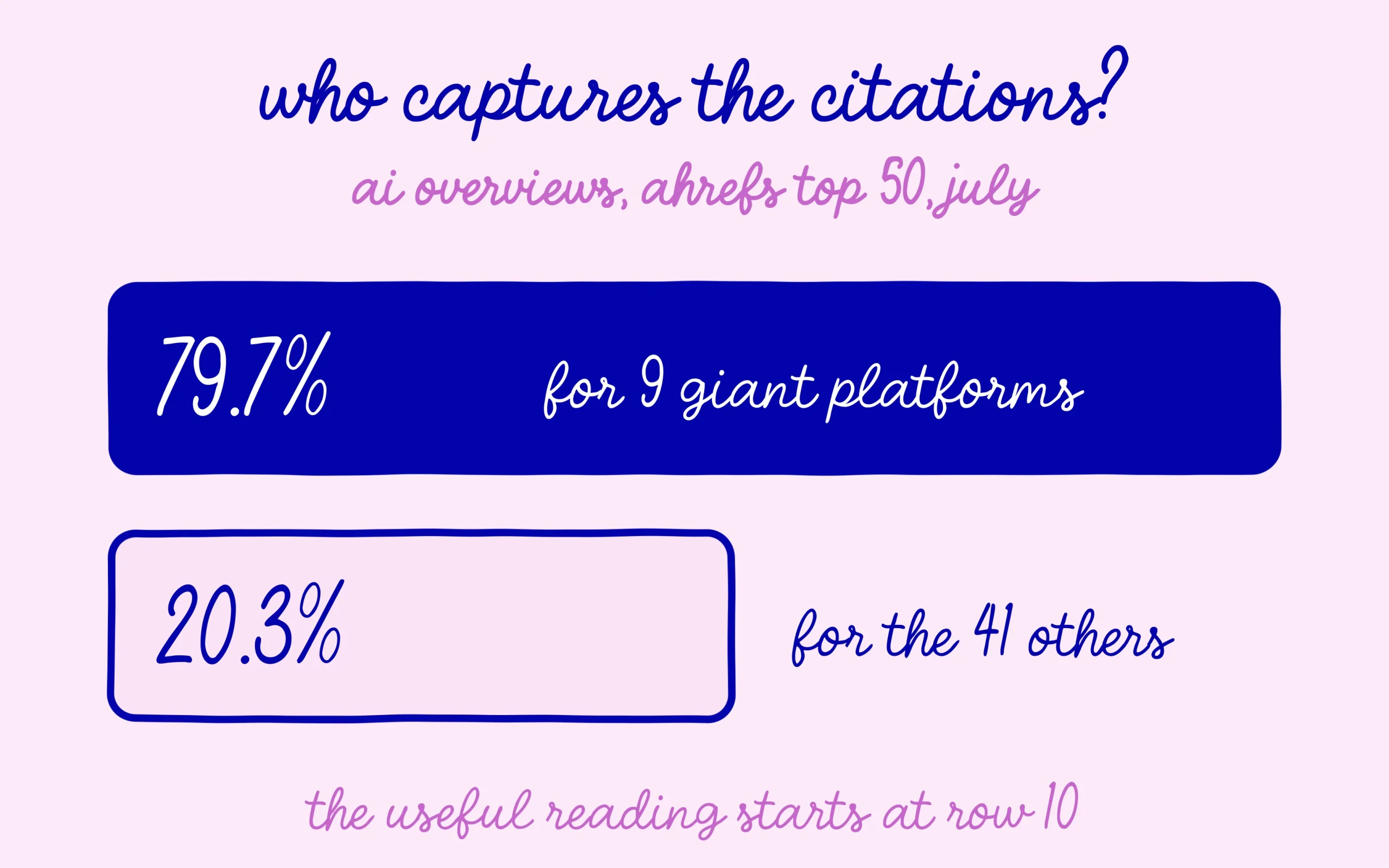
Nine platforms capture 79.7% of the top-50 citations on their own, with YouTube alone at 21.1%.
The remaining 41 domains fall into six families that all publish the same thing: verifiable data, prices, ratings, thresholds, definitions.
The GEO takeaway: structure your pages as extractable data, on one narrow vertical, backed by sourced proof.
Summarize This Article with AI
ChatGPTA mention share computed across three million queries
The numbers come from Brand Radar, the Ahrefs tool that records what AI platforms answer on real search queries. For this ranking, every domain cited as a source by Google’s AI Overviews was logged across more than 3 million US queries spanning all topics, then ranked by how often it shows up. The study is maintained by Si Quan Ong, SEO and marketing educator at Ahrefs, and refreshed automatically every month, so the table always reflects the latest snapshot. Every figure quoted below comes from the July 2026 edition, United States queries, all topics. The full list, with each domain’s share and its month-over-month movement, sits in the Ahrefs ranking of the most-cited websites in Google AI Overviews.
Before reading any row, spend a minute on the metric itself, because it shapes the whole interpretation. Mention share expresses a domain’s citations as a percentage of the summed citations of the 50 most-referenced sources. It measures a slice of the top-50 attention pie, never a slice of the entire web, so a site missing from the table may still get cited now and then, just less often than the site in fiftieth place. That framing also means the shares are relative to each other: when one platform surges, everyone else’s slice mechanically shrinks, even with stable citation volumes. Each row also carries the number of distinct pages cited and the Domain Rating, the Ahrefs score grading a backlink profile from 0 to 100. Crossing those columns is where it gets interesting: Healthline earns 0.8% of citations from barely more than 10,000 cited pages, one of the best per-page returns in the whole table.
Nothing about the top of the table will surprise you. YouTube captures 21.1% of citations with more than 1.7 million pages referenced, Reddit follows at 18.5%, Facebook at 10.7%. Then come Google itself at 7.1%, Instagram at 5.8%, Quora at 5.0%, Wikipedia at 4.8%, Amazon at 3.5% and TikTok at 3.2%. Add up the published shares and nine platforms concentrate 79.7% of all measured citations. That weight of community platforms matches what we found in our article on how heavily AI tools cite Reddit and Wikipedia. And the audience at stake is real: Google says AI Overviews reach more than 2 billion monthly users across more than 200 countries.
The 41 AI Overviews sources left once the giants are gone
One thing to watch before copying anyone: the top 9 teaches you nothing you can use. Those nine domains are web infrastructure, four social networks, a video platform, a global forum, an encyclopedia, a marketplace and the search engine itself. Their massive presence describes the architecture of the internet, never an SEO or GEO playbook a brand could replicate. Nobody becomes YouTube by improving their markup. The useful question sits one level down: what earns citations in this ranking without being a historical giant? Quora deserves a side note before moving on: a questions-and-answers site sitting at 5.0% says a lot about how much generative engines value short, direct answers to precise questions.
Rows 10 to 50 tell a much better story. Structured-catalog e-commerce comes first: Walmart opens the second half of the table at 1.0%, followed by eBay, Home Depot, Target, Best Buy, Lowe’s and Etsy. Millions of standardized product pages, with price, availability and specs sitting in the same spot on every page. Right behind them sit the car-shopping sites, Edmunds, Kelley Blue Book, Cars.com and CarGurus, which publish valuations and price benchmarks updated continuously on one single topic.
Review aggregators form the third family: TripAdvisor, Trustpilot, Yelp, Angi and Consumer Reports. Trustpilot climbed eleven spots in a single month, the biggest jump in the table, with Yelp right behind at nine spots gained. The fourth family is editorially validated health content: Healthline, WebMD, GoodRx and PubMed Central, medically reviewed pages with explicit dosages, thresholds and warnings. Business and finance media follow, Forbes, Business Insider, the New York Times, CNBC, Yahoo Finance and NerdWallet, and the list closes with pure reference: Merriam-Webster, Collins Dictionary and wikiHow.
Keep the orders of magnitude honest: none of these 41 domains exceeds 1% of mention share. Seen from the top 9, that is a rounding error. Seen from a normal site, it is enormous: Walmart gets cited across 58,671 distinct pages, TripAdvisor across more than 43,000. A 0.4% share in this table still means tens of thousands of citations captured against the entire web. And the bottom half stays genuinely open: ZipRecruiter, Etsy and Serious Eats all entered the top 50 as newcomers in the July snapshot, which shows the list of AI Overviews sources gets reshuffled every single month below the giants. How the summary box itself works, and what it changes for a young site, is covered in our full guide to AI Overviews.
Extractable data: the pattern running through all six families
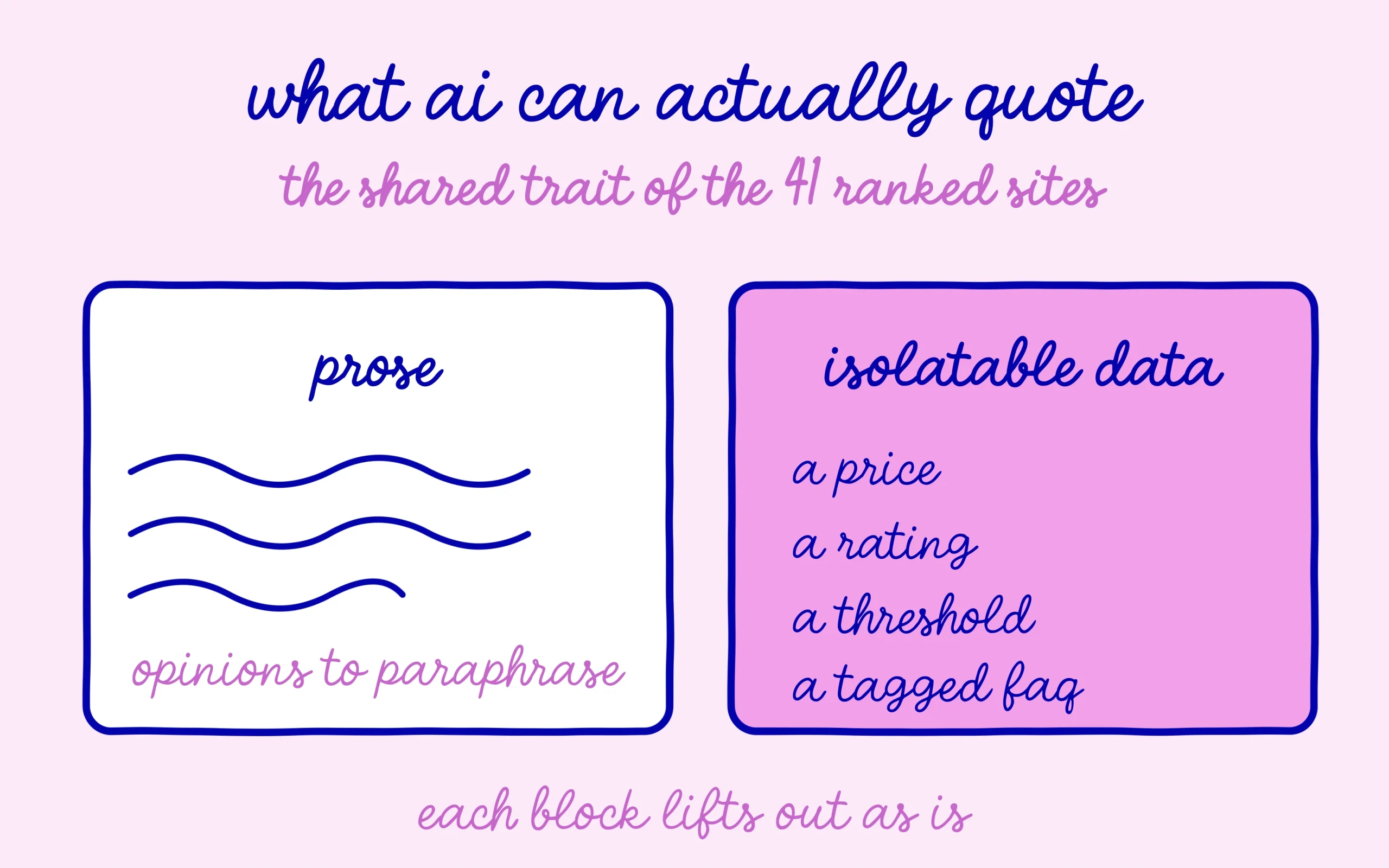
What remains is to explain what these six families share, and this reading is ours, since Ahrefs publishes the raw table without interpreting the pattern. A Walmart product page, an Edmunds valuation, a TripAdvisor score, a Healthline dosage, a Merriam-Webster definition: every one of those pages carries elements an AI can lift as-is, a price, a figure, a threshold, a short answer to a precise question. And citation gets decided at the level of the lifted passage, one fragment pulled out of a page rather than the page as a whole. A generative engine assembles its answer from fragments, and structured markup, Product, Review or FAQPage, helps slice those fragments cleanly. We measured that effect in our article on what schema markup actually changes for AI citations.
Narrow topical authority is the second shared trait. Edmunds only talks about cars, GoodRx only about drug prices, Kelley Blue Book only about vehicle valuations. These AI Overviews sources are unbeatable on their vertical and completely absent everywhere else, unlike generalist media that covers everything while owning nothing. The table sides with the specialists: the generalists that survive in it, Forbes or the New York Times, get there with a Domain Rating above 90 and decades of history, an entry ticket nobody can buy today. That specialization mechanic lines up with our analysis of topical authority as the criterion AI search rewards.
The most counterintuitive part concerns community content: among the 41, it is verified content. A TripAdvisor or Trustpilot review is scored on a scale, dated, attached to one specific place and moderated, while a forum thread stays a raw conversation whose reliability changes from one message to the next. Reddit does weigh 18.5% of the table, but Reddit belongs to the infrastructure top 9, with a million cited pages: it is a model for nobody. Still, the lesson transfers to your own site: structured, scored, verifiable reviews are material generative engines know how to cite, a free-text guestbook is invisible to them. That distinction matters a little more every month, since review platforms are precisely the family climbing fastest in the current table.
Three GEO moves to copy from the top 50
Start by turning your pages into extractable data. In practice: go back to the content that already ranks and surface the data hiding inside it. A tutorial gains a table of durations and costs, a product page shows price, dimensions and compatibilities in plain sight, a long-form article ends with a FAQPage-tagged block answering in two sentences the three questions everyone asks. The fix takes two minutes per page once the habit settles in, and it hands generative engines exactly what they lift from the 41 domains in the ranking. You are essentially rewriting each page so that its most quotable sentence can stand alone, out of context, and still be true.
Then comes the choice of one narrow vertical, covered completely, instead of chasing general authority. The table shows sites cited massively on a tiny perimeter: car valuations, drug prices, definitions. For a young site, that means mapping a narrow subject, working through it page by page until no common question is left unanswered, and accepting to publish nothing outside it. Spreading twenty articles across ten topics, on the other hand, means existing nowhere in the eyes of an engine hunting for the most legitimate source on each query. The habit to build is asking, before every new piece, whether it deepens the vertical or dilutes it.
Finally, back every claim with verifiable proof. All six families in the ranking sell verification in some form: aggregated scores, collected prices, physician-reviewed content, established definitions. On your site, that translates into sourced and dated figures, authentic customer reviews rather than anonymous testimonials, measurements you actually ran. A verifiable, dated data point gets cited more than a claim, and it survives model updates, because it stays the most solid trace available on its micro-question.
The classic technical trap would be to hunt for one more shortcut here, some magic file to drop at the root like the llms.txt file almost no crawler ever reads. The ranking of AI Overviews sources rewards no technical trick. It rewards a content format, isolatable data, kept current on one assumed vertical, over years. That is slower than any hack, and it is the only thing the table keeps validating, month after month, snapshot after snapshot. If you keep one number from the whole study, keep this one: nine platforms absorb 79.7% of the citations, and each of the 41 remaining domains earned its seat with that same patient content format.
Keep learning on SEO Noobies.



[…] a problem end to end ages considerably better. On what AI Overviews actually pick up as sources, the breakdown of what the top cited pages have in common gives concrete […]