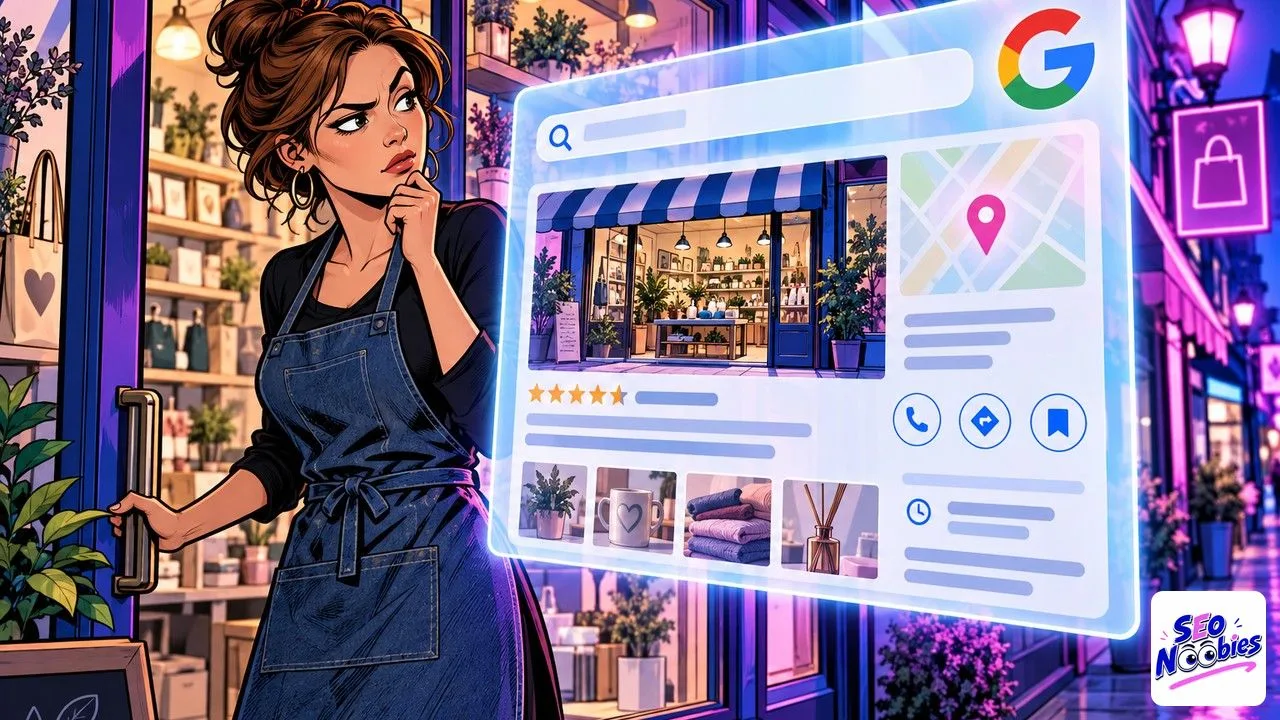
A branded search is the moment someone types your company’s name straight into Google, usually because they already know you or a friend just mentioned you. For years it was the calmest query a business could have: your site came first, maybe with your Business Profile on the side, and that was the end of it. Since late September, Google has been adding its AI-written summary to these results pages far more often, including for household names like Amazon and Adobe. Nobody at Google announced it, and the shift was spotted by practitioners who check results pages every day. Here is what was actually observed, where that summary sits on the page, and what is worth checking on your own company’s name.
TL;DR
SEO specialist Chris Long tested around a hundred brands, and 93% of them now trigger an AI Overview when their name is typed into Google.
Analytics company DemandSphere reports that AI Overviews on branded search tripled during the month of September.
In most of the verified examples, the summary sits below the official website, further down the page, and Google has made no comment.
The useful move today: search your company name, read what the AI says about you and note which sources it links to.
Get an AI summary of this article
AI Overviews Now Show Up for 93% of the Brands Tested
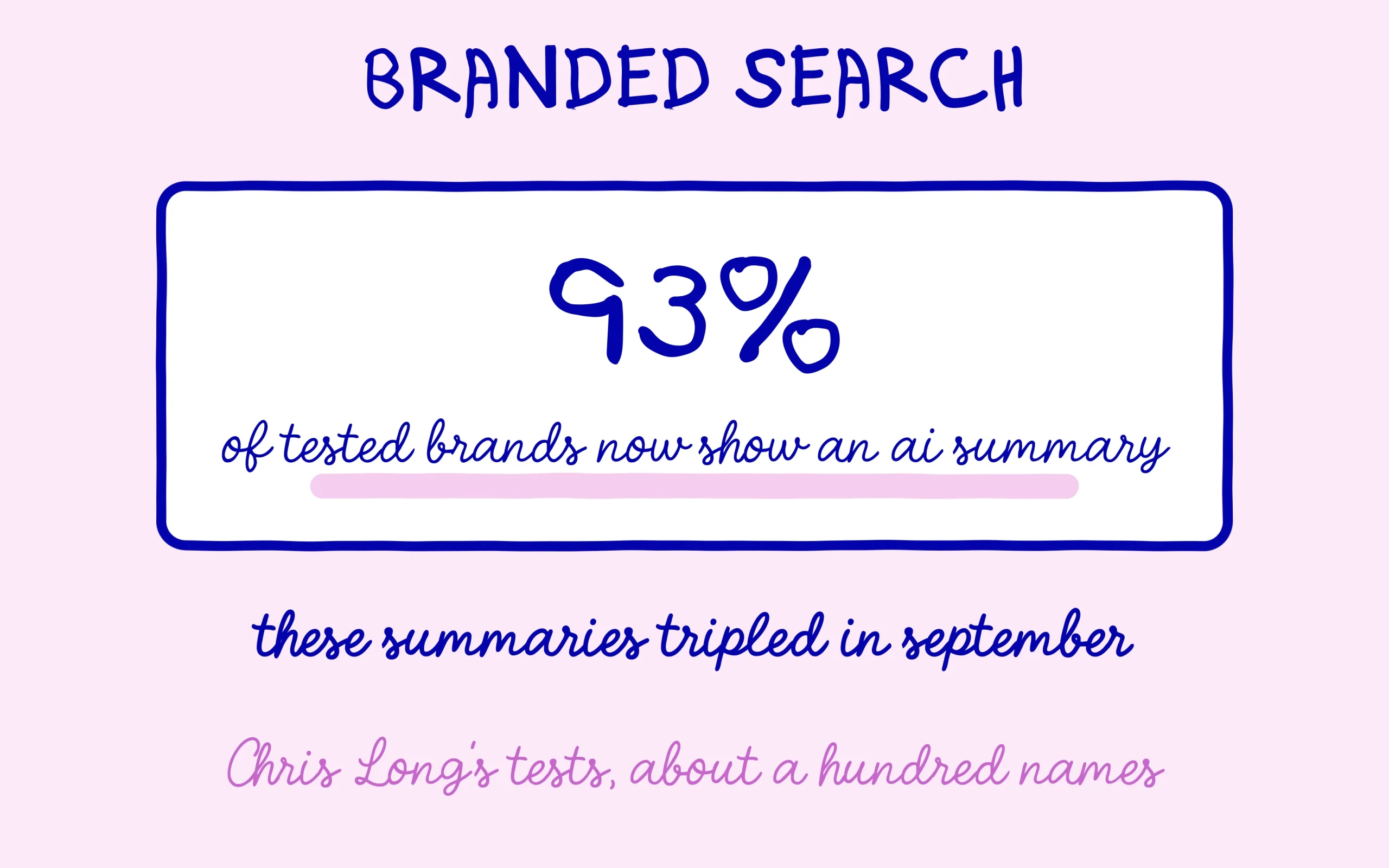
The starting point is a set of tests shared by Chris Long, an American SEO specialist who spends a lot of time pulling apart Google’s results pages. In his post on X dated September 30, he wrote that he searched for about a hundred brand names and found an AI Overview, the AI-generated summary Google places in its results, on 93% of them. Reddit, Salesforce, Amazon and Adobe were among the names he listed.
This has been building for a while. Chris Long had already flagged a handful of AI summaries on branded search back in July, on a much smaller scale. What changed at the end of September is the reach: almost every name he tested is now affected, while branded search had mostly stayed out of the AI layer until then.
Barry Schwartz, who runs the industry site Search Engine Roundtable, repeated the exercise on his side and published his screenshots for Wikipedia, Adobe, Reddit, Amazon, Samsung, Motorola, Yahoo, Apple and the bottled water brand Poland Spring. He also passed on a figure from DemandSphere, a US company that tracks brand visibility across search engines: AI Overviews triggered by a branded search tripled in September. Two independent sources describe the same shift at the same time.
Two exceptions stand out in the tests. Searching for “Google” itself brings up no AI summary, and the names of news publishers stay clear of it too. Google has stayed silent on the rollout so far. Everything we know comes from observation, and a test run on a hundred famous brands tells us little yet about the branded search of a small business or a local tradesperson.
What a Branded Search Shows Now, and How High
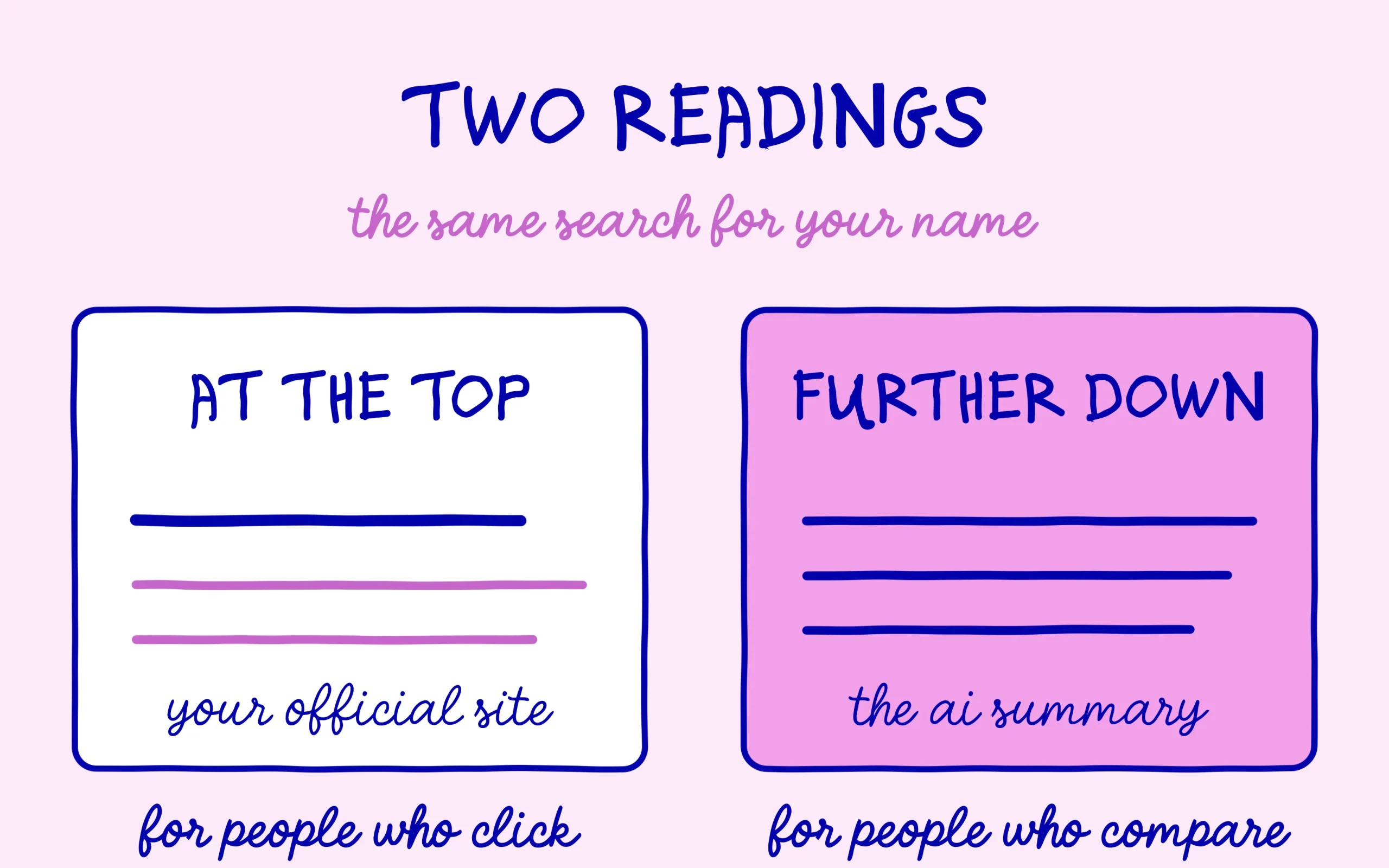
In most of the published screenshots, the brand’s official website holds the top of the page, followed by its main sitelinks, and the AI Overview appears further down, often after the first scroll. Adobe was the odd one out in the examples, with its summary showing at the very top.
That placement is partly reassuring. When someone runs a branded search to reach your website, there is a good chance they click the first link before they ever get to the summary. The real question sits with the person who keeps scrolling because they want an opinion first: what others say about you, your prices, your reviews, how you compare with a competitor. That is exactly the reader who will take in the AI summary.
And that summary is stitched together from whatever Google finds about you across the web, which includes third-party pages, forums, comparison articles and directory listings. SEO Noobies covered the same mechanism when looking at how brand mentions carry weight in AI answers: what the web says about you counts as much as what you write yourself.
For a business, branded search therefore turns into a second reading surface, and most owners have not noticed it yet. The top of the page stays yours as long as your site is properly indexed. The summarised part depends on how consistent the information about you is across the web, and wrong opening hours, an old offer or a three-year-old review can easily find their way into it.
Discover the SEO Noobies agency
Checking What Google’s AI Says About Your Company
The first check takes five minutes. Open a private browsing window, type your exact company name, then the same name followed by “reviews” and “pricing”. A cold branded search like this one mirrors the path of a customer who is still making up their mind. If an AI summary appears, read it in full and write down three things: what it claims, what is wrong or outdated, and which sources it links to. Those sources are what you will need to fix or complete if something is off. The same check works on ChatGPT and Perplexity with the method to check your AI citations without paying for a tool.
One detail deserves attention when you read those sources. If a third-party page describes you badly, say a directory with your old address or a comparison article crediting you with a service you dropped, the fix happens on that page, through an update request to the publisher or from your own account on the directory. Fixing only your website leaves the wrong information available for the next branded search.
Google offers no setting dedicated to shaping that summary. Its documentation on AI features states that the conditions for appearing in AI Overviews are the ones that already apply to regular search: a page that is indexed, eligible to show a snippet in results, and genuinely helpful to the reader. Plain SEO fundamentals remain the only official lever on a branded search.
In practice, that means a clear About page, service pages that say in plain text what you do and for whom, current prices or price ranges if you show them, and a Business Profile that matches your website. Some tags do limit the snippets Google can reuse, such as nosnippet, yet they also shrink the preview of your page in regular results. On your own branded search, that trade rarely makes sense.
Finally, keep a sense of proportion. These tests cover very large, mostly American brands, and nothing yet shows how fast the behaviour will reach the branded search of smaller businesses elsewhere. The simplest habit is to rerun the test on your name once a month and note what changes.
Keep learning on SEO Noobies.