
Schema markup shows up in almost every GEO conversation right now, usually wrapped in the promise that clean structured data is what gets you cited by ChatGPT or Perplexity. After a year of testing AI visibility on my own sites, I stay a bit more careful than most of what I read. A fairly thorough experiment just came out on exactly this question, and it puts a few popular beliefs back in their place. It does not say markup is useless, but it shows that its role inside AI answers is very different from what people assume. Here is what it actually measured, and what it means for a site that is just getting started.
TL;DR
Schema markup, the structured data added to your page code, has helped Google show rich results for years.
An experiment across seven AI engines found that most of them do not even read that markup when building an answer.
The visibility swings that were observed came from a broad algorithm shift, not from the markup itself.
Keep structured data for classic SEO, and rely on clear, visible on-page content to get cited by AI engines.
Summarize This Article with AI
ChatGPTWhat AI engines really do with your schema markup
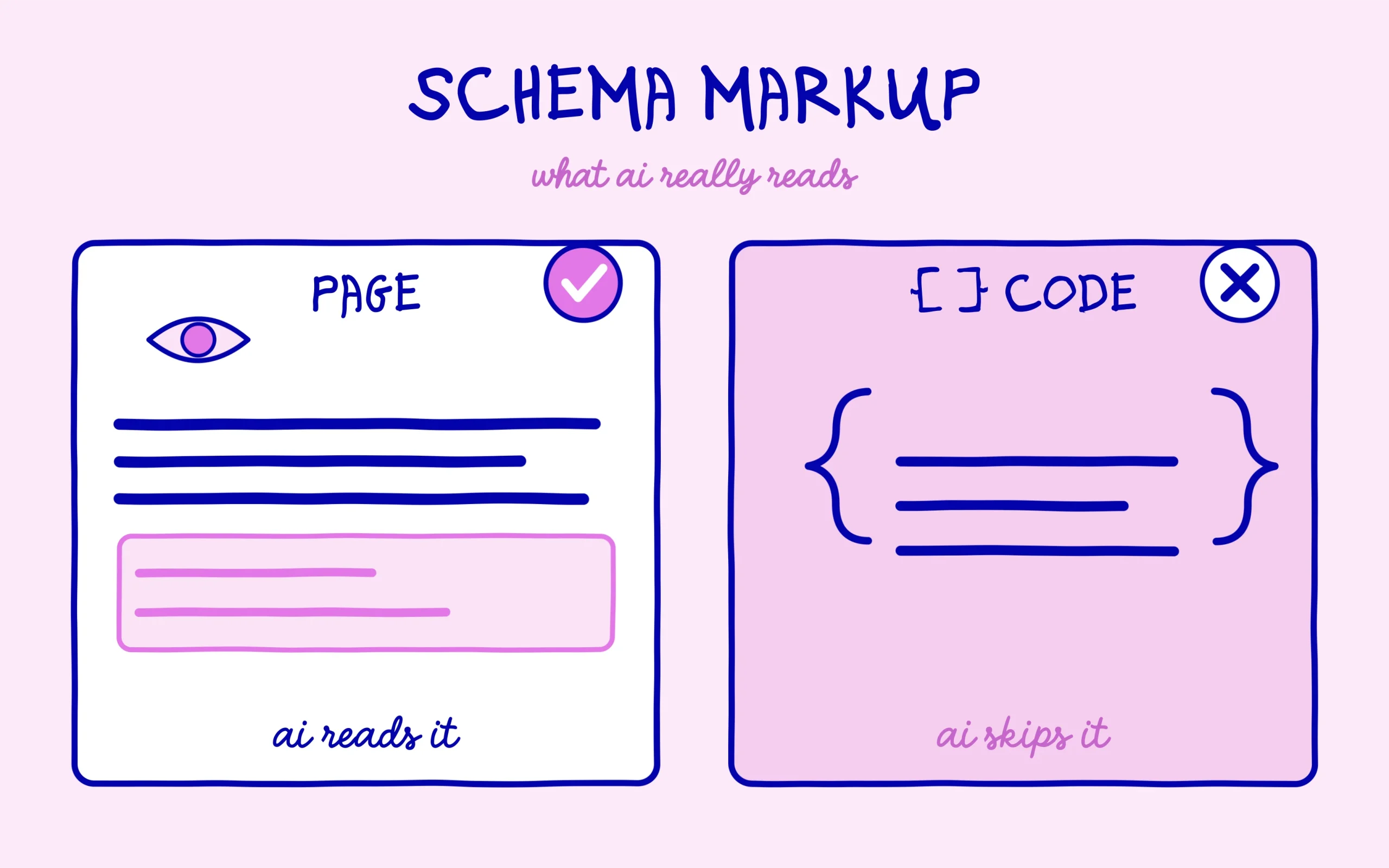
The study ran from December 2025 to March 2026 across seven AI answer engines, with five types of structured data and 319 prompts tracked over three months. The first test was simple: ask each AI to read the schema markup sitting on a page. Only one engine, Gemini, pulled the code back correctly. ChatGPT, Claude, Perplexity and Copilot failed, and Google’s AI Mode went as far as inventing a schema type that existed nowhere on the page. Most AI engines never even see your markup at the moment they answer, as shown in the experiment Otterly published across those seven generative engines.
That result feels strange when you come from classic SEO, where marking up your pages has been a long-standing reflex. On Google, it earns you rich results: review stars, an expanded FAQ, a clean breadcrumb under the title. That mechanism still works, and nothing in the study challenges it. But a generative engine does not read a page the way a crawler does. It works on text, it breaks that text into small chunks, and a block of code tucked into the header carries nowhere near the weight of a readable sentence in the body. It is the same pattern we saw with the llms.txt file studied across 137,000 sites, another technical trick sold as the new magic tag for GEO.
Let me back up for a second for anyone new to the term. Schema markup is a set of invisible labels added to a page’s code to tell machines what it is about: this is an article, this is a price, this is a review rated four out of five stars. Google has used it for years to build its rich results, and it stays an excellent classic-SEO practice. The confusion comes from assuming a generative AI reads those labels the same way a search engine does. The experiment shows it does not. It mostly reads what a human sees on screen, the sentence, the heading, the definition written in the text, and far less the instructions tucked away in the source code.
Why the visibility swings had nothing to do with markup
The second test is the one that breaks the most assumptions. The authors added structured data to a set of pages, then tracked how their brand presence moved over three months. The numbers scatter in every direction: coverage dropped 71% on ChatGPT, jumped 611% inside Google’s AI Overviews, gained 42% on AI Mode, lost 35% on Gemini. Enough to declare a win or a disaster depending on which engine you decide to look at.

Except one detail changes the whole reading. Competitors who had touched nothing on their own markup went through roughly the same swings over the same window. Markup explains none of those gains, which came from a shift in how each engine picks its sources, a background move that hits everyone at once. The third test drives it home: an exclusive fact placed only inside the code was never picked up by any AI. It is the same source-selection logic that sometimes brings forgotten old content back into AI answers: what counts is the trust granted to a page, not the invisible code it carries.
There is a real practical lesson in there when you are starting out. Do not chase your AI visibility numbers from one month to the next, because they move for reasons that are completely out of your hands. One month you gain thirty percent on an engine, the next you give it all back, without having touched a single line of your site. Celebrating or panicking over those swings means reacting to noise. What deserves your attention is the underlying trend over several months, and above all the quality of what you put online. The rest is not something you control, so you may as well accept it right away.
One honest caveat, so we do not throw the baby out with the bathwater. This experiment covers three months and a handful of engines, it is not a truth carved in stone. AIs move fast, and nothing rules out that one engine starts making better use of structured data tomorrow. What the study establishes clearly today is that none of them does so reliably, and that no schema markup replaces readable content. Betting on it as your main GEO lever would mean wagering on engine behavior that does not exist yet.
What actually gets you cited by an AI today
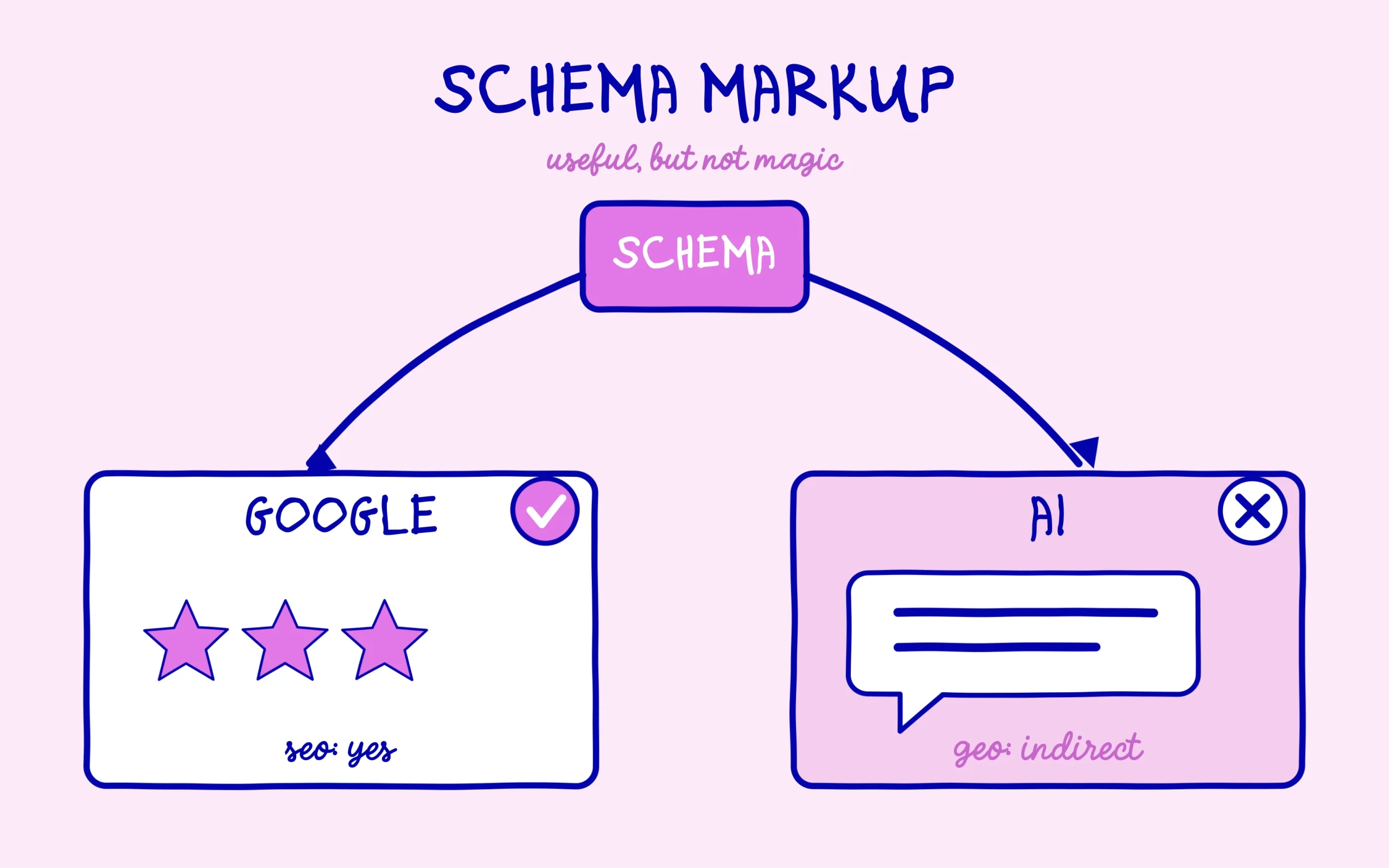
So should you throw schema markup away? Absolutely not. It stays useful for classic SEO, and a beginner site has every reason to mark up its articles, product pages and review pages cleanly to earn rich results on Google. The gain is real, it is simply indirect on the AI side: better classic visibility sometimes ends up feeding generative answers, but as a knock-on effect, never because an AI read your markup. To place all of this in the wider search picture, the starting point is still understanding how SEO and GEO play together.
In practice, here is how I put it to clients who are just starting. Keep clean markup on the pages that matter, article, product, review, local business, because it helps you on Google and it takes a few clicks to set up with a plugin like RankMath. But do not spend three hours polishing a schema markup block imagining it will land you inside ChatGPT. That time is far better spent elsewhere. One hour spent writing a clear, complete answer to a real question from your audience will always weigh more, on the AI side, than the best-filled tag in the world.
What generative engines really pull out is visible, clear content written into the page. A real question-and-answer section spelled out in plain text weighs more than an FAQ buried only in the code. Headings that honestly announce what each part contains, sharp definitions, data that only you publish: that is what an AI can read, understand and cite. My field advice comes down to one line. Keep marking up for Google, but put your GEO energy into content a machine can understand without having to decode anything at all.




[…] leans on clear markup rather than on any new trick. It lines up with what we found when we dug into what engines really do with schema markup. In GEO, markup helps comprehension, it does not manufacture citations. A perfectly marked-up […]