AI citations follow a logic that overlaps with Google rankings far less than most people assume, and the figure documenting it is blunt: across 15,000 prompts, only 12% of the pages cited by assistants were sitting in Google’s top 10 for the same question. Put another way, nearly nine out of ten sources an AI quotes come from somewhere other than page one. The number has been circulating in the industry for a while, usually stretched in one direction or the other. It deserves a proper look at the method, the spread between engines, and above all the large exception that changes how you should read it.
TL;DR
Ahrefs compared the sources cited by ChatGPT, Gemini, Copilot and Perplexity against Google results across 15,000 prompts and found 12% average overlap with the top 10.
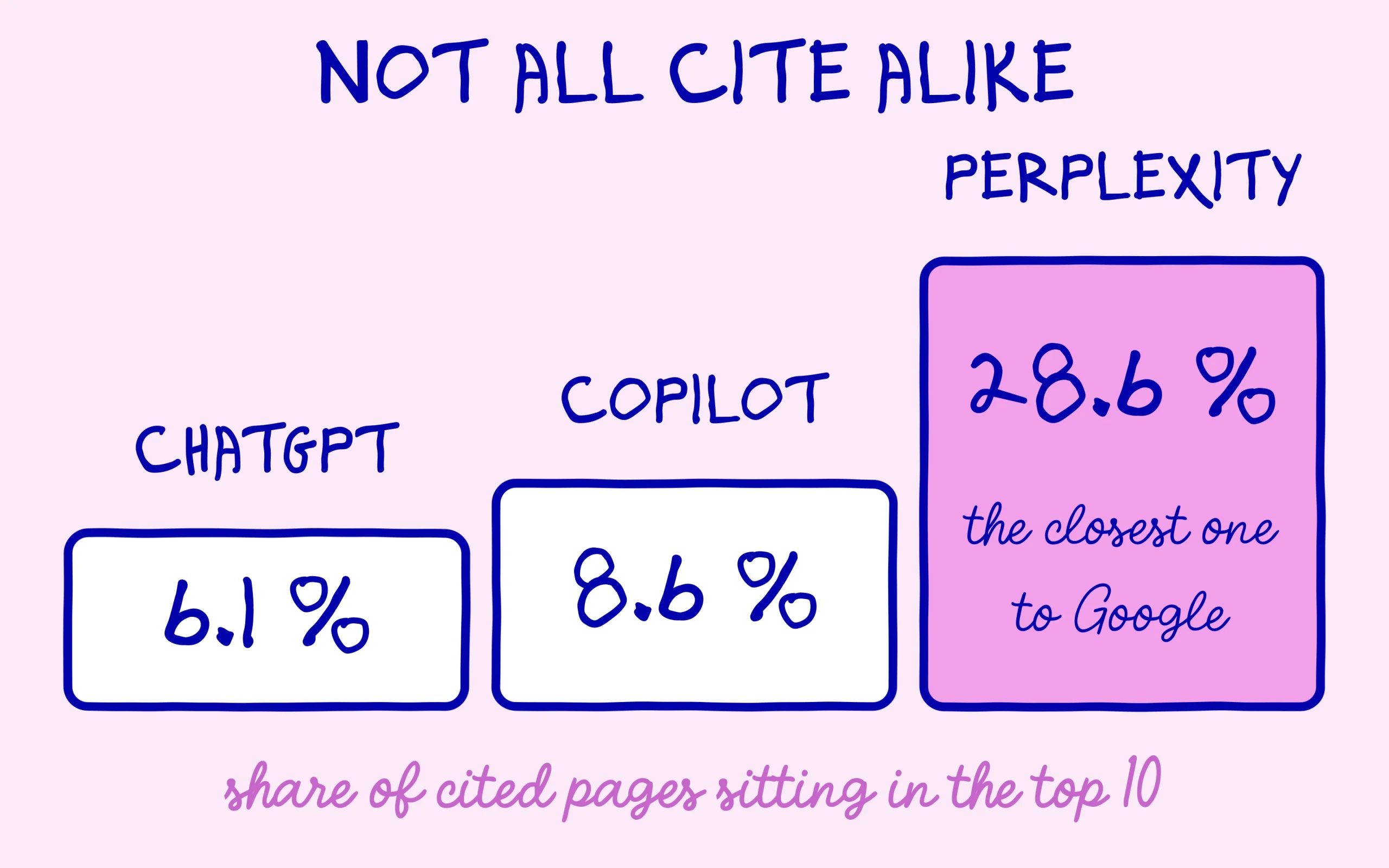
The spread between engines is enormous. Perplexity overlaps at 28.6%, while ChatGPT drops to 6.1% in its reference block.
Google’s own AI Overviews are the exception and pull 76% of their citations from the top 10, which rules out applying the 12% figure to AI search as a whole.
A site that has not ranked yet is not shut out of AI citations, but it then depends on signals outside its ranking: clarity, mentions elsewhere, recency.
Summarize This Article with AI
ChatGPTWhat Ahrefs checked across 15,000 prompts
The study comes from Louise Linehan and Xibeijia Guan, published on the Ahrefs blog in August 2025. The protocol is easy to follow. They ran 15,000 prompts through four assistants, collected every URL quoted in the answers, then fired the same prompt at Google and counted how many of those URLs appeared in the first ten results. The prompt set deliberately leans long tail, with questions like how much it costs to install a security camera.
The headline average for AI citations lands at 12%, and that is the number everyone repeated. The per-engine breakdown teaches you considerably more than the average does. Perplexity overlaps the top 10 at 28.6%, Copilot at 8.6%, Gemini at 8.2%, ChatGPT at 8.0% for in-text links and 6.1% for its reference block. Between first and last there is a factor of five.
That gap is telling you something structural. Perplexity was built from day one as a search engine that writes its answers, with a heavy web retrieval layer underneath. ChatGPT was built as a conversational model that later had search bolted on,, and it maintains its own source pools rather than leaning on a public results page. Two different lineages produce two different citation habits, and there is nothing mysterious about it.
One caveat about reading these AI citations belongs here before going further, because it gets dropped every time this figure travels. A 12% overlap does not mean 88% of cited pages are invisible on Google. A page at position 14 or position 30 is still indexed and still ranked, it simply falls outside the top 10 chosen as the comparison threshold. The study measures overlap with page one, and nothing beyond that.
Why AI citations drift away from Google rankings
After a year of watching this on my own sites and across client work, my reading is that the drift starts with the question itself. Google handles a query as typed. An assistant breaks the request into several sub-questions and hunts a source for each one. The page it ends up quoting answers one fragment of the request, and it has no particular reason to dominate the results page for the original wording.
The second reason sits in the format of what gets lifted. A model does not cite a page, it cites a passage it could extract cleanly. A page that is merely decent overall but carries one immaculate paragraph on the exact point under treatment makes a better candidate than an excellent but sprawling piece. Ranking rewards a whole page, citation rewards a passage. Those two units of measurement have no reason to line up.
Then come the signals that live entirely outside your website. What other people write about you, the threads where your brand surfaces, the roundups that list you, all of it feeds generated answers without ever passing through your own ranking. That mechanism shows up clearly in local verticals, where an AI answer fills the gap with whoever else is documented. A site can therefore be cited for reasons it only controls indirectly.
Recency plays a part too, and not in the way most people expect. On moving subjects, assistants will happily reach for a recent, clearly dated page even when it has accumulated no authority at all, while Google takes weeks to surface the same page. That recency premium is the main way young sites break into AI citations, and it closes the moment the subject settles.
Honestly, there is a boundary worth drawing right here. Those explanations remain practitioner hypotheses, backed by published observation yet never documented by the model vendors. Nobody outside OpenAI genuinely knows how ChatGPT arbitrates between two candidate sources. Anyone selling a guaranteed method to land in its citations is selling a conviction dressed up as a process.
The AI Overviews exception nobody quotes
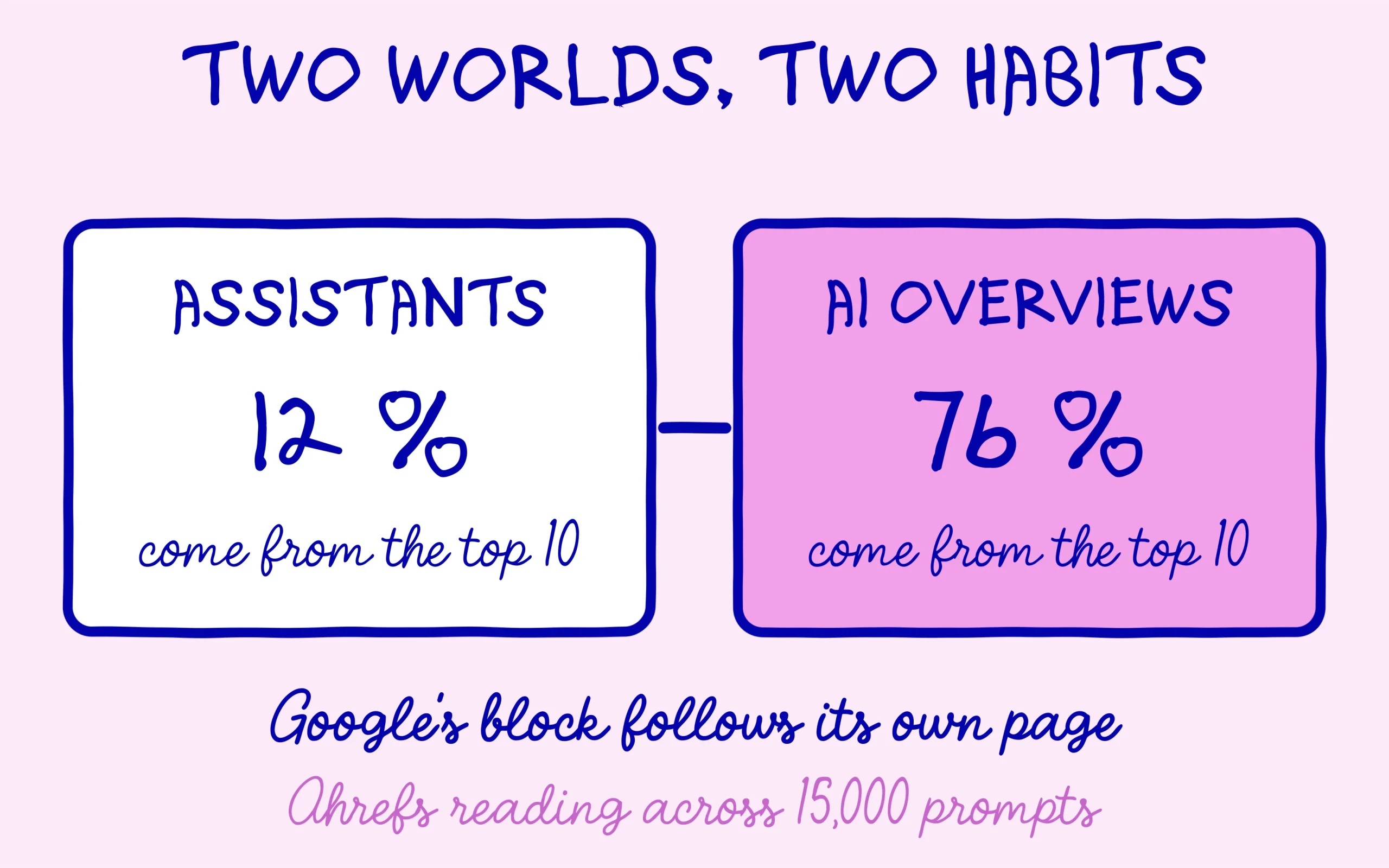
Here is the part most write-ups of this study leave out, and it flips the conclusion people draw from it. In the same research, Ahrefs measures that 76% of AI Overviews citations come from pages already ranking in Google’s top 10. Where standalone assistants largely bypass the results page, Google’s own generative block tracks it closely.
The practical consequence follows directly. If your traffic depends on Google, ranking work remains the primary route into the generated answers your visitors will actually see, because those answers are AI Overviews. The 12% figure describes a separate universe, the one where somebody opened a dedicated app. Conflating the two leads people to deprioritise classic search on the strength of data that says nothing about it.
What this exception also tells you is that the two surfaces reward broadly compatible work. The traits that make a good source for an assistant are the traits that make a good page full stop, something the breakdown of what cited AI Overviews pages share lays out in detail. Nobody is facing two rival disciplines competing for one budget.
What this means before you rank
The first takeaway on AI citations is genuinely encouraging when starting out. Missing page one does not lock you out of AI citations, and on narrow subjects a six-month-old site can end up quoted alongside established references. It happens, I see it regularly. The thing to note is that it happens on long, specific phrasings, never on the generic queries everybody fights over.
The second takeaway seriously tempers the first. A citation earned without a ranking is an unstable citation. It rests on no acquired position, it hangs on an internal arbitration that can shift at the next model update without warning, and it leaves no workable trace in your reporting. Building a whole acquisition channel on that means renting land on an unknown lease.
In day-to-day terms the working method barely changes, it sharpens. On any page targeting a question, the answer needs to arrive early, phrased as a self-contained sentence that survives outside its context. That is the easiest shape for a model to lift, and it is exactly what structuring a page so it gets picked up in an answer describes. The rest of the page carries on serving human readers and rankings.
A word on measuring AI citations, since that is where a lot of time evaporates. Checking your citations by hand across three assistants once a month costs nothing and is plenty at the beginning. Dedicated tracking tools earn their place past a certain volume, but a young site lacks the surface area for their readings to hold steady week to week. Observe first, and let the tooling arrive when there is something to tool.
My conclusion fits in one sentence the 12% figure does not carry on its own. AI citations open a real side door for sites that do not yet own their results page, provided you treat it as a supplement and never as a shortcut. Ranking remains what holds the whole thing up, including inside the generated answers Google serves its own users.
Keep learning on SEO Noobies.