
LLM traffic, meaning the visits landing on your site from ChatGPT, Perplexity, Claude or Gemini, carries a flattering reputation: that visitor supposedly converts far better than one arriving from Google. The claim shows up in nearly every GEO pitch on the market, repeated so often that it has quietly hardened into accepted fact. A study covering 54 sites, run with an actual statistical test, lands somewhere much cooler. Another one, published a few weeks earlier by a tool vendor, says close to the opposite. After ten years in SEO, that kind of contradiction interests me more than either number on its own, because it shows how a data point turns into a sales argument.
TL;DR
Across 54 sites measured over six months, organic converted at 4.60% and AI-sourced visits at 4.87%, a gap the statistical test rates as not significant.
A competing study puts an AI search visitor at 4.4 times the value of an organic one, using a very different scope and method.
The real gap sits in volume: 0.24% of sessions against 31.9% for organic in the measured sample.
Tracking the channel separately in your analytics is worth doing now, treating it as a revenue pillar is premature.
Summarize This Article with AI
ChatGPTWhat The 54-Site Study Actually Measured
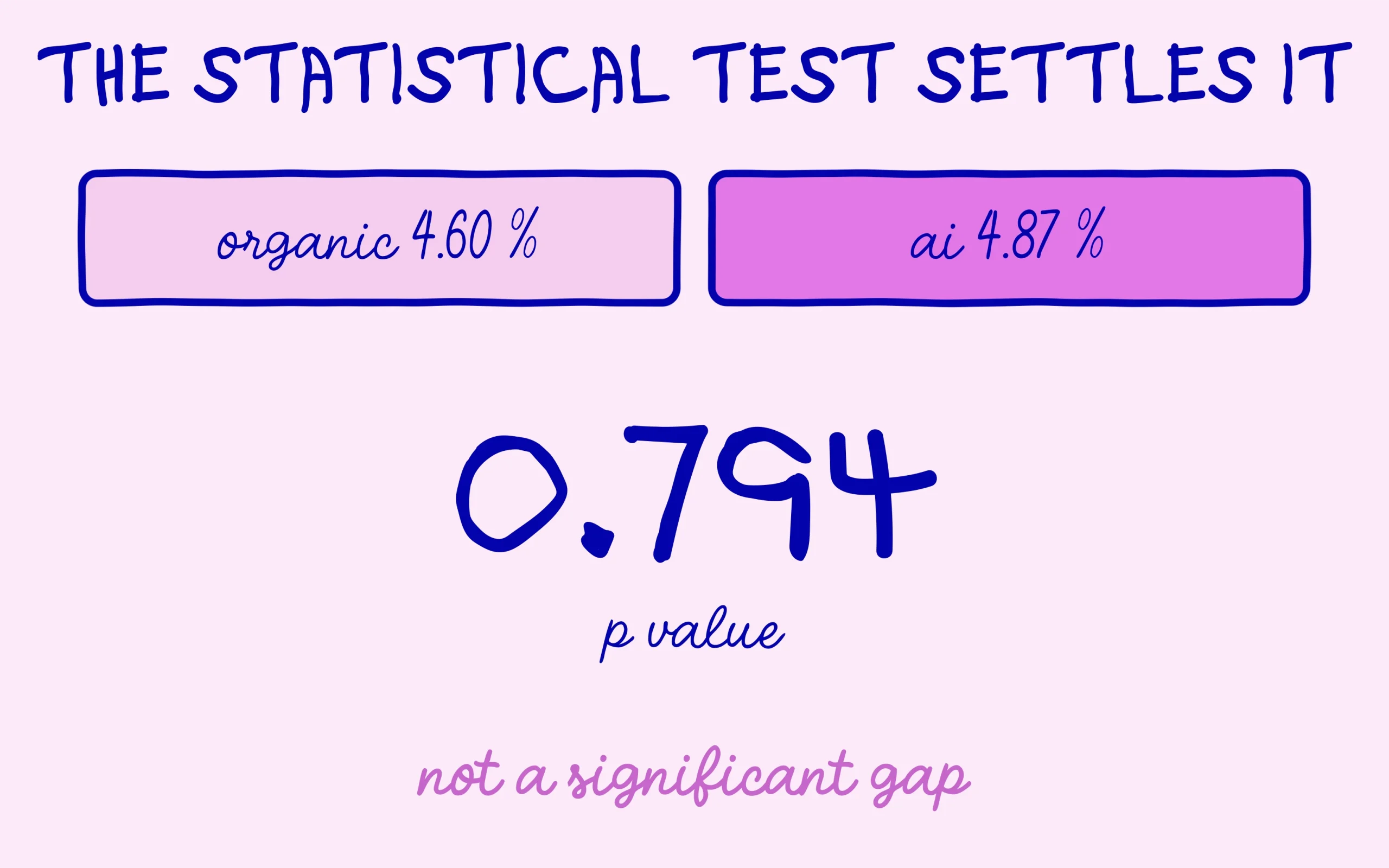
The most solid work on this question covers 54 sites across varied industries, six months of GA4 data, measured at session level. The headline results fit in two numbers. Organic posts a conversion rate of 4.60%, while visits arriving from large language models reach 4.87%. So a gap does exist, it comes to 0.27 percentage points, and it tilts the way GEO advocates would want.
Things get more interesting once that gap goes through a test. The p-value comes back at 0.794, which in plain terms means a difference that size stood a very strong chance of showing up through sampling noise alone. The authors reran it on the 33 highest-volume sites, where the gap widens to 1.24 points, and the p-value still sits at 0.376. The full method is documented in the Amsive study comparing conversion across LLM and organic traffic.
A word on what “not significant” means, since the phrase gets mangled constantly. It does not claim the two channels convert identically. It says the data gathered cannot settle the question either way. Absence of evidence is not evidence of absence, and a wider sample could reveal a genuine gap tomorrow. For now, nobody can honestly lean on these numbers to promise a better conversion rate.
Something else about the design is worth appreciating, because it is rare. Comparing two channels on a single site tells you almost nothing, since one site’s audience, offer and seasonality drag everything around. Pairing each site against itself, then testing across the whole panel, strips out most of that noise. Anyone quoting LLM traffic numbers from one account, however impressive the screenshot, is doing something categorically weaker than this.
The date deserves flagging too. This work went out in September 2025, on data older still. The landscape has shifted since, and the volumes involved have climbed, which is visible in the AI referral figures recorded across Shopify merchants. That vintage does not make the study disposable: its method remains the most rigorous published on the subject, and nothing has contradicted it using a comparable protocol.
Why Two Serious Studies Disagree
A few weeks before that work landed, a different figure was already everywhere: an AI search visitor supposedly worth 4.4 times the average organic one. The number is striking, it sticks in the memory, and it fed a sizeable chunk of the past year’s GEO sales talk. It comes from an analysis spanning more than 500 high-value topics across digital marketing and SEO.
Once you look at what each one measures, the two results stop clashing head-on. The first compares sessions across a mixed panel of sites, the second reasons over marketing and SEO topics specifically, which happens to be the exact ground where AI users are most numerous and furthest along in their thinking. The reasoning is laid out in full in the study putting a value on a visitor arriving from AI search.
Scope explains most of the distance between them, and it deserves spelling out. Someone asking an assistant which rank tracker to buy has already worked through their options and arrives close to a decision. Someone landing on a recipe page from the same assistant is nowhere near that state of mind. Averaging both into a single conversion figure produces a number that describes neither situation, which is roughly what happens whenever a study spans industries rather than a single vertical.
That said, one detail belongs on the table without hedging. The study producing the most spectacular multiplier comes from a vendor selling AI visibility tools. This disqualifies nothing at all, vendor data is frequently the best available, and nobody else holds those volumes. It simply argues for reading the scope before the headline, which few of us bother doing when a number happens to suit us.
A more mundane explanation sits underneath the disagreement, and it comes down to how LLM traffic gets identified in the first place. A share of these visits arrives with no readable referrer, because the mobile app or the browser strips the source. Those sessions land in the direct bucket instead, mixed in with people typing your address by hand. Depending on the detection method each team chose, one study captures a slightly different population than the other, and both can be right about their own sample.
What I see on my own sites resembles the first result far more than the second, with one large caveat: my volumes are nowhere near enough to conclude anything. Below a few hundred visits over the observed window, a conversion rate says almost nothing, and that holds for every channel. Two extra orders in a month can double the figure a small site proudly reports.
Volume Is Where The Real Gap Sits
All this arguing over rates buries the most telling number in the study. Within the measured sample, organic accounts for 31.9% of sessions and 33.8% of conversions. Visits arriving from language models account for 0.24% of sessions and 0.42% of conversions. On incoming volume, the ratio runs somewhere around one to a hundred and thirty.
One further figure sharpens the picture: close to 90% of the sites in the panel received under 0.6% of their traffic from AI sources. Which means the average is already being pulled upward by a handful of well-positioned sites, and the median site sees even less than the headline percentage implies.
The trend, though, points firmly one way. A broader look at how traffic channels are shifting across the web measures 66% growth in AI traffic through 2025, rising in 16 of 17 industries, while still sitting under 0.15% of total visits. Those two facts coexist comfortably and are detailed in the analysis of how traffic channels are being reshaped across the web. Fast growth on a tiny base stays a tiny base for a good while.
That thin volume also warps how the numbers read month to month. When LLM traffic amounts to twenty visits, its conversion rate leaps from zero to ten percent on the strength of a single order, then collapses again four weeks later. A good share of the spectacular screenshots circulating right now show exactly that: a tiny channel whose natural volatility throws off flattering peaks. The rate on display is not lying, it simply is not measuring what people claim it measures.
Which is why the conversion rate question strikes me as secondary right now. A channel at 0.24% of volume cannot be run as a revenue pillar, even if it converted twice as well. The arithmetic settles quickly: on a site pulling 10,000 monthly visits, you are looking at roughly twenty AI-sourced visits, and one or two conversions on a good month.
What I Would Do With LLM Traffic Today
Start with the step that costs nothing: isolate the channel in your analytics. Build a segment grouping ChatGPT, Perplexity, Claude and Gemini referrals, then look at it once a month. You will know where you genuinely stand, rather than reasoning from averages published by people whose business looks nothing like yours.
Then wait until you have material before drawing conclusions. Under a few hundred visits across the observed period, a conversion rate carries close to zero information. Consulting clients ask me for their “GEO performance” after three weeks with impressive regularity. The honest answer is that there is nothing to read yet.
On budget, my read is straightforward and slightly boring. The work that makes you visible inside AI answers overlaps roughly 90% with the work that makes you visible in Google: readable pages, kept current, genuinely answering a question. No separate budget needs opening yet, and the energy pays back better on the fundamentals covered in our guide to increasing website traffic when you are starting out.
One extra habit pays off if you want to go further without spending anything. Look at which specific pages receive your LLM traffic, not just the headline volume. On most of the sites I watch, two or three URLs soak up nearly all of it, and they are almost always pages answering a question phrased in ordinary language. That detail is worth considerably more than a conversion rate, because it tells you which content format the models are actually keeping from your site.
I could be wrong on the timing, and I will say so plainly. If the observed growth holds for two or three more years, this channel becomes anything but marginal, and whoever set up their measurement early will spot the turn before everyone else. My disagreement is narrower than it sounds: selling a conversion advantage today, as settled fact, when the available data does not show one.
Keep learning on SEO Noobies.



[…] One more number from the same interview cuts against a common assumption. Readers arriving from ChatGPT convert to subscription at a rate far above anything the social platforms deliver, well ahead of Facebook and of Discover recommendations. The volume stays small, the quality of that volume does not, which matches what we found looking at how LLM traffic actually converts compared with Google. […]