Rank tracking, the daily chart your SEO tool draws to show where your site sits on Google, depends on something Google keeps making harder. Since mid-September, several tool makers have admitted they are collecting noticeably less data than usual. The starkest report comes from Derek Perkins, founder of the Nozzle tracking tool, who described a drop of about 80% in the data he can pull from Google. Nothing has changed for your website itself. What has changed is how much you can trust a chart that suddenly dives or flatlines this week, because it may be telling you about a struggling tool rather than a ranking loss.
TL;DR
Google is getting better at blocking the bots that read its results, and rank tracking tools are caught in the crossfire.
Nozzle reports about 80% less data, and Sistrix says its collection has been running at a reduced rate since September 16.
Tools are recovering at different speeds, which can create fake movements in your reports.
Before reacting to a drop, check Search Console, which gets its numbers straight from Google.
Get an AI summary of this article
Why Rank Tracking Got Harder in Mid-September
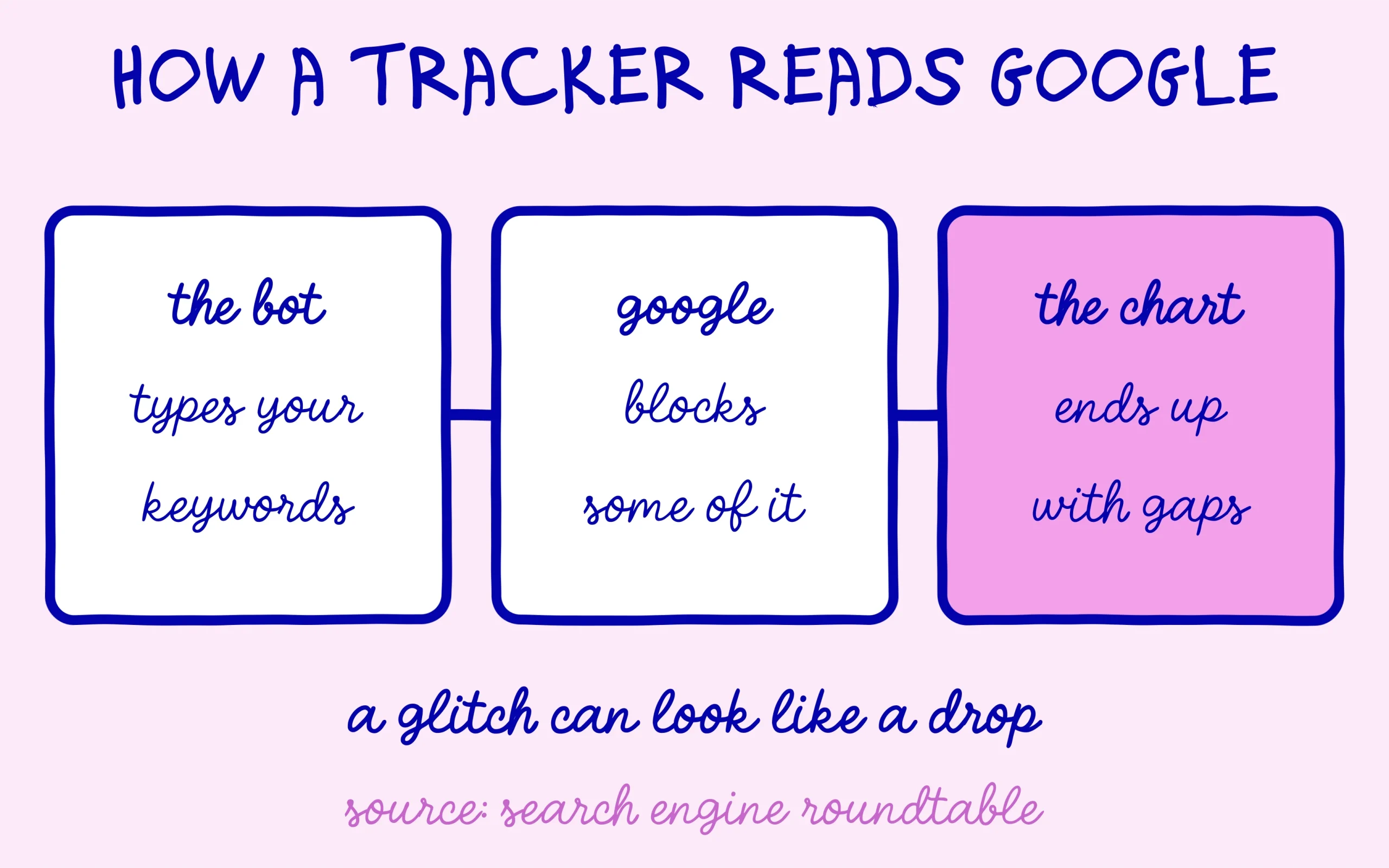
A rank tracker works with bots that type your keywords into Google, read the results page and record the position of your site. Google has never liked this, and it has been tightening the screws month after month. In late August it started routing every click through an intermediate address, which we covered in our piece on Google’s goto redirect. That change forces bots to follow each link one by one just to find out where it leads.
Another step came around September 13. Barry Schwartz of Search Engine Roundtable wrote in his September 18 report that Google appears to be having more success blocking scrapers and tracking tools. He connects it to the “verify you are human” checks Google has been testing for weeks before showing some results. A tool that can’t read Google can’t see your site.
Google isn’t alone here either. The same day, Search Engine Roundtable noted that Bing has started asking some searchers to prove they are human before showing results. Schwartz groups the bots that scrape results to feed AI systems together with the ones run by tracking tools, and rank trackers end up in the same net whether their makers like it or not.
Derek Perkins, quoted in that same report, described roughly an 80% drop in the data Nozzle can collect, and said he saw similar trouble at DataForSEO, a data provider that many tools rely on. Sistrix posted a note on its status page on September 16 saying Google had changed how search results are delivered once again, and that its data collection was running at a reduced rate. Steve Paine at Sistrix pushed back on any sense of panic, explaining that data is still flowing and the team is adapting its processes.
Discover the SEO Noobies agency
What These Data Gaps Do to Your Reports
The most practical consequence is the gap between tools. Consultant Glenn Gabe, whose observations Schwartz picked up, compared several tools after the latest round of ranking turbulence: Ahrefs caught the recovery, Semrush did too with a lag, and Sistrix had not picked it up yet. So two tools can show a rebound and a flat line for the same week, while your site did nothing different at all.
It helps to separate two things that often get blurred. Your actual position on Google is decided by Google, for real people typing real queries, and none of this blocking touches it. What the tools report is a sample: a bot checking a keyword from one place, at one moment, on a schedule the tool chooses. When that sample gets thinner, the chart gets noisier, but the thing it tries to measure hasn’t moved because of it. For a beginner, that distinction is worth more than any single number, because it decides whether you spend next week rewriting pages that were never in trouble.
The timing makes things even murkier. Schwartz points to ranking movements around September 4, 12 and 15, none of them confirmed by Google. When results genuinely shift at the same moment tools lose sight of them, it gets hard to tell whether a curve reflects the market or the tool’s blind spots. Keep in mind that a missing data point, or a measurement taken less often, can look exactly like a drop on a chart.
If you pay for a subscription, there’s a pricing question too. When collecting a results page costs more, a tool maker has three options: raise prices, update positions less often, or cut the number of keywords included in each plan. Nothing like that has been announced so far. Still, rereading your plan’s terms at renewal time is time well spent.
Search Console as Your Rank Tracking Reference Point
Search Console, Google’s free tool, doesn’t rely on bots at all: its numbers come from real searches. Its average position is based on the top spot your site reached for each query, then averaged, as Google’s documentation explains. It doesn’t tell you everything, but no bot blocking can starve it of data. If you’re new to it, our chapter on Google Search Console covers the basics.
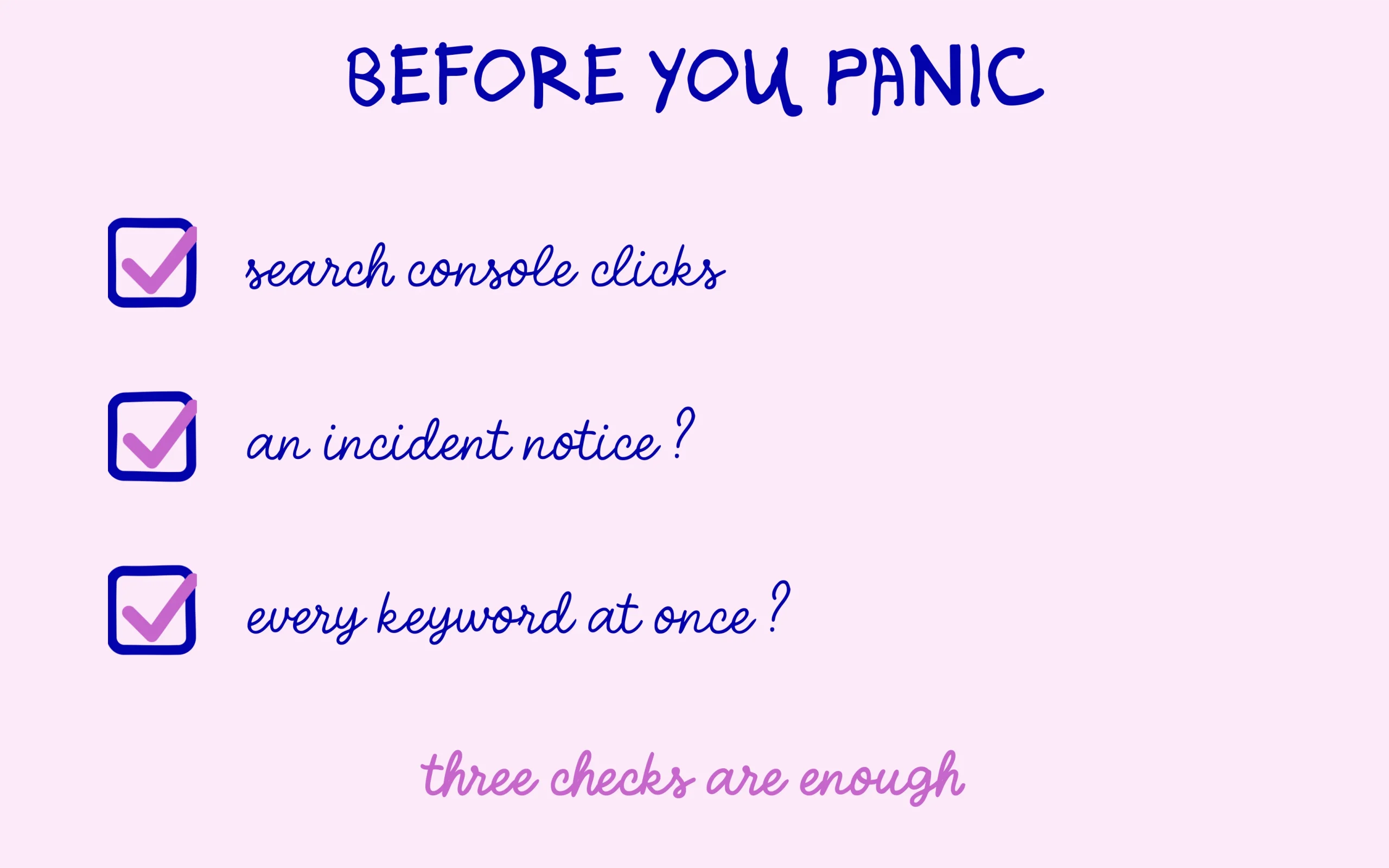
When your tracker shows a drop, three checks are enough. First, see whether clicks and impressions in Search Console fell over the same period. Next, look for missing data or an incident notice from the tool, like the Sistrix status page. Finally, compare several keywords against each other. If they all moved on the same day, including ones whose clicks stayed flat in Search Console, the tool is the most likely explanation.
Rank tracking is still useful for spotting a trend over several weeks. It’s far less useful for judging a single day, and even less so right now. For a small business, real traffic and incoming enquiries remain the numbers that actually matter.
Keep learning on SEO Noobies.