
A Google redirect now sits between the search results page and every site you click. Instead of sending you straight to the page you picked, Google routes the click through an intermediate address, google.com/goto, and then drops you where you wanted to go. Nothing changes on screen, which is why the move went almost unnoticed: the results page looks the same, the site opens the same. The path of the click, though, is different, and that kind of detail has a way of showing up in a website’s stats sooner or later. There is nothing to fix on your side, so no need to worry. Here is what we know about the detour, why Google built it, and the few things worth watching in your measurement tools over the coming weeks.
TL;DR
Links on Google’s results pages now pass through a google.com/goto redirect before reaching websites, a mechanism tested since July.
A Google spokesperson frames the detour as a technical measure against evolving forms of abuse, with no further detail.
The redirect runs server-side: a bot scraping the results now has to follow every link one by one, which gets expensive at scale.
Your visitors notice nothing and your rankings do not move. The things to watch live in your analytics, not on your site.
Summarize This Article with AI
ChatGPTWhy Google Redirects Every Click Through google.com/goto
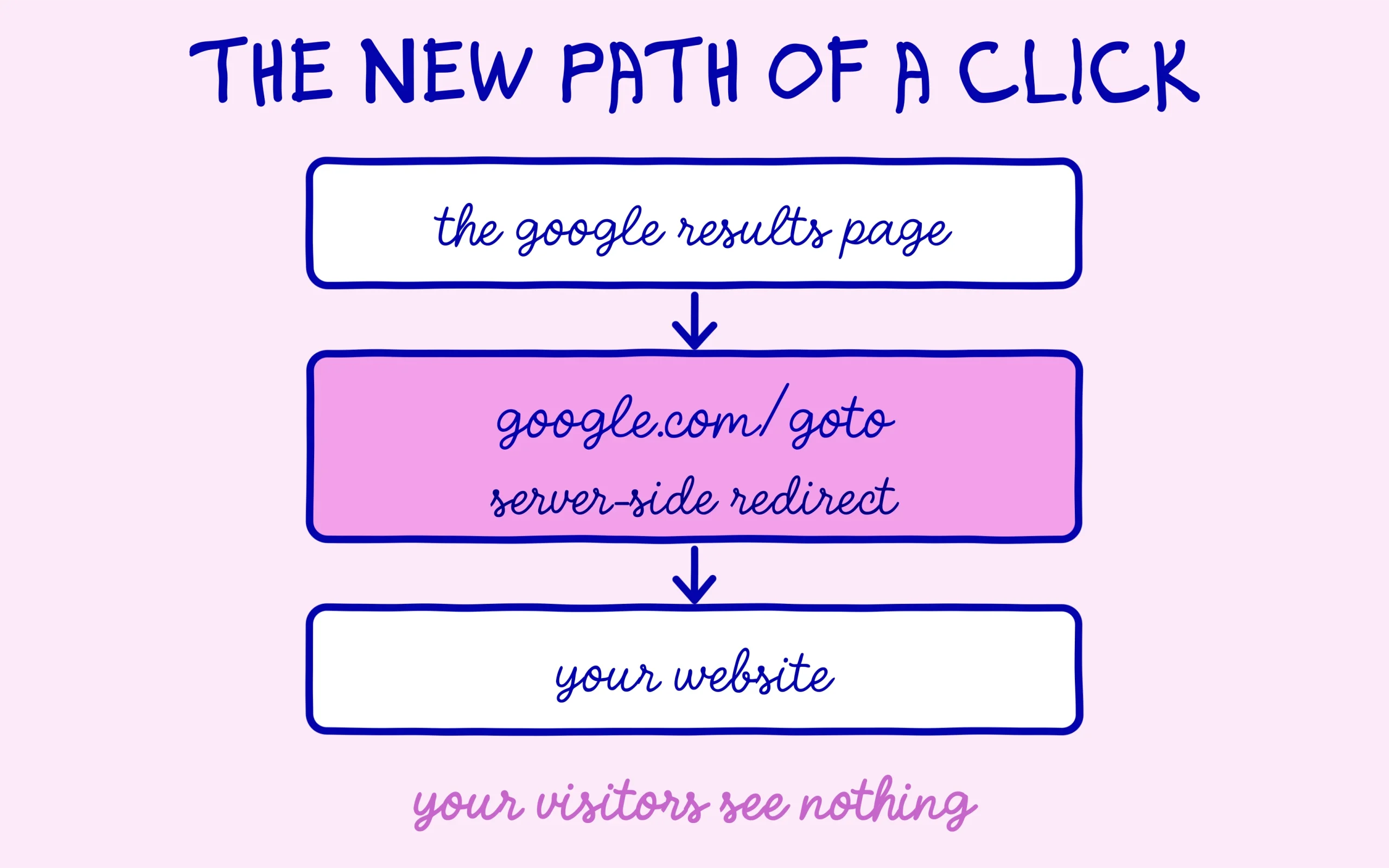
Until now, a result link pointed directly at the destination page. With the new setup, the click first hits a URL shaped like google.com/goto followed by an encoded parameter, and a redirect executed on Google’s servers then delivers the visitor to the target page. The whole trip takes a fraction of a second and stays invisible to the person browsing. The parameter gives nothing away either: the destination address can no longer be read anywhere in the code of the results page. For the searcher, nothing changes, not the perceived loading time, not the landing page. Testing started quietly in July, and the mechanism spread to nearly all searches over the summer.
Google confirmed the rollout to Search Engine Land, which reports a near-complete deployment observed across several residential IP providers. The company’s spokesperson said Google maintains technical measures against evolving forms of abuse, and regularly takes steps to protect its services and its users. That wording is deliberately vague, and no official documentation accompanies the change so far. Google has shipped plenty of search updates this year, but rarely one this quiet for something touching every single click.
What the mechanism actually does still says a lot about the intent. The destination address is no longer readable in the code of the results page: it is encoded, and only the server-side redirect can resolve it. A bot scraping Google results at scale now has to follow every single link to find out where it leads, which multiplies the cost of the operation. Put simply, the detour targets robots scraping the results page, and your visitors will never notice it. Tools that harvest results pages in bulk, and the AI systems that feed on them, are the ones this lock was built for.

What the goto Detour Means for Your Traffic Stats
The real question for a site owner sits inside the measurement tools. And honestly, there is no complete answer yet: Google has not detailed anything. Not the referrer passed to websites, not how analytics platforms will attribute the traffic, not whether any reports will show side effects. The unknowns are real, and the first field reports from site owners will tell us within a few weeks whether the detour leaves visible traces in the numbers. To frame what is at stake: GA4, Matomo, Plausible or any other tool installed on your site reconstructs where a visit came from using the information the browser passes along at the moment of the click. A new link added in the middle of that journey can in theory change what those tools receive, or change nothing at all. Since the Google redirect went live, public measurements are still missing on the actual effect.
A simple piece of reasoning helps keep things calm, though. Search Console counts your clicks inside Google itself, upstream of the journey, not by querying your site. A redirect added after the click has no obvious technical reason to change that count. It would not be the first time Google’s reports required careful reading either: Search Console already mixes AI Mode queries in with your regular ones without letting you tell them apart. And one more thing worth keeping in mind: a redirect after the click does not touch rankings. Your positions are decided before the click, in the ordering of results, not in the trip that follows it.
Where an effect could genuinely land is on the SEO tools themselves. Rank trackers work by reading results pages automatically, which is exactly the activity the Google redirect makes more expensive. The companies behind those tools are used to adapting whenever the results page evolves, but every extra lock gets paid for somewhere, in collection time or in infrastructure costs. Search Engine Land also points to a broader reading: limiting data harvesting by third parties, AI systems included, that re-read Google’s results to build their own answers. The connection between AI crawling and what you see in your stats is already measurable elsewhere, as Microsoft Clarity now ties AI scraping to real visits. Tracking your visibility inside generative engines relies partly on the same collection techniques, so the lock could complicate life for GEO measurement tools too.
The detour also arrives in a landscape where traffic measurement was already under pressure. Searches ending without any click at all reached 68% in the first quarter of 2026, and every change to the results page makes the numbers a little harder to read for a site that is just getting started. One more reason to know precisely what each of your tools measures, and where its data comes from.
The Right Reflexes When Your Numbers Look Off
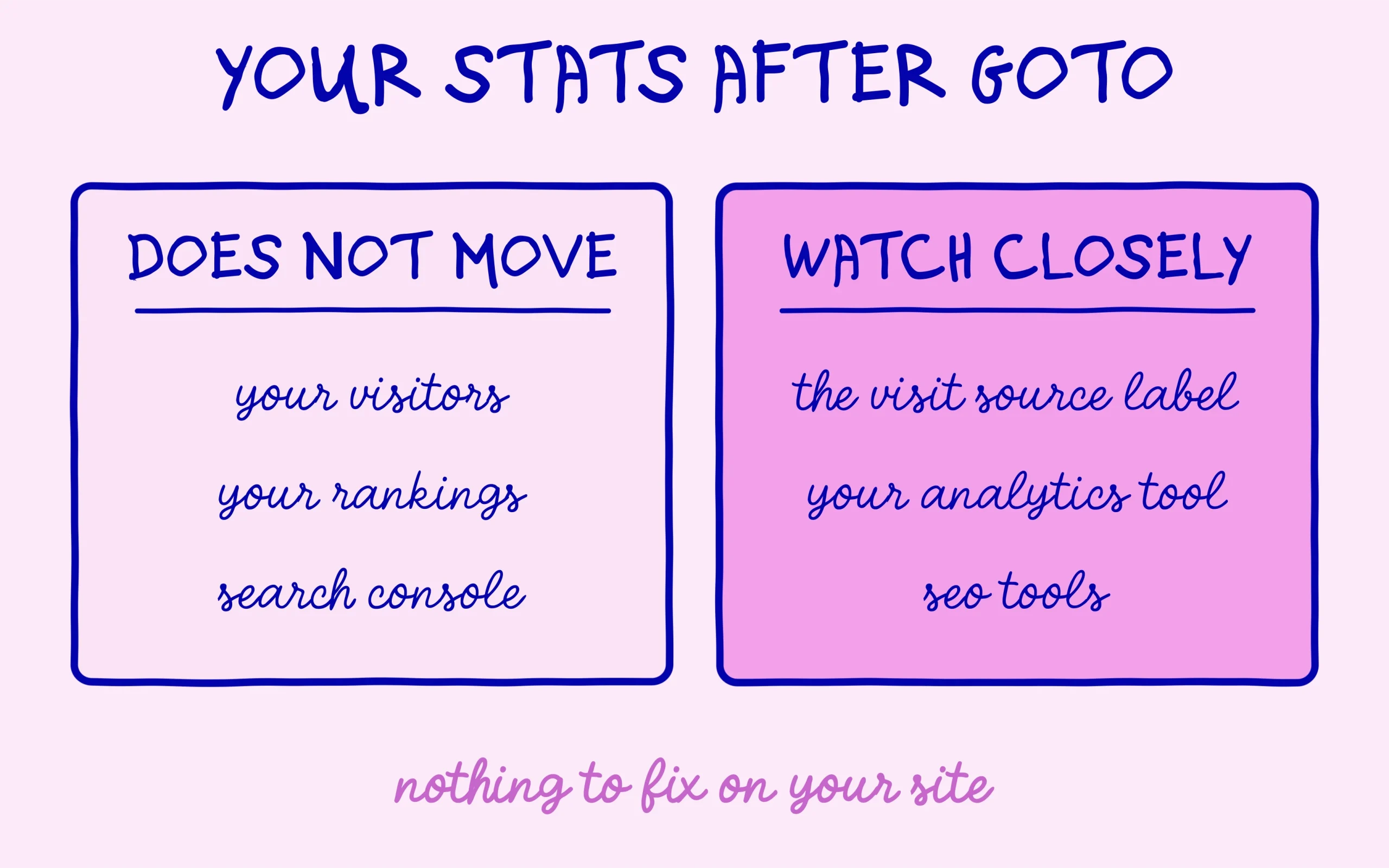
First reflex, and the most important one: there is nothing to change on your site. No setting, no plugin, no tag. The Google redirect lives entirely on Google’s side, between its results page and your server, and no tweak on your end can speed it up, bypass it or switch it off. A site that worked before the change works exactly the same after it. Be wary of the alarmist recommendations that will inevitably start circulating about this.
Second reflex: open your analytics and look at how your traffic sources have been split over the past few weeks. If the share attributed to Google drops while direct traffic or some unusual source climbs by the same amount, you may be looking at an artefact of the new click path rather than a real loss of visitors. Your overall visit volume should remain the number to trust: the label attached to each visit can get blurry, while the visit itself still gets counted. Write down what you observe, with the date next to it: write the date down before you blame anything, because without a reference point you cannot tell whether an oddity comes from your site or from a change on Google’s side.
The classic trap here is attribution. When numbers dip right after a visible Google change, the temptation is to blame that change and stop looking. Sometimes the real cause is a broken page, a lost backlink, or seasonal demand doing what seasonal demand does. Keep the usual method: date the drop precisely, rule out technical issues on your side, then work out whether you lost positions or whether people simply searched less. The Google redirect is one hypothesis among several, never the automatic answer. Running through that checklist takes an hour at most, and it will save you from rebuilding a site that was never broken in the first place.
For everything else, Search Console remains your most reliable reference for clicks and impressions coming from Google, since it measures at the source. That said, this story is not finished: the Google redirect can still be adjusted, documented, or extended. If the company publishes details about how the goto detour shows up in measurement tools, they will be worth reading closely. Until then, watch your numbers with a bit more curiosity than usual, and leave it at that.
Keep learning on SEO Noobies.



[…] it started routing every click through an intermediate address, which we covered in our piece on Google’s goto redirect. That change forces bots to follow each link one by one just to find out where it […]