You open the robots.txt of your site running behind Cloudflare and you find lines nobody on your team ever wrote: a Content Signals directive, added automatically by your infrastructure provider. The classic beginner reflex is to panic and wonder whether your rankings are at risk. The good news: this file scares people for no reason. It is a few lines of plain text in a document you can open with Notepad, driven by a reading mechanism that takes two minutes to understand. Google has just confirmed, on top of that, that this Cloudflare directive has no effect whatsoever on its crawlers. We will look at what Cloudflare actually added, what Google said about it, then re-read together what robots.txt really does and what it will never do.
TL;DR
Cloudflare inserts a Content Signals directive into the robots.txt of sites it manages, meant to govern how crawlers and AI systems use the content.
John Mueller confirmed the directive has no effect: Google does not recognize it, any more than llms.txt or llms-author.txt.
The mechanism to remember: a crawler only applies directives it explicitly recognizes and silently ignores everything else in the file.
Today’s action: open your robots.txt, check what it contains, and keep it short with standard directives only.
Summarize This Article with AI
ChatGPTWhat Cloudflare Actually Adds to Your Robots.txt Files
The diagnosis starts with the facts. The directive is called Content Signals and its intent is understandable: give publishers a way to express what bots may do with their content, at a time when AI crawlers vacuum the web to train models. It distinguishes three usage categories: Training for model training, Agent for AI agents browsing the web, and Search for classic search. Cloudflare set September 15, 2026 as the deadline for its new default settings: on new domains, Training and Agent will be blocked by default on ad-carrying pages, while Search stays allowed.
The classic technical trap sits exactly there: a directive only has value if the bot reading the file recognizes it. And no major search engine or crawler has adopted this standard, which Cloudflare launched with no prior agreement from the parties who actually read robots.txt files. The move joins the broader wave of invented signals for AI bots, like the famous llms.txt file whose Ahrefs study across 137,000 sites had already shown adoption without measurable effect. In practice, those lines now live in a file you thought you controlled, added by your infrastructure rather than by you, and they will puzzle the next audit that runs over the site.
John Mueller’s Answer: No Effect, Just Extra Weight
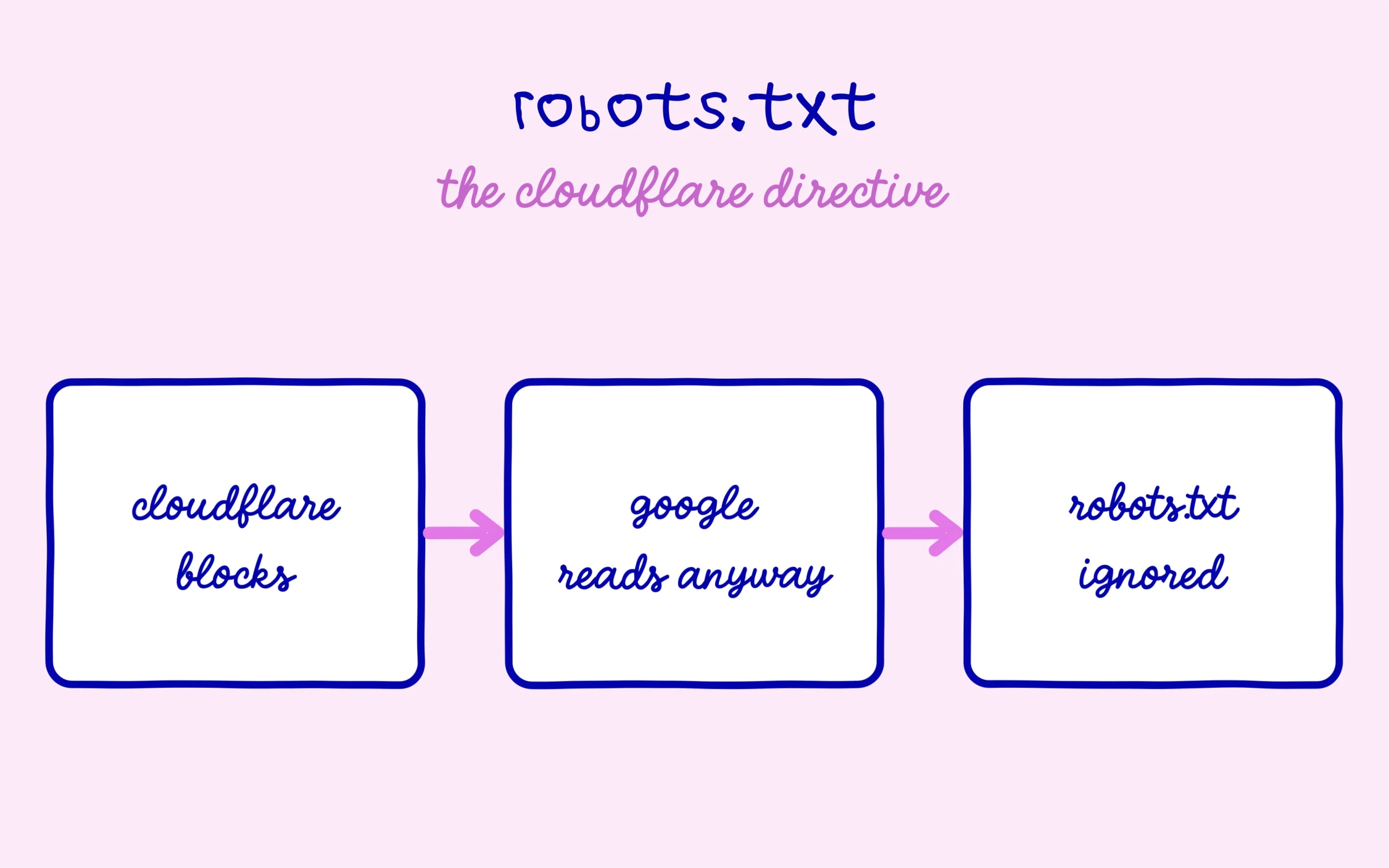
Google’s reaction came through John Mueller, on Reddit. The Content Signals directive has no effect on crawlers or LLMs, and it adds unnecessary weight to the robots.txt file. Mueller also spelled out that Google recognizes neither llms.txt, nor llms-author.txt, nor content-signal directives inside robots.txt. The list of rules Google reads is short, public and documented, and everything else gets ignored. In an audit, this always comes up: files padded with lines copied from blog posts or injected by third-party tools, none of which any engine has ever committed to reading. The extra lines do not break anything, but they build a false sense of control, which is worse than no control at all.

The underlying mechanism explains everything, and it fits in one rule: a crawler only applies directives it explicitly recognizes. Anything outside its vocabulary is skipped in silence, with no error and no warning. You can write whatever you like in a robots.txt, including polite requests to AI systems, and a passing bot will only honor what its specification covers. The same Mueller, a few days earlier, reminded everyone that a separate site for AI serves no purpose: engines work from their public standards, never from unilateral inventions.
Still, Cloudflare’s initiative documents a real market demand: publishers want a control lever over AI usage of their content, and existing standards do not fully provide one. The directive produces nothing today, but the pressure it expresses will most likely end up in a standard negotiated with the engines. Meanwhile, it changes nothing for your rankings, in either direction, and no action is required on your side.
Re-Reading Your Robots.txt: What It Does, What It Never Will
Before touching anything, go back to the official definition, which fits in one line: robots.txt tells search engine crawlers which URLs they can access on your site. Its primary job is crawl traffic management, keeping bots from overloading the server or wasting time on unimportant or duplicate pages. A routing tool for robot traffic, comparable to signage at the entrance of a building: useful for directing legitimate visitors, useless as a lock. The same strict-standards logic governs how long Google takes to re-evaluate canonicals: precise rules, real delays, zero room for improvisation.
The symptom that betrays the most widespread mistake: a page you blocked in robots.txt keeps showing up in Google results, with no description. The diagnosis is documented in black and white: this file is not a mechanism for keeping a web page out of Google. A URL blocked from crawling can perfectly well stay indexed if other pages link to it. Google details the correct use cases in its official introduction to the robots.txt file. The fix is within your reach: to genuinely remove a page from the index, use a noindex tag or password protection, never a robots.txt block.
One thing to watch before closing the file: not every bot obeys robots.txt. Serious engines respect it, shady crawlers walk right past it, and different crawlers can interpret syntax differently, which makes complex rule combinations risky territory when you are starting out. The habit to build is simple and takes two minutes: open yourdomain.com/robots.txt in a browser, read what sits there, and make sure every line matches a directive documented by the engines. A short file, standard directives, zero fantasy. The Cloudflare affair confirms it at industrial scale: even an infrastructure giant cannot invent a standard on its own.