
Anyone learning SEO picks up the habit of counting links early. How many sites point at yours, from which industry, carrying how much authority. Every tool puts that number on the dashboard in large type, and it is the figure that feels most reassuring when you check your progress. Then you look at the published data on visibility inside AI-generated answers, and that habit takes a real knock. Brand mentions, meaning the plain fact that someone writes your name somewhere without necessarily linking to you, sit far above backlinks in the measured correlations. Here is what the numbers actually say, and what you can reasonably do with them when you are starting from nothing.
TL;DR
Ahrefs measured the AI Overviews visibility of 75,000 brands and found a 0.664 correlation for brand mentions against 0.218 for backlinks.
The top three factors in that ranking all sit outside your own website, which moves part of the work off your pages.
A follow-up study covering ChatGPT and AI Mode puts YouTube mentions higher still, around 0.737.
These are correlations rather than proven causes, and the author of the study says so herself in plain terms.
Get an AI summary of this article
What Ahrefs Actually Measured Across 75,000 Brands
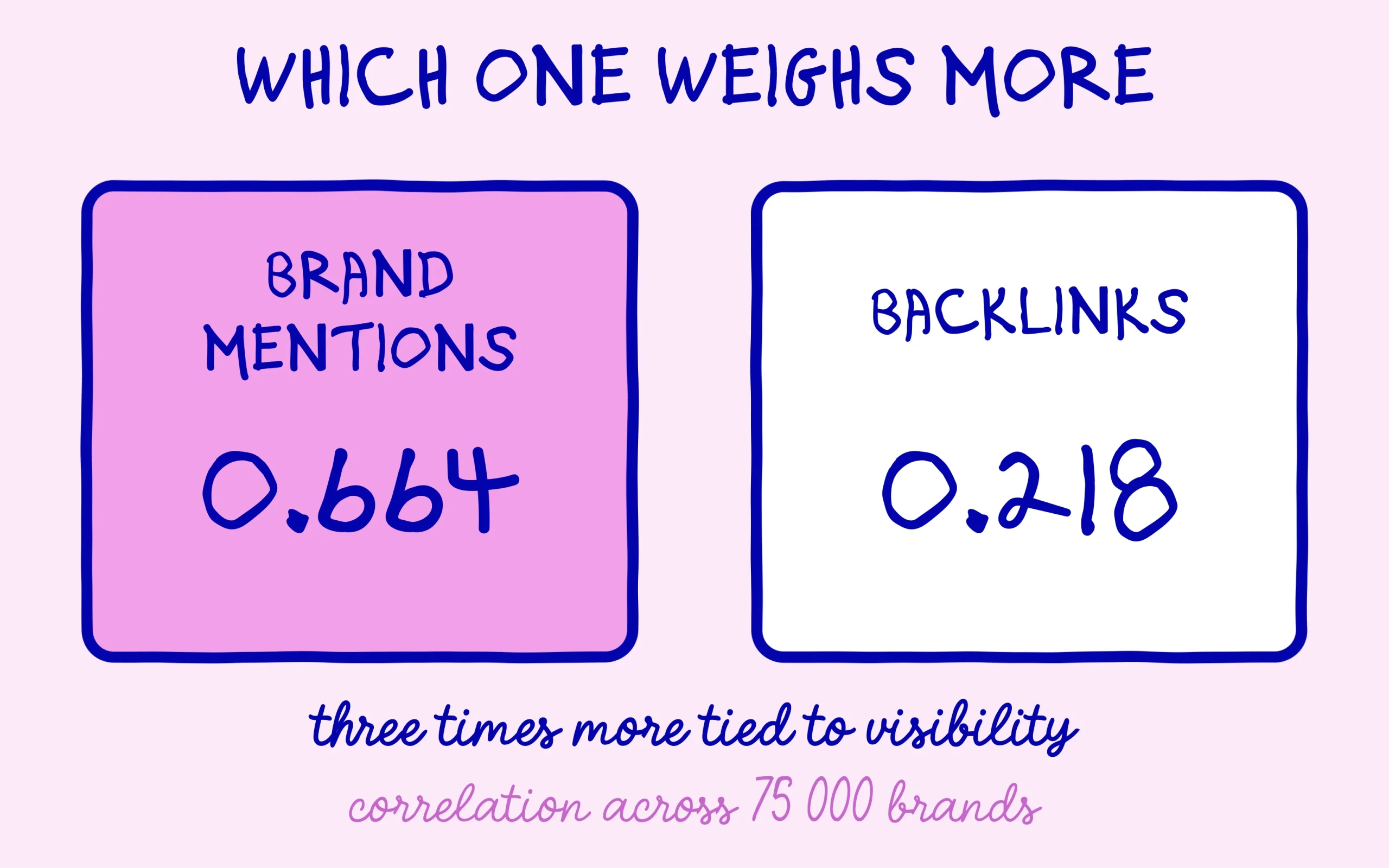
The study carries the byline of Louise Linehan, with data work by Xibeijia Guan, published on the Ahrefs blog in May 2025. The protocol fits in a paragraph. The team picked 75,000 brands whose domain sits above 40 Domain Rating and whose head keyword pulls at least 800 monthly searches, then tracked how often those brands surfaced across millions of AI Overview responses using Brand Radar. Roughly 26% never showed up at all, and the remaining 74% form the analysed sample.
The resulting ranking is the part that travelled. Branded web mentions come first at a Spearman coefficient of 0.664. Branded anchors follow at 0.527, then branded search volume at 0.392. Domain Rating drops to 0.326, referring domains to 0.295, and backlinks close out the link-based factors at 0.218. All three leading factors are things that happen away from your own website.
A word on what those numbers mean, because skim-reading them does real damage. A Spearman coefficient measures how closely two rankings move together on a scale running from 0 to 1. At 0.664 you are looking at a genuine relationship that is nowhere near mechanical, and at 0.218 the relationship is weak. Louise Linehan takes the trouble to write that correlation is not causation, and that every factor she tested lands somewhere between moderate and very weak. Nowhere does she conclude that links should be dropped.
One sampling limit deserves to be stated plainly. All 75,000 brands sit above 40 Domain Rating, so the study observes established players rather than projects launched last month. What the data describes is the hierarchy of factors among sites that already exist online. Nothing guarantees the same hierarchy holds for a brand new site, and as far as I know nobody has published the equivalent for that segment.
It is worth pinning down what the tool counts, because the vocabulary invites confusion. A brand mention in the Brand Radar sense is your name appearing in the text of a page, with or without a link back to you. An article that writes your name and never links to you counts, exactly like a roundup that drops you into a comparison table. That category, the one most SEO dashboards display nowhere at all, is what comes out on top of the ranking.
The finding still lines up with what turns up elsewhere. The observation that some brands with solid SEO stay missing from generative answers points in exactly the same direction. A site can tick every technical box, rank perfectly well, and remain invisible inside a conversation where nobody ever talks about it.
Why What Other People Write About You Carries So Much Weight
The mechanics get clearer once you remember how a language model learned. It absorbed enormous volumes of public text, and inside that text your company exists as the sum of everything written about it. A link is an instruction aimed at a crawler. A sentence naming you in a roundup, a thread where a customer describes their experience, a news piece that lists you alongside three competitors, all of that becomes text the model can surface later.
Which also explains why third-party sources keep resurfacing in answers. You can see it clearly in the finding that assistants cite Reddit and Wikipedia far more than specialist media. Those platforms concentrate mentions written by other people, in a descriptive register, which is precisely the raw material a model needs to answer a question like which agency should I pick in this city.
There is an uncomfortable consequence to accept here. You do not control your brand mentions the way you control your tags. A title rewrite takes three minutes, whereas no amount of effort makes a forum discuss you tomorrow morning. That shifts part of the work onto ground which looks a lot more like public relations than technical SEO, and it is a genuine discomfort when you learned the craft through markup. The upside is that a useful mention needs no permission and no link-building budget.
There is a second-order effect worth naming. A model does not merely register that you exist, it absorbs the words wrapped around your name. If every roundup describes you as the cheap option, that framing travels into the answers, and no amount of on-site copywriting overrides it. Brand mentions therefore carry a qualitative payload alongside the raw count, which is a reason to care about where they appear rather than only how many there are.
This also reframes an old argument about unlinked citations. For years the debate ran on whether Google treated a naked brand name as a ranking signal, and the answer stayed murky. In generative search the question loses its edge, because the text itself is the substrate the model works from. Whether a crawler follows anything is beside the point when the sentence naming you has already been read and stored.
Discover the SEO Noobies agency
YouTube Video, the Factor That Climbs Even Higher
Ahrefs published a second study in December 2025, again authored by Louise Linehan, widening the analysis to ChatGPT and AI Mode alongside AI Overviews. The ranking shifts, and a new line moves ahead of everything else. Mentions inside YouTube videos land around 0.737, above ordinary web mentions. The factor did not exist in the first study because the data was not available at the time.
The result surprises less once you consider what assistants do with transcripts. A reasonably long video produces dense text, often structured as questions and answers, with brands named in a descriptive context. That is what the breakdown on why AI tools cite the long YouTube video most lays out. For a small operation this opens an unexpected door, because appearing in somebody else’s video rarely costs money.
That said, I stay careful with this particular figure. A strong correlation on a recently added factor can reflect something else entirely, such as the fact that widely known brands are also the ones people discuss on video. What I take from these brand mentions in video is the general direction rather than the exact coefficient. Being named by other people, on formats models read easily, keeps landing near the top of the list.
The practical reading for a small team is narrower than the headline suggests. Launching a channel to chase that coefficient means committing to a production rhythm most small teams abandon within three months, and an empty channel earns nothing. Being a guest on somebody else’s video costs an afternoon and lands your name inside a transcript that already has an audience. The asymmetry between those two options is large, and it points clearly at the second one when resources are thin.
What a Site Starting Out Can Do About Brand Mentions
Measure before you change anything. Type your company name into ChatGPT, Perplexity and Gemini, then ask a recommendation question in your sector without naming yourself. Ten minutes tells you whether you exist in those answers and in what terms. The full method sits in this walkthrough on checking your AI citations without paying for a tool, and it needs nothing beyond a browser.
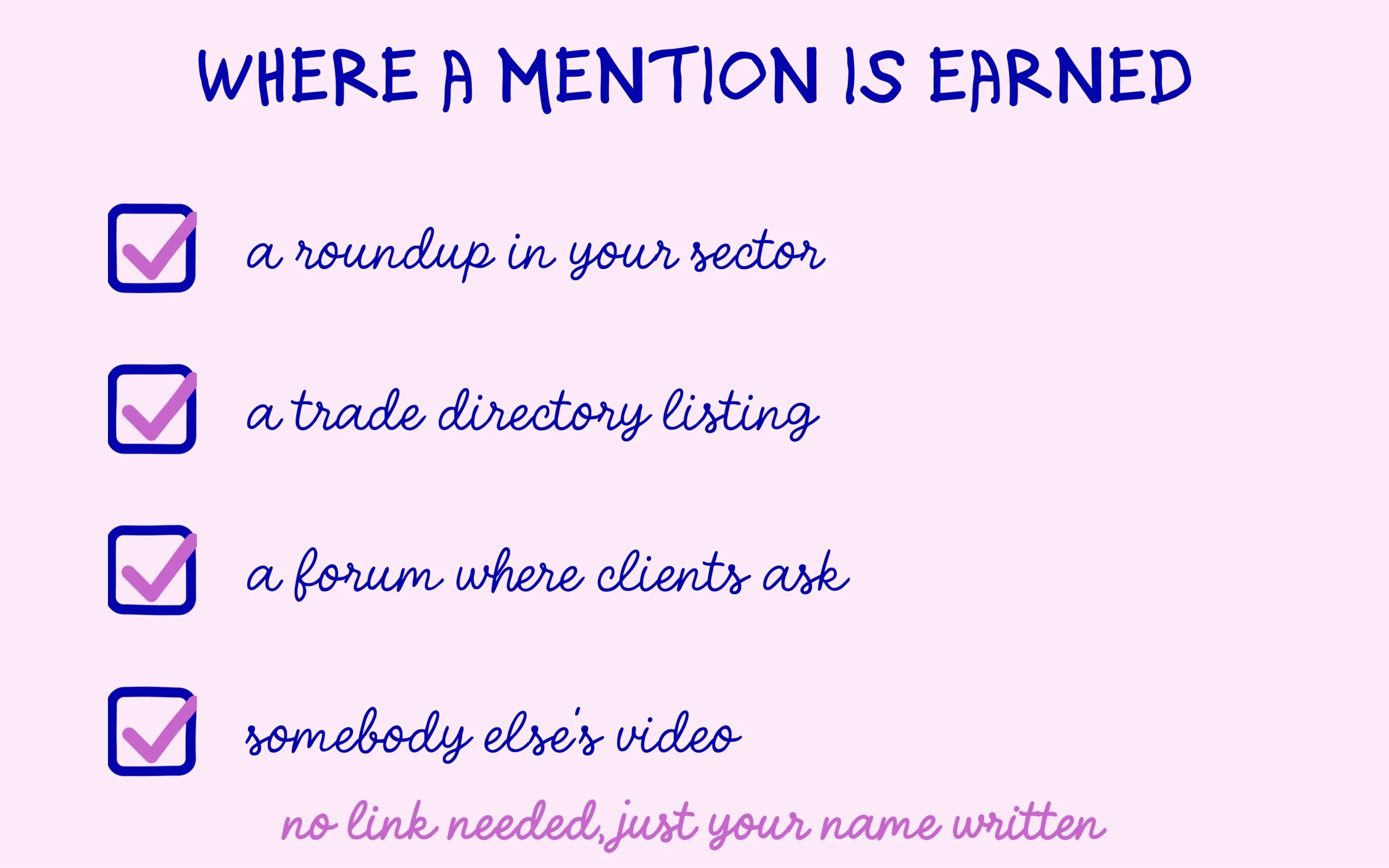
Then go looking for the places where your sector already gets discussed. Industry roundups, specialist directories that accept a descriptive listing, podcasts that host practitioners, forums where your future customers ask their questions. A genuinely useful signed answer in a relevant thread produces a usable mention. So does a properly filled profile on a trade directory. These moves return almost nothing in link authority and a great deal in textual presence.
You also need to make your brand easy to describe. If your homepage fails to state clearly who you are, what you do and who you do it for, nobody can mention you accurately, whether that person is a journalist, a customer or a model. One sharp positioning sentence, repeated identically across your site, your Google listing and your profiles, hands the model a stable phrasing to reuse. That is the foundation behind the work on topical authority as the reference AI ends up citing.
One trap waits on this ground, and it shows up fast whenever a number starts circulating. Vendors already sell bundles of brand mentions, modelled on link packages, with citations placed in bulk across sites nobody reads. The logic mirrors industrial link building, and it hits the same wall. A mention only carries weight for a model when it lives inside text a real person reads and which describes honestly what you do. Paying to appear in a list of three hundred companies on a ghost page produces nothing usable.
Budget generously on timing. A useful mention takes weeks to appear, then more time still before models ingest it, since their indexes do not refresh at the pace of a Google crawl. On the sites I run day to day, the gap between a mention going live and that mention surfacing inside an answer is measured in months rather than days. That is one more reason to start by recording where you stand, so you have a baseline to compare against later.
Keep the measurement light enough that you actually repeat it. A short document listing five recommendation prompts in your sector, run once a month, with the names that come back written down, tells you more than any dashboard you would forget to open. The point is to spot the moment your own name starts appearing, and to notice which competitor currently occupies the slot you want.
Finally, keep your links. Nothing in this study says link building has stopped working, and backlinks hold their role in classic Google rankings, which remain the first traffic source for very nearly every site. However, if you have to choose between two hours spent negotiating one more link and two hours spent making yourself citable in a sector roundup, the published data currently leans toward the second option. After ten years doing SEO daily, that is the trade-off that looks soundest with what we know today.
Keep learning on SEO Noobies.


[…] articles and directory listings. SEO Noobies covered the same mechanism when looking at how brand mentions carry weight in AI answers: what the web says about you counts as much as what you write […]