If I had to name the most underrated lever for getting cited by AI in 2026, I would say the YouTube video without hesitating. A large study just measured where generative engines pull their citations from when they point to YouTube, and the result is clear: long-form video takes almost everything. What grabs me here is not how big channels perform, it is what this opens up for someone just starting out. After a year digging into it on my own sites, I think it is one of the few doors still wide open. Here is what the data says and what I actually do with it, no needless jargon.
TL;DR
On YouTube, long-form video captures 94% of AI engine citations, versus under 6% for Shorts.
The study analysed more than 100 million AI citations over 30 days, across six generative engines.
Useful surprise: view count barely predicts citation, many cited videos have fewer than 1,000 views.
What matters is a clear, well-described video split into chapters, not the size of the channel.
Summarize This Article with AI
ChatGPTWhat the study on YouTube video and AI citations reveals
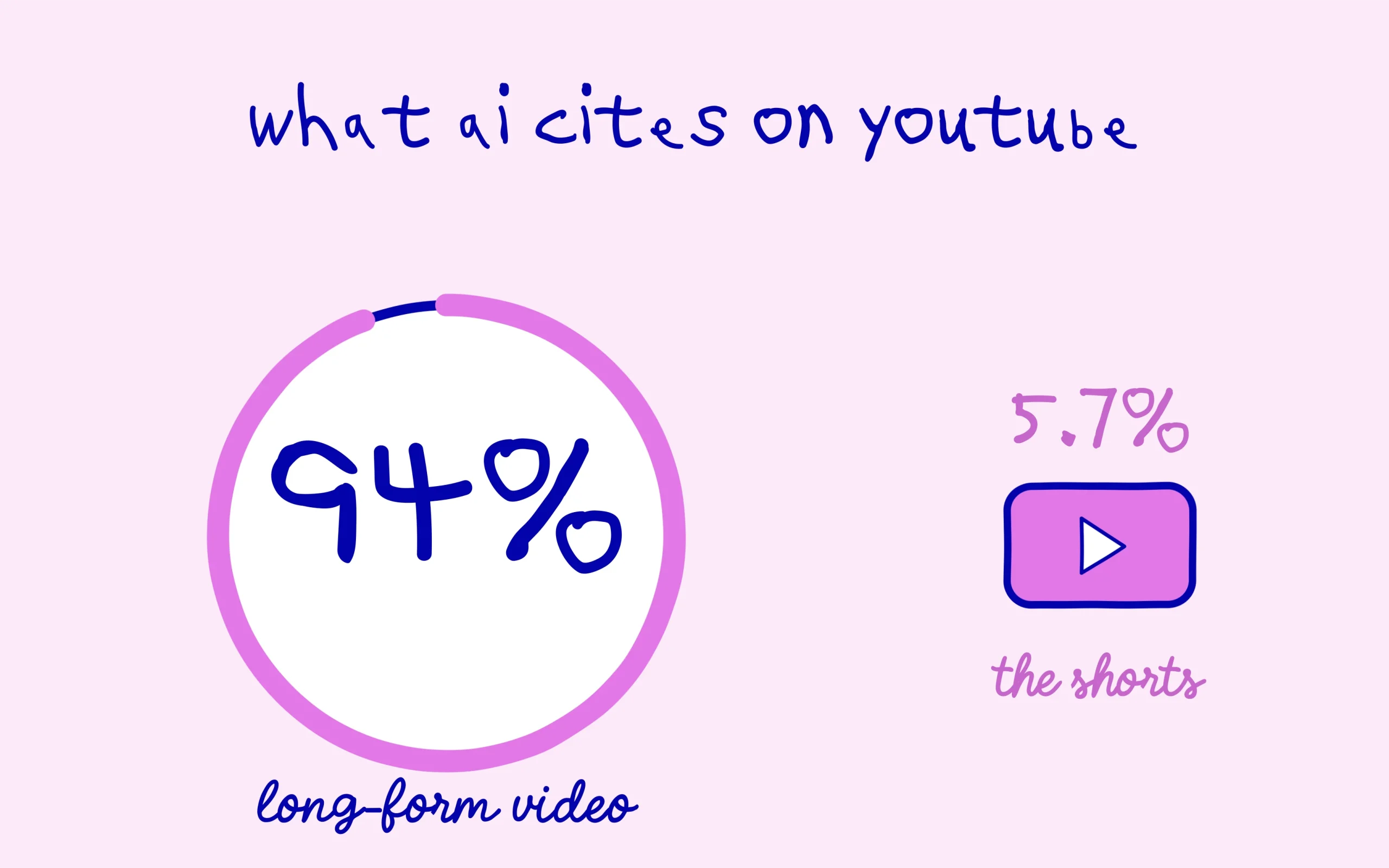
Let’s start with the number that caught my eye. When an AI engine cites a YouTube video, it is a long-form video in 94% of cases. Shorts, despite booming on the platform, account for just 5.7% of citations, and everything else, playlists, channels, live streams, splits the remaining 0.3%. The gap is brutal, and it runs against the instinct of many creators who bet everything on the short format. These figures come from an Otterly study on AI citations around YouTube, built on more than 100 million citations observed in a single month.
Another point I find important, so you aim at the right target: not every engine cites YouTube the same way. Perplexity is the biggest source of video citations at 38.7%, closely followed by Google’s AI summaries at 36.6%, then Google’s conversational mode at 19.6%. ChatGPT accounts for only 4.4% of YouTube citations, and the other engines are marginal. If your topic lives mostly in Perplexity and in Google’s summaries, video becomes a channel worth watching closely.
Keep a sense of proportion, though. Video and social still make up only about 5.5% of all AI citations, every format combined, and within that social block Reddit leads ahead of YouTube. The YouTube video is not the main channel for AI citations, but it is an accessible one, still barely worked by beginners, and that is exactly what draws me to it.
Why long-form video wins out over Shorts
The reason is fairly logical once you think about it. An AI engine cites a video because it holds a developed answer, a precise passage it can pull out and present. A thirty-second Short delivers a punchline, rarely a full explanation with an identifiable moment to quote. A long-form video unfolds, structures, revisits the points, and hands the AI something to point at. It is the same mechanism as an article: the more thorough and locatable the content, the more citable it becomes.
There is a technical detail that confirms this, and I find it very telling. On Google’s side, a large share of video citations point to a precise timestamp, a chapter of the video, rather than the whole thing. Google’s AI summaries link to a dated moment in nearly three quarters of cases. In other words, the AI does not cite your video, it cites minute four of your video where you answer the exact question. A well-chaptered long video multiplies these entry points, where a short format offers none.
It is worth pausing on those chapters, because they are the practical heart of the whole thing. When you split a video into named sections, you are effectively handing the engine a menu of answers it can quote one by one. A viewer might watch the whole clip, but an AI only needs the ninety seconds that match the question, and a clear chapter title tells it where to look. This is why two videos of equal length can perform very differently: the one with sharp, descriptive chapters gets mined repeatedly, while the shapeless one gets skipped even when its content is just as good.
What that changes for you is concrete. A ten-minute video answering one real question, with marked chapters, gives the AI several places to help itself. It is the same underlying logic I describe when authority built on one clear theme ends up being reused by the engines. A clear chapter beats a whole video with no signposts, because it gives the AI exactly what it is looking for.

Good news: popularity does not make the citation
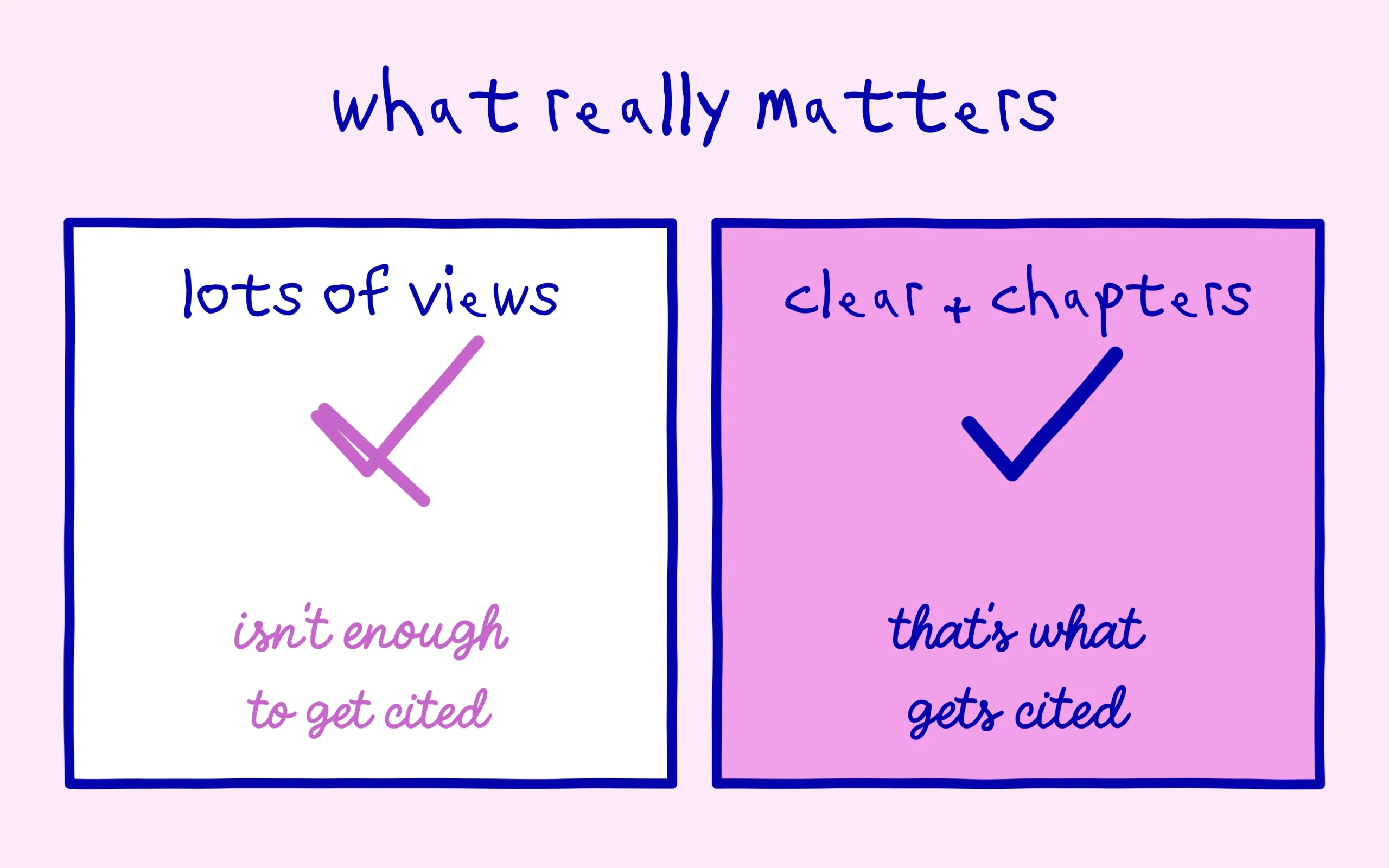
Here is the part that should reassure any beginner. The study shows that view count has almost no link with being cited. Close to 41% of cited videos have fewer than 1,000 views, a third come from channels under 10,000 subscribers, and many have only a handful of likes. Statistically, the correlation between popularity and citation is near zero. I see it with my clients too: a small, precise video gets picked up where a big generalist production gets skipped.
What correlates most with citation, on the other hand, is the quality of the video description. A rich description, one that explains what the video covers and what you will find in it, clearly helps the AI understand the content and judge it citable. Half of the cited videos actually run under eight minutes, so it is not about going long for the sake of it, but about being clear and well explained. After ten years doing SEO, I recognise an old principle there: what is easy to understand is easy to reference.
What I take from this is that you can stop chasing views before you think about citations. A channel that regularly publishes sharp answers builds a stock of citable videos, whatever its current audience. On my own sites, I have seen old, almost forgotten videos resurface in AI answers months after going live, simply because they answered a precise question well. A good video’s lifespan far outlasts its initial view peak, and that is exactly what makes the channel worth it when you start from zero with no community. You are not racing a trend, you are laying bricks that keep getting picked up, and that patience plays straight to a beginner’s strengths.
This reversal echoes what I see with text, where people often assume you need volume and fame to exist. In practice, it is mainly clarity and genuinely readable content that count in the eyes of AI, far more than technical tricks. A modest channel can get cited if its video answers better than the rest. It is rare, in this field, to have such open ground.
How a beginner can aim for a citation with a YouTube video
Let’s get concrete, because this is where it plays out. First pick a real question people in your topic ask, one of those they type into an AI, and build a YouTube video that fully answers it. Not a flyover, a complete answer, with the example and the real case. You already start with an edge over Shorts and over videos that talk about everything without settling anything.
Then split your video into chapters, with titles that announce each answer. That segmentation is exactly what Google’s engines love to point at, and it costs nothing to set up. Treat the description the way you would treat an article intro: say what the video covers, list the points, add the key moments. This description is the signal that weighs the most, so make it a real summary rather than a rushed line.
Do not overlook consistency either. A single well-made video can land a citation, but a series that each answers one question in your field sets your channel up as a reference the engines keep finding. You need neither a studio nor a professional creator’s pace, just a clear thread held over time: one question, one answer, one chapter. It is slow, foundational work, much like classic SEO, where steadiness always ends up showing. Start small, one video per topic, and let the stock grow. In my experience that growing library becomes the most reliable asset a small channel can own.
Last reflex, think of the video as a complement to your text, not an isolated channel. The same question can live as an article on your site and as a video on YouTube, and get cited in both places depending on the engine. This logic of multiple presence ties back to what I explained about how AI citations depend heavily on your topic and the form of the content. The YouTube video is a citation channel still open to methodical beginners, as long as you aim for clarity before performance.
Keep learning on SEO Noobies.