
Comparison lists published by other people carry far more weight in AI answers than anything sitting on your own domain, and two field tests released this week finally put numbers on it. Zeeshan Yaseen, co-founder of the RankViz platform, tracked one brand’s presence across ChatGPT, Claude, Gemini and Perplexity over several months, then ran the exercise again on a second brand starting from nothing. In the first run, close to three quarters of the citations came from comparison pages hosted somewhere else entirely. That finding cuts straight across the prevailing advice, which is to optimise your own pages and wait. Here is what both tests measured, and what a site with no PR budget can do about it.
TL;DR
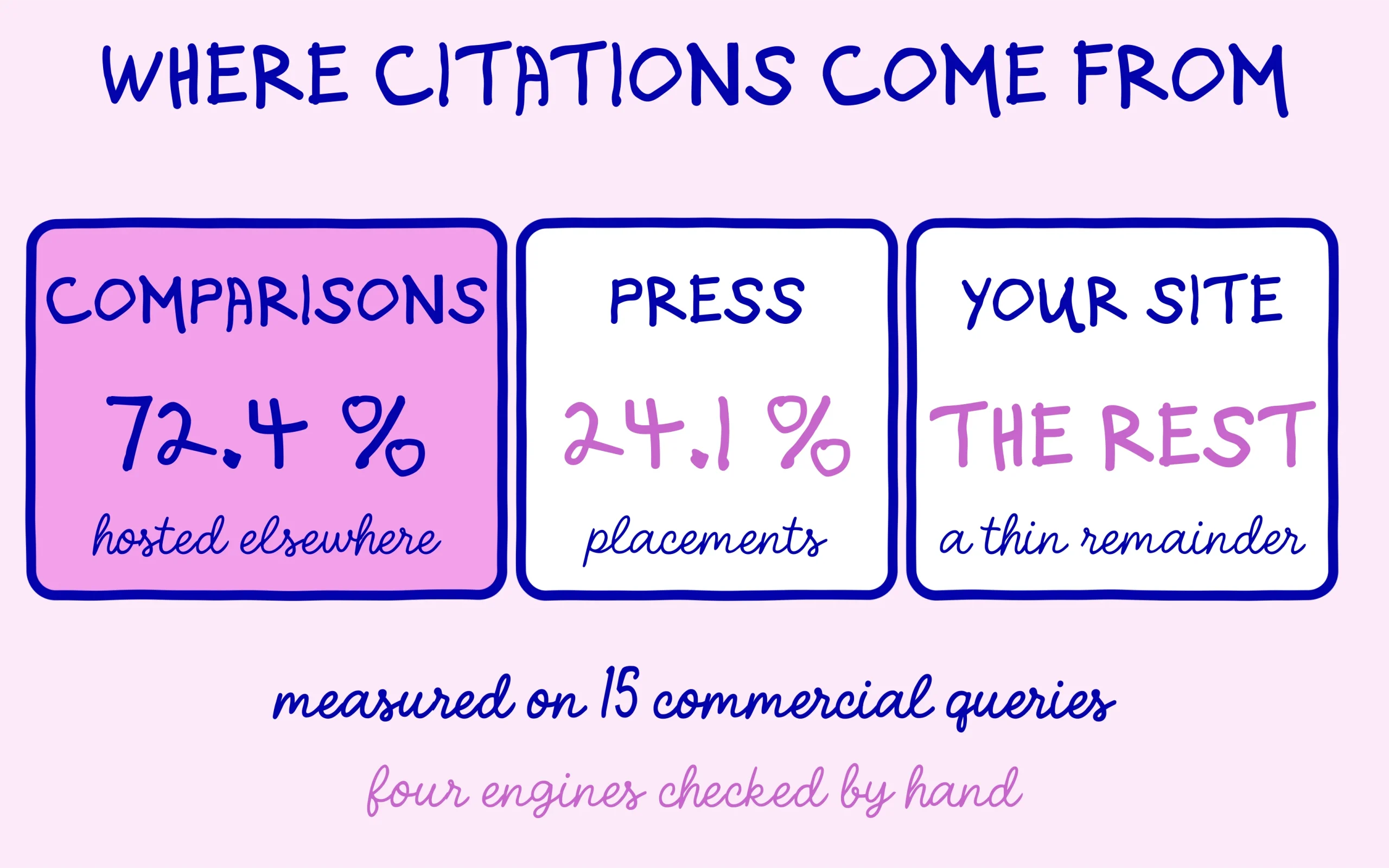
In the first test, third-party comparison lists accounted for 72.4% of the citations the tracked brand earned, with press coverage contributing 24.1%.
The second test, a thirty-day cold start for an agency with no prior presence, produced 298 appearances across six platforms, led by Gemini and Google AI Mode.
Both protocols rely on manual platform-by-platform checks across fifteen commercial-intent queries, which makes them field measurements rather than large-scale research.
For a small site the practical takeaway is short: appearing in other people’s comparison lists matters as much as publishing on your own.
Get an AI summary of this article
What the Two Citation Tests Actually Measured
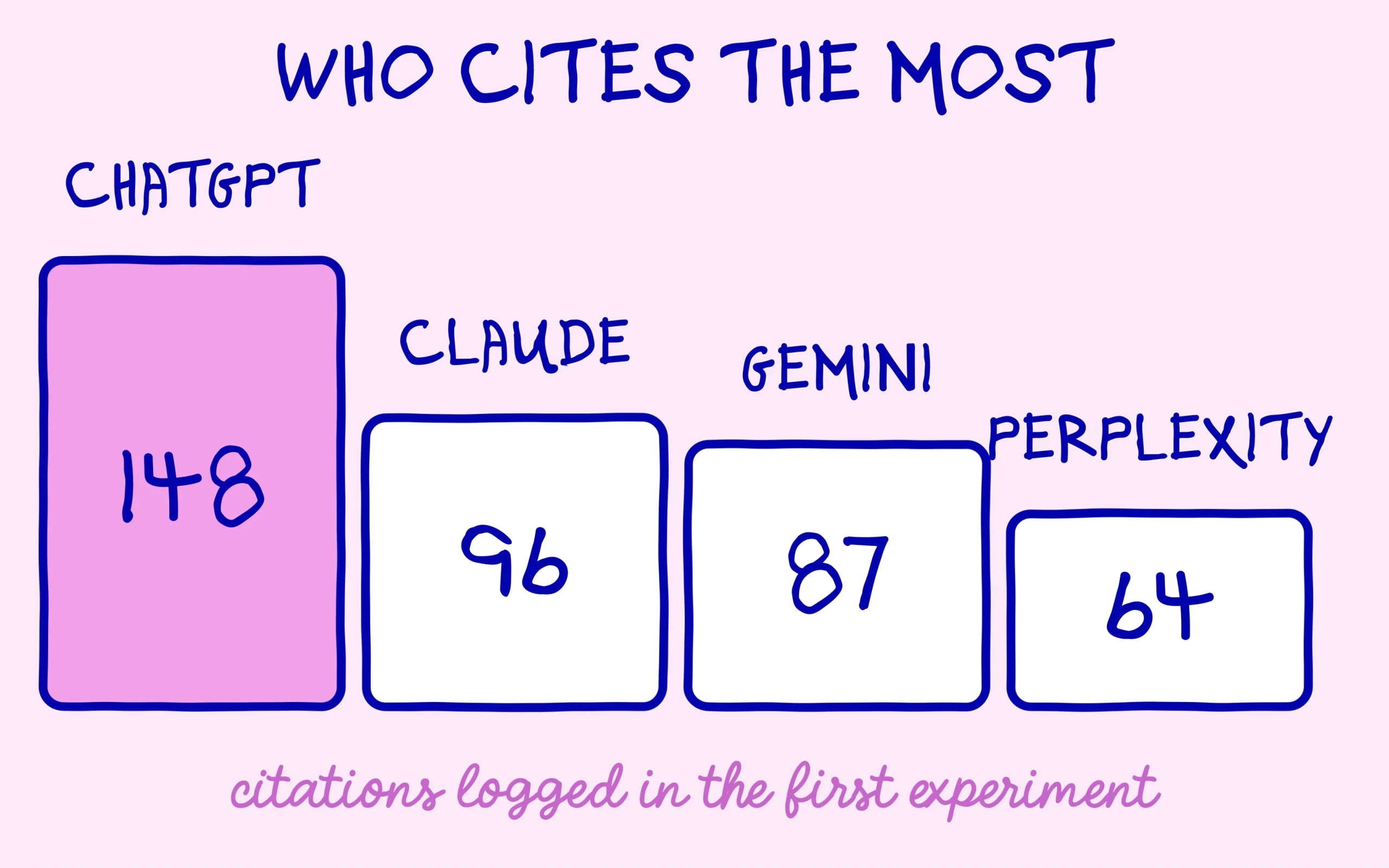
The first test followed fifteen commercial-intent queries across four platforms, ChatGPT, Claude, Gemini and Perplexity, over a period of several months. Checks were run by hand, query by query, with and without a VPN to strip out location effects. The tracked brand surfaced on ten to twelve of the fifteen queries depending on the window, peaking at 37.01% presence. Citation counts put ChatGPT first with 148, ahead of Claude on 96, Gemini on 87 and Perplexity on 64.
The breakdown by source type is what reframes the whole thing. Comparison lists supplied 72.4% of every citation earned, with press placements accounting for 24.1%. Everything else, including the brand’s own publishing and its organic LinkedIn activity, splits a thin remainder. Yaseen sets out the protocol and the full figures in his write-up of both experiments on Search Engine Land.
The second test answers a different question, which is what a cold start looks like. A SaaS link-building agency with zero prior footprint in generative answers was tracked for thirty days on the same fifteen commercial queries, this time across six platforms with Google AI Mode and Grok added. The counter reached 298 appearances over the period. The ranking flips compared with the first run: Gemini leads on 104 citations, Google AI Mode follows on 95, then Claude on 59, ChatGPT on 32, with Grok and Perplexity on 4 apiece.
A word on how much weight these numbers can carry, since it decides what you do with them. Two brands, fifteen queries, manual checks: this is field work, run by hand on two cases. The orders of magnitude deserve attention, the decimal places much less. Treating 72.4% as a general law would misread the evidence, while concluding that third-party sources dominate owned ones holds up perfectly well.
Why Other People’s Comparison Lists Carry the Weight
The mechanism is plain enough once you picture what a model does with a buying question. Someone asking for the best tools in a category wants a shortlist, meaning several names set side by side with their differences. A page already built that way hands over an almost finished answer, whereas a brand page hands over one name and a sales argument. The engine needs to weigh options, and a page that only talks about itself gives it nothing to weigh.
Perceived independence layers on top of that. A page recommending its own publisher carries a visible conflict of interest, and generative engines lean towards sources that look neutral on a purchase question. That bias lines up with what we had already seen about page selection: our piece on how the ChatGPT index settles on the pages it cites found the decision turning on contextual signals well before it turns on the page copy itself.
That said, concluding your own site is pointless would be the wrong lesson. Both tests measure the source cited inside the answer. The path that led the engine to consider the brand sits outside what was measured. A company whose site explains nothing about what it does stands little chance of being represented accurately by a comparison page, and that page researches its entries somewhere. Our analysis of topical authority as a condition for being picked up by AI described the same two storeys: your site builds the substance, third-party sources circulate it.
Discover the SEO Noobies agency
What a Site With No Budget Can Do About It
The first move costs nothing and takes half an hour. Ask three different engines the question a customer would ask to find a supplier or product like yours, never naming your company, and write down which pages the answers cite. You end up with the list of comparisons, directories and rankings those engines treat as authoritative in your field. That list is your target, and it differs in every sector.
Next comes the submission work, which is tedious and rarely done properly. Plenty of those pages accept applications, listings or corrections, and most companies never send any. Checking that your details are accurate where you already appear usually beats chasing a fresh mention. A stale entry on a cited page hurts more than being absent, because the engine will repeat the outdated version quite happily.
One caution belongs here before anyone reorganises a whole quarter around this. In the second test, thirty days of presence converted into 18.5% of new users arriving through referral links, plus 3.25% identified through Google Analytics’ AI Assistant channel. Those shares stay modest against total traffic, and they come from a single company. Working the comparison lists builds standing where purchase decisions get made, without producing the visit volume a strong classic ranking delivers. The two goals run alongside each other.
Tracking closes the loop, and it costs nothing either. Re-running the same queries once a month and logging them in a plain spreadsheet is enough to see whether presence moves. Our measurement of what the sites cited in AI Overviews genuinely have in common already made this point: regular measurement of a small sample teaches more than an expensive tool nobody opens. Thirty minutes a month gives you a serious basis for deciding where the effort goes next.
Keep learning on SEO Noobies.