
GEO, short for Generative Engine Optimization, is the work of getting quoted by ChatGPT, Perplexity, Claude or Google’s AI summaries, where classic SEO chases a slot among ten blue links. The question everyone has been circling for a year is easy to ask and hard to settle: which kind of page do these engines actually pull from when they assemble an answer. A study released in late August by Ten Speed gives one of the first numeric answers on a serious corpus, and the result cuts against a good chunk of received wisdom. After a year of testing these engines on my own sites, I find its conclusions line up fairly well with what I see, with caveats worth stating upfront. Here is what the numbers say, what they mean for the shape of your pages, and what they do not prove.
TL;DR
Across 7,387 citations logged by Ten Speed, product pages account for 24.1% of the sources generative engines pulled from.
Blog posts and press releases follow at 17.4%, far ahead of Reddit, YouTube and forums combined at 4.2%.
What separates a quoted page from an ignored one is mostly whether it answers without the rest of the page being read.
The study covers software and business services buying, so its proportions do not transfer cleanly to every sector.
Summarize This Article with AI
ChatGPTWhat 7,387 Citations Say About The Pages That Get Picked
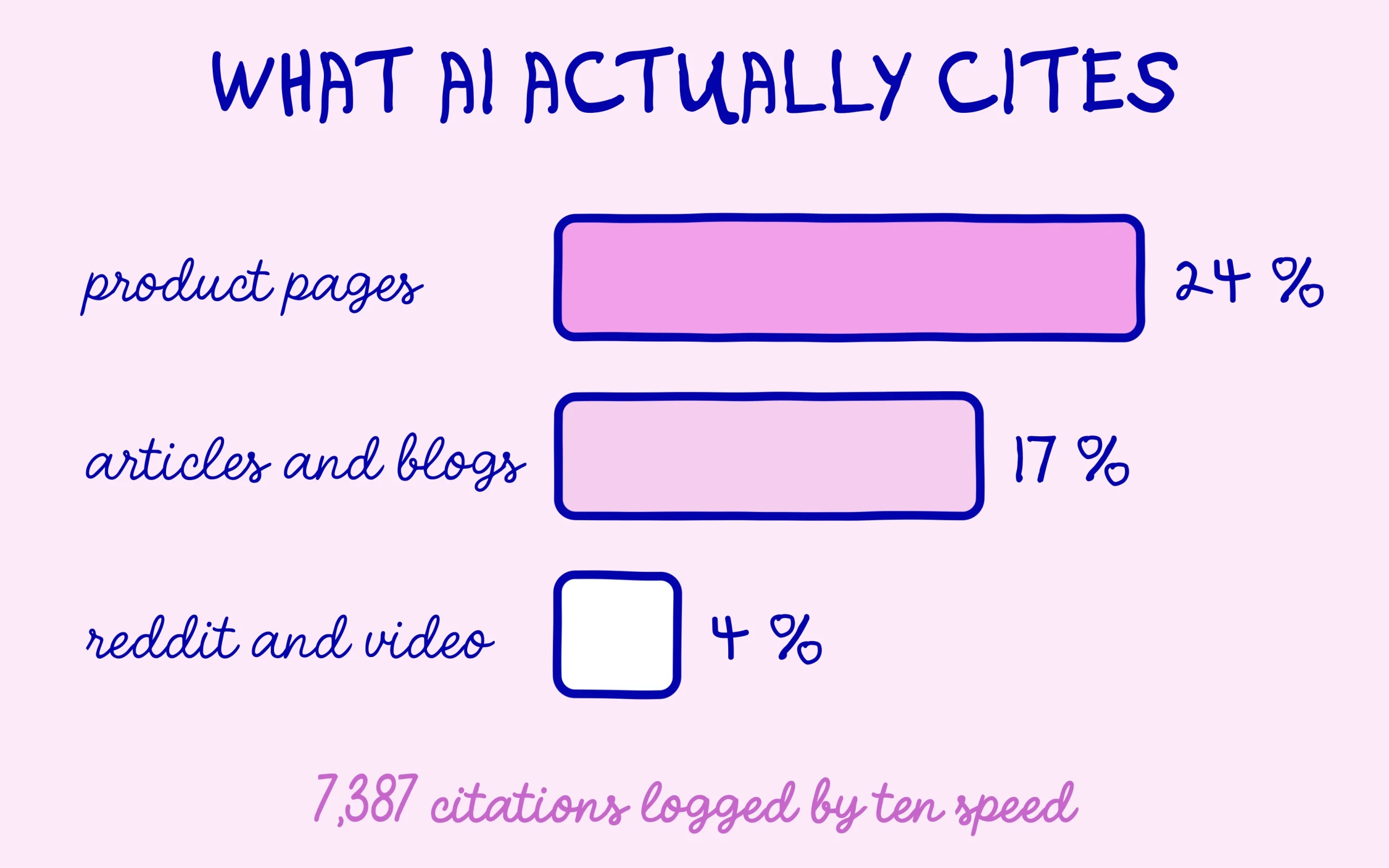
The study was run by Nelson Brassell for Ten Speed, a generative search analytics firm, and it sits in their breakdown of what gets cited at the evaluation stage. The protocol: 170 buying questions put to ChatGPT, Perplexity, Claude and Gemini, then a full sort of the 7,387 sources those four engines returned.
Sorted by page type, product pages lead at 24.1%, with articles, blog posts and press releases behind them at 17.4%. Comparison pages and listicles land around 13% each, how-to guides near 9%, homepages at 7.8% and directory profiles at 7.2%. Reddit, YouTube and forums bring up the rear, all of them together, at 4.2%.
That last figure deserves a pause, because it runs head-on into the prevailing advice. For eighteen months the standard tip has been to go post on Reddit if you want AI to quote you. We already tracked the collapse of Reddit citations inside ChatGPT back in August, and Ten Speed’s numbers confirm the direction on a separate corpus. Content you own carries more weight than the discourse admits, at least on professional buying questions.
For a GEO strategy, that ranking reshuffles the order of work. Plenty of sites spent the year producing long-form articles hoping to feed the engines, while their commercial pages, the ones carrying prices and feature lists, sat untouched since launch. If GEO plays out on those pages first, the maths changes.
Looking more closely at the spread, the formats at the top share a trait of shape rather than of nature. A product page, a comparison page and a listicle all answer a closed question by putting the information on the table straight away. The how-to guide, which unfolds an explanation step by step, gets picked up roughly three times less often than the product sheet showing a price and a feature list.
Why A Self-Contained Answer Gets Quoted More Easily
A generative engine does not read a page the way a person does, top to bottom. It cuts the page into pieces, keeps only the pieces that match the question, then rewrites from those pieces. That cutting is the whole basis of GEO, and it accounts for most of the gaps Ten Speed measured.
Worth saying plainly what this does not mean. GEO is not a licence to publish thin pages stuffed with bullet points, and engines drop shallow content as fast as readers do. The point is narrower: an answer buried in paragraph nine is invisible to a system that only ever reads paragraph one of each section.
Take a concrete case. On a product page, a pricing block holds a number, a currency, a billing period and what the plan includes. Lifted out on its own, that block still makes sense and can be used in an answer. On a how-to guide, a paragraph opening with “as we saw above” collapses the moment it leaves the page. The engine will not climb back up to fetch the missing context, it simply moves to the next candidate.
This cutting mechanic matches what we unpacked about how the ChatGPT index picks the pages it cites. The engine hunts for passages that stand on their own legs, with something checkable inside. A paragraph leaning on the one before it never gets quoted, however well it is written.
There is a direct consequence for how you write, and it cuts against everything journalism school teaches. Holding your effect, building tension, saving the conclusion for the close: all of it works against GEO. The shape that performs in GEO is closer to a dictionary, where every entry gives its definition before qualifying it.
This is the first GEO reflex to build, and the most uncomfortable one for anybody who enjoys writing. GEO does not ask you to write worse, it asks you to place the useful information ahead of the narrative run-up. On paper the difference looks slight, in practice it decides everything.
GEO Starts With The First Sentence Of Each Section
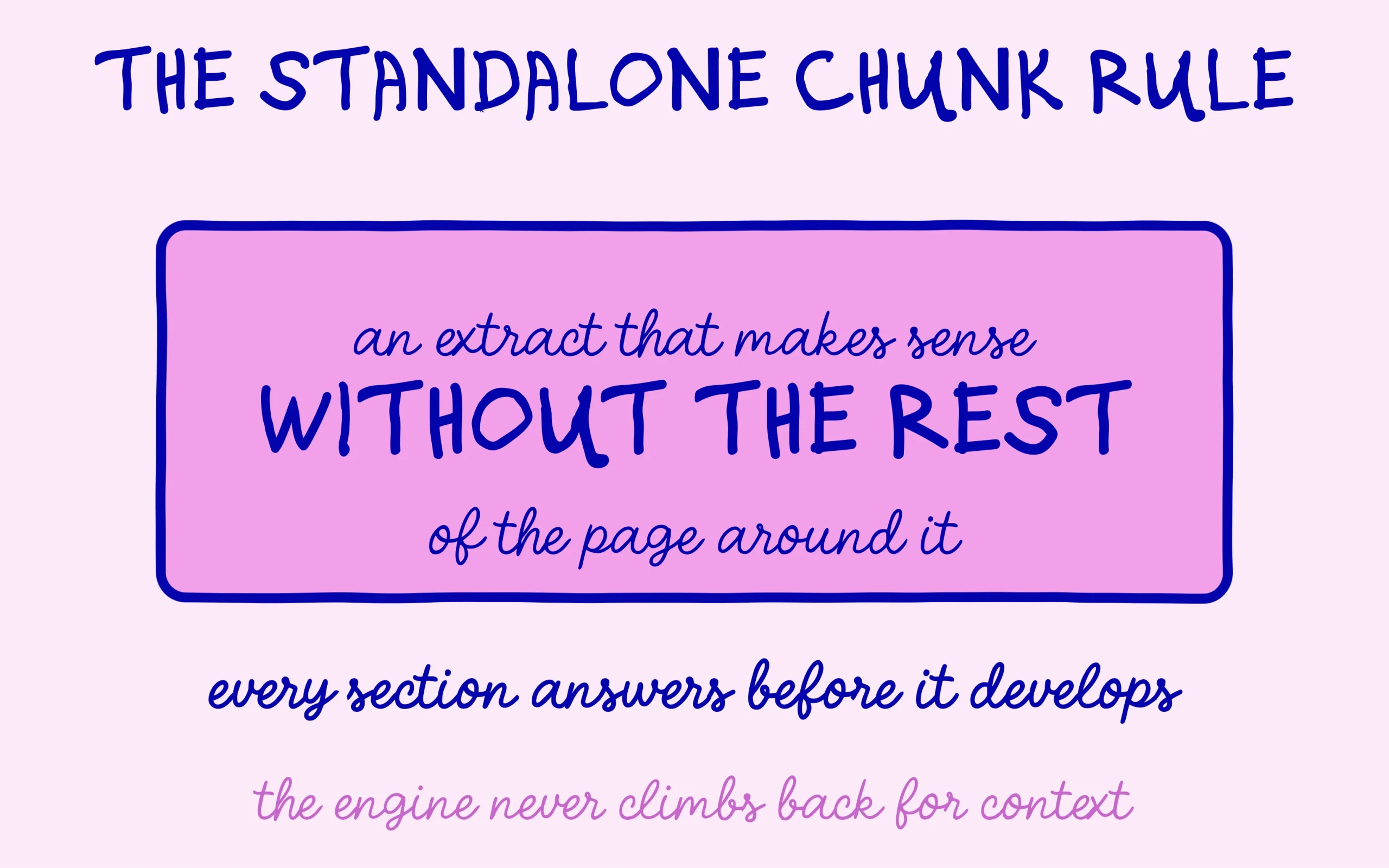
The practical rule that falls out of all this fits on one line. Every section of your page should open with a sentence answering the question its heading asks, before you develop anything. Two or three lines will do, provided they hold up alone.
In practice, if your heading asks what an audit costs, the next sentence gives a range and a unit. If it asks how long indexing takes, the next sentence gives an order of magnitude. The development, the exceptions and the nuance come after, and they serve the human reader who stays on the page. That double reading is the core of GEO today: the same page has to work for someone skimming it and for an engine taking it apart.
Three further GEO reflexes hold that structure up. Spell entities out in full in every section instead of writing “it” or “this tool”, because an extracted chunk loses its pronouns. Put numbers in wherever you honestly can, since an engine repeats a figure more readily than a judgement. And write headings as the real questions your buyer types, rather than as mood-setting phrases.
On the technical side, Google published a guidance page for generative search back in May that leans on clear markup rather than on any new trick. It lines up with what we found when we dug into what engines really do with schema markup. In GEO, markup helps comprehension, it does not manufacture citations. A perfectly marked-up product sheet with no price in it stays silent.
Then comes the deeper question, the one deciding whether engines come to you rather than to somebody else. GEO structure moves a page from unusable to usable, it does not create standing. That is the subject of topical authority and how it gets built, and it is months of work no amount of formatting substitutes for.
What This Study Does Not Say, And Why It Matters
Brassell sets out the limits of his own data, and they deserve repeating honestly. The corpus covers software and business services purchases across fintech, security, hospitality and IT. Nothing guarantees the same proportions hold for a recipe, a medical question or a local tradesperson.
He also notes the gap between 24% for product pages and 4% for Reddit was described rather than tested statistically, and that platform-level data was never collected in a way that allows comparing the four engines. The whole thing is a snapshot taken on one date, of systems that shift monthly. Our own tracking of what the sites cited by AI Overviews have in common already showed results moving between periods.
My honest read is to keep the principle and stay wary of the percentages. The GEO principle, which matches everything observable this past year, is that a self-contained, numbered passage gets reused more often than an argument that unspools. The percentages depend on sector, on engine and on month. Building a plan on one figure sampled on one day across four verticals repeats the mistake the industry made with click-through studies a decade ago.
One last word on measurement, since the question always follows. GEO measures badly, and the tools claiming otherwise mostly sell you an average built on prompts that are not yours. Treat any single visibility score as a rough direction, never as a number you would report to a board.
The right use of a study like this one is to go check on your own site. The best GEO audit is still free. Put the ten questions your customers ask before buying to ChatGPT and Perplexity, note which pages come back, and see whether any of them are yours. It takes an hour, and it beats any market average for telling you where you actually stand.

Keep learning on SEO Noobies.