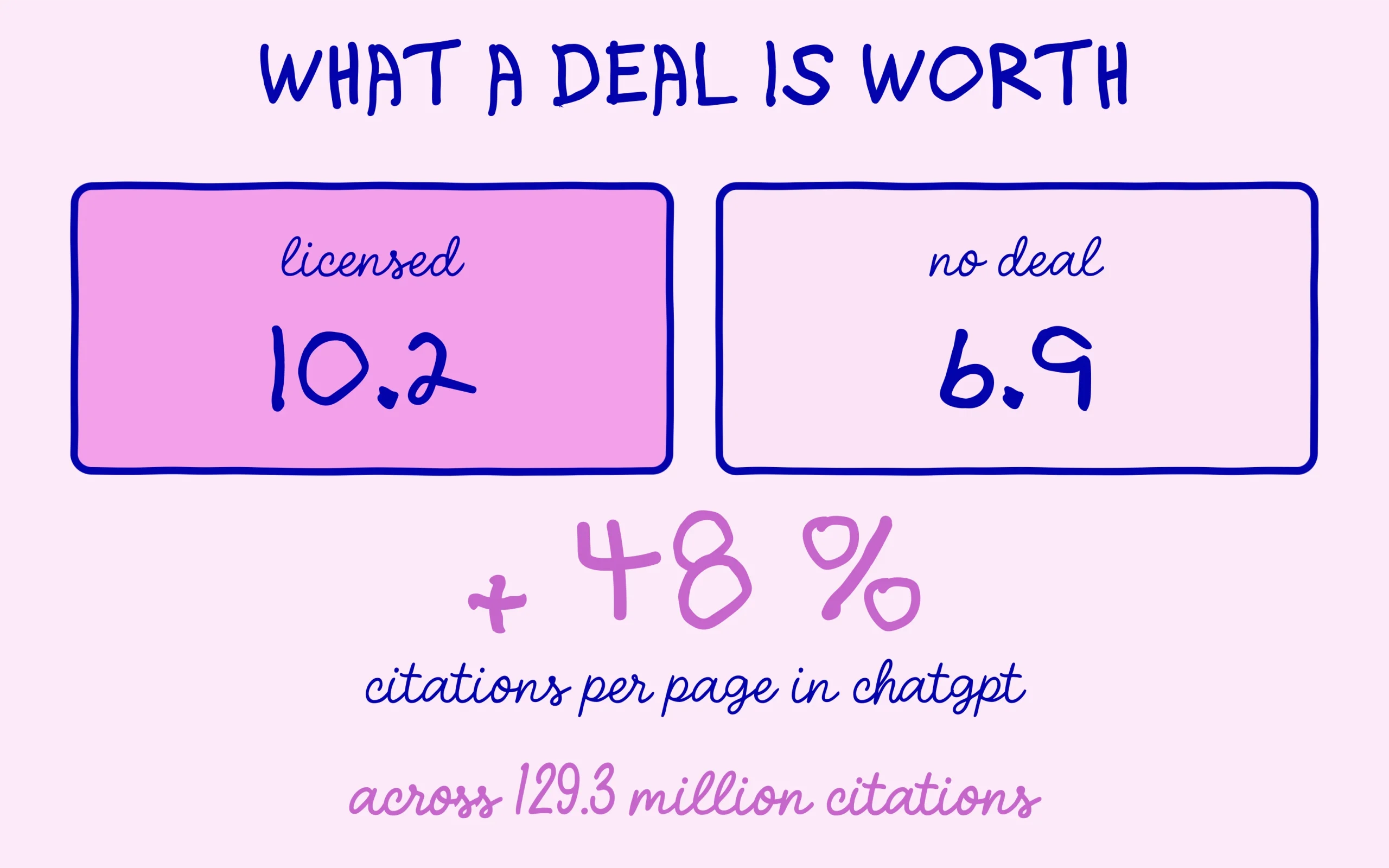
OpenAI licensing appears to move how often a news publisher gets quoted inside ChatGPT, and a study released on 20 August finally puts a number on it. Press Ranger and Otterly.AI went through 129.3 million citations recorded across seven generative AI platforms during June, then matched every cited page against the list of deals signed between AI companies and news publishers. The gap they report is easy to read: 10.2 citations per page for publishers under contract with OpenAI, against 6.9 for publishers with no deal at all. No small site is ever going to negotiate one of those contracts. What makes the study worth your time sits somewhere else, in what the six other platforms returned.
TL;DR
Press Ranger and Otterly.AI analysed 129.3 million citations recorded in June 2026 across seven generative AI platforms.
Pages from publishers with an OpenAI deal average 10.2 ChatGPT citations, against 6.9 for publishers without one, a 48% gap.
The advantage shows up nowhere else: Google-licensed publishers sit slightly below comparable unlicensed ones in AI Overviews, and Perplexity treats its partners exactly like everyone else.
For a site with no contract, the levers stay what they were before the study: structured content, clean facts, and a presence on the sources these engines read back.
Summarize This Article with AI
ChatGPTWhat 129 Million Citations Actually Measured
The study came out on 20 August from two companies that each own half of the problem. Press Ranger runs a press relations database, Otterly.AI tracks how brands surface inside generative engines. Together they logged 129.3 million citations over June 2026 across seven platforms: ChatGPT, Google AI Overviews, Google AI Mode, Perplexity, Copilot, Gemini and Claude. Every cited page was traced back to its publisher, and every publisher to the licensing deals it had confirmed. The method and the full breakdown sit in the announcement published alongside the study.
The headline number belongs to ChatGPT. A page from a publisher covered by OpenAI licensing averages 10.2 citations there, while a comparable page from an unlicensed publisher averages 6.9. That is a 48% gap. It climbs to 112% for publishers who signed with OpenAI and with nobody else. Pool all seven platforms together and the advantage drops to 46%, which looks close to the first figure until you ask where it comes from. The whole gap lives on one platform and thins out the moment you widen the frame.
One more figure explains the rest: 57.9% of the total AI citation volume earned by publishers under OpenAI licensing comes from ChatGPT alone. Those publishers have built more than half of their generative visibility on a single platform they do not control, running on rules that can shift overnight. How fast that kind of balance moves is exactly what we covered in our piece on the collapse of Reddit citations inside ChatGPT Search.
Why OpenAI Licensing Only Moves ChatGPT
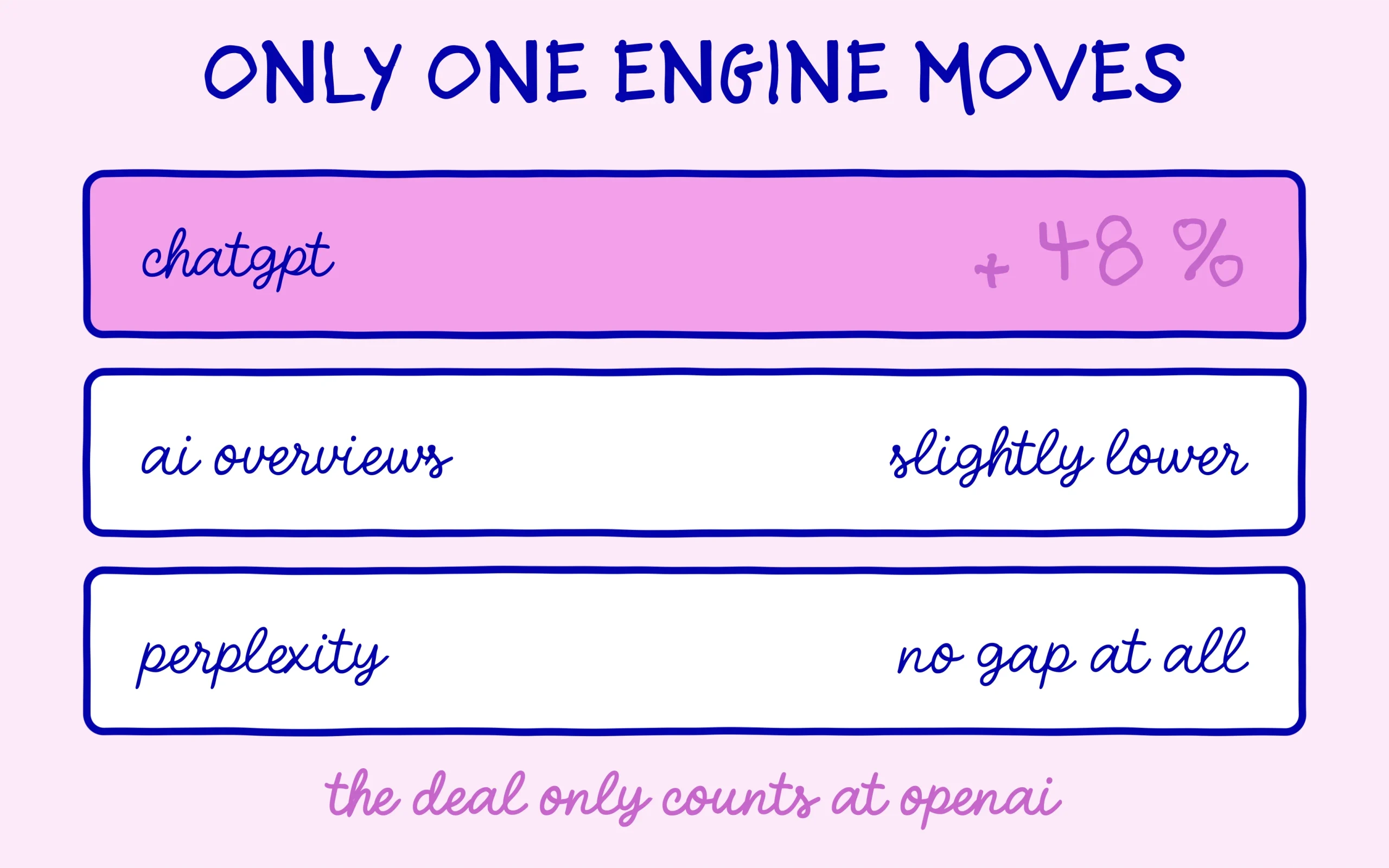
On Google the result tips the other way. Publishers holding a Google deal get cited in AI Overviews at a slightly lower rate than comparable publishers without one. Over at Perplexity, contracted partners land at strict parity with everybody else. OpenAI licensing therefore stands out as the only deal in the sample that produces a visible edge on the platform of the company paying for it. Every other signature the researchers tracked showed no measurable effect on citation counts.
Thomas Peham, co-founder and chief executive of Otterly.AI, the Austrian platform that tracks brand citations across AI engines, makes the point plainly when presenting the findings: a commercial agreement does not convert into visibility on its own. That caveat deserves to be taken seriously. A correlation measured over a single month of logs does not prove that OpenAI deliberately favours its partners in answers. Publishers who sign these contracts also tend to be the ones already publishing at volume and already well identified long before any deal existed.
The flat result on Google and Perplexity says something useful about how those engines pick sources. They keep pulling whatever they judge relevant, contract or no contract, through selection mechanics we broke down in our article on how the ChatGPT index picks the pages it cites. Paying a publisher does not make it citable everywhere, which is decent news for everyone with nothing to sign.
What a Site With No Deal Can Take From This
A site that launched this year will never sign an OpenAI licensing deal, and there is no scaled-down version of that contract for small publishers. So the question worth asking is which slots remain open. Plenty do. Licensed news brands make up a limited share of cited sources, well behind the community and encyclopedic platforms we looked at in our breakdown of the sources AI tools cite far more than media outlets. The rest of the volume spreads across thousands of sites that never negotiated anything with anyone.
Three checks take about an hour and beat watching the licensing news. Start with your robots.txt and confirm it genuinely lets the generative crawlers through, because a block inherited from a security plugin costs you more than any contracted competitor ever will. Then look at whether your pages state their facts in a liftable way, with figures, dates and sentences that still stand once pulled out of their paragraph. Finish by checking where your brand shows up away from your own domain, because that third-party presence is what these engines cross-reference when they decide who to quote.
That said, one month of logs is not a foundation for a strategy. June 2026 is a snapshot, deals keep moving, and nothing guarantees OpenAI licensing will produce the same gap in December. The sane reading is to note the order of magnitude and watch whether the next round of data holds it up. For a site starting out, the practical takeaway fits on one line: what makes you citable is not for sale, at least not at your scale, so you may as well work on the part you control.
Keep learning on SEO Noobies.
[…] the count would buy nothing. Who ends up quoted in those answers is the harder question, and the licensing deals OpenAI has signed already weigh on […]
[…] effect on how often those publishers turn up in answers, which we documented in our look at the citation gap between licensed and unlicensed publishers. An engine that pays its sources builds a structurally different relationship with them. Google now […]