
AI answers about a small company are almost never empty, even when the model holds nothing at all on that company. Duane Forrester, who launched Bing Webmaster Tools at Microsoft and worked on the launch of Schema.org, laid out the mechanism in a piece published on 3 September. When a model finds no trace of your business, it does not stop and it does not warn anyone. It fills the hole with the best documented source nearby, and that source is very often your closest competitor. Most beginners worry about being invisible inside ChatGPT, while the case described here is a good deal worse: the machine answers confidently, using somebody else’s numbers. Here is how the swap happens, the four shapes it takes, and how to catch it without losing a day over it.
TL;DR
Duane Forrester, formerly of Microsoft and involved in the launch of Schema.org, described on 3 September what models do when they lack evidence about a company.
With nothing to draw on, the model borrows from a competitor, from a category average, or from an outdated version of your business, and never flags the borrowing.
The answer carries the same confidence as a properly grounded one, which hides the error from your buyer and from you alike.
Test with category questions that never mention your name, because your name acts as a retrieval cue and conceals the very gap you are trying to measure.
Summarize This Article with AI
ChatGPTWhat Duane Forrester found in thinly documented companies
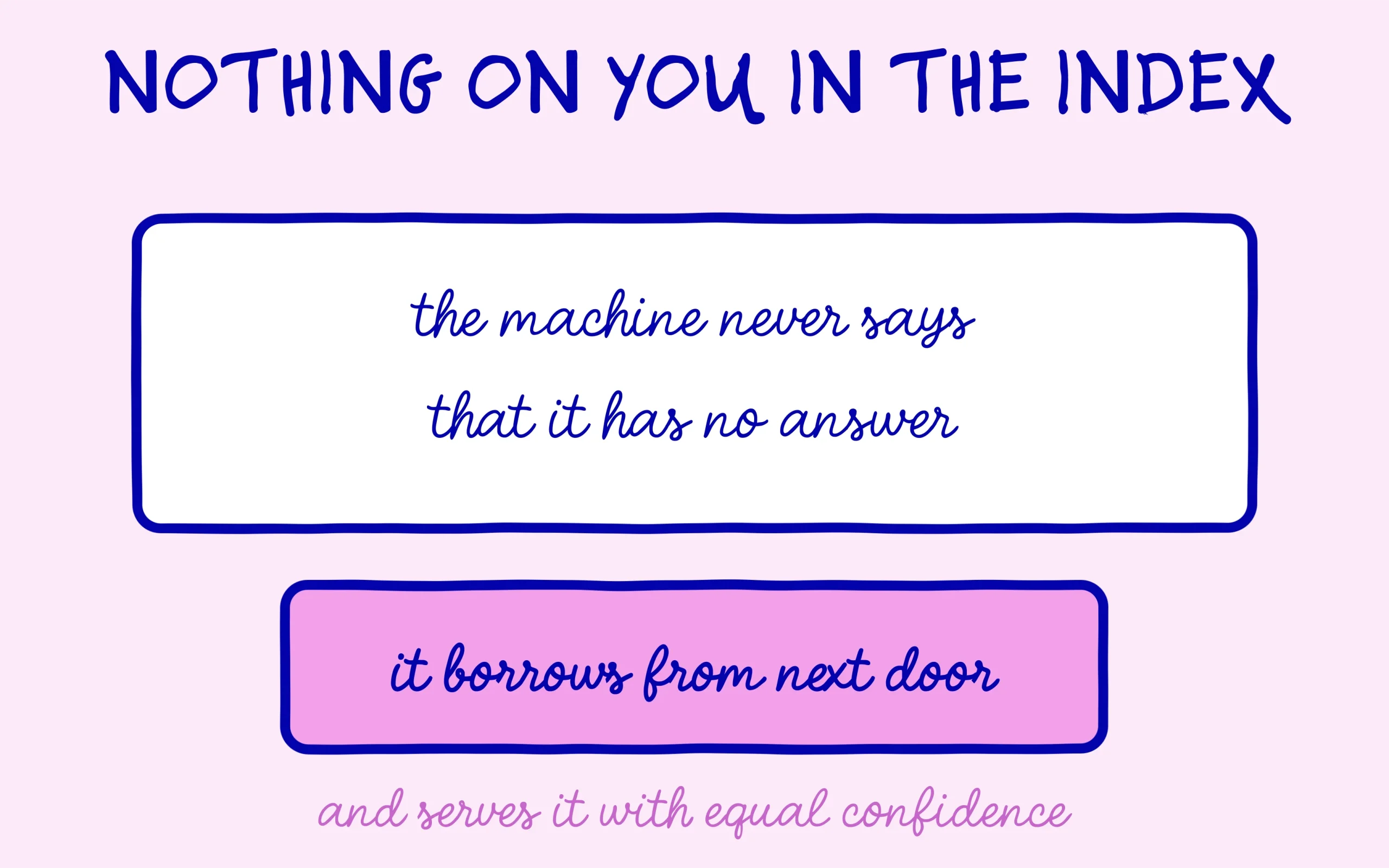
The starting point is a plain observation. Ask a language model about a company it holds nothing on, and you will almost never get a straight “I have no information on that”. Forrester, who now advises marketing leaders after building Bing Webmaster Tools, describes the behaviour in his analysis published on Search Engine Journal. The model reaches for the best documented source around the topic and serves it as though it were yours. AI answers come out with no visible seam anywhere in the sentence.
All of this happens off your own site, which is exactly why it slips past the usual checks. A content audit looks at your pages, your headings, your internal structure. It says nothing about what a model tells a buyer using third-party sources you have no hand in. Visibility inside generative engines does not track SEO performance either, as the study on brands that rank well on Google yet stay missing from generative answers made clear.
Forrester leans on three academic papers to explain where the behaviour comes from. Work by Mallen and colleagues shows that scaling a model mostly improves its grasp of popular facts and leaves rare ones untouched. Longpre and colleagues, at EMNLP in 2021, found that a model favours what it memorised whenever that memory contradicts the document placed in front of it. Sciavolino, the same year, measured how retrieval systems lose accuracy on questions built around thinly covered entities. a small company lives squarely in that thin zone, holding a handful of scattered mentions where an established rival holds hundreds.
Worth stressing that none of this is a bug someone forgot to fix. A model that answered “no data” every time a small business came up would be useless to the person asking, so the design leans towards producing something rather than nothing. That trade-off is reasonable at the scale of a product used by hundreds of millions of people. It simply lands badly on the company being described from a distance, using material that was never about it.
The four shapes AI answers take around a gap
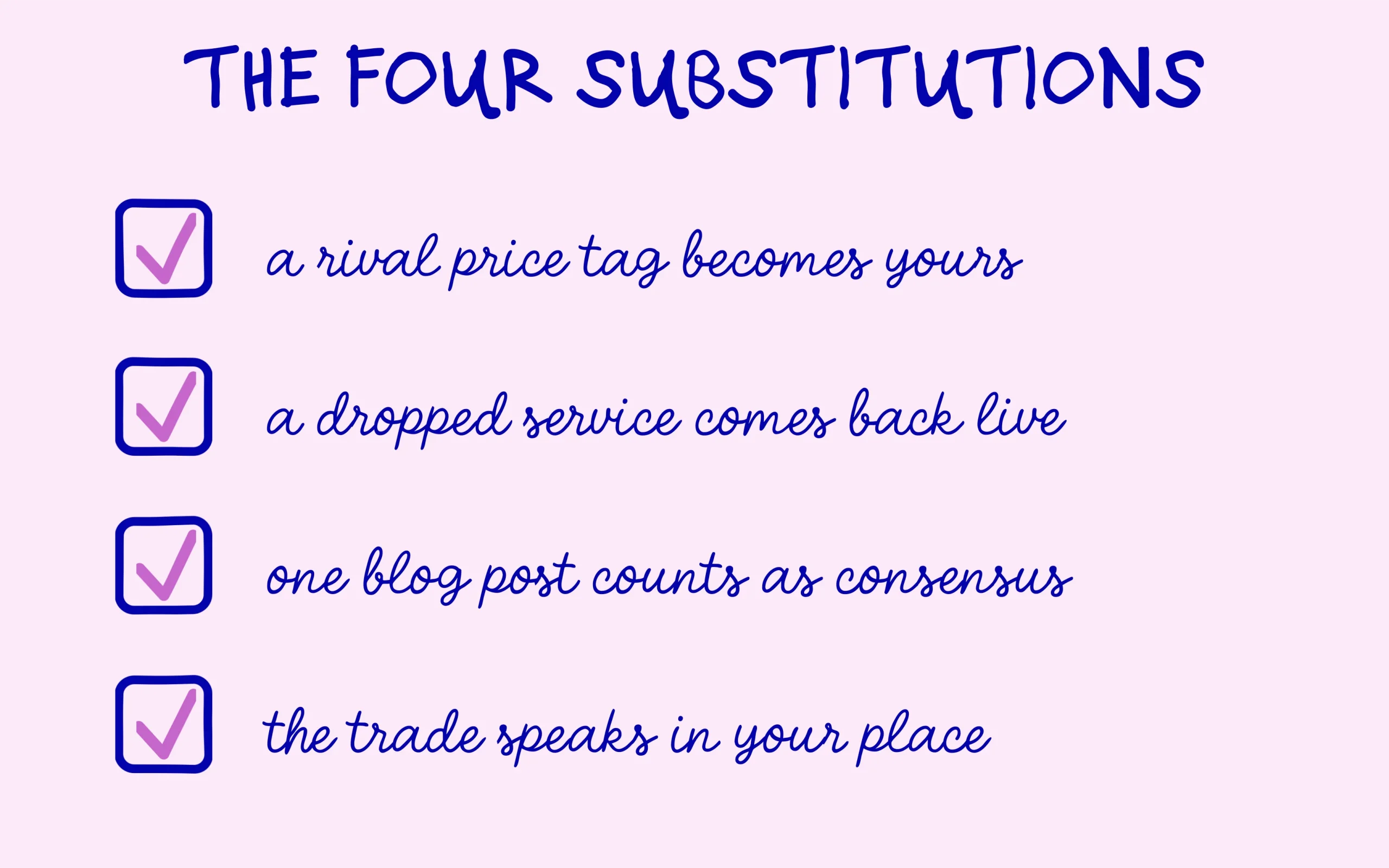
The first shape is a silent borrowing. Your pricing model turns into your largest competitor’s pricing model, for the simple reason that theirs sits on twenty public pages and yours sits nowhere. The second dresses the past as the present. A discontinued service, an old promise, a version of your business from three years back come back in the present tense, with no time marker to warn anyone. A shop that dropped a product line in 2024 keeps getting credited with it, and the enquiry lands for something nobody can deliver.
The third shape is the sneaky one. A single source, one stray blog post, carries the exact weight that forty independent sources would carry. The fourth applies broad category knowledge to your specific case: with nothing on how you actually operate, the model describes how the trade generally operates and hands it over as your method. Forrester walks through all four in the longer version on his newsletter Duane Forrester Decodes.
All four share the trait that makes them harmful. AI answers come out in the same steady tone in every case, with no caveat, no hedge, no mention of the patch-up that just took place. The buyer reads something believable and walks away with it. nothing in the wording flags the substitution, so the signal that would make you react never arrives. Building a recognisable place on your subject remains the sturdiest defence, which is the whole point of the topical authority generative engines look for before citing anyone.
Testing without ever saying your company name
The instinctive move is to ask ChatGPT what it knows about you. Forrester explains why that is the least informative test available. Your name inside the prompt works as a retrieval cue: it pulls whatever thin evidence exists straight into the conversation and hides the very gap you set out to measure. You walk away reassured by AI answers that proved nothing at all.
His method runs the other way round. Ask category questions that name only the trade, questions that name a competitor without naming you, and questions about a capability rather than a company. Above all, reuse the wording your buyers actually type before they buy. Ten questions are enough to see the pattern, provided you write them down before you start and record the answers as they come. The AI answers that surface then show who the machine reaches for when nobody feeds it your name, and the whole check runs without paying for a tracking tool.
What you do with the result is where the reading really shifts. Forrester suggests treating the output as a map of where third-party description is missing, rather than a list of pages to write on your own site. the shortage sits with everyone else, so the repair runs through mentions, listings and outside sources that describe you correctly and recently. A content audit, however thorough, stays blind to that work as long as it only looks at pages you own.
One practical detail makes the exercise repeatable. Run the same set of questions again a month later and compare the two records side by side, because a single reading tells you nothing about direction. Answers move as sources get published, updated or dropped, and the useful signal is the drift between two dates rather than the wording of any one reply. Beginners who keep that log spot a change weeks before it shows up anywhere in their analytics.
Keep learning on SEO Noobies.


[…] ever passing through your own ranking. That mechanism shows up clearly in local verticals, where an AI answer fills the gap with whoever else is documented. A site can therefore be cited for reasons it only controls […]
[…] The first takes five minutes. Ask the most used AI chatbots, ChatGPT, Perplexity and Gemini, the questions a customer would ask before buying from you, naming your brand, then read what comes back. The thing to watch is accuracy rather than presence, because an AI quoting you wrongly costs more than silence. Outdated information, a price that no longer exists, a service you dropped last year, all of it keeps circulating until something more recent contradicts it. The mechanism mirrors what happens when AI answers fill a gap with a competitor’s details. […]
[…] it finds elsewhere, sometimes to a competitor’s benefit, as we covered in our piece on AI answers that fill the gaps with a competitor. Barry Schwartz summed up his own unease by saying he’s not sure he wants AI describing his […]