
The standard line about AI Overviews is that they drain traffic from the sites they quote. Louis Dreyfus, chief executive of the Le Monde group, has just said the opposite in an interview published on 8 September by INfluencia: no sudden drop in audience since the summaries reached French results, subscriptions holding their pace, and a reading of the summaries as trailers rather than replacements. One publisher’s experience settles nothing on its own. It is still worth putting next to the loss figures the press industry has been quoting since the summer, because the gap between the two says something useful about who actually gets hurt.
TL;DR
The head of France’s Le Monde group reports no sudden audience drop since AI Overviews launched there on 22 July.
The group added 24,000 subscribers in July and the same again in August, with its app accounting for 36% of total traffic.
Publisher bodies point to traffic losses of 33% to 38% across the European markets where summaries were already live.
A national daily with an app and a known name is insulated in ways a niche site living on Google is not.
Summarize This Article with AI
ChatGPTWhat Le Monde measures since AI Overviews landed
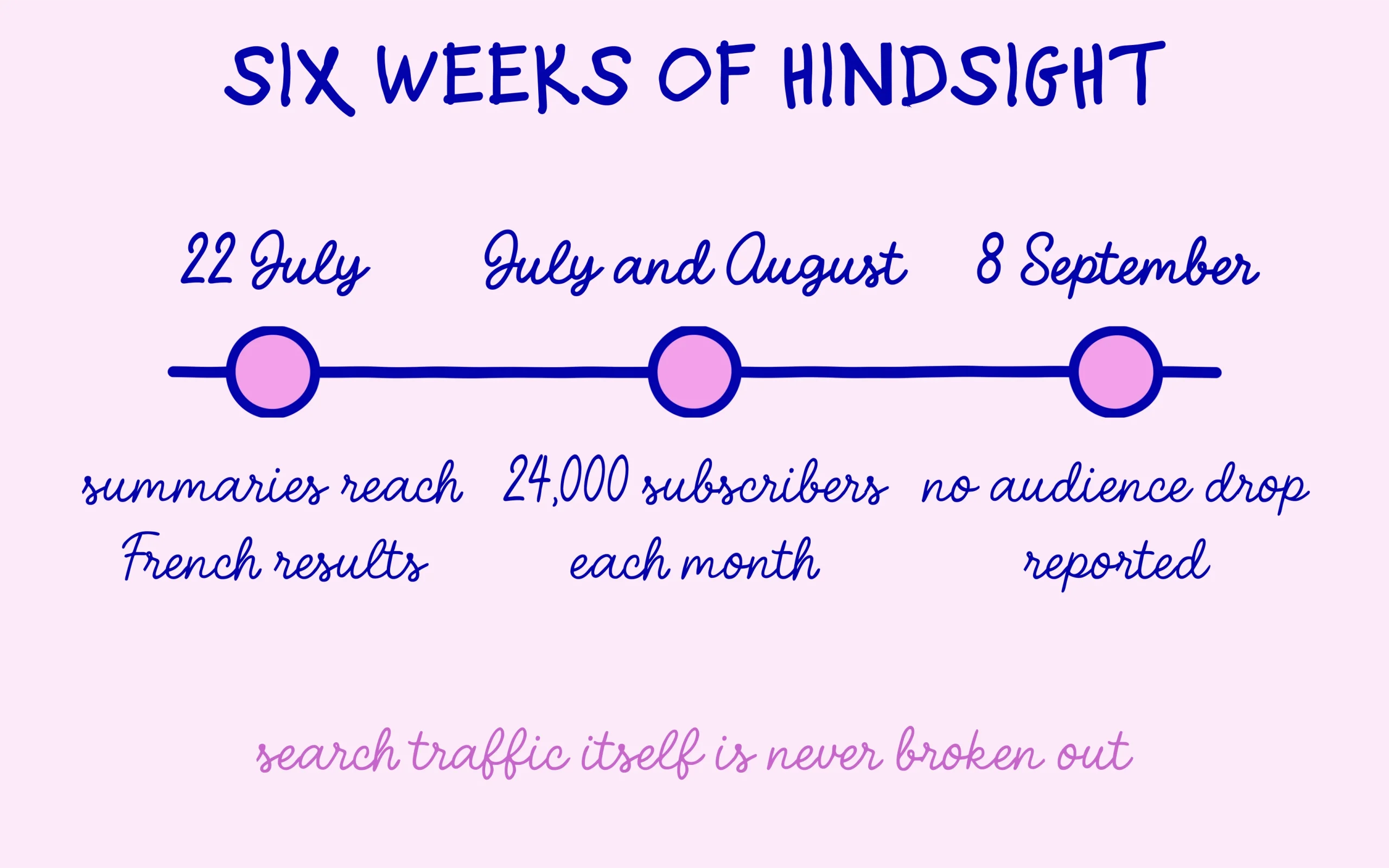
The claim is unusually concrete, and it comes from a publisher putting its own numbers on the table rather than commenting on someone else’s. No sudden fall in audience since generated summaries entered French results on 22 July. Twenty-four thousand new subscribers in July, the same volume again in August, and the English-language edition up 7% over the first half of the year against 2025.
A short refresher for anyone new to the term. AI Overviews are the answer blocks Google writes itself and places above the classic results, with a handful of source links along the edge. They do not replace the results page, they sit in front of it, and every blue link slides further down the screen as a result. The whole argument comes down to that shift, because a link that moves down is a link that gets clicked less.
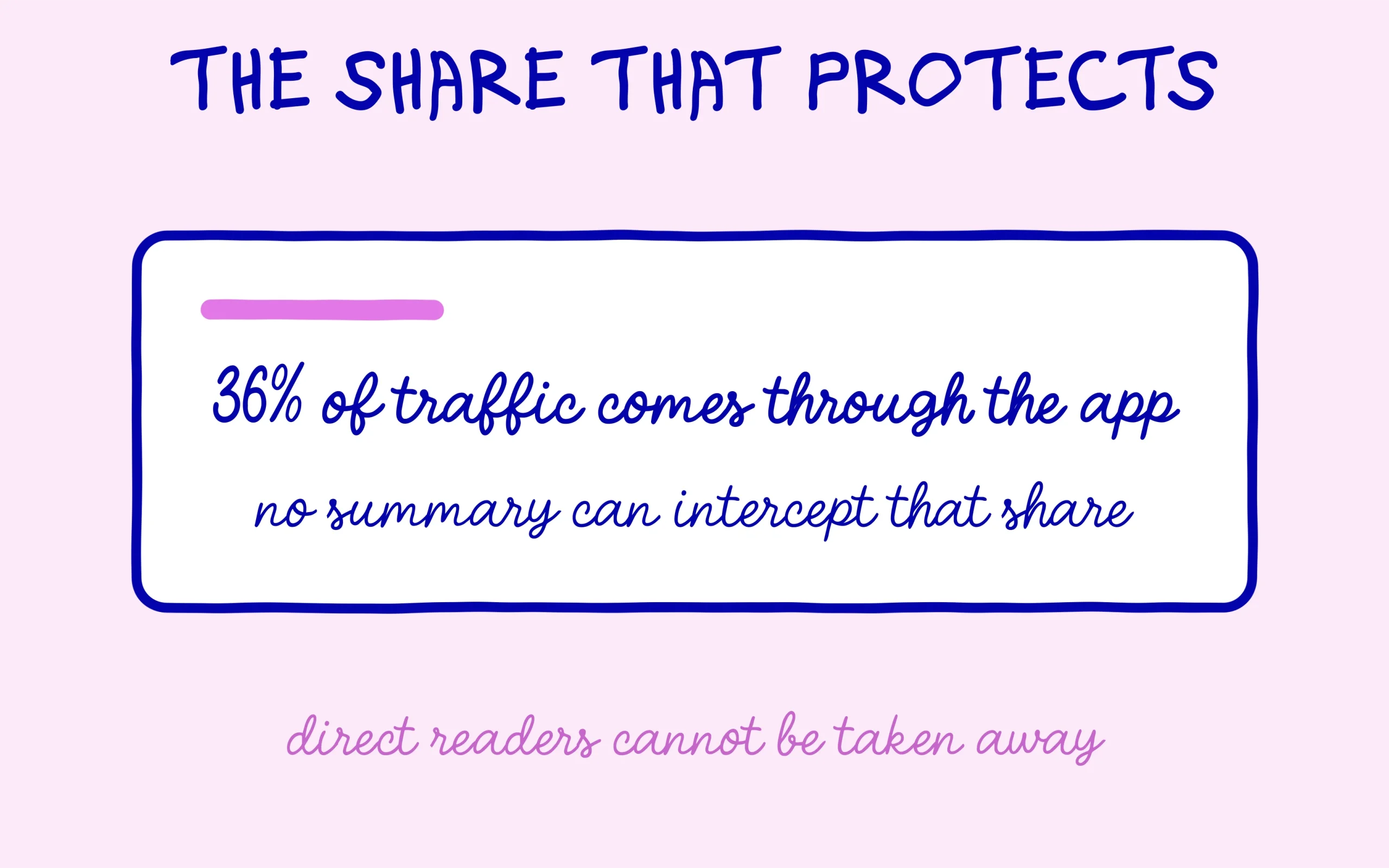
The most revealing figure sits in the traffic mix rather than in the totals. The group’s mobile app accounted for 36% of all traffic in August. More than a third of the audience never touched a search result at all, and no summary at the top of Google can intercept a reader who opens an app or a newsletter out of habit.
On the summaries themselves, Dreyfus describes them as teasers that put forward content far richer and more complex than the answer shown. That is a defensible position when you employ a newsroom of that size. It travels badly to a page whose entire purpose is to answer one closed question, because the summary hands that answer over in full and the click no longer has a job to do.
One more number from the same interview cuts against a common assumption. Readers arriving from ChatGPT convert to subscription at a rate far above anything the social platforms deliver, well ahead of Facebook and of Discover recommendations. The volume stays small, the quality of that volume does not, which matches what we found looking at how LLM traffic actually converts compared with Google.
Why the industry numbers tell another story
Publisher organisations have been quoting much darker figures. France’s press alliance, which filed a complaint in August, cites a regulator estimate of 33% to 38% traffic loss in European markets where summaries were already running. Dreyfus himself relays declines of up to half the audience in service sectors, based on conversations with other publishers.
Both accounts can hold at once, because they describe different exposure. A national daily has a name people type directly, an app sitting on hundreds of thousands of phones, and subscribers who return out of routine. A niche site drawing nine visits in ten from search has none of those buffers, which is what the early French click measurements in our look at the clicks lost since the launch already suggested.
There is also a gap between total audience and search traffic. A flat overall audience can easily hide organic decline offset by app, newsletter and social. Nothing in the reported remarks breaks out the Google channel on its own, and nobody should read the statement as evidence that this particular channel is healthy. The wider complaint from French publishers, covered in the case taken to the regulator, rests on exactly that distinction.
Timing argues for caution on both sides. Six weeks of observation across a European summer is a short window, and summer is the least representative traffic period of the year. A staged rollout rarely produces a clean break either. It erodes query by query, and the drop often becomes visible three or four months later on a curve that looked flat throughout.
What a small site should take from the gap
The first lesson is about dependence. The share of traffic that does not come from Google is your only insurance, and the traffic mix at Le Monde is a textbook illustration. An email list of two hundred people, a following on one platform, visitors who return by typing your name: all of it looks trivial next to a search curve, right up to the week the search curve moves.
What you publish matters just as much. Pages that give a short answer to a closed question are the ones summaries hurt most, since the summary does the work. Pages carrying a method, a first-hand account, or data nobody else holds keep a reason to be clicked, and they double as the raw material those generated answers are built from.
Being cited inside one of those blocks is worth more than it sounds, too. It is shelf space at the very top of the page, on a query where your site might never have reached the classic top three. AI Overviews take with one hand and give with the other, and where the balance lands depends entirely on the kind of queries you live on. On a buying query the citation pays. On a three-line definition it barely registers.
It is worth being honest about what one interview can prove. A chief executive speaking to the trade press is describing a company that is doing well, in a month when it was doing well, and no publisher volunteers a bad quarter to a journalist. The figures quoted are checkable and the tone is measured, which is more than most of this debate offers. Treat it as one data point from the best-protected end of the market.
Then comes the measurement habit. Rather than following the industry argument, open Search Console and compare impressions against clicks on your twenty main queries, June versus September. Impressions holding while clicks fall usually means a summary has settled above your result. That check takes fifteen minutes and beats every sector-wide average you will read this month.
The full interview, with the subscription figures and the group’s diversification strategy, is on the INfluencia site where Louis Dreyfus was questioned, and the paper itself is at Le Monde in English. Read it for what it is: one solid operator’s snapshot, at one point in time, from a company that spent a decade making sure search never became its only source of readers.

Keep learning on SEO Noobies.



[…] in both directions, and not everyone reports the collapse the discourse predicted: our reading of one major newspaper’s audience after AI Overviews rolled out found a far more mixed picture than the headlines suggested. That ambiguity serves Google as much […]