
Google Shuts Down the AI-Only Site Trend
You may be wondering whether you need to build an “AI-friendly” version of your site to get cited by ChatGPT, Perplexity or Claude. The idea has been making the rounds on SEO social feeds for the past few weeks: serve LLM crawlers (Large Language Models are the generative AIs that answer user questions) a stripped-down markdown version of your pages, separate from your main site, the same way you’d serve an RSS feed. John Mueller, one of Google Search’s most public voices, has just pushed back hard against the whole idea. He even called it “a stupid idea”. Here’s what he actually said, why he’s not wrong, and what to do instead when you’re starting out and want to be visible in generative engines.
TL;DR
John Mueller (Google) publicly rejected the practice of serving a separate markdown version of a site to LLM crawlers.
His main argument: a well-structured HTML page already serves humans, search engines and AI at the same time, and a parallel copy is technical debt you have to maintain forever.
The approach also risks triggering cloaking rules, since serving different content to bots than to humans has been penalized by Google for over two decades.
What actually works to be read well by AI engines: clean HTML, a clear H1/H2/H3 hierarchy, short paragraphs, and links to primary sources.
Summarize This Article with AI
ChatGPTWhat John Mueller Actually Said
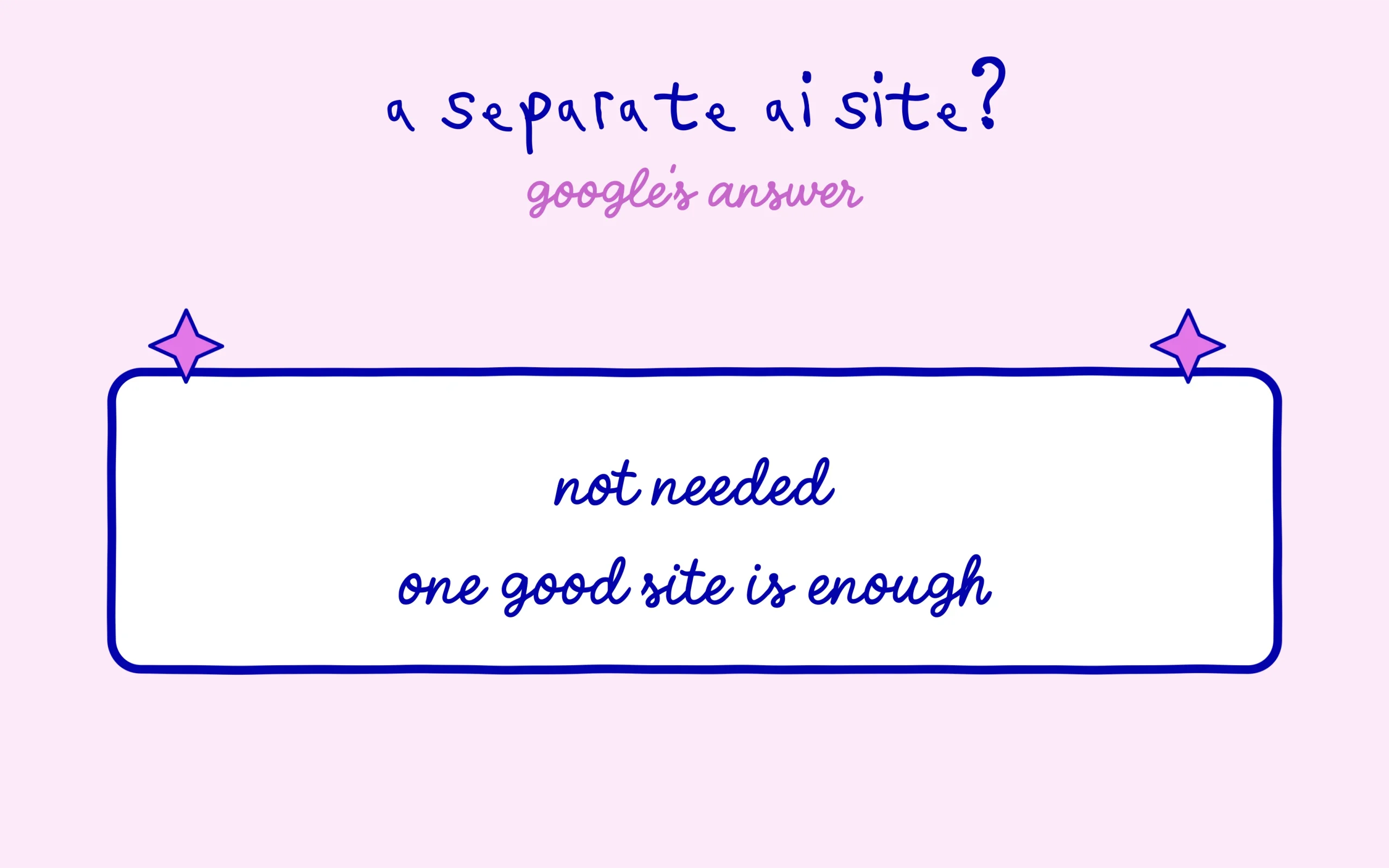
The discussion started from a social media post recommending that site owners serve AI crawlers a markdown version of their pages. The pitch from proponents was simple: markdown is lighter than HTML, easier for a language model to parse, and a dedicated version would give you tighter control over what the AI actually sees on your site. A kind of “clean feed” for generative engines, running in parallel with the classic site meant for humans.
Mueller pushed back with no hedging. A well-designed website already works for AI agents, search engines, LLMs and, most importantly, people. He reminded the thread that LLMs have been trained on regular HTML from day one, and that they have no trouble extracting meaning from it. His point is that what matters isn’t the file format, it’s how readable the content is, human or bot. Building a separate copy means maintaining two versions of the same site in parallel, an ongoing cost for a benefit he considers imaginary.
Fabrice Canel, his counterpart at Microsoft Bing, publicly aligned with the same position within days. Two authoritative voices from Google and Microsoft saying the exact same thing at the same moment is a strong signal for anyone considering wiring up an llms.txt or a markdown route to flatter the AI engines.

Why an AI-Only Version of Your Site Is a Bad Idea
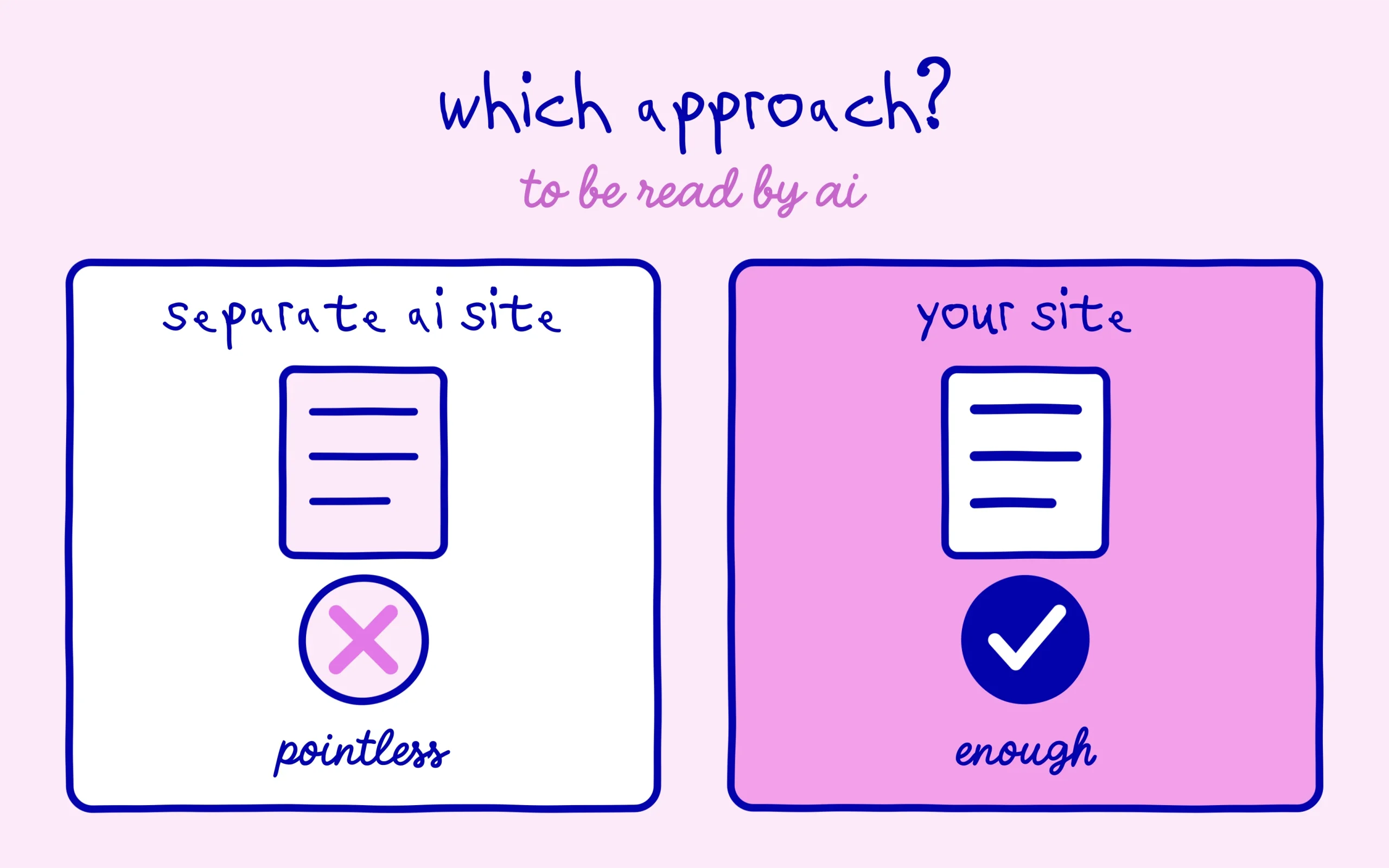
The first issue is structural. Maintaining two versions of the same site means doubling the work on every article you publish. Each edit has to propagate through the human HTML and the AI markdown, with the constant risk that the two drift out of sync. Six months in, the AI version can end up stale, carrying information the real site has already corrected. The result is that generative engines cite your site on outdated facts, and you lose credibility with the readers who actually check.
The second issue is regulatory. Serving different content to bots and humans is the textbook definition of cloaking. Google has banned this practice for more than two decades and has always enforced it with hard algorithmic penalties. Even if your AI-only version were richer and more honest than your human HTML, the mere fact that they technically differ is enough to trigger the signal. You’d be taking a disproportionate risk for a benefit that is at best hypothetical.
The third issue is technical. Mueller flagged it clearly: LLMs have been trained on trillions of ordinary HTML pages, not on curated markdown feeds. Their ability to parse a classic web page is already deeply optimized. Serving markdown brings no measurable value on top. You add complexity without any perceivable improvement in how the reader or the generative engine handles your content.
One nuance is worth understanding. A tiny llms.txt file at the root of your site, modeled after robots.txt, is still a fair and even recommended practice by some in the community. That file is only a few kilobytes and works as a lightweight guide, pointing AI crawlers toward the content you want to flag. There is no content duplication involved, just a simplified site plan. Don’t confuse that minimalist approach with building a full markdown copy of your site: it’s a different project entirely, a hundred times heavier and far riskier.
What Actually Works to Get Read by AI Engines
The good news for a beginner is that classic SEO fundamentals are exactly what generative engines reward. Clean HTML, a properly nested H1 then H2 then H3 hierarchy, short paragraphs that each carry a single idea, direct sentences instead of long-winded ones: ChatGPT, Perplexity and Google AI Overviews handle all of that natively. An article well structured for a rushed reader is already well structured for an LLM.
One extra layer is worth putting in place: Schema markup. Schema.org is a structured vocabulary that Google, Microsoft, Yahoo and Yandex built together to help engines understand the type of content they’re reading. A blog post tagged as Article, a recipe tagged as Recipe, a business tagged as Organization: those invisible markers give search engines an instant read on the meaning of your content. Generative engines also use these signals when deciding what to cite.
The last lever, often underrated by beginners: cite your sources. Whenever you drop a number, quote an official statement or back a claim with a study, a link to the primary source gives the generative engine a verifiable anchor point. Perplexity and Google AI Overviews strongly favor pages that point to reputable primary sources. It’s an E-E-A-T signal (Experience, Expertise, Authoritativeness, Trustworthiness) that weighs on the citation decision.
Mueller’s practical takeaway holds together in one line worth keeping in mind every time you publish: writing well for your readers is already writing well for generative engines. You don’t need a parallel site, you need a site that’s actually done right.
Keep learning on SEO Noobies.



[…] problem today, simply because an AI judges it citation-worthy. The logic matches what came up when Google clarified that no separate site is needed to be read by AI systems: generative engines work on the same web as everyone else, with their own selection […]
[…] This window also reframes another poorly understood point: even once Google has removed the page from the cluster, the new indexing still has to be reflected in search results, which adds a few extra days of latency. Between fixing the content and seeing the page return in results under its true URL, two to three full weeks is a reasonable expectation. The same patience applies on the generative side, where AI engines take time to refresh their view of a page, a topic John Mueller recently clarified around the site: command applied to AI. […]