
AI Overviews have reportedly cost Wikipedia around 100 million visits every month, according to an academic paper published on arXiv and picked up by the trade press this week. The headline number travels well, which is precisely why the method behind it deserves a careful read. Wikipedia is an unusual website in almost every respect, except for one thing that applies to everybody: it answers questions, and generated answers now answer the same questions. Here is what the study actually establishes, where it cannot go, and which part of it transfers to a site with ordinary traffic.
TL;DR
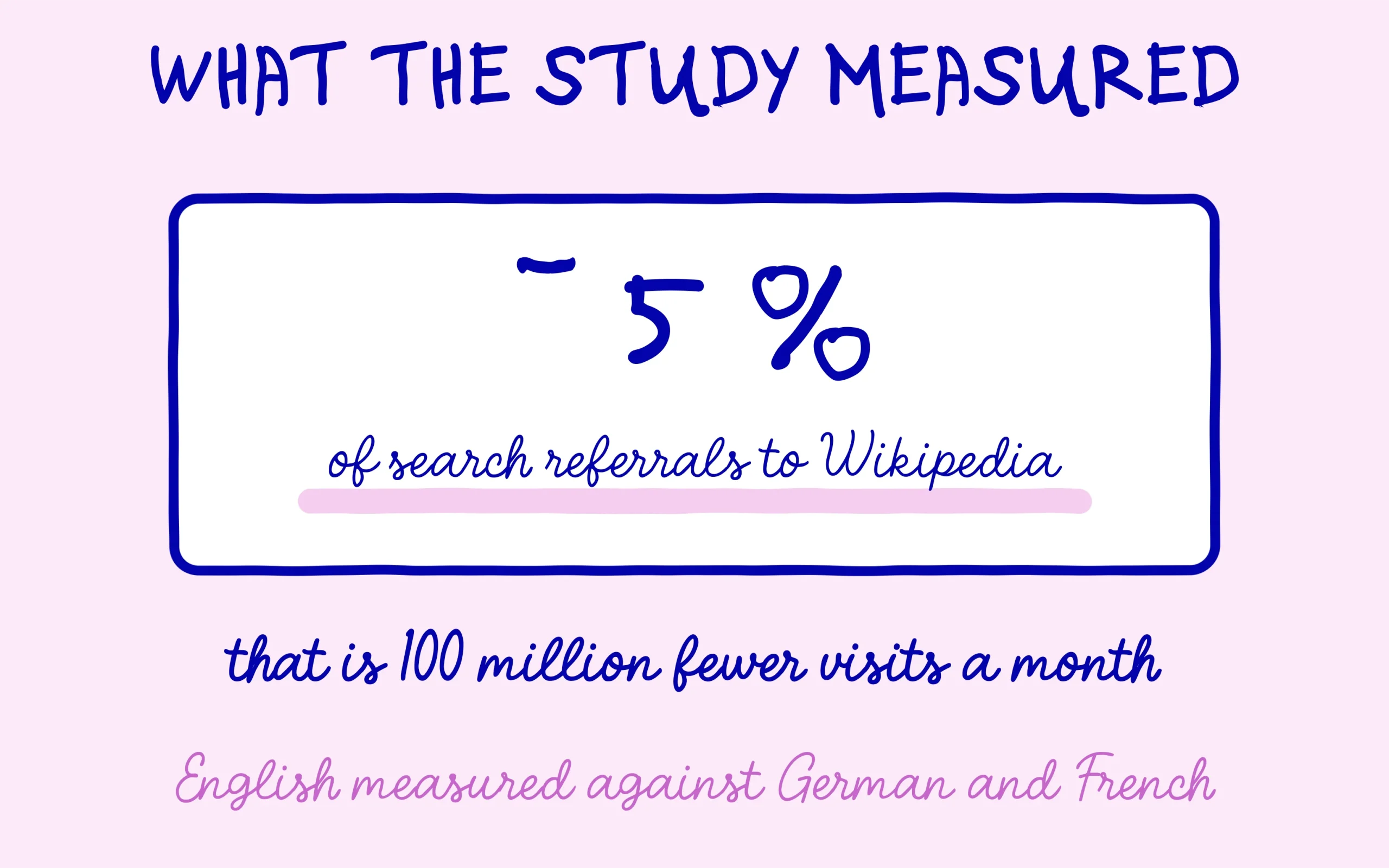
A University of Washington study estimates that AI Overviews pushed search referrals to English Wikipedia down by 5.45% against the German edition and 4.82% against the French one.
Applied to Wikipedia’s volume, that decline works out to roughly 100.27 million lost referrals a month, close to 1.20 billion over a year.
Google disputes the attribution, because the public Wikimedia data lumps every search engine together and cannot single out Google’s own contribution.
The percentage matters far more than the raw total. A 5% slide on stable informational queries is the useful order of magnitude for any content site.
Summarize This Article with AI
ChatGPTHow two language editions became a control group
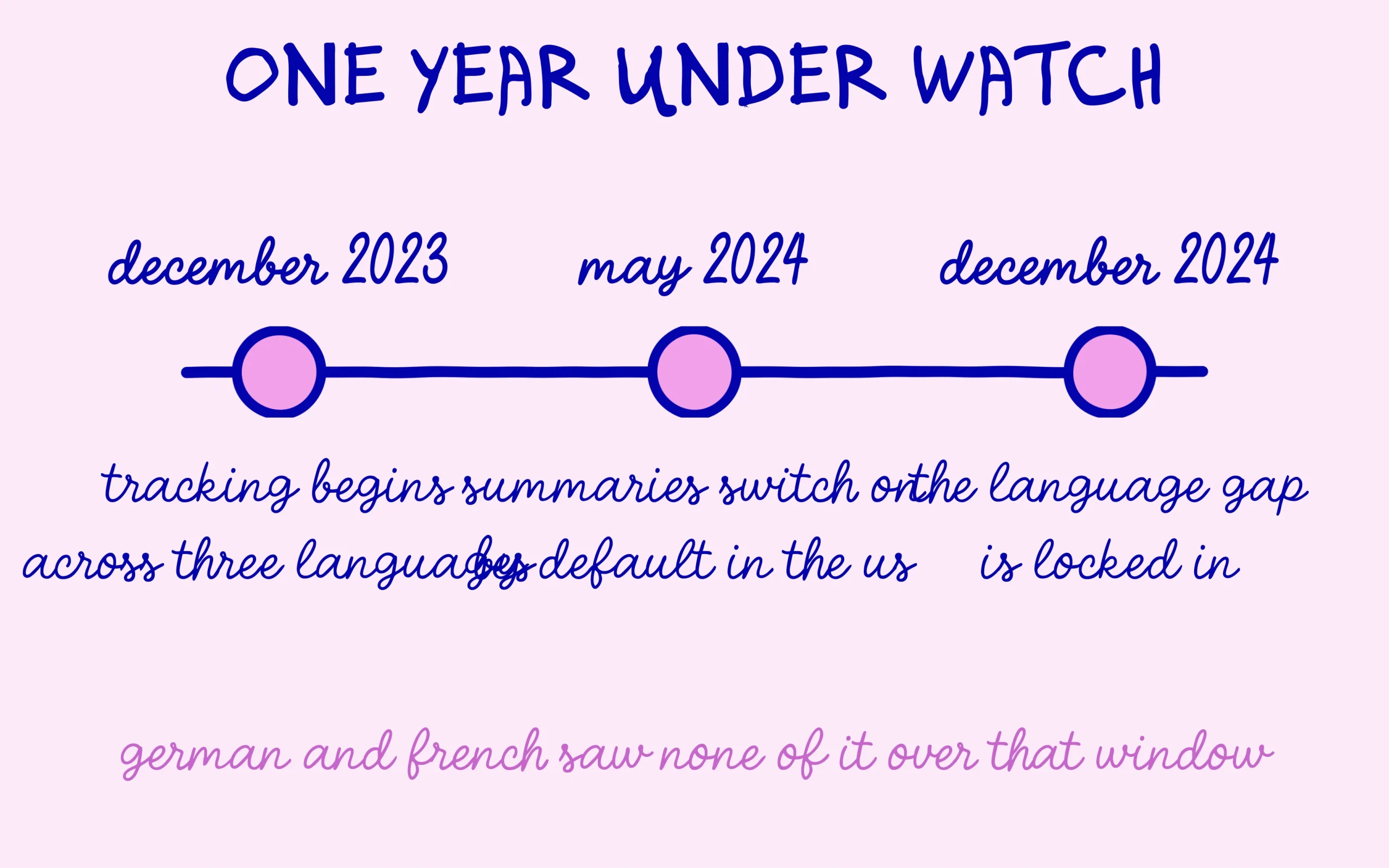
The paper comes from Mehrzad Khosravi and Hema Yoganarasimhan at the University of Washington, under the title Impact of AI Search Summaries on Website Traffic. Their starting idea is clever enough to be worth following even without a statistics background. Google switched AI Overviews on by default in the United States in May 2024, while Germany and France went without them for the whole observation window. Wikipedia exists in all three languages, and its articles map onto each other almost one to one.
From there the authors track how English traffic moved against its German and French twins between December 2023 and December 2024. English lived with the feature, the other two did not. Anything else that shook the web during that year should have hit all three editions roughly alike, so the gap that opens between them isolates the effect under study. The comparison runs across 499,927 English-German article pairs and 530,873 English-French pairs.
What comes out is a 5.45% drop in search referrals to English when measured against German, and 4.82% when measured against French. Two independent comparisons landing within half a point of each other is what gives the result its weight. Scaled to Wikipedia’s real traffic, that means roughly 100.27 million fewer referrals a month and close to 1.20 billion across the year.
One detail says a lot about how trustworthy the figure is. An earlier draft of the same paper reported a 15% decline, calculated from daily page views. The current version drops to 5% by switching to external search referrals, a narrower measure but a more honest one. Authors revising their own headline downwards is usually a good sign, since it points to work that keeps tightening instead of chasing impact. Both versions are still circulating, so it helps to know which one you are reading.
None of this arrives out of nowhere. Publishers in markets where generated answers landed later have been reporting the same direction of travel, and the early click measurements from the French rollout pointed that way months ago. What the Washington team adds is a controlled comparison where the field previously had raw observation.

Where Google pushes back on the AI Overviews figure
Google’s objection is technical, and it holds up on its own terms. As Matt G. Southern reported in Search Engine Journal, the public Wikimedia dataset behind the study counts referrals from every search engine without separating them. A decline in search-sourced traffic therefore cannot be pinned on AI Overviews by arithmetic alone, since Bing, DuckDuckGo and the rest sit inside the same total.
That said, the objection loses much of its bite once you look at how the study is built. Those other engines serve German and French readers too, so their influence should show up across all three editions. The thing that set English apart during that window was the default rollout in the United States. The argument does not dismantle the finding, it just reminds everyone that what is being measured stays at the level of a pattern.
A sharper limitation comes from geography. Only about 40% of English Wikipedia’s traffic originates in the United States, and that is the one market where the feature was live. The real effect on American readers is therefore probably steeper than the measured 5%, diluted as it is by the other 60%. The published number is an average that flattens the very region where the action happened.
It is also worth noting what the data cannot see at all. Somebody who reads a generated answer drawn from Wikipedia and never opens the page leaves no trace in these figures. The content gets consumed, the visit never happens. That split between how often a text is used and how often it is visited is the blind spot running through every audience metric in circulation right now.
The finding also refuses to generalise across every kind of publisher, and a fresh counter-example makes the point. French daily Le Monde said this week that it had seen no audience loss it could attribute to generated answers, a case covered here in the write-up of what the paper measured internally. The two results sit together more comfortably than they first appear. A news outlet lives on subjects that renew constantly, while an encyclopedia answers settled questions that models summarise with ease.
The number that actually transfers to a small site
Start with the part that does not transfer. Those 100 million visits describe a traffic base almost nobody reading this operates at, and rescaling them to your own site produces nothing useful. The portable figure is the percentage: somewhere around 5% fewer search referrals on stable informational content, with a steeper effect in markets where the feature has been live longest.
The exposed content profile comes through clearly in this study. What slides is the page answering a closed question, where the answer fits in three lines and does not change from one year to the next. A definition, a date, a unit conversion. A piece that carries a method, a reasoned comparison or genuine field experience resists summarising far better, and it still earns the click.
In practice this reshapes editorial planning rather than cancelling it. A young site publishing twenty short definitions to chase volume is working the exact segment generated answers absorb. The same effort spent on five pages that treat a problem end to end ages considerably better. On what AI Overviews actually pick up as sources, the breakdown of what the top cited pages have in common gives concrete markers.
Measuring this on your own site needs no paid tool. In Search Console, pull twelve months of impressions and clicks for your most informational pages and lay them side by side. Flat impressions with sliding clicks matches the pattern this study describes. Impressions falling as well tells a different story, one about ranking rather than generated answers.
A closing word on timing, because it prevents decisions taken too fast. This study covers a window that already closed in December 2024, on a United States footprint. AI Overviews have changed considerably since, and the European rollout is recent. Treat the 5% as an opening order of magnitude to verify against your own data, never as a forecast to apply to your traffic.

Keep learning on SEO Noobies.