
Google released its August spam update on August 18 at 9:27 a.m. Pacific, and the official notice runs to two sentences. No blog post came with it, no new rule, no hint about which practices are being targeted. This is the third anti-spam rollout of the year and it applies worldwide, across every language. For a site that is just getting started, guessing what Google changed leads nowhere. The useful move is to hold your own pages up against a list Google has published and maintained for years. Here is what the announcement actually says, and what it lets you check without panicking.
TL;DR
Google rolled out the August spam update on August 18 at 9:27 a.m. Pacific, globally and in every language.
No new rule shipped with it: the sixteen spam families Google already publishes remain the only grid to read this against.
The two earlier anti-spam rollouts of 2026 finished in nineteen hours and in two days, while this one is announced as taking a few days.
A hit site does not bounce back by fixing things quickly: Google describes a reassessment measured in months.
Summarize This Article with AI
ChatGPTWhat Google actually said about the August spam update
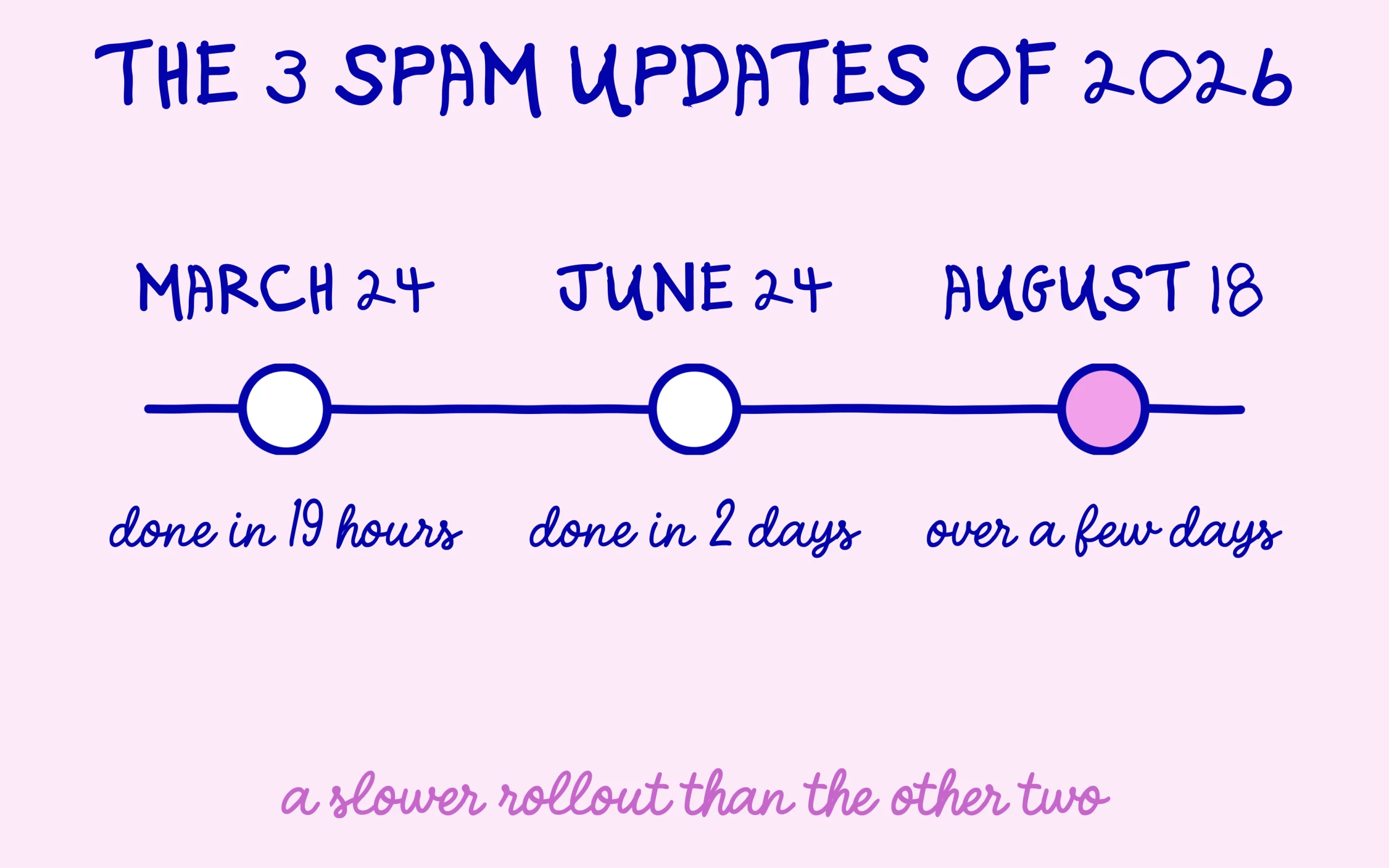
The entry on the Google Search Status Dashboard says this much: the August spam update has been released, it applies globally and to all languages, and the rollout may take a few days to complete. Nothing more. The incident opened on August 18 at 9:27 a.m. Pacific and still sits as ongoing as these lines are written. That flat wording matches the pattern of earlier rollouts, which we walked through in our history of major Google updates from Panda to the AI era.
What is missing tells you more than what is there. No Search Central blog post, no named policy, no mention of a newly sanctioned behaviour. The documentation page covering the anti-spam rules has not moved since December 2025 either. When Google wants to target one specific practice, it names that practice in the update title, the way it did for the rollouts aimed at links. Nothing of the sort here.
On duration, the two earlier rollouts of the year give a useful reference point. March’s update started on March 24 and wrapped in a little under twenty hours. June’s, launched on June 24, took two days to finish. Announcing “a few days” on the August one points to a slower rollout than either. While a rollout is still running, the positions you observe mean very little, and that window is exactly when the worst decisions get made.
The sixteen spam families Google spells out in the open
The grid exists and it is public. Google lists sixteen families of practice on its official page covering the search spam policies: cloaking, doorway abuse, expired domain abuse, hacked content, hidden text and link abuse, keyword stuffing, link spam, machine-generated traffic, malicious practices, misleading functionality, scaled content abuse, scraping, site reputation abuse, sneaky redirects, thin affiliation, and user-generated spam.
Of those sixteen, only five genuinely apply to a site in its first year. Scaled content abuse covers publishing pages in bulk with no value of their own. Thin affiliation covers pages that copy a product sheet so a referral link has somewhere to live. Keyword stuffing remains the classic trap for a beginner who was told to repeat the target phrase. Scraping covers lifting someone else’s content. Expired domain abuse covers buying a domain for its history. The rest describes manipulation nobody sets up by accident.
However, an anti-spam rollout does not behave like a core update. It does not reassess the overall quality of a site, it applies rules to identified behaviours. That distinction changes how you should react, and we unpacked it in our walkthrough of how Google’s algorithms work in plain English. A site losing positions during a spam update with nothing on its conscience is probably looking in the wrong place.
One detail is worth filing away. Back in May 2026, Google clarified that these same anti-spam rules also cover attempts to manipulate generative answers, AI Overviews and AI Mode included. Nothing indicates the August rollout targets that specifically, and the company has not confirmed it. The rule exists now, and that is all anyone can honestly say today.
What a beginner site can check this week
The fear that comes up most often involves content written with an AI. It deserves defusing right away, because it burns an enormous amount of time. Google does not punish a text because a machine produced it, it punishes bulk production of pages with no value of their own, whatever tool was used. The distinction is laid out in our piece on what Google really penalises in AI content, and this rollout did not change it.
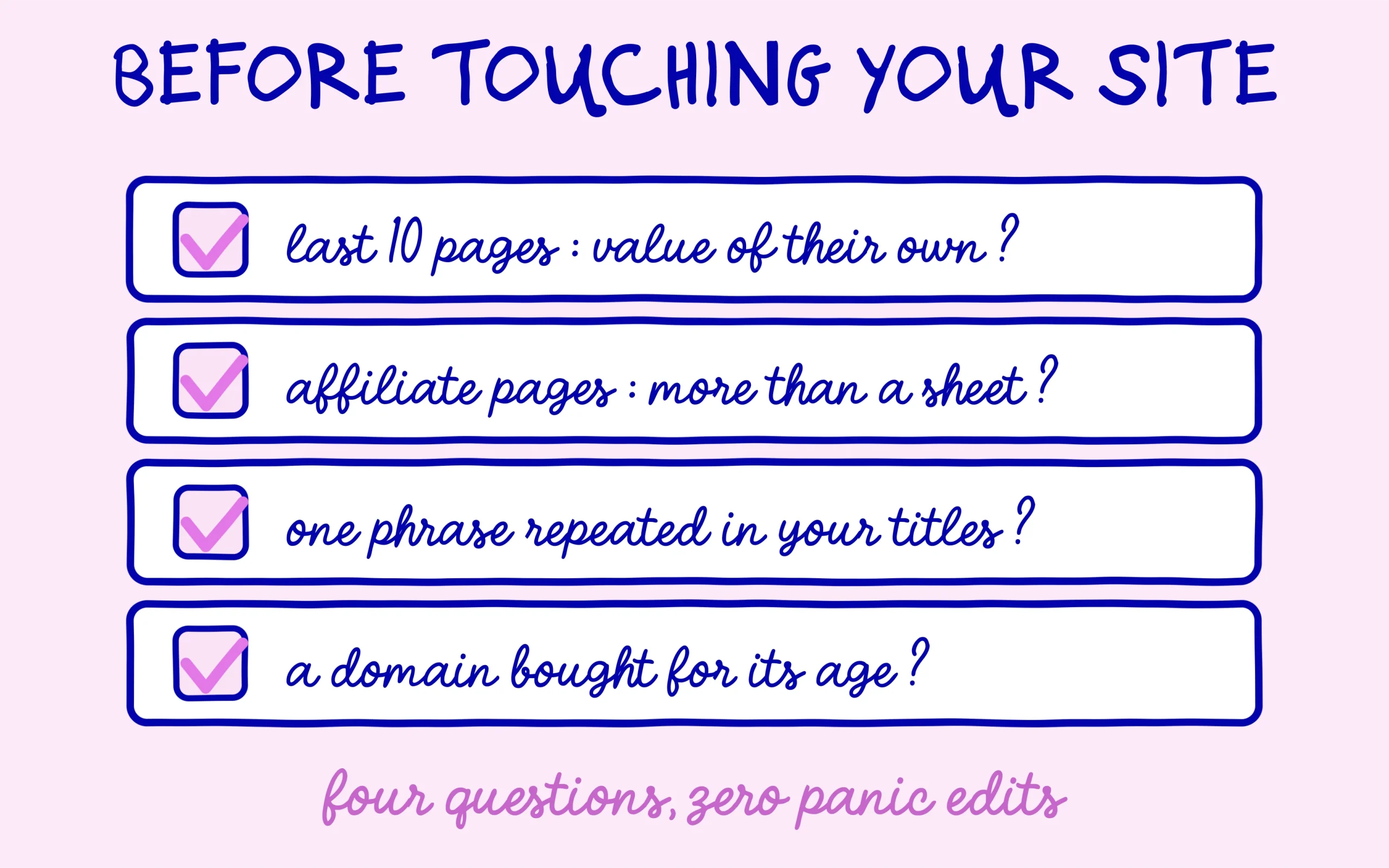
In practice, four checks cover most of the ground. Pull up your last ten published pages and ask whether each one carries something a reader would not find elsewhere. Look at the pages holding affiliate links and confirm they contain more than a copied product sheet. Reread your titles and opening paragraphs for a phrase repeated mechanically. And if you bought a domain for its age, know that the practice sits explicitly on the list.
That leaves recovery, and Google’s own answer on timing is bluntly discouraging. The company writes that changes may help a site improve if its automated systems learn, over a period of months, that the site complies with the spam policies. Months. Not a few days, not the week after the fix lands. Fixing fast buys nothing if you expect a fast answer, and plenty of sites stack panicked edits because they never read that sentence.
The worst instinct during a rollout is serial editing. A deployment spread over several days produces ranking swings that do not reflect the final state yet. Wait until Google marks the incident as complete on its dashboard before drawing any conclusion. Until then, the only move that pays is rereading your own pages with the list of sixteen families open next to you.
Keep learning on SEO Noobies.



[…] links, and August happened to bring a spam update that we covered when it landed, including the way it reached every language rather than English alone. A site that falls apart while an operation of that size is rolling out has a far simpler […]
[…] follows the August one closely, and the pattern repeats almost word for word. If you followed how the August spam update hit every language, none of this will surprise you: a short notice, a staggered rollout, and no public list of […]