
One piece of advice keeps circulating in conversations about visibility inside AI answers: serve a markdown version of your pages to the crawlers behind generative engines so they understand your content better. It sounds sensible when you first hear it, and a handful of tools now offer the conversion in a single click. Then someone at Google described what he actually sees in his own server logs, and the picture stopped matching the promise. Let’s look at what he found, at the only controlled test anyone has published, and at how to decide whether this deserves your time when you are just starting out.
TL;DR
John Mueller, from Google’s Search Relations team, says that on his test sites the only crawlers claiming to accept markdown are SEO tools.
His practical advice: measure whether AI bots actually request the format before generating files for them.
The randomised experiment run by Profound across 381 pages found no statistically significant gap between markdown and HTML.
For a beginner site, improving the HTML you already serve pays off more than bolting on a parallel version.
Summarize This Article with AI
ChatGPTWhat John Mueller found on his own test sites
This started with a question posted in the TechSEO forum on Reddit on 31 August: has anyone had any success serving markdown files to language models? John Mueller, who works on webmaster relations at Google, answered by sharing his own experience. His line is short: on his test sites, the only crawlers that claim to accept markdown are SEO tools.
It pays to read exactly what he said and what he did not. Mueller was not speaking for Google, he was describing what shows up in his own access logs. That makes it a field observation from someone with the means to look, rather than a company position. He closed with “ymmv”, short for your mileage may vary, which is about as clear a caveat as you get.
The most useful part of his answer is the method that came with it. Before generating markdown versions of an entire site, set up a way to track whether AI bots are requesting them at all. measure the demand first, produce the format second. That reflex saves a lot of pointless work, and it travels well beyond this particular question. It is the same log-reading habit that reveals which pages the ChatGPT crawler actually reads on a given domain, and the answer there surprises most owners the first time they look.
The underlying argument Mueller has made in earlier exchanges on the topic fits in one sentence: every AI system out there already crawls and reads HTML. None of them needs an alternative version of your pages. Meaning lives in structure, hierarchy and context, and flattening all of that does not make a page easier for a machine to work with.
It helps to understand why the idea caught on in the first place, because the reasoning is not silly. Crawlers hitting a modern page often wade through heavy templates, JavaScript rendering and navigation boilerplate before they reach the paragraph that actually answers something. A stripped markdown file removes all of that noise and hands over the substance directly. On paper that should make extraction cheaper and more reliable, which is precisely the argument the vendors offering the feature put forward.
The catch is that a plausible mechanism is not evidence of an outcome. Plenty of technically elegant ideas have died quietly in SEO because the systems they targeted never asked for them. Whether the crawlers behind ChatGPT, Perplexity or Gemini request markdown at all is a question you settle by reading logs, not by reasoning about what would be efficient for them.
The one controlled test comes back inconclusive
One person’s logs, however well placed that person is, still is not proof. The good news is that a controlled test exists. Profound, a company that analyses brand visibility inside generative engines, published the results of a randomised experiment run between 19 January and 8 February 2026.
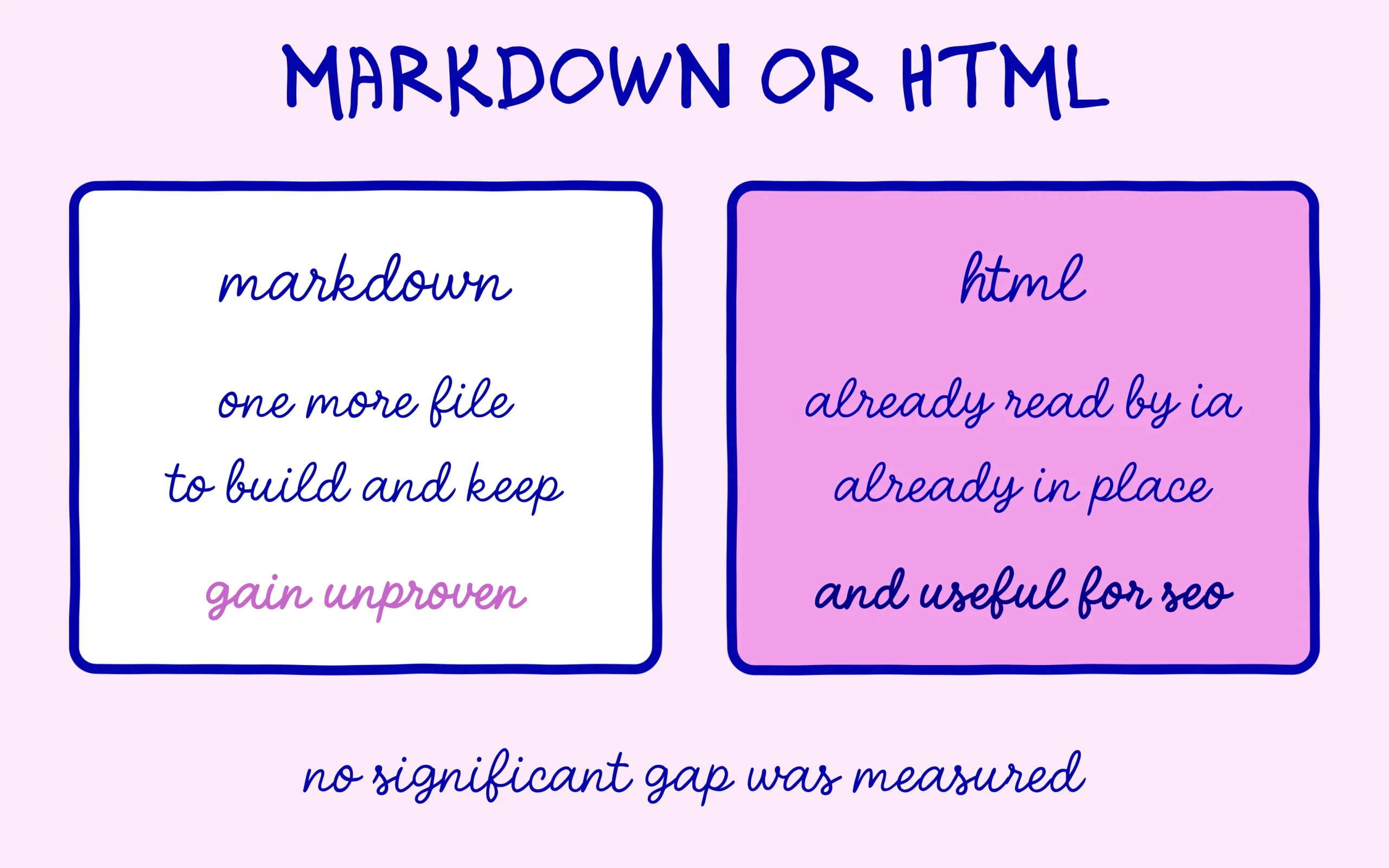
The protocol is clean and worth describing, because the description is what gives the result its weight. Three hundred and eighty-one pages across six sites, randomly split into two groups: 189 served as HTML, 192 served as markdown. Human visitors always got HTML, with bot detection deciding the format in real time. Three weeks of measurement.
The raw numbers tilt slightly toward markdown: one extra bot visit per page at the median, around 16 % more on average. The gap never reaches statistical significance though. The authors themselves conclude they cannot confidently claim the format produced that extra traffic. ChatGPT-User alone accounted for close to 74 % of the crawls they recorded.
Worth noting too: the effect they did observe clustered on pages that already pulled decent traffic. Read pessimistically, that suggests any benefit would land where you need help least, on the pages bots already visit. Read charitably, three weeks and 381 pages may simply be too small a window to catch a modest real effect. Both readings point to the same conclusion for now, which is that nobody should be promising you a gain here.
That kind of methodological honesty is rare in a field where plenty of claims travel with no measurement behind them at all. The link to Mueller’s observation is direct: on one side a practitioner who does not see the bots asking, on the other a study that cannot demonstrate a gain. The same pattern showed up around llms.txt, where the Ahrefs analysis of 137,000 sites also came back without a measurable effect.
Is markdown worth your time as a beginner
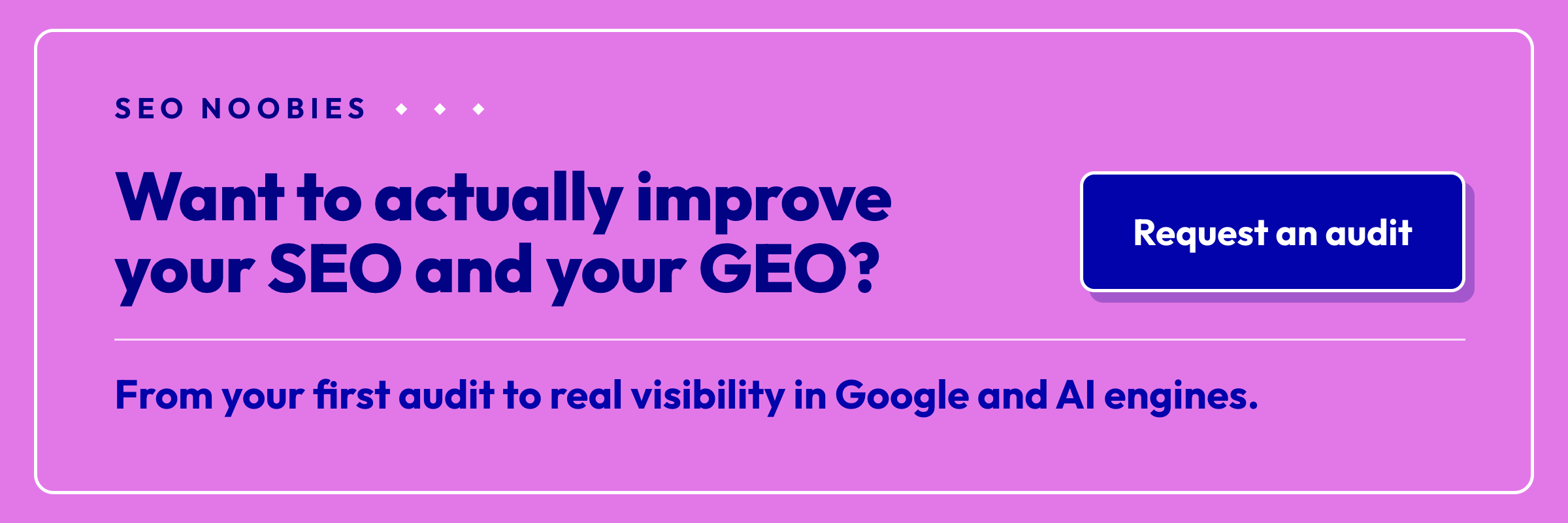
The short answer is no, not as a priority. A young site almost always has better work waiting: pages that answer their target question poorly, a wobbly heading structure, content that does not exist yet. Adding a technical layer for an undemonstrated gain is repainting a facade before the roof goes on.
There is one angle that does deserve ten minutes though, and it has nothing to do with the promised upside. It is about control. If your host or your edge provider already offers automatic conversion of your pages for agents, the feature may be running without you knowing. We watched a very similar default cause trouble with the Cloudflare directive Google ignores, and the principle carries over: a switch flipped by an intermediary ends up deciding on your behalf.
Checking takes two moves. Open your hosting access logs, filter on the known AI bot names, then look at which file type they request. That is exactly the reflex Mueller recommends. If no AI bot has ever requested a markdown file from you, the question is settled for your site, whatever anyone else reports on theirs, and you can close the tab with a clear conscience.
The place where your effort pays best is still the HTML you already serve. A section heading that genuinely announces what follows, an answer written in three sentences instead of one dense block, structured data laid out properly: all three help Google and generative engines at the same time. None of them requires an alternative format.
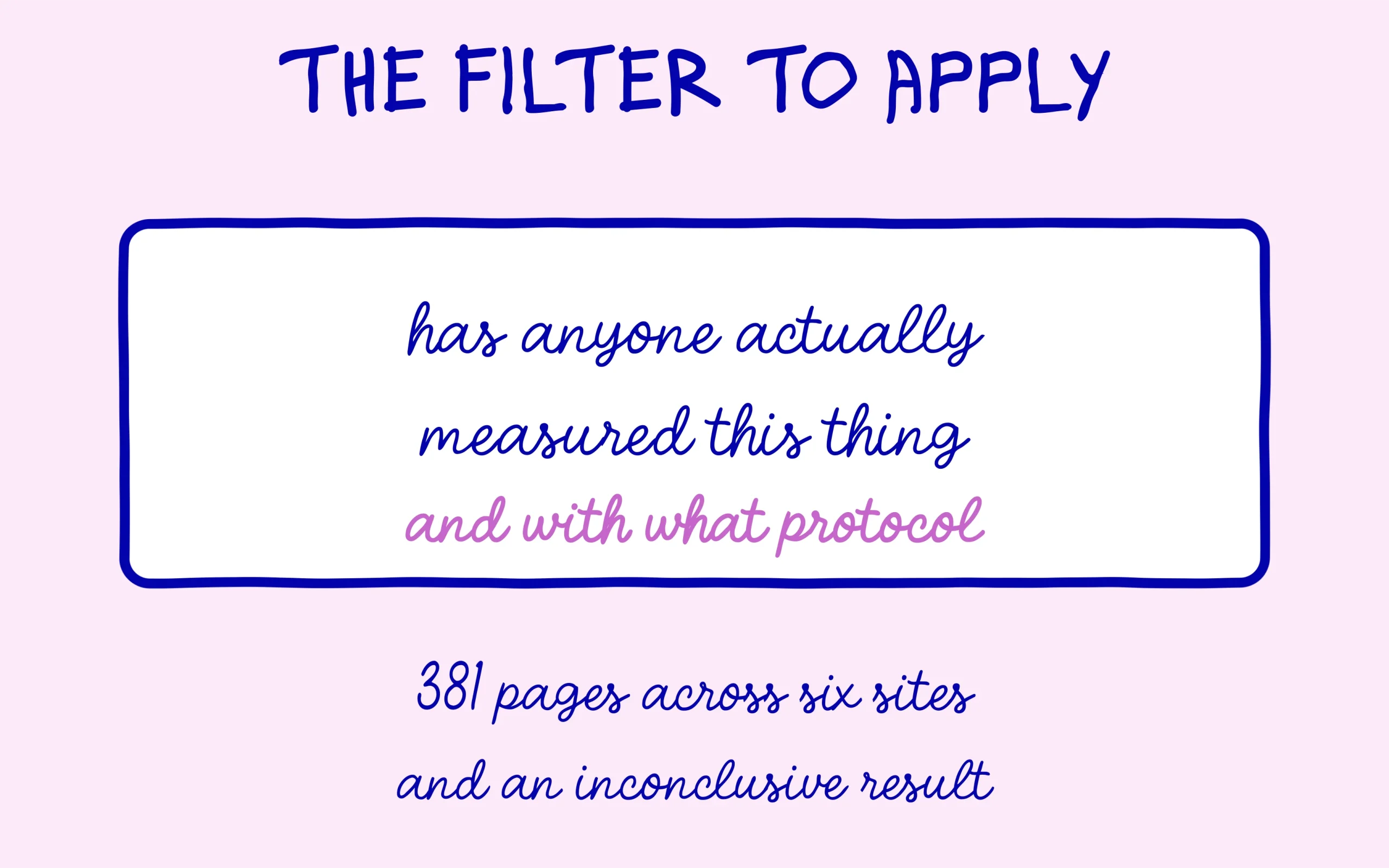
What this episode really says goes past markdown itself. Every time a new GEO tactic starts circulating, one question sorts it quickly: has anyone measured this, and with what protocol? When the answer is a randomised test that comes back inconclusive, there is no rush to follow the crowd. When nobody has measured anything at all, there is even less.

Keep learning on SEO Noobies.