On September 10, Google opened Dreambeans to every free Google Account in the United States, after three months behind a paid subscription. The app spends the night assembling a set of illustrated stories out of whatever sits in your Gmail, Calendar, Photos, YouTube, search history and, more recently, Gemini. In the morning you get a finite collection of personalised stories, and some of those stories point out to websites. For anyone who owns a site, the question is concrete rather than philosophical: one more layer now sits between an intention and a visit. Here is what Dreambeans actually does, and what it shifts for a small audience.
TL;DR
Dreambeans is a Google Labs app that compiles personalised stories overnight from your connected Google apps and serves them as an illustrated collection each morning.
Since September 10, 2026, access no longer requires a paid subscription in the United States, which moves the experiment to a far wider scale.
Stories carry outbound links, but the reader gets a tailored summary first, which pulls value away from the click and towards the summary.
No Dreambeans-specific optimisation exists today. What matters is still whatever Google can already read on your pages.
Get an AI summary of this article
What Dreambeans Assembles Overnight
Google introduced the app on June 3, 2026 on the official Google Labs blog, in a post signed by Gozde Oznur, product manager at Labs. The concept lives in the product name. Overnight, the app “dreams”, meaning it works through everything piling up in the apps you granted it, and pulls a handful of stories out of the mess. What lands in the morning is a collection that ends rather than a feed that never does. Dreambeans builds its content from your personal data before you have asked anything at all.
Google names the connected sources plainly: Calendar, Gmail, Photos, Search, YouTube, and Gemini as of recently. The underlying technology is called Personal Intelligence, and the card illustrations come from Nano Banana 2. You pick which apps the tool may read, and the official Google Labs help page states that Dreambeans privacy settings sit apart from those of other Google products. Building your first batch of stories takes up to a day.
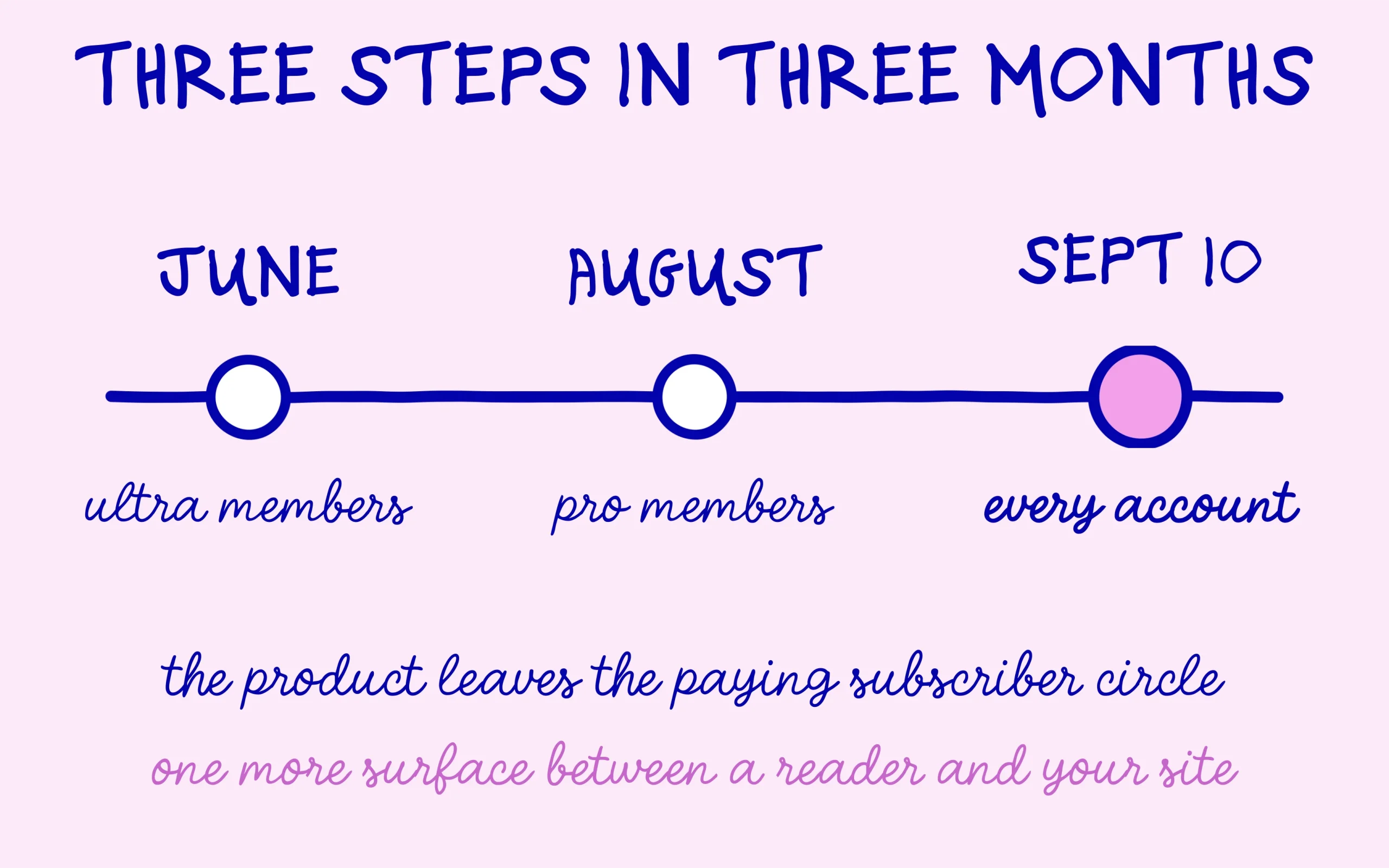
What changed on September 10 comes down to a single line about access. The product went to AI Ultra subscribers in June, reached AI Pro subscribers in August, and now runs on any free Google Account in the United States, on Android and iOS, for users aged 18 and over. Moving from a subscriber pool to every American account is the real event of the week.
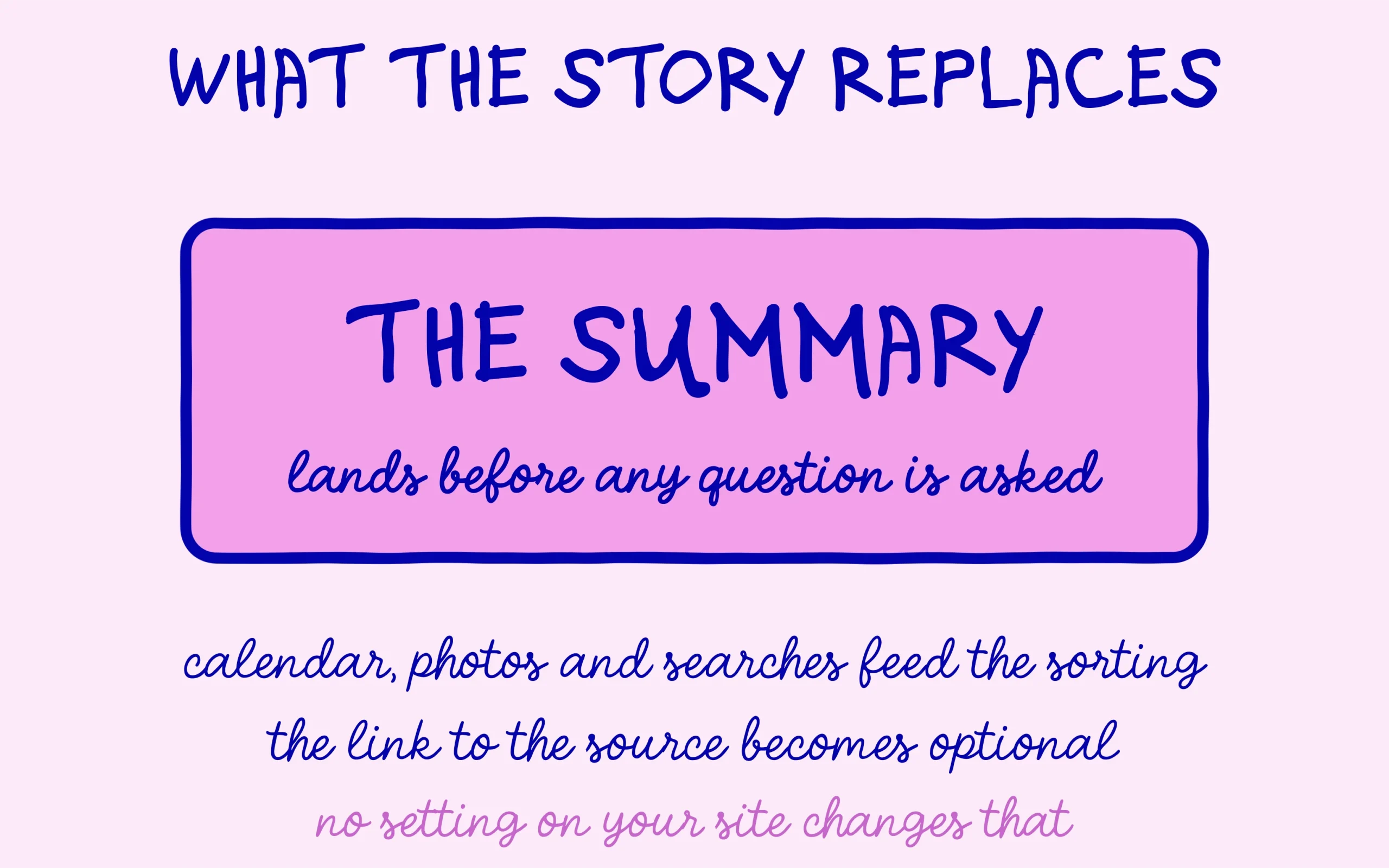
One detail explains the product logic better than any description. Each story carries internal fields recording what it covers, why it surfaced for you, how confident the system is, and when it stops being relevant. Dreambeans does more than stitch content together, then. It holds a position on what deserves your attention right now. The signals weighing on that sort are immediacy, geographic proximity, and how practical the information is. That ranking logic is nothing new at Google: the arrival of Gemini 3.8 in AI Mode already rested on much the same kind of triage.
Discover the SEO Noobies agency
Why a Personalised Summary Eats Into the Click
The mechanism should feel familiar by now. When an answer shows up ahead of the links, a share of readers stops at the answer. What differs here is the personalisation. The story does not answer a typed query, it answers a situation inferred from your calendar, your photos and your past searches. A summary that already knows your context leaves far fewer reasons to go looking at the source.
That said, panic is the wrong read. Measurements on comparable surfaces show wildly uneven effects from one site to the next. French daily Le Monde stated that AI Overviews had not dented its audience so far, while other publishers report the opposite. What those measurements share is that they cover brands readers already look up by name.
For a young site the question lands differently. Nobody searches for you by name, so your presence depends entirely on some system deciding to cite you. That is already true inside generative answers, and Dreambeans adds one more surface where the decision happens without you. The upside, such as it is, sits in the fact that the criterion holds everywhere. A page a machine understands stands a chance of being picked up, and a page it cannot parse stands none.
What a Site Owner Can Do Right Now
One clarification comes before everything else: Dreambeans runs entirely on the app side, out of reach of anyone who owns a website. Any method being sold today as Dreambeans optimisation has been made up from scratch. The app draws on its own user’s personal data and on the web as Google already knows it.
There is still a lesson buried in how the product sorts. A feed favouring what is dated, located and actionable mechanically rewards pages carrying those markers. A page stating plainly when it was written, where it applies and what it lets you do is easier to pick up than a general piece with no anchor. Timeless, placeless content gives that kind of sorting nothing to grab, however good it may be.
In practice, the useful work is the work you would have done anyway. A page whose subject is obvious from the title and the opening paragraph. Dated, attributed facts instead of generalities. A heading structure that genuinely follows the argument. Those are the same ingredients deciding whether you show up when AI Overviews take the clicks in France, and a new app does not change them.
Then comes measurement, and honestly there is none. Dreambeans appears in no Search Console report, and nothing suggests Google plans to add it. The product remains a Labs experiment, limited to the United States, and most Labs experiments do not survive. Following it costs five minutes of reading a month. Building a strategy on it would make no sense until it proves it lasts.
Keep learning on SEO Noobies.