
For months the conversation has treated ChatGPT’s index as one big pile of pages, and an analysis published on 4 September by Tomek Rudzki on the Peec AI blog suggests the plural fits better. There are twelve specialized indexes, each holding a different kind of content: general web, PDFs, YouTube, news with its own freshness tiers, arXiv, Wikipedia, local, finance, legal, medical, shopping and images. So the question of whether ChatGPT knows your page no longer has one answer. It depends which shelf the question sends it to. Here is what the analysis actually shows, and how to read it without turning it into busywork.
TL;DR
ChatGPT does not query one database. It runs a family of twelve specialized indexes split by subject area.
A technical field left visible in ChatGPT’s own traffic between 21 May and 21 July 2026 made it possible to see where each result came from.
OpenAI’s crawler moves at a measured 35,000 requests per hour, which is nowhere near enough to have seen most of the web.
Being present on the shelf that matches your business matters more than being present somewhere.
Summarize This Article with AI
ChatGPTTwelve specialized indexes instead of one pile
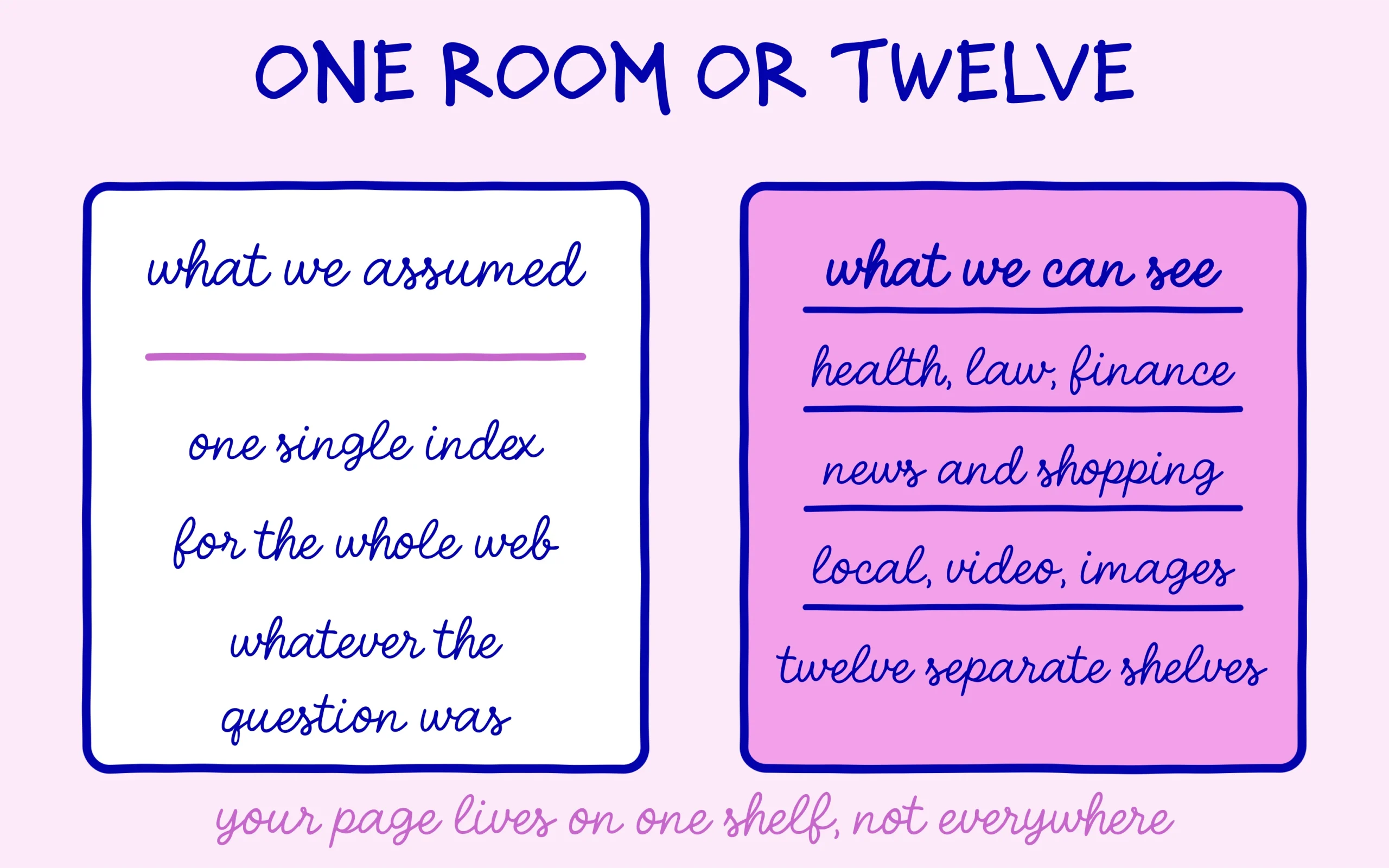
OpenAI’s in-house index carries an internal codename, Labrador. Its existence was already documented, and we covered how the ChatGPT index picks the pages it cites. What the new analysis adds is the shape of it. Instead of one enormous store of pages, there is a family: general web, PDFs, YouTube, news, arXiv, Wikipedia, local, finance, legal, medical, shopping and images.
A library makes the idea concrete. A library that keeps everything in one room treats a legal textbook and a recipe book exactly alike. A library organised into sections sends the reader to the right shelf before anyone opens a book. These specialized indexes work the same way, and the sorting happens before your page is ever weighed against anything.
One detail deserves attention. The news shelf carries its own freshness tiers, which tells you that publication dates do not weigh the same everywhere. On a news question, a three-year-old page has very little chance of being useful. On a legal or a how-to question, age costs nothing as long as the content still holds up. Plenty of site owners have started republishing old posts with a fresh date on principle, and this split shows how badly calibrated that reflex is.
For a niche site, the practical consequence lands quickly. An accountancy firm, a health publisher and an online shop do not compete on the same shelf, and nothing says that showing up on one means showing up on another. The old question was whether ChatGPT knows you exist. These specialized indexes add a second one on top: which shelf is it even looking on.
What a technical field left in the open made visible
The method here is worth explaining, because it says a lot about how much anyone really knows on this topic. Between 21 May and 21 July 2026, a field named result_source showed up in the technical exchanges between ChatGPT and the browser. That field named the origin of every result on screen, with four possible values: the in-house index on one side, three outside suppliers on the other.
In other words, the finding rests on a window that has since closed. The field is gone, and what we know comes from those two months of observation. That is far more solid than most of what circulates about AI search, and it is also the limit to hold on to before turning a dated sample into a permanent rule.
The analysis also confirms that OpenAI still leans on at least eight outside suppliers, Google, Bing, Yelp and TripAdvisor among them. So the in-house index replaces nothing yet, it sits alongside. On shopping queries, tests are running that pit the two approaches against each other on slices of traffic between 8 and 20 percent, which reads much more like a handover being prepared than an experiment run out of curiosity. The full breakdown sits in Tomek Rudzki’s analysis on the Peec AI blog.
This structure explains something a lot of site owners run into and cannot account for. A brand gets named confidently on one question and vanishes on the next one, even though both sit squarely inside what the business does. Read through a single index, that looks arbitrary. Read through twelve, it stops being mysterious: the two questions were answered from different shelves, and the brand only lives on one of them.
What this changes for a site that just launched
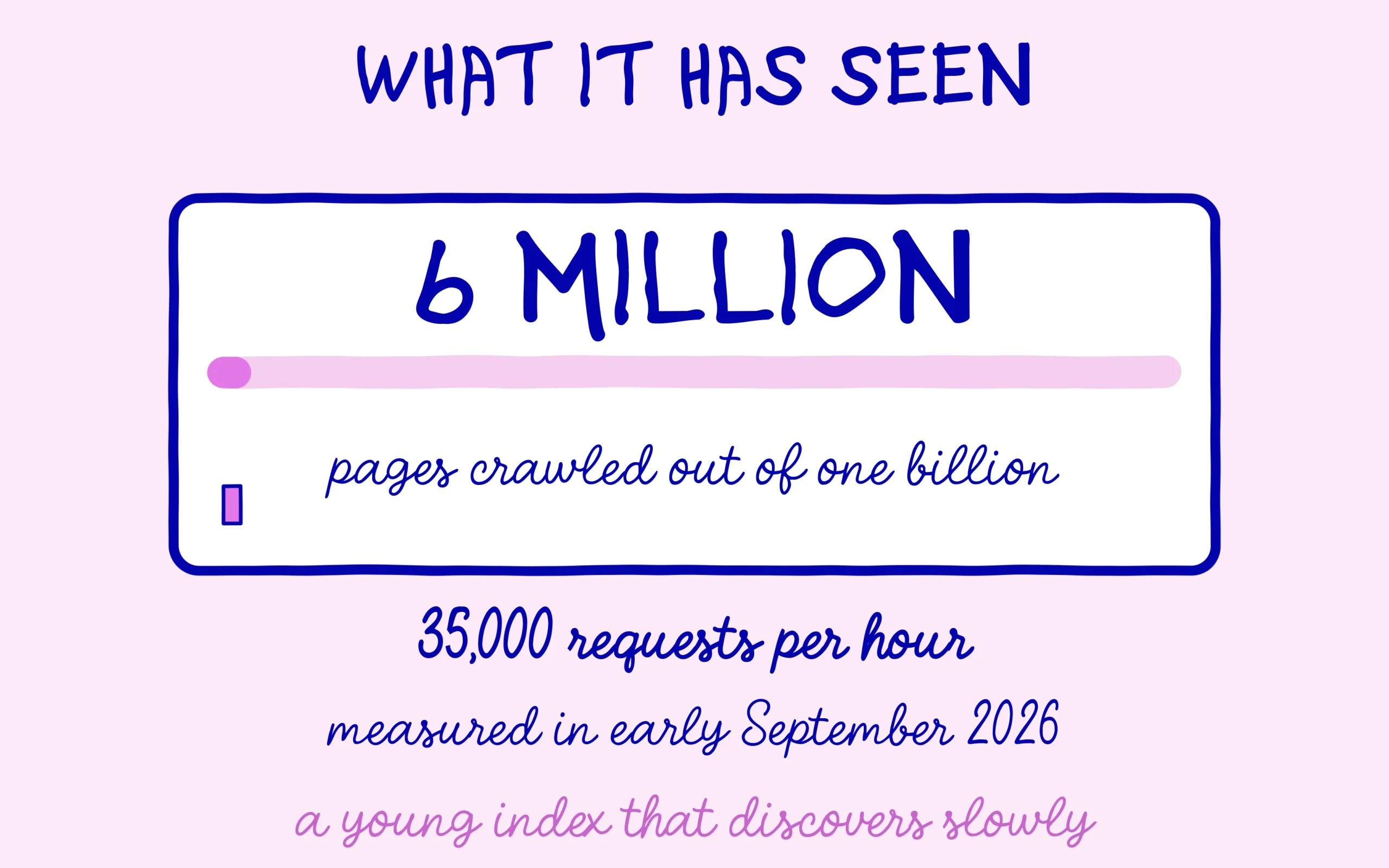
The crawl figure is what puts everything back in proportion. On a test site holding a billion pages, OpenAI’s crawler had fetched six million of them by early September, at a rate of 35,000 requests per hour. Measured against the size of the web, that is a young index that discovers far more slowly than Google does. A recent site therefore stands little chance of being in there yet, and that has nothing to do with the quality of what it publishes.
That slowness cuts both ways, though. An index that crawls little leans harder on the sources it already trusts, which lines up with what we see in the way ChatGPT citations shift depending on your topic. A health site, a legal site and a travel site face very different odds for the same underlying reason. They are not standing in the same aisle.
In practice, the most useful thing to do is also the least technical. Ask ChatGPT the questions your customers actually ask, read what comes back, and write down who gets cited. It costs nothing, it takes about fifteen minutes, and your AI citations show up without a paid tool. You will find out quickly whether answers in your field rest on independent sites or on three large incumbents.
Worth checking at the same time: whether OpenAI’s crawler can reach you at all. A crawler moving at this pace will not knock twice, and a site that blocks it in robots.txt or behind an aggressive security layer removes itself from every one of those twelve shelves at once. That check takes about two minutes in your robots file, and it is the only genuinely technical item on this whole list.
Be careful, though, about turning this into a technical project. Advice is already circulating about tagging pages to declare their subject area to the specialized indexes, as if a marker were enough to pick your own shelf. Nothing in the observed data points that way, and OpenAI has documented no such mechanism. Sorting happens on what a page genuinely contains, never on what it claims to be in a tag added for the occasion.
Everything else holds steady. No tag, no file at the root of your domain and no hidden setting opens the door to these specialized indexes. What opens it is being reachable by OpenAI’s crawler and being a page somebody has a reason to cite on its subject. Both take time, and both were already the right work before any of this came to light.

Keep learning on SEO Noobies.