
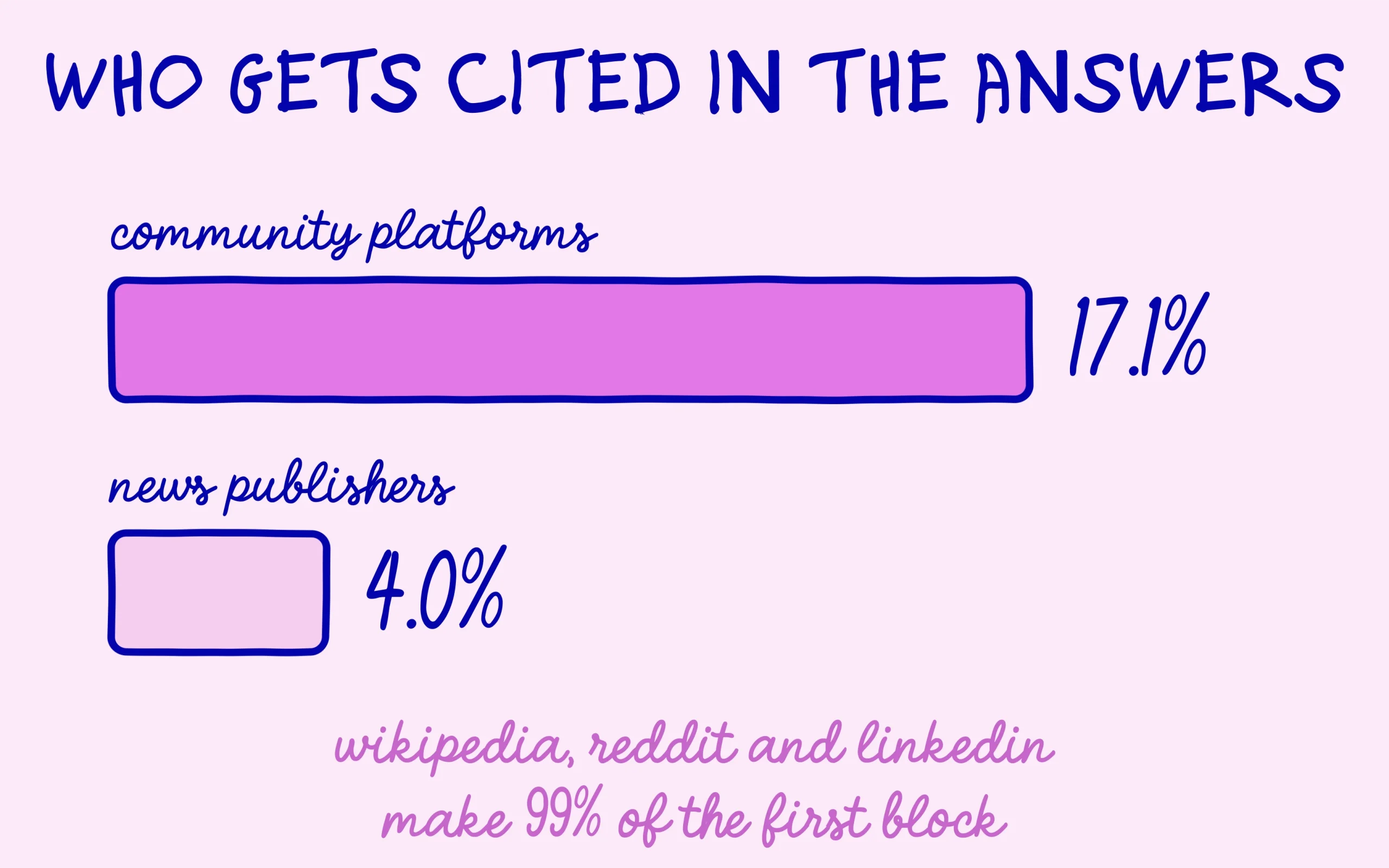
When an AI answer credits a third-party source, the odds are it points to Reddit and Wikipedia rather than a professional news outlet. An analysis of roughly 35,000 ChatGPT citations has now put a number on it, and the gap is wider than most people assumed. Community platforms account for 17.1% of cited domains, against 4.0% for publishers. That is more than four to one, on questions where you would expect well-researched articles to surface instead. Here is what the study says and what a beginner site can realistically do about it.
TL;DR
An analysis of roughly 35,000 ChatGPT citations puts community platforms at 17.1% of cited domains, against 4.0% for publishers.
Wikipedia, Reddit and LinkedIn together account for 99% of those community citations.
The share holds steady across every stage of the buying journey, between 15.1% and 18.2% depending on the moment.
Showing up on those platforms takes honest, consistent participation rather than a burst of promotional posting.
Summarize This Article with AI
ChatGPTWhat an analysis of 35,000 ChatGPT citations found
The dataset covers 3,177 software-related prompts, asked in the United States, on ChatGPT only, in December 2025. Every answer was parsed to collect the URLs it credited, and the domains behind them were sorted by type: the vendor’s own site, review platforms, publishers, community platforms.
Once vendor domains are set aside, the ranking of third-party sources is genuinely surprising. Community platforms lead comfortably at 17.1% of cited domains, carried mostly by Reddit and Wikipedia. Publishers stall at 4.0%. That imbalance extends an earlier observation on how ChatGPT citations shift depending on your topic, with different source families surfacing from one field to the next.
Inside that community block the concentration gets tighter still. Wikipedia, Reddit and LinkedIn make up 99% of citations in the category. The long tail of niche forums and specialist groups barely registers next to those three addresses. Three platforms absorb almost all the community voice that gets quoted, and that point rarely gets stated this plainly.
The full method and the stage-by-stage breakdown sit in the G2 study on which sources get cited as research progresses. The citations themselves were captured with Profound, a tracking tool that records what models actually surface in their answers.
Why Reddit and Wikipedia take up so much room
One detail deserves attention before any explanation: the community share never collapses along the journey. It sits at 17.8% during discovery, 18.2% in exploration, 15.1% in evaluation and 17.2% in focused evaluation. Someone asking a very specific question still gets pointed at those sources almost as often as someone just discovering a topic.
Reddit and Wikipedia hold that ground because of what actually lives on them. A Wikipedia page delivers a stable, sourced definition inside a structure that never changes, which makes it a convenient anchor for a plain fact. A Reddit thread answers a question asked in natural language, with competing replies and lived experience attached, which maps neatly onto the shape of a conversation. LinkedIn rounds it out with statements tied to a named human being.
That said, none of it is locked in. Reddit’s visibility inside ChatGPT dropped 11.7% over twenty-eight days to 8 June 2026, then climbed back 18.1% by 29 June. Swings that size in a matter of weeks are a reminder that no platform holds a permanent seat. A source’s place in the answers moves faster than its real authority, and the same applies to your own site.
There is a second lesson hiding in how steady those numbers are. Plenty of content written to please generative engines tries to look like a reference article, while the material that gets quoted most looks more like a useful conversation. The selection mechanism described in how the ChatGPT index picks the pages it cites pushes the same way: readability, freshness, a direct answer to a question someone actually asked.
How a small site can show up on those platforms
One approach to rule out immediately: posting your links across Reddit and Wikipedia to force citations does not work and backfires quickly. Communities moderate, fresh accounts dropping links get removed, and a deleted contribution cites nobody. The useful question is how to get mentioned by people other than yourself.
Answering questions in your field honestly, under a named account, giving a complete answer even when it does not route anyone back to your site, remains the sturdiest route. The analysts behind the study also note that a named individual gets picked up more readily than a brand account. A human signature carries further than a logo.
On your own site, the job is to become the reference people quote inside those discussions. A thorough, current article that genuinely answers the question in the thread eventually gets shared by somebody else. That is precisely the mechanism covered in our piece on topical authority and how AI tools pick the references they trust.
Then there is monitoring. An alert on your site name or brand lets you catch mentions as they happen, reply where it helps, and spot the questions that keep coming back. Those questions make an excellent article backlog too, since they are the ones real people are genuinely asking.
Worth setting expectations on the timeline as well. None of this pays off in a fortnight. A thread you answered in March can surface in an AI response months later, once it has accumulated replies and started ranking on its own. Treating community presence as a slow deposit rather than a campaign is the only version of this that holds up.
A closing note on how far these figures stretch. The sample covers one model, one country and one software vertical, so it cannot be generalised as it stands. The weight of Reddit and Wikipedia in AI answers does hold up across plenty of other topics, and that concentration is probably the most useful signal to keep in mind while building your own presence.
Keep learning on SEO Noobies.



[…] all measured citations. That weight of community platforms matches what we found in our article on how heavily AI tools cite Reddit and Wikipedia. And the audience at stake is real: Google says AI Overviews reach more than 2 billion monthly […]
[…] So what can a small site actually do with these numbers? The core lesson fits in one line: AI visibility gets built largely away from your own pages. The overperforming brands owe their spot to roundups, hands-on tests and best-of lists written by third parties, exactly the kind of content the models absorbed in bulk during training. Pitching the comparison articles of your niche, answering the journalists and bloggers who cover your space, collecting detailed reviews on recognized platforms: that external presence now weighs as much for AI engines as it does for Google. Community platforms play an outsized role in this loop, as shown by the data on how heavily AI tools cite Reddit and Wikipedia. […]