
ChatGPT citations do not happen at random, and a recent study proves it with numbers: depending on the field you publish in, your odds of being cited by the assistant swing from one to nearly five. Travel sits far ahead, education trails at the back, and the gap between them is striking. Behind those figures is something useful for any beginner wondering whether this whole being-cited-by-AI thing actually applies to them. Most coverage stops at the ranking of sectors, but there is a more actionable read to take from it. Here is what the data says and how to use it without drowning in it.
TL;DR
A study on ChatGPT’s outbound links shows the citation rate varies sharply by topic.
Travel is the most cited sector (around 22%), education one of the least (around 5%), with an average close to 7%.
In under a year, the share of ChatGPT answers that contain a link has grown more than fivefold.
The beginner takeaway: work out whether your topic is citation-friendly, then make your content easy to cite.
Summarize This Article with AI
ChatGPTWhy ChatGPT citations depend so much on your topic
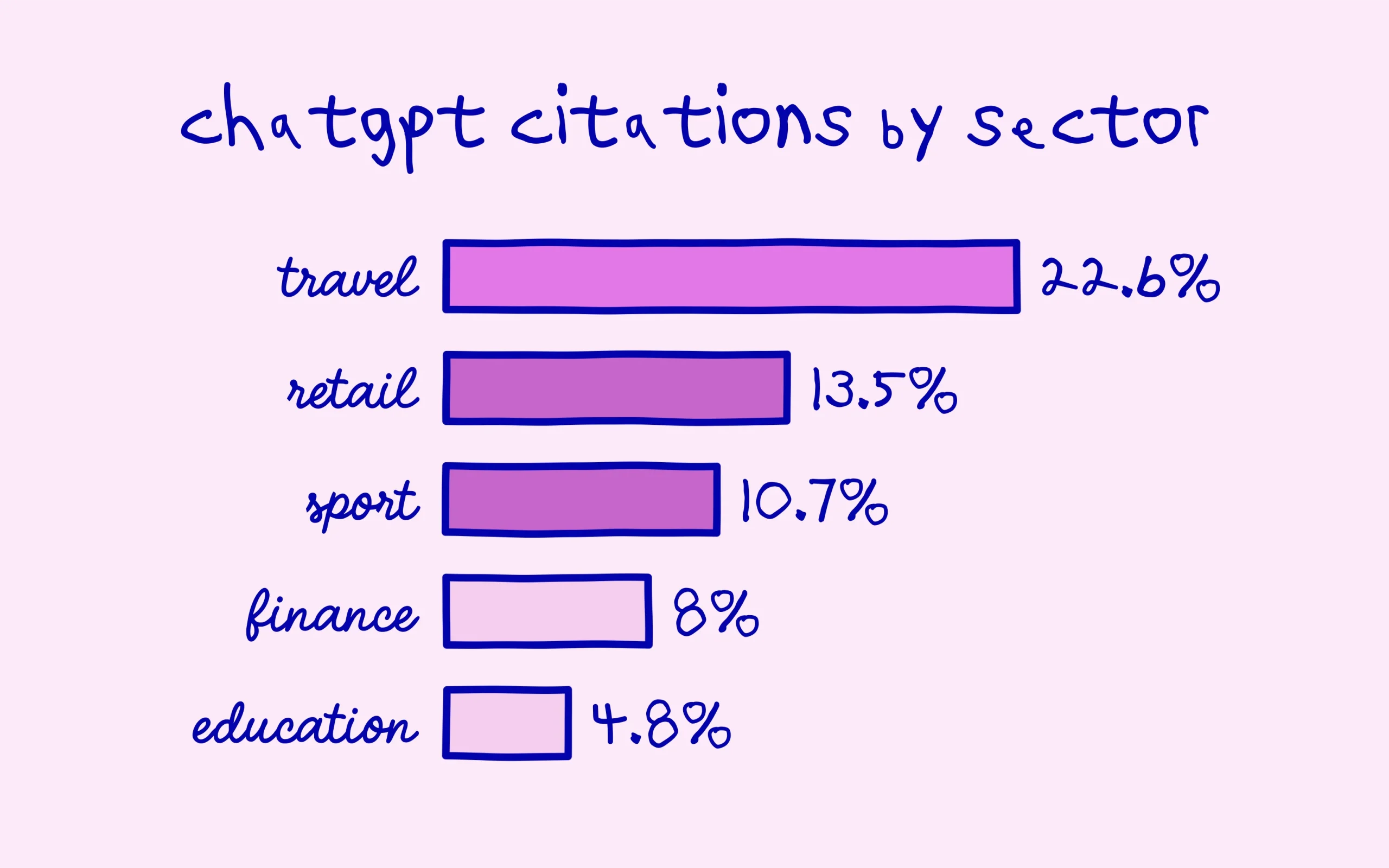
Let’s start with the numbers, because they speak for themselves. Across a sample of the top citations recorded in the United States in May, travel leads with roughly 22.6% of answers pointing to a source. Retail follows at about 13.5%, sport near 10.7%, then finance at 8%. The all-sector average sits around 6.8%, and education brings up the rear at just 4.8%. Put plainly, on a travel question ChatGPT links out almost five times more often than on an education one. These figures come from the 2026 Generative AI Landscape report published by Similarweb, which presents them as estimates based on U.S. desktop traffic.
Why such a gap? Because not every question calls for the same kind of answer. On travel, the user wants times, prices, recent reviews, so the assistant leans on living sources it happily cites. On a coursework or definition question, it can answer from memory without needing to point anywhere. The topic largely decides the citation reflex, before your page’s quality even enters the picture. That is exactly why the authority you build on one clear theme carries weight in AI answers.
One thing to keep in mind before drawing grand conclusions. These figures cover one month, on the U.S. market, and the study itself calls them estimates. They give a solid trend, not a carved-in-stone truth. Your sector strongly shapes your odds of a ChatGPT citation, but it does not fully decide them, and that is rather good news for what comes next.
What the rise in ChatGPT’s outbound links reveals
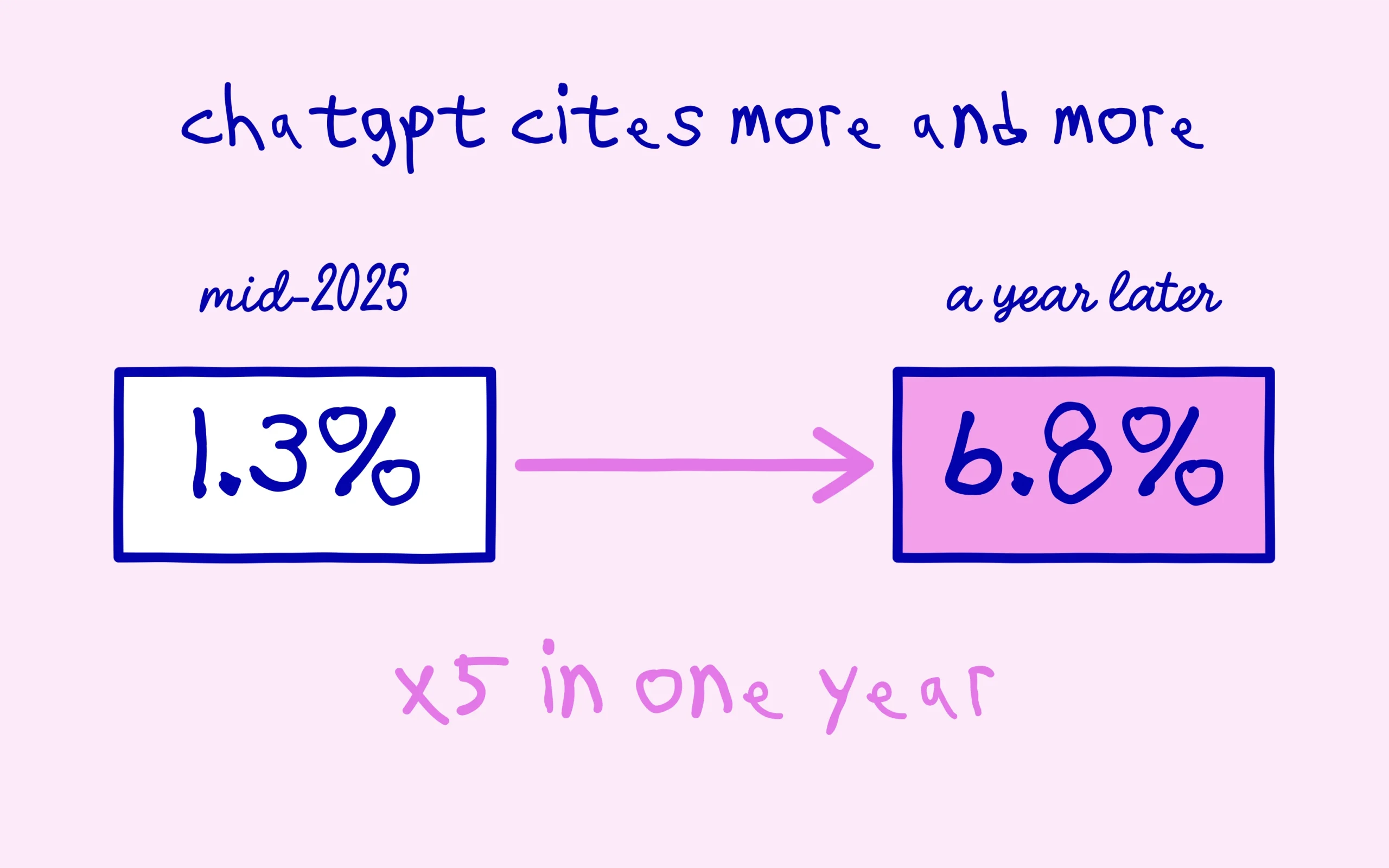
Beyond the ranking by sector, ChatGPT citations also tell a trajectory. The share of ChatGPT answers that contain a link to a source went from about 1.3% in mid-2025 to 6.8% a year later. In plain terms, the assistant cites more than five times as often as before. The trend is not perfectly linear, it has had ups and downs, but the overall direction is clear: citing sources is becoming a rising habit, not an exception.
Look at where those links go and the picture sharpens. Reviews and user-generated content grab the biggest share, around 28.9%, closely followed by news and publisher sites at 26%, then online retail near 14.1%. Translated for a beginner, that means concrete, up-to-date, lived-in content is worth more to the assistant than yet another generic page. The same principle shows up when you wonder whether technical markup moves the needle, given that most AI engines mainly read the visible text on the page.
There is a nuance worth keeping in mind. A high citation rate in a sector does not mean easy citations, it often means the competition to be the cited source is livelier there. On a quieter topic, fewer pages fight for the spot, so a clear, current answer can stand out faster. Either way the takeaway holds: match your content to what the question actually needs, and you give the assistant a reason to point at you rather than someone else.
What comes out of these two moves is a window opening. ChatGPT citations are multiplying, and they favour content even a small site can produce: an honest review, a usage report, a fresh data point. The AI citation train is not reserved for big sites, as long as you publish what the assistant wants to quote.
How to give yourself a shot at being cited as a beginner
First step, place your topic. If you are in travel, online retail, sport or practical finance, you are on ground where the assistant cites a lot, so make the most of it. If you are on a more explanatory subject, do not give up, but aim for the angles where an answer needs a current source: comparisons, first-hand reports, recent figures. The goal is to sit where a citation has a reason to exist.
Second step, publish the kind of content the assistant reuses. ChatGPT citations go first to reviews, user reports and fresh publisher pages, rather than to hollow text. An honest test, a dated comparison, a recent figure with its date beats a long generic article. That is rather good news as a beginner, because this content does not need a big team, just honesty and a bit of method to keep it useful and current.
Finally, make your content easy to cite. One idea per paragraph, a clear figure with its date, a heading that states the answer precisely, a firm stance rather than a lukewarm text. The assistant reuses a passage all the more readily when it stands on its own, lifted out of context. To understand how these answers are built and on what terms a site ends up in them, the guide to AI summaries and what they change for your site lays the groundwork. Clear, dated, opinionated content has a far better shot at being picked up.
Keep learning on SEO Noobies.



[…] crawls little leans harder on the sources it already trusts, which lines up with what we see in the way ChatGPT citations shift depending on your topic. A health site, a legal site and a travel site face very different odds for the same underlying […]