
This AI Overviews guide starts from a simple fact: Google Search now writes an AI-generated summary at the top of its results, above your links, and pairs it with a conversational mode called AI Mode. If you run a small site, that shift is going to touch your traffic whether you notice the cause or not. After a year of watching this play out on English-speaking markets and testing it on my own sites, I want to give you a calm, complete read on it, without the doom but without sugarcoating either. The goal is not to scare you, it is to help you understand the mechanism and know what to actually do when you are starting out. So we will take it from the top: what it is, what changed, the real measured impact, and above all how to keep existing inside it.
TL;DR
Google now shows AI-generated summaries (AI Overviews) and a conversational AI Mode, rolling out across more markets after long regulatory and publisher disputes.
The traffic impact is real and measured: the click-through rate of the top result can collapse when an AI summary appears, and barely 1% of users click the links inside the summary.
Getting cited inside an AI Overview becomes a goal of its own: it hinges on clear, extractable content and on your recognized authority on a topic.
Some tricks sold as magic (an llms.txt file, markup alone) change nothing; your energy goes into content and into measuring via Search Console.
Summarize This Article with AI
ChatGPTContents
1. AI Overviews and AI Mode: what they actually are
2. What flipped for search this year
3. The real impact on your traffic, with the numbers
AI Overviews and AI Mode: what they actually are
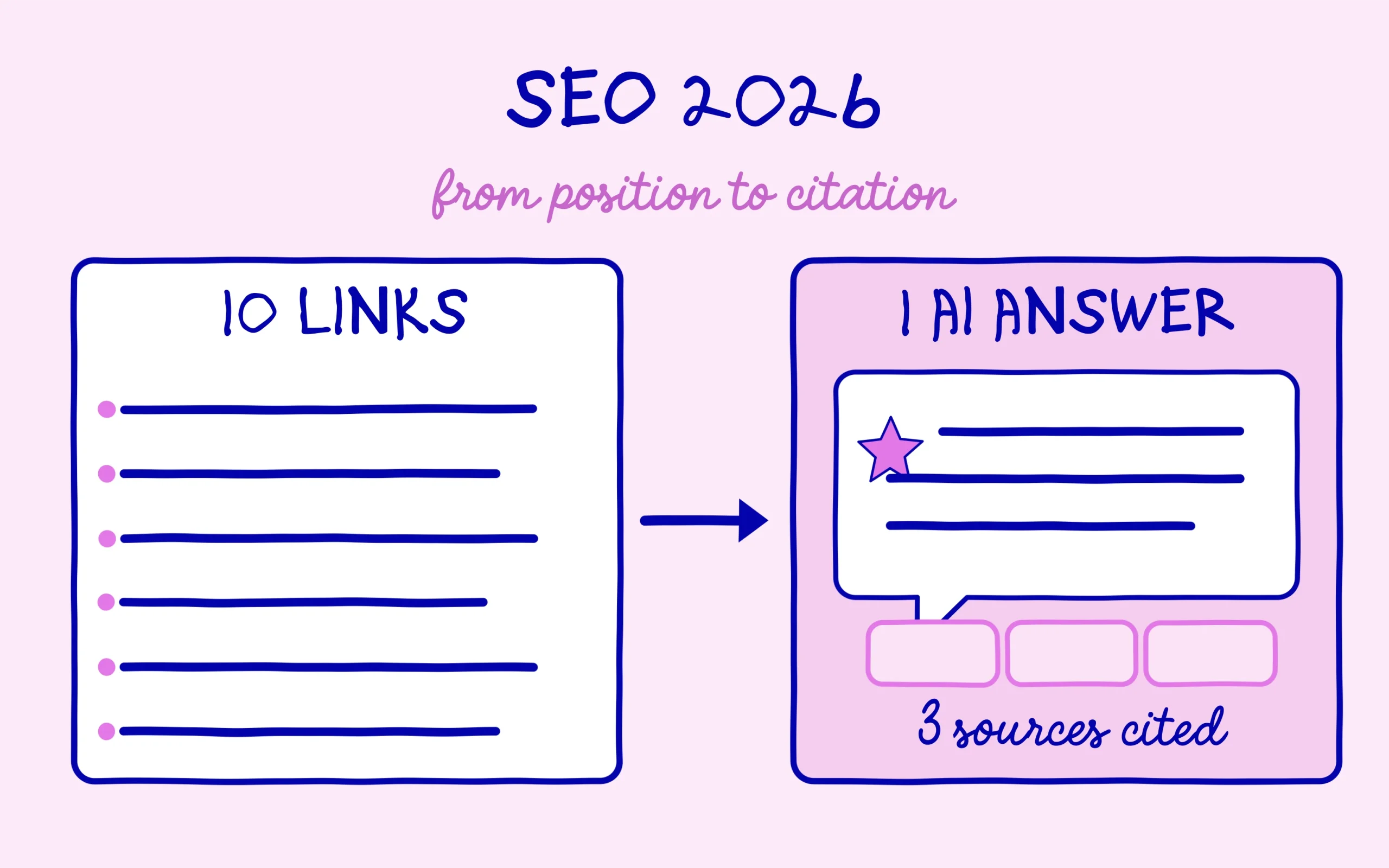
Let us settle the words first, because the two get mixed up constantly. An AI Overview is the short synthesis Google generates automatically at the top of the results page to answer your question directly, with a few sources cited underneath. AI Mode is a separate, conversational interface where you talk to the engine like an assistant and chain questions together. The first one imposes itself on you inside the classic results, the second is a space the user chooses to open. In both cases the logic is the same: Google no longer just lists links, it writes an answer built from several pages.
For a beginner, the key nuance sits in one word: selection. The engine picks a handful of sources it trusts to build its summary, and the rest falls away. This is no longer a ranking of ten links where you can grab a spot, it is a single answer that cites three or four pages. The shift looks a lot like what we already described about how SEO and GEO play together in 2026, except here it becomes concrete and visible to everyone overnight. We move from a game of positions to a game of citations.
One thing that reassures beginners: you will not see an AI Overview on every single query. They fire mostly on informational questions, the how-tos, the definitions, the topics where a synthesis makes sense. On a brand search, a strongly transactional query or a precise buying intent, Google often stays on its classic links. Knowing which queries trigger a summary in your niche is already half a diagnosis: those are the ones that will lose clicks, and the ones to rethink first.
What flipped for search this year
Several markets held out for a long time without AI Overviews, and that was no accident. The holdup came from old fights over publisher rights, the kind of framework that forces platforms to compensate news outlets when they reuse their content. As long as no agreement was reached, Google kept its AI summaries off those territories. In France, the rollout finally landed on 22 July 2026, on desktop, mobile and the app, announced by Elizabeth Reid, the head of Google Search, after roughly two years of blockage tied to the country’s neighboring-rights law.
These deals usually give publishers a payout and the option to pull their content from the summaries. But for a small site, a blog or a shop that is just getting going, the important part is elsewhere: you are now affected, whether you are a media outlet or not. The citation mechanism applies to every page on the web, not just the press. You can find the timeline and the stakes in our coverage of the AI Overviews rollout, but remember one thing above all: what used to be a distant novelty reserved for the United States is now your everyday search.
The real impact on your traffic, with the numbers
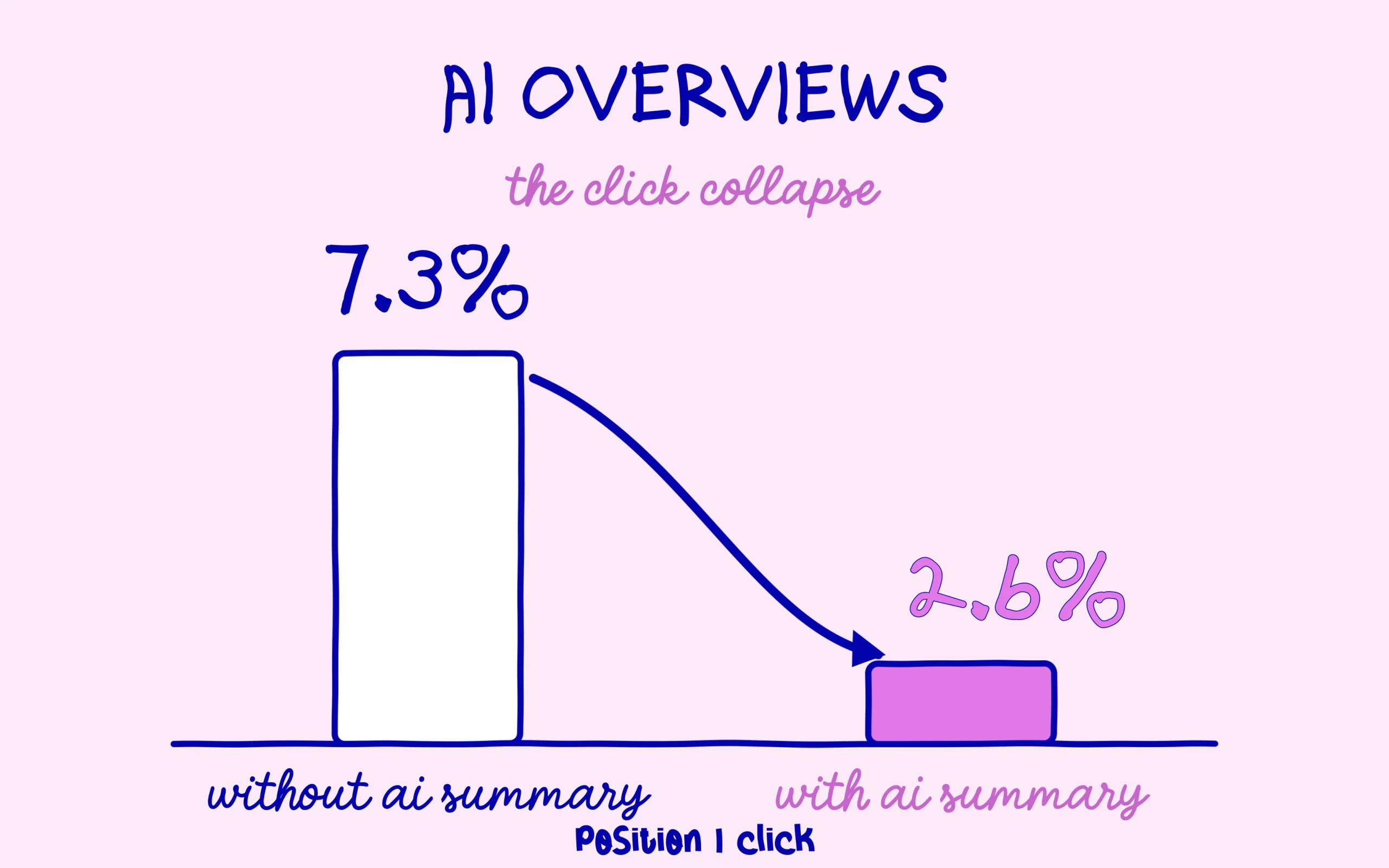
Here I have to be honest, because the numbers are not reassuring and you will see them in your own analytics anyway. An Ahrefs analysis published in April 2025, titled “AI Overviews Reduce Clicks by 34.5%”, measures that on informational queries where an AI summary appears, the click-through rate of the top organic position drops from 7.3% to 2.6% between March 2024 and March 2025, roughly a 34.5% fall. In other words, being number one no longer guarantees the click once Google has already answered above you.
The pattern feeds into the bigger zero-click trend we have tracked for months: more and more searches end without any site being visited. We have tracked that zero-click shift for months, with more and more searches ending without any site being visited, and AI Overviews sharply accelerate it. Visibility moves from the page to the answer itself. That does not mean organic traffic dies, but that it concentrates on the queries where the user genuinely wants to go further, compare, buy, dig deeper. The simple questions now find their answer directly in the summary.
How to get cited inside an AI Overview
Since the game becomes a game of citations, the real question is no longer only about ranking, it is about being one of the sources Google reuses in its answer. And here a Pew Research data point helps frame the stakes: when an AI summary appears, users click only 8% of the time versus 15% without one, and only 1% click the links cited inside the summary. Most summaries actually lean on three or more sources, as detailed in Pew Research’s study on click behavior around AI summaries. Getting cited does not pour direct traffic on you, but it sets your brand up as a reference inside the answer, and that counts more and more.
Concretely, two levers stand out for maximizing your odds of being picked up. First, clear and extractable content: sharp answers to precise questions, written plainly on the page rather than buried in filler. Second, authority on a topic: Google reuses first the sources it treats as references on a theme, which we broke down in our analysis of topical authority in AI search. A beginner has every reason to cover one narrow niche seriously rather than skim fifty subjects. It is slow, but it is what builds a lasting presence in generative answers.
If I had to boil down to three moves what a beginner can do right now, it would go like this. First, pin down the two or three key questions of your business and answer them clearly and fully on a dedicated page. Then, structure that answer so a machine can extract it: a heading that poses the question, a first paragraph that answers it directly, no detour. Finally, feed your authority on the topic by publishing around it regularly, so Google ends up seeing you as a reference in that niche. Nothing magic in there, just deep work applied in the right place.
What does nothing, and how to measure your presence
Before we wrap, a word on the fake fixes, because plenty will be sold to you. The llms.txt file, pitched as the new magic tag to get read by AI, changes nothing measurable about your presence in the answers, and markup alone does not get you cited by a generative engine. These technical recipes feel reassuring because they give the impression of doing something, but they never replace content a machine truly understands. The energy you would spend polishing a config file is far better invested in writing a clear answer to a real question from your audience.
That leaves measurement, because you only steer well what you observe. Google Search Console is gradually folding AI Overviews data into its performance report, which lets you see whether your pages show up in these summaries and on which queries. Add a very simple manual check: regularly type your target queries and your brand name into Google and into an engine like Perplexity, and note what gets cited. That monitoring reflex beats a thousand complicated tools when you are starting out. The real change here is not a punishment, it is a new playing field, and those who tame it now gain a head start on everyone who will discover it six months from now.


[…] Keep the orders of magnitude honest: none of these 41 domains exceeds 1% of mention share. Seen from the top 9, that is a rounding error. Seen from a normal site, it is enormous: Walmart gets cited across 58,671 distinct pages, TripAdvisor across more than 43,000. A 0.4% share in this table still means tens of thousands of citations captured against the entire web. And the bottom half stays genuinely open: ZipRecruiter, Etsy and Serious Eats all entered the top 50 as newcomers in the July snapshot, which shows the list of AI Overviews sources gets reshuffled every single month below the giants. How the summary box itself works, and what it changes for a young site, is covered in our full guide to AI Overviews. […]
[…] of context. To understand how these answers are built and on what terms a site ends up in them, the guide to AI summaries and what they change for your site lays the groundwork. Clear, dated, opinionated content has a far better shot at being picked […]