
NicheObserver launched a free tool called Reach on September 8, promising to size up the audience of any website using data Google publishes itself. I’ll be upfront: announcements like this make me wary. I’ve watched plenty of traffic tools produce numbers that fell apart the moment you compared them with a real Search Console account. So instead of getting excited over a demo, I read the first published reviews closely, cross-checked them against each other, and went to look at the tool myself. Here’s what I took away for someone just starting out, including what won me over and what left me wanting more.
TL;DR
Reach, NicheObserver’s free tool, gives a domain an audience score from 0 to 100.
The data comes from Google’s Chrome UX Report, so it reflects real Chrome visits.
Safari and iPhone traffic are invisible to it, and a moving score isn’t proof of moving traffic.
Use it to compare trends between sites, never as a replacement for Search Console.
Get an AI summary of this article
What NicheObserver’s Reach Actually Measures
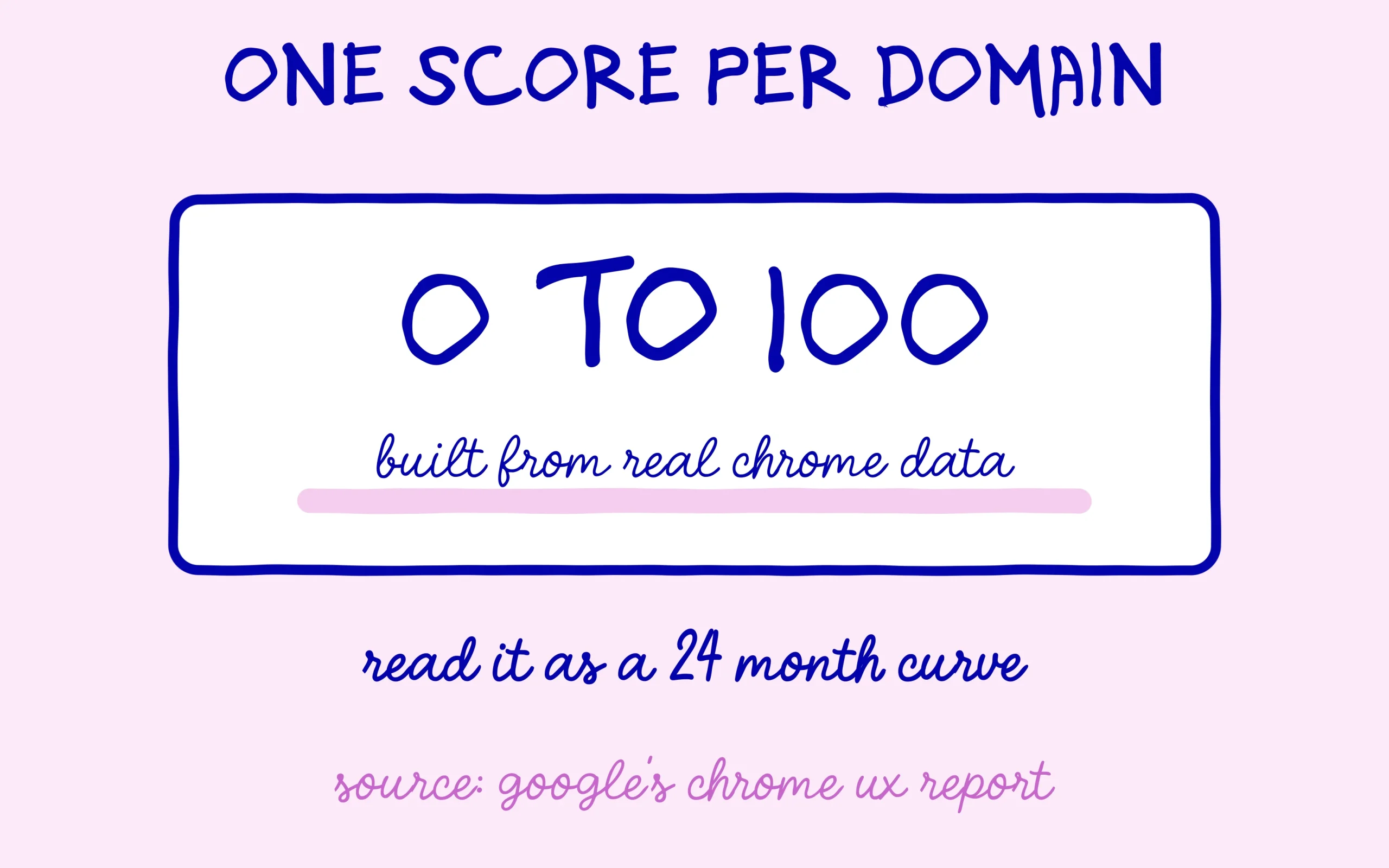
Let’s start with where the data comes from, because everything else follows from it. Reach is built on the Chrome UX Report, which Google shortens to CrUX: a public dataset, released every month, that summarizes the experience of real Chrome users on desktop and Android. These are actual page loads from real people, where many traffic tools extrapolate from a panel of users or a statistical model. For me, that’s the first real point in its favor.
If CrUX rings a bell, that’s because it’s the same source behind the field data in PageSpeed Insights, the part that tells you how fast your pages load for real visitors. Google publishes it so site owners can measure user experience. NicheObserver had the idea of using it to answer a different question: how many people, relatively speaking, load a given site. I like ideas like this one, because they rest on public data anyone can check.
The tool was presented by Kevin Richard, known in French SEO circles as 512banque, during a live stream on X. Johan Sellitto broke down how it works in his write-up for Abondance. Reach turns the raw data into a score from 0 to 100 per domain, along with a popularity bracket, a likely main market and 24 months of history. It never shows a visit count. Reach measures how sites stack up against each other. Keep that in mind and the results become much easier to read.
Coverage is broad. The Abondance piece cites more than 35 million queryable domains over 24 months, more than 40 million origins, and 238 countries and territories, with around 13.9 million domains observed in August 2026 alone. The tool is currently free and comes with several ways in: single-domain search, a bulk mode, an API, an extension tied to SEObserver, and an MCP server, which lets an AI agent query the data directly.
Kevin Richard pitches it openly as a free alternative to Similarweb, the paid reference for estimating a site’s audience. The positioning is honest on one key point: Reach doesn’t break traffic down by source. You won’t learn whether visits come from Google, social media or ads. You’ll learn whether a site gets real users, and how its weight changes over time.
What the First Published Reviews Found
The most hands-on review I read came from Eric Thomas, published on September 9 in his analysis for Menow. He compared Stack Overflow, DeepSeek and Cursor, three sites on very different trajectories, and showed how reading the data month by month reveals shifts that a single number hides. That’s exactly the use case I find most interesting: seeing who is rising and who is sliding.
His review also highlights three features I’d missed in the announcement. Bulk mode takes up to 100 domains at once. A dedicated section lists the month’s winning and losing domains, handy for spotting movement in a market. And the tool publishes country rankings, limited to the top 1,000 sites. Eric Thomas is careful to point out that Reach doesn’t provide a full census of browsers or visits, and that it doesn’t replace Google Analytics or mainstream SEO platforms.
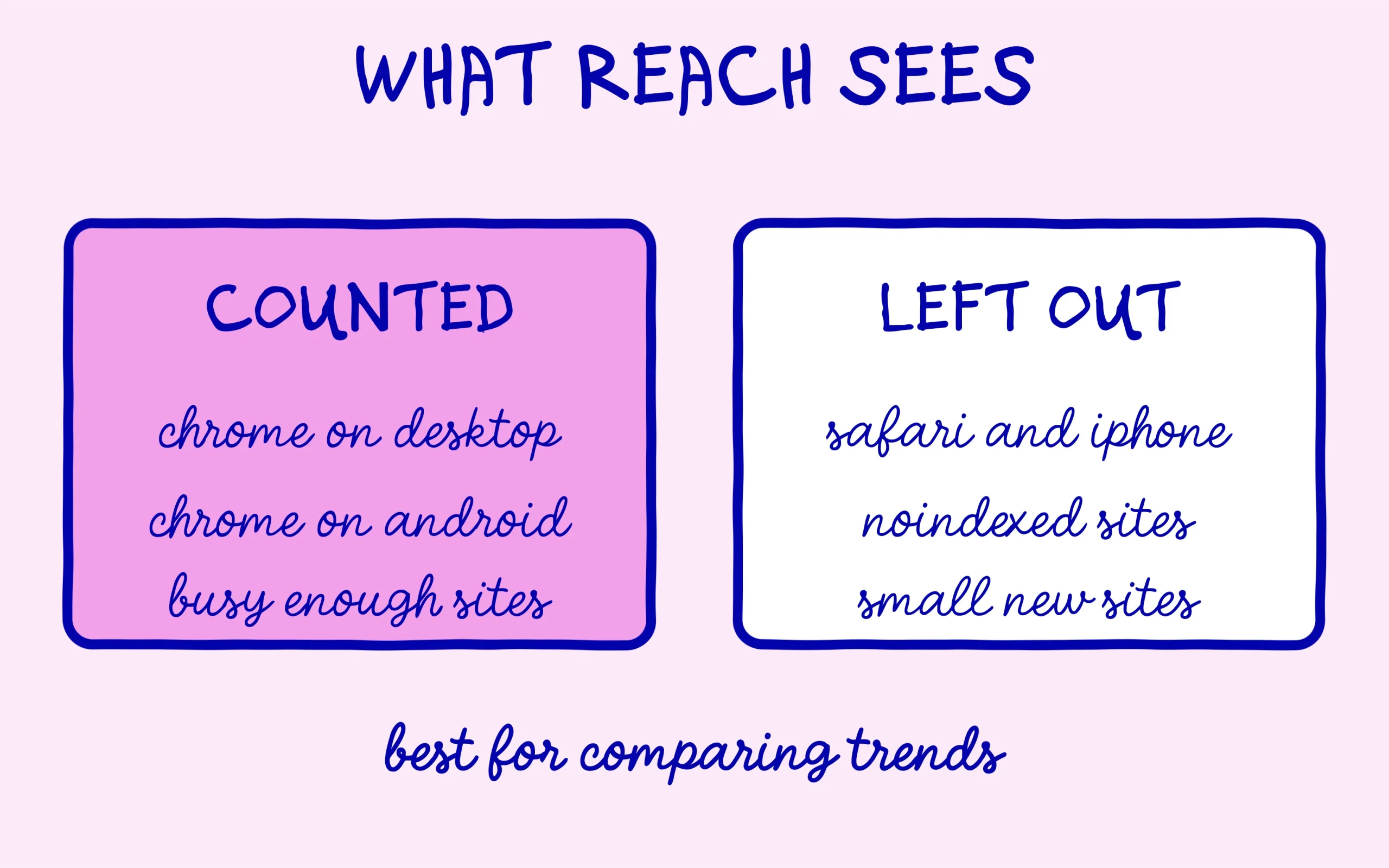
Johan Sellitto, for his part, spends real time on the limits, and I’m grateful for it. Safari and iPhone visits are excluded, since CrUX only collects Chrome data. Noindexed sites don’t show up. CrUX eligibility rules apply, so a site needs enough Chrome traffic to appear at all. Most importantly, a score that changes from one month to the next doesn’t necessarily mean traffic changed: a shift in CrUX coverage can produce exactly the same effect.
My First Look at the Tool, and Its Limits for a Small Site
I went to the Reach page to form my own opinion. First surprise: from my connection, the tool asked me to create a free account before running a search, with a link to its API documentation. Nothing dramatic, signing up costs nothing, but worth knowing before you try a quick lookup between meetings. To be fully transparent, I haven’t run a measurement campaign across dozens of domains, and I won’t show you numbers I didn’t collect myself. What I can offer is a careful reading of two independent reviews, plus my own view of where the tool fits for someone who runs a small site and has no budget for paid data.
What bothers me most for beginners is the eligibility threshold. A brand-new site may not appear at all, simply because it doesn’t get enough Chrome traffic to make it into Google’s dataset. Neither the announcement nor the reviews I read give a precise threshold, so I won’t make one up. If you type in your own domain and nothing comes back, your site is just too small for this data source for now, which is completely normal in the early months.
The other blind spot is the iPhone. If your audience is heavily mobile and heavily Apple, say a fashion store or a travel site, a big slice of your visitors falls outside the measurement. The score still works for comparing two sites, since the same bias applies to both, but it describes your real audience poorly. For that, your own data remains the only reliable reference, and our guide to Google Search Console as a free tool walks through reading the clicks Google actually sends you.
Discover the SEO Noobies agency
My Verdict on Reach for Beginners
Honestly, I think the tool is well designed, and above all honest about what it is. It makes no claim to know a visitor count it can’t know. For a beginner, I see three concrete uses: checking that a site you’re considering for a guest post or an ad placement really gets visitors, following a direct competitor’s trend over several months, and spotting the sites climbing in your niche through the winners and losers section. None of these needs any technical knowledge.
My one reading rule: always look at a curve, never a single point. A score of 42 on its own means little. A competitor going from 30 to 45 over six months, on the other hand, is worth a closer look at what they published during that time. And if your own score dips for a month, check Search Console before you worry, since CrUX coverage alone can explain the change.
Would I add it to a beginner’s toolkit? Yes, without hesitation, because it’s free and answers a question free tools have left unanswered until now. I’d just keep it in its proper place, as a comparison and monitoring tool, well behind Search Console for anything about your own site. Here’s how I’d use it in week one: list the three or four competitors ranking above me on my main queries, run them through bulk mode, and study their 24-month history rather than today’s score.
The competitor whose curve climbs fastest deserves a proper visit. Which articles did they publish during that stretch, on which topics, and how often? That kind of monitoring costs nothing, and it usually sparks more ideas than a keyword list does. I’ve seen beginners lose weeks chasing phantom traffic curves from paid tools that measured nothing real on their side. A free tool built on data you can verify, used with the right expectations, is a far healthier habit to start with, and NicheObserver’s Reach fits that description well.
Quick Quiz on Reach
Where does Reach get its data?
See the answer
From Google’s Chrome UX Report, a public dataset summarizing real page loads by Chrome users on desktop and Android.
Why might a small site not show up in Reach?
See the answer
Because CrUX eligibility rules apply: a site needs enough Chrome traffic to be included in Google’s dataset.
Does a month-over-month score drop prove traffic dropped?
See the answer
No. A change in CrUX coverage can produce the same effect, which is why you read trends over several months and check Search Console.
Keep learning on SEO Noobies.