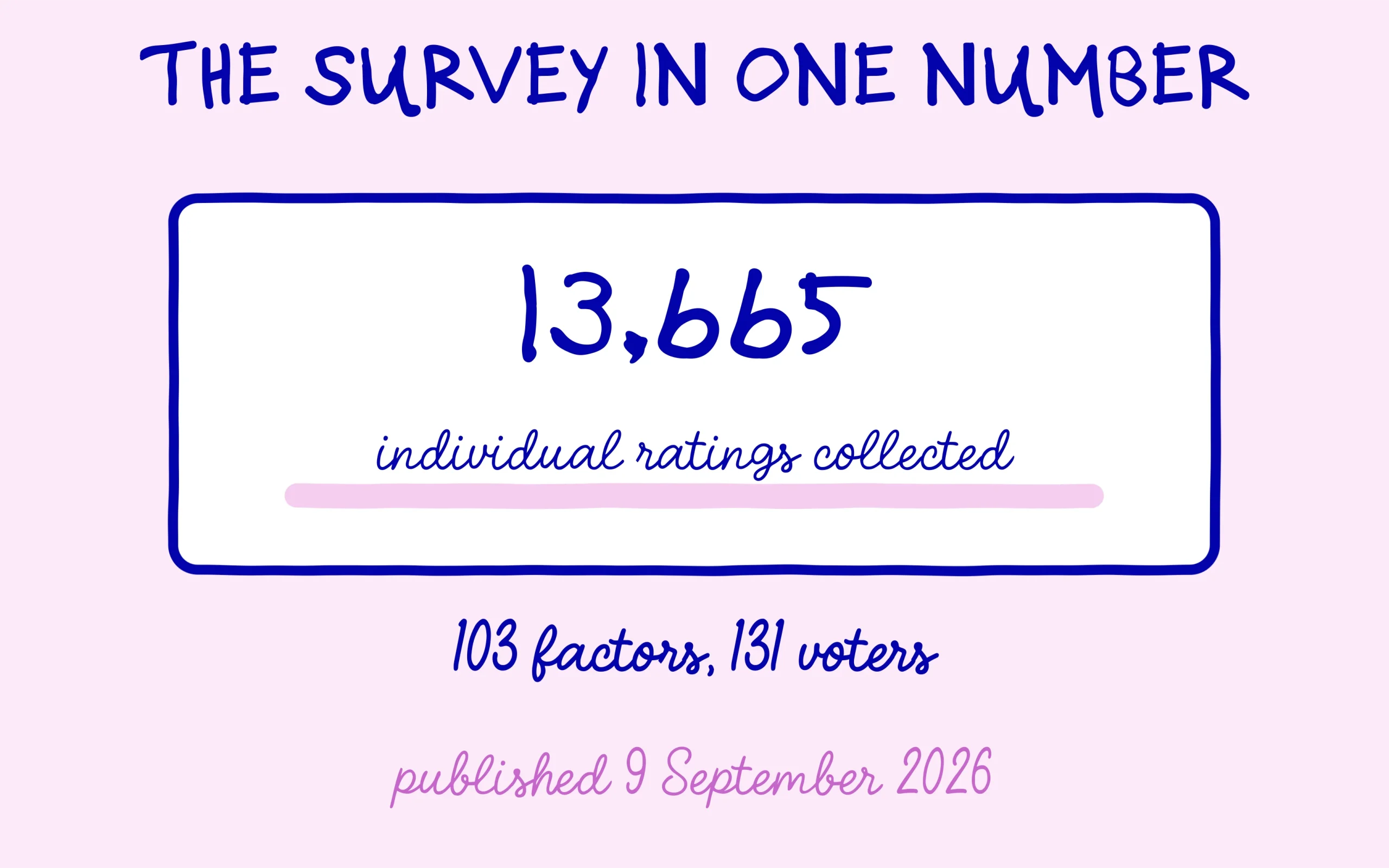
Every list of Google ranking factors published in the last decade has had the same problem: two hundred lines, no order of priority, and no way for a beginner to know where to start. The survey Cyrus Shepard released on 9 September through Zyppy works the other way round. It asked 131 working SEO professionals to score 103 signals one by one, on a scale running from strongly positive to strongly negative, and it collected 13,665 individual ratings in the process. What comes out is short enough to act on. Here is what the votes say, and what a site with fifty pages can reasonably do with them.
TL;DR
131 SEO professionals rated 103 ranking factors on a seven-point scale, from strongly positive to strongly negative.
Relevance takes first place, named in the top three by 57.1% of respondents, with backlinks close behind at 54.8%.
Scaled AI content is rated negatively unless a human has substantially reviewed it.
Meta descriptions come last: the panel credits them with no effect on position at all.
Summarize This Article with AI
ChatGPTRelevance takes the lead, backlinks stay right behind
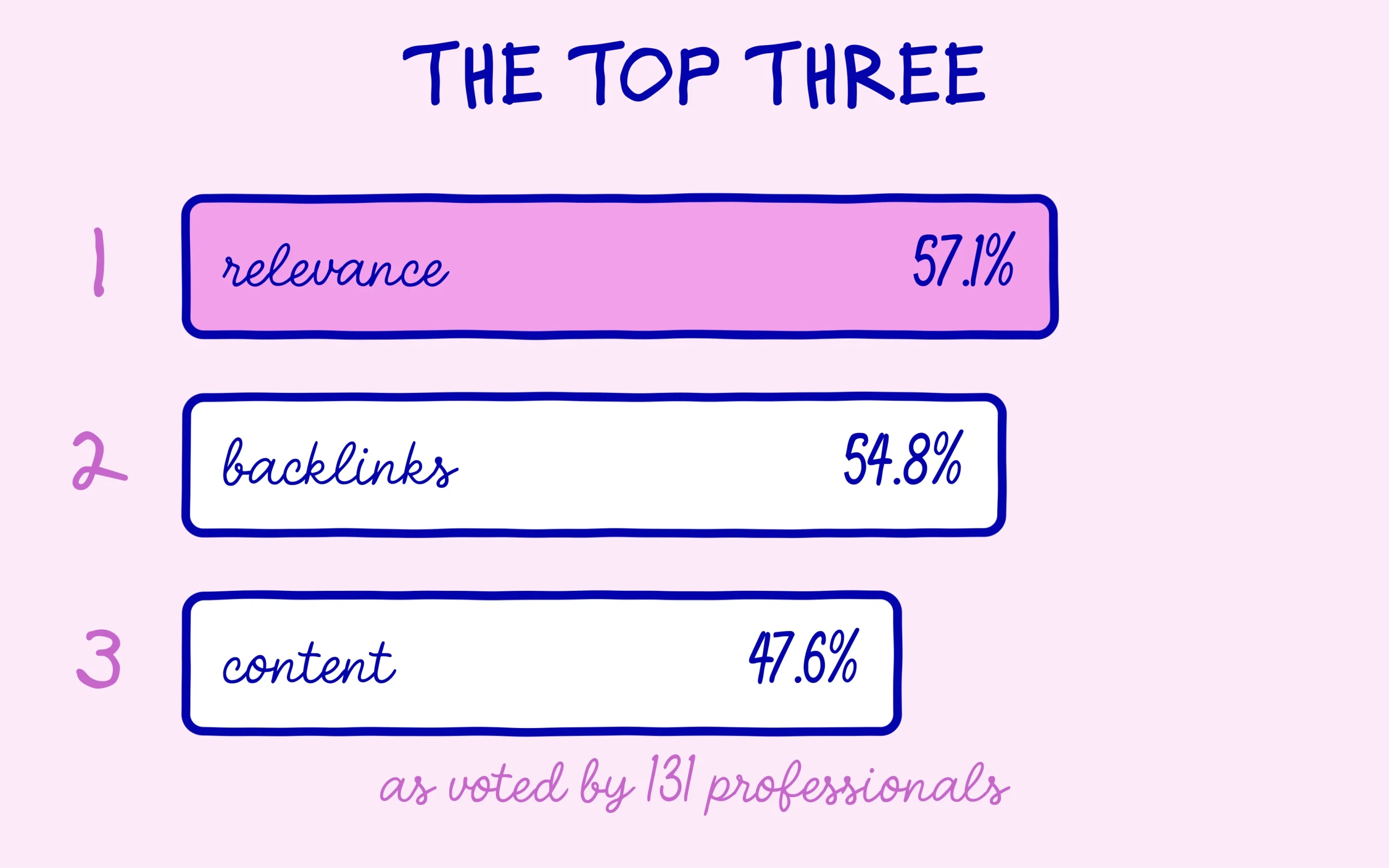
The order comes from how often each signal was named in a respondent’s top three. Relevance leads at 57.1%, backlinks follow at 54.8%, content quality at 47.6%. Authority and trust sit at 36.5%, behaviour and click signals at 29.4%, brand signals at 27%. User satisfaction gets 19.8%, technical health 17.5%, topical authority 14.3%, and internal links round out the top ten at 11.1%. Authority and trust, in particular, map closely onto what Google actually wants from your site under E-E-A-T.
Relevance here means something narrow and testable. It is whether the page answers the question the searcher actually typed. A page titled “best invoicing software” that spends four hundred words on the history of bookkeeping before naming a tool fails that test, however well written it happens to be. That filter runs first, and everything else runs after it.
The second place is the one worth pausing on. Plenty of commentary over the past year has declared links finished, replaced by brand mentions or by whatever the current framing happens to be. The panel says otherwise. Links are still the second most cited signal, under three points behind relevance. What has changed is the qualifier attached to them: respondents point to links from trusted, topically close domains, not to raw volume.
The scoring scale is worth a line of its own, because it shapes the result. Respondents could rate any signal from three points positive to three points negative, so they could say a factor actively hurts rather than simply saying it helps a little. Few surveys of ranking factors allow that, and it is what makes the rejection of scaled AI content visible further down the table.
At the other end, one item draws near-unanimous scepticism. Meta descriptions get credit for click-through and nothing for position. That does not make them useless, but it does mean no amount of rewriting will lift a page. Most SEO plugins still flash a warning until the field is filled, which keeps a fair number of beginners busy on the one item the panel rates at zero.
What the panel thinks of scaled AI content
The most debated part of the survey covers content produced at volume by a language model. Respondents score it negatively when no human has substantially reviewed it. Two things score high in the same section: original research and first-party data, which is to say whatever a site is uniquely placed to publish.
One contributor puts the shift in a single line: AI has made content cheap, so quality becomes the filter. That reading lines up with what Google actually penalises in AI-assisted content, where the dividing line falls between unreviewed automated output and drafts a person has genuinely worked on.
For a small site, that is better news than it first sounds. Publishing thirty generic posts a month now costs almost nothing, so it buys almost no advantage. What you know and nobody else can write keeps its value: your own pricing, what your customers ask you, how the work is really done in your trade. A contractor documenting five jobs with real photographs and real numbers holds something no generator can reproduce.
However, the nature of the exercise deserves a caveat. An expert survey measures what practitioners believe they observe, never what the algorithm does. Google has not endorsed this list and never will. Its value comes from 131 independent opinions converging, which is enough to set priorities and not enough to treat as law.
Reading these ranking factors when your site is new
The most useful thing to take from it is an order of operations. A new site trying to work ten signals at once works none of them properly. The votes suggest a queue: answer a question somebody genuinely asks, publish something only you can say, then worry about incoming links and the rest.
It also helps to know what the list cannot do. No published set of ranking factors has ever been confirmed by the search engine itself, and this one is no exception. What a survey of this size gives you is a field consensus to test against your own pages, week by week. A signal sitting fifth for 131 practitioners may well be the first real lever on your site, for the simple reason that you have never touched it.
Technical health landing eighth is easy to misread. It sits there because it behaves like a precondition rather than a lever. A page crawlers cannot reach ranks nowhere at all, whatever its relevance. Once crawling and indexing are clean, piling on more technical work returns very little, and eighth place is exactly what that pattern looks like.
Generative engines follow a similar shape. The pages that surface inside ChatGPT, Perplexity or AI Overviews tend to cover one subject precisely, on sites already known for that subject, which is close to what the fifty most-cited sources have in common in our look at AI Overviews sources. The output format differs. The input signals barely do.
The full breakdown, factor by factor, sits in the survey Cyrus Shepard and Dawn Shepard published on Zyppy. Treat it as a snapshot of what the profession believes matters in 2026: useful for ordering your own work, never a substitute for looking at what your pages actually do.
Keep learning on SEO Noobies.