
Query fan-out landed in SEO conversations a few months ago, and it already comes packaged as a skill to master, complete with guides, checklists and paid courses. I have watched it travel in that shape for a while now and it bothers me slightly, because the mechanism itself is entirely real while the promise bolted onto it is not. Google describes query fan-out in its own documentation, in one sentence, then immediately adds a clarification almost nobody quotes. I want to start with that clarification, because it reframes everything after it. Then we can look at what the mechanism actually implies when you run a small site.
TL;DR
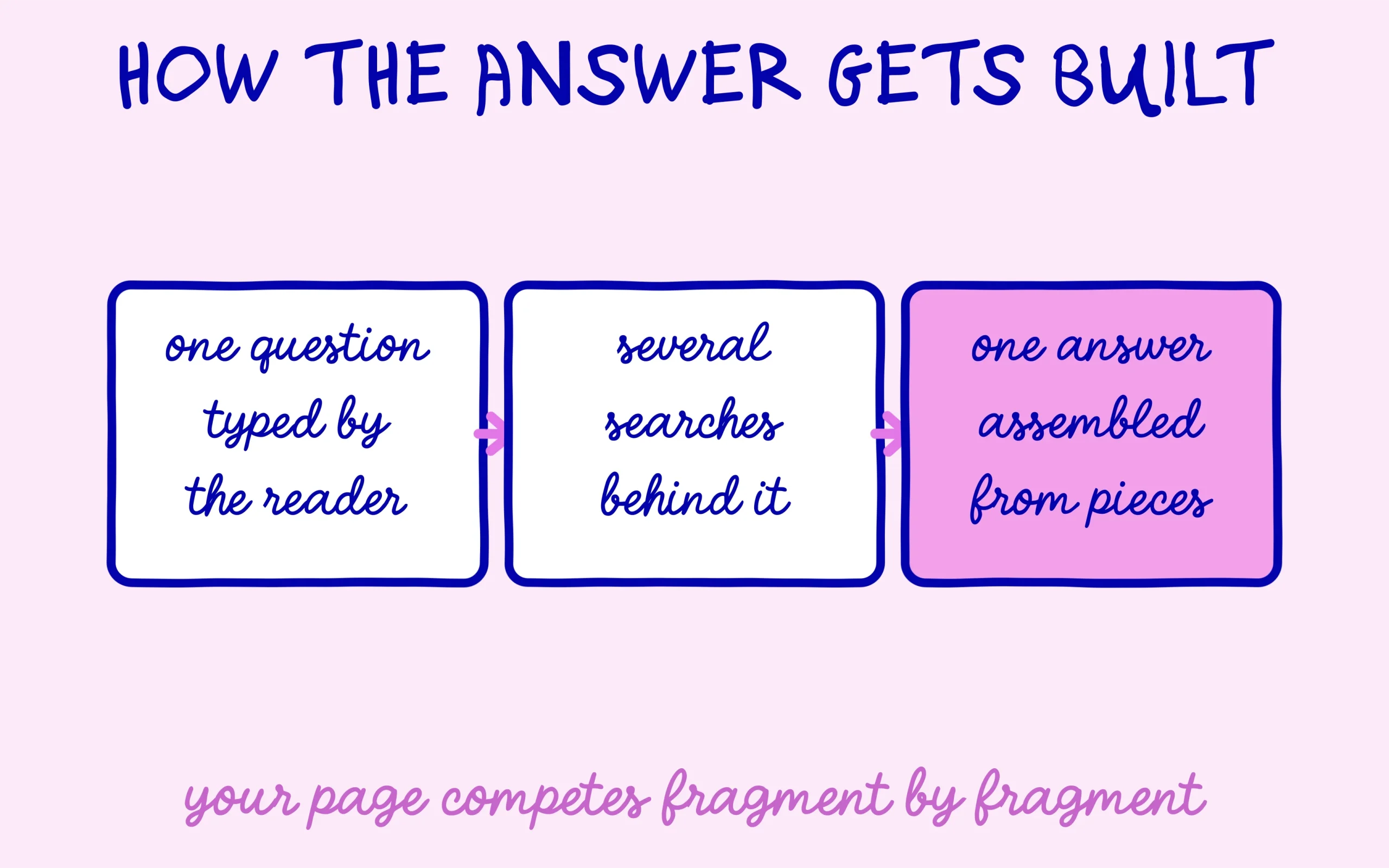
Query fan-out describes AI Overviews and AI Mode issuing several related searches, across subtopics and data sources, to build one answer.
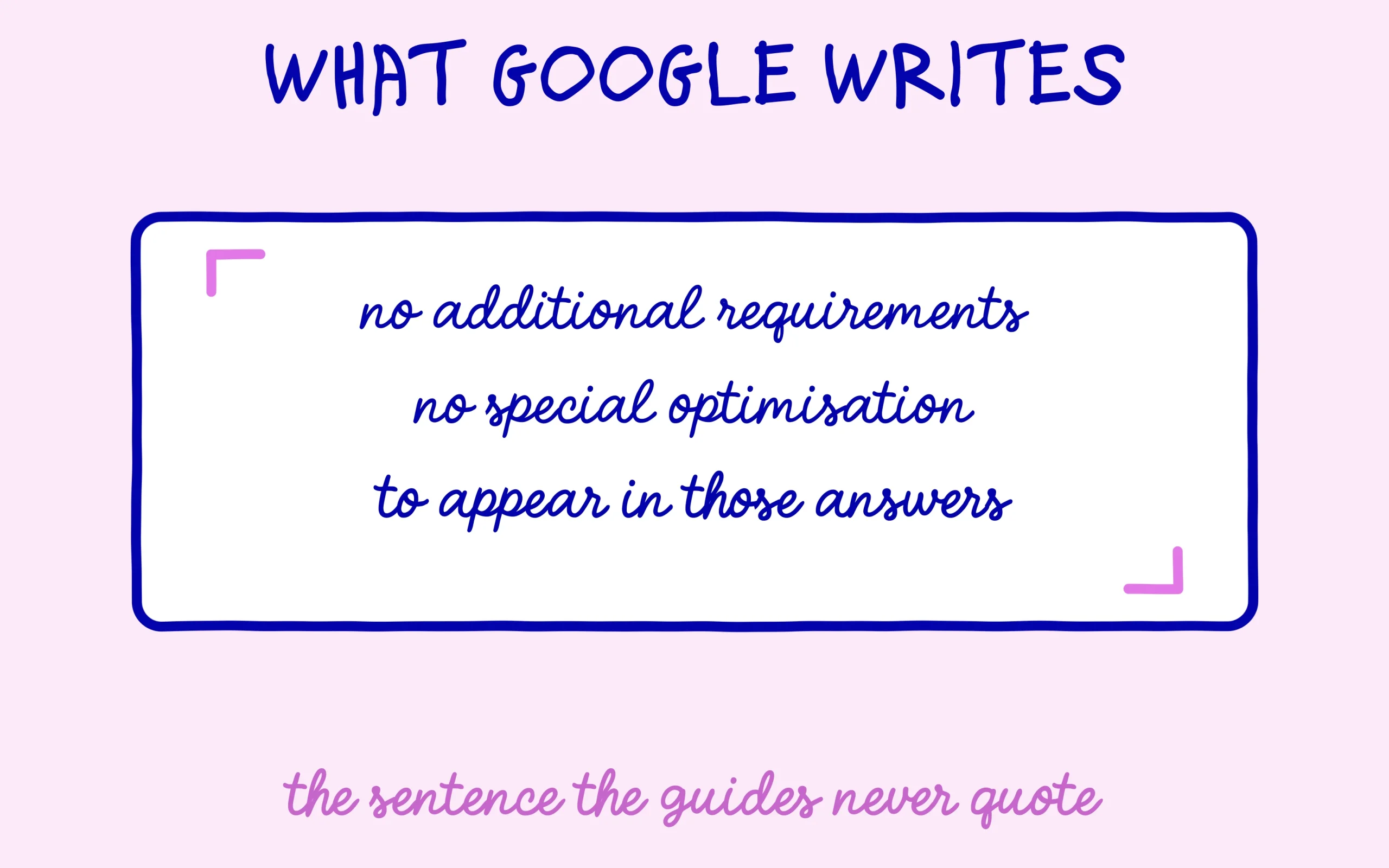
Google writes in that same documentation that no additional requirements and no special optimisation are needed to appear in those answers.
The practical consequence lands on how fully you cover a subject, not on a writing technique to apply paragraph by paragraph.
A young site gains more from covering one subject properly than from dissecting a mechanism it cannot observe.
Summarize This Article with AI
ChatGPTWhat Google actually writes about query fan-out
The documentation aimed at site owners carries one blunt sentence: AI Overviews and AI Mode may use a query fan-out technique, issuing multiple related searches across subtopics and data sources, to develop a response. That is it. Google confirms the mechanism, describes it without mystery, and it matches what everyone repeats: your question triggers several searches behind the scenes, and the final answer assembles whatever those searches return.
The next sentence is the one nobody carries forward. On that same page, Google writes that there are no additional requirements to appear in AI Overviews or AI Mode, and no special optimisations necessary. It sits in Google’s official documentation on AI features in Search, spelled out, right beside the definition everybody quotes. The two sentences travel together everywhere except in articles selling a method.
Let me be honest about how far that clarification goes. Google has every interest in repeating that nothing special is required, and the company has made similar statements before that turned out to be incomplete. My own read stays measured: I do not treat that sentence as gospel, but I notice that none of the guides selling a query fan-out technique rest on anything other than indirect observation. Between an official sentence and a method inferred from a hunch, I start from the first one and adjust with what I see afterwards.
To place the mechanism inside a bigger picture, our complete guide to AI Overviews and what changes for your site covers how those answer blocks work and how they pick their sources. Query fan-out is one brick in that wall, not the wall.
Why a page can be read without ever ranking well
Here is the implication that matters, and it beats the definition. If one question triggers several searches on subtopics, your page can get pulled in for one of those subtopics without ever having targeted the main question. An article about the hidden fees of a service can be summoned into an answer whose starting question was about choosing a provider. You never aimed at that query and you show up anyway.
The reverse is harder to swallow. A page ranking well on its main query can stay absent from generative answers on that very query, because the sub-searches it fired covered angles the page never touches. On the sites I run day to day, I have seen both cases, and I have never once managed to predict which one would apply before watching it happen. That is exactly why I stay wary of methods sold as repeatable.
This behaviour lines up with what we see across other generative engines. How a model picks the pages it cites depends far less on a single query than on a spread of phrasings, a point covered in our article on how the ChatGPT index picks the pages it cites. The technical plumbing differs, the consequence for a publisher looks remarkably similar.
There is a change of scale to accept as well. A generative answer pulls in a fragment of your page rather than the whole thing: a paragraph, a definition, a figure wrapped in its sentence. Your article therefore competes fragment by fragment, against pages that look nothing like yours and never aimed at the same thing. An average page carrying an excellent answer on one narrow point can get picked up, while an excellent but diluted page misses out entirely.
Reading by fragments explains something many publishers describe without naming it: the sense of being everywhere and nowhere. You show up regularly inside answers, on peripheral angles, without ever owning the main answer. A system that splits a question apart before handling it produces that result mechanically, and no ranking failure hides behind it.
A useful reminder in passing: all of this sits on top of a results page that already has its own blocks, related questions and snippets. If that layer is fuzzy for you, our chapter on reading a results page across SERP, PAA and snippets sets the scene before you stack the generative layer on top.
What the mechanism really changes when you are starting out
In practice, the only solid conclusion you can draw from query fan-out fits in one sentence: covering a subject fully beats aiming at an isolated query. Topical coverage is the name SEO has used for that for years. The mechanism simply hands you one more technical reason to believe it, since the sub-searches go looking for neighbouring angles your page either covers or does not.
What does that look like on a site with fifteen articles? Treating one subject with its surrounding questions rather than publishing fifteen unrelated texts. If you write about choosing a web host, the neighbouring angles are the real three-year cost, migration, support, and the ceiling of shared hosting. Those angles deserve to exist somewhere on your site, as separate pages or as sections of one text. Our article on topical authority and the reference an AI ends up citing covers that in detail.
Where it gets awkward is measurement. You will never see the sub-searches a question triggered. No tool exposes them, Google does not publish them, and the lists of sub-queries floating around certain articles are reconstructions rather than readings. After ten years in SEO, I have learned to distrust numbers I cannot verify myself. When you read that an engine fires anywhere between five and twenty-eight parallel searches, ask where that number came from.
One concrete exercise beats a long explanation here. Take the subject of your next article and write out, by hand, the eight questions somebody genuinely asks around it. Not eight variants of the same keyword, eight different questions. Then check which ones your site already answers somewhere, and which ones exist nowhere on it. The gaps that surface are worth more than any query fan-out guide, because they come out of your own subject rather than a generic method.

Where to spend your energy instead of chasing a recipe
My position is simple and slightly boring. Query fan-out is worth understanding as a mechanism, because grasping why a page appears or vanishes makes you sharper. It is not worth treating as a technique to apply, because nobody, including the people selling the method, can show you the link between a text manipulation and an appearance in a generative answer.
What I do on my own sites comes down to three habits. I start from the real questions people ask around a subject rather than a keyword list sorted by volume. I answer each question on its own terms, under a section heading that names it, so an excerpt still makes sense out of context. And I make sure the pages on one subject reference each other, which stays the cheapest way to signal that a body of work exists.
None of those habits belongs to query fan-out, and that is precisely what reassures me about them. They worked before the term arrived and they will work once another term has replaced it. A good habit that does not depend on one mechanism outlives that mechanism, and it is the only criterion worth applying when you have neither the time nor the budget to chase every new thing.
You are under no obligation to agree with me here, and I could be wrong if Google eventually documents signals specific to generative answers. Until that day arrives, a beginner spending an evening restructuring paragraphs for an invisible mechanism would have been better off publishing one more article on their subject. Less exciting to talk about, and it works better.

Keep learning on SEO Noobies.