
Most people assume ChatGPT recommendations come out of a genuine hunt across the web, with the model weighing options it discovers along the way. A look at the network traffic behind the app tells a different story, one where the shortlist is drafted a step earlier, at the moment the model writes its own search query. That query very often carries brand names nobody typed. For any site hoping to show up in AI answers, that small technical detail moves the whole contest to a place you probably were not watching.
TL;DR
Across 27 observed conversations, the first query ChatGPT wrote for itself contained brands the user never mentioned in 21 of them.
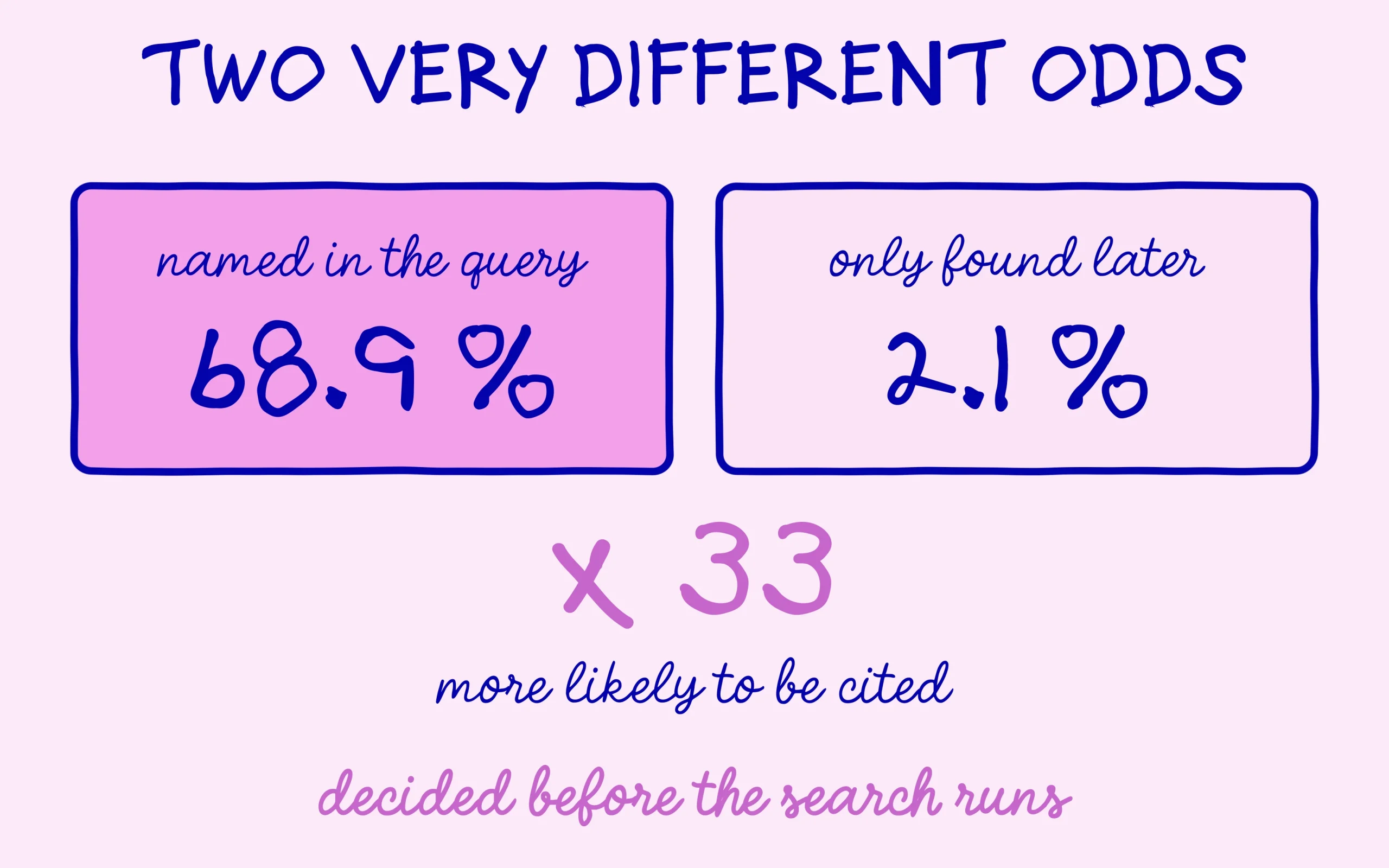
A brand named inside that query ends up cited in 68.9% of answers, against 2.1% for a brand only picked up during the search.
Out of roughly 3,554 pages retrieved, only 110 were cited, which works out to 3.1%.
Landing in ChatGPT recommendations depends on already being familiar to the model, and that familiarity is built off your own site.
Summarize This Article with AI
ChatGPTWhat the network traffic reveals about ChatGPT’s own queries
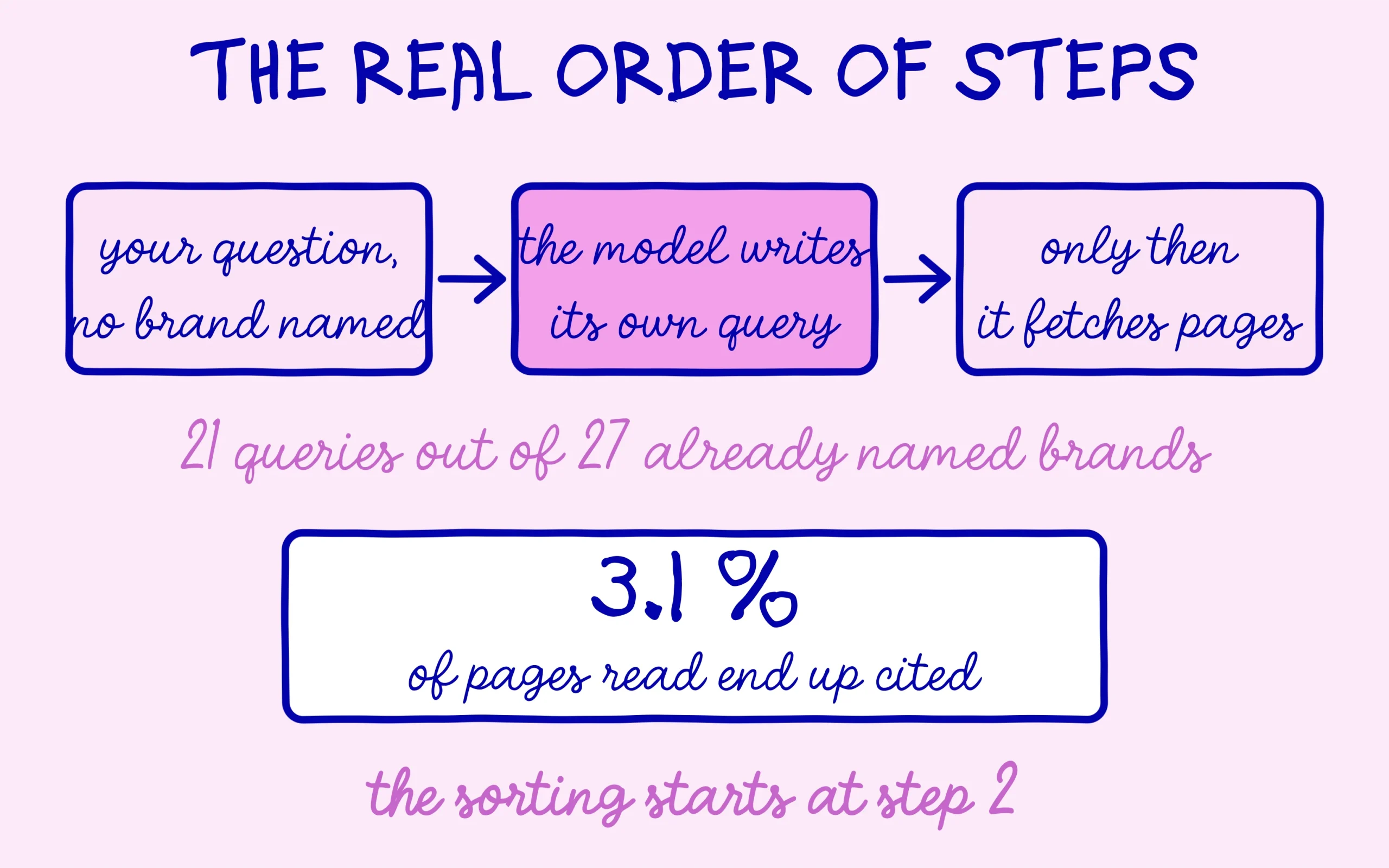
The method SEO consultant Suganthan Mohanadasan used is refreshingly plain, and that is part of why it holds up. Open your browser’s developer tools during a conversation and you can watch the network calls the app sends out. One key in that stream holds the search queries ChatGPT writes for itself before it fetches anything at all. You get to read, in plain text, what the model decided to go looking for after reading your question. It is the same observation ground that helped us work out why ChatGPT citations swing so much from one topic to another.
The numbers land hard. Across 27 conversations built around plain requests like “recommend me a tool for X”, that opening query already named brands in 21 cases even though the user had named none. The model is not asking the web what the options are. It reaches into what it absorbed during training, drops those names into its query, then goes hunting for pages that discuss those specific names. ChatGPT recommendations are largely written before the search even fires.
Where it gets genuinely uncomfortable for a small site is the gap between the two groups of brands. A brand sitting in that opening query gets cited in 68.9% of answers. A brand that only turns up because some retrieved page mentions it drops to 2.1%. Call it a 33 to 1 advantage. Nothing in classic search behaves that way, where the drop between first and second position is measured in single-digit percentage points.
The rest of the data sketches a very narrow funnel. Around 3,554 pages were retrieved across the conversations studied, and 110 of them made it into an answer, so 3.1%. Position inside the result cluster matters too: a page sitting first gets cited 5.2% of the time, sliding to 0.3% from sixth place onward. The same ruthless sorting you know from a results page replays inside the model’s reasoning, only steeper. That sorting sits right alongside what we covered on how the ChatGPT index picks the pages it cites.
Why ChatGPT recommendations lean on memory before the web
This behaviour makes sense once you remember how these systems are put together. A language model swallowed an enormous pile of public text before it ever went live. Brands that kept appearing next to their category in that text quietly became probable answers. Ask for a recommendation without naming anyone and the model produces those names by default, the same way it produces any other expected word. A Semrush study covering more than 50,000 brands across 1,094 US categories, tracked over six months, gives a sense of how settled those positions are: a brand leading its topic by five points holds that lead month to month in 90.4% of cases, and only 15.2% of topics have a clear owner at all. The detail sits in the topic-level visibility analysis run across 50,000 brands.
The web search comes afterwards, and it works more like a fact-check than an exploration. It confirms, dates and sources what the model had already lined up. A genuinely excellent page can therefore be read and quietly dropped, purely because the brand it argues for was missing from the opening query. The shortlist closes before your server sees a single request, which explains why so many well-built sites never see their name surface.
One finding runs against instinct and deserves a pause. Flooding the results with pages from the same domain does not raise your odds. Two pages from one site surfacing together hit 6.2% citation, the strongest figure in the whole dataset. Push it to six pages or more and the rate collapses to 1.7%. Publishing fifteen near-identical articles on one query lowers your chances rather than lifting them. The full protocol and the raw readings sit in the analysis Suganthan Mohanadasan published on his blog.
The limits deserve stating plainly, because they are real. These readings come from a single ChatGPT Plus account, logged in Dubai across 24 and 25 July 2026, on a sample weighted towards software and AI tooling. Suganthan Mohanadasan says it outright in his write-up: treat the percentages as a direction of travel rather than a market measurement. Something else stands out on reading it, the analysis leans on no work beyond his own and cites no source other than his own readings. That takes nothing away from the method, it simply places what we are holding: an observation awaiting confirmation rather than a settled result. In a category the training data covered thinly, say a local service or a genuinely new niche, the balance between memory and retrieval could well tilt the other way.

What a beginner site can actually do with this
The first practical conclusion stings a little when you are starting from nothing. Getting into the query the model writes for itself happens away from your site, in the places where your name already circulates. your name travels before your site does, as far as the model is concerned. Roundup pages, forum threads, comparisons written by other people, mentions inside niche articles. Those are the texts the model read, and their slow accumulation is what turned certain names into probable ones.
That said, being findable still earns its keep, and dropping it over one statistic would be a mistake. A brand the model already knows still needs clean, current, readable pages so the fact-check confirms what it was about to say. Without them the model quietly cites a competitor who documents the same thing better. The two layers work together, and neglecting the second one means winning the casting call only to fumble the audition.
There is a test worth running tonight, and it costs nothing. Ask ChatGPT three recommendation questions in your field without ever naming your own brand, then write down which names come back. What you get is the roster of competitors holding the ChatGPT recommendations slot in your category by default. Run it again in a month. It is a rough measurement, and it remains the most accessible one for knowing whether you exist at that first stage.
Timing is the part nobody can pin down today. A retrained model absorbs whatever mentions piled up since its last version, meaning the work you do now pays out later on a schedule nobody publishes. Knowing which sources these systems reach for most readily at least tells you where to aim, as shown by the platforms AI tools cite far more than the press. Publishing steadily and getting mentioned elsewhere stays the only dependable lever on that layer.
Keep learning on SEO Noobies.



[…] Does that mean anyone will finally learn why ChatGPT quotes one site over another? Honestly, expect nothing on that front in the short term. The duties land on risk and moderation, not on the ranking recipe. What might come out of it is a bit more public material to work from, in the same spirit as what already surfaces when you dig into how ChatGPT assembles its recommendations. […]
[…] before buying. Mixed behaviour still rules, which lines up with what was already visible when ChatGPT recommendations turned out to be settled before the search even runs, inside what the model learned long […]