
Google has started testing AI Contribution, a scheme that pays publishers when their content feeds its AI-generated answers. It runs through Search Console, it is currently open to a small set of sites, and Google frames it as a pilot built to learn while it runs. Two years of friction between search engines and the people who write the pages those engines summarise make this worth a close read before anyone gets excited. Here is what the programme actually does, what it does not do yet, and what a small site can sensibly expect from it.
TL;DR
AI Contribution is a Search Console feature that lets an enrolled publisher accumulate earnings when its content contributes significantly to a generated answer across Gemini, AI Overviews and AI Mode.
Google calls it an early-stage learning pilot, open to a limited number of publishers, meant to test how best to reward high-quality content on top of the traffic and tools it already provides.
Nothing else changes: the generative AI inclusion control and the performance reports that go with it remain available to every site, pilot or no pilot.
No rate card, no average payout and no rollout date have been published, so there is nothing to act on from a site that has not been approached.
Get an AI summary of this article
What Search Console Means by AI Contribution
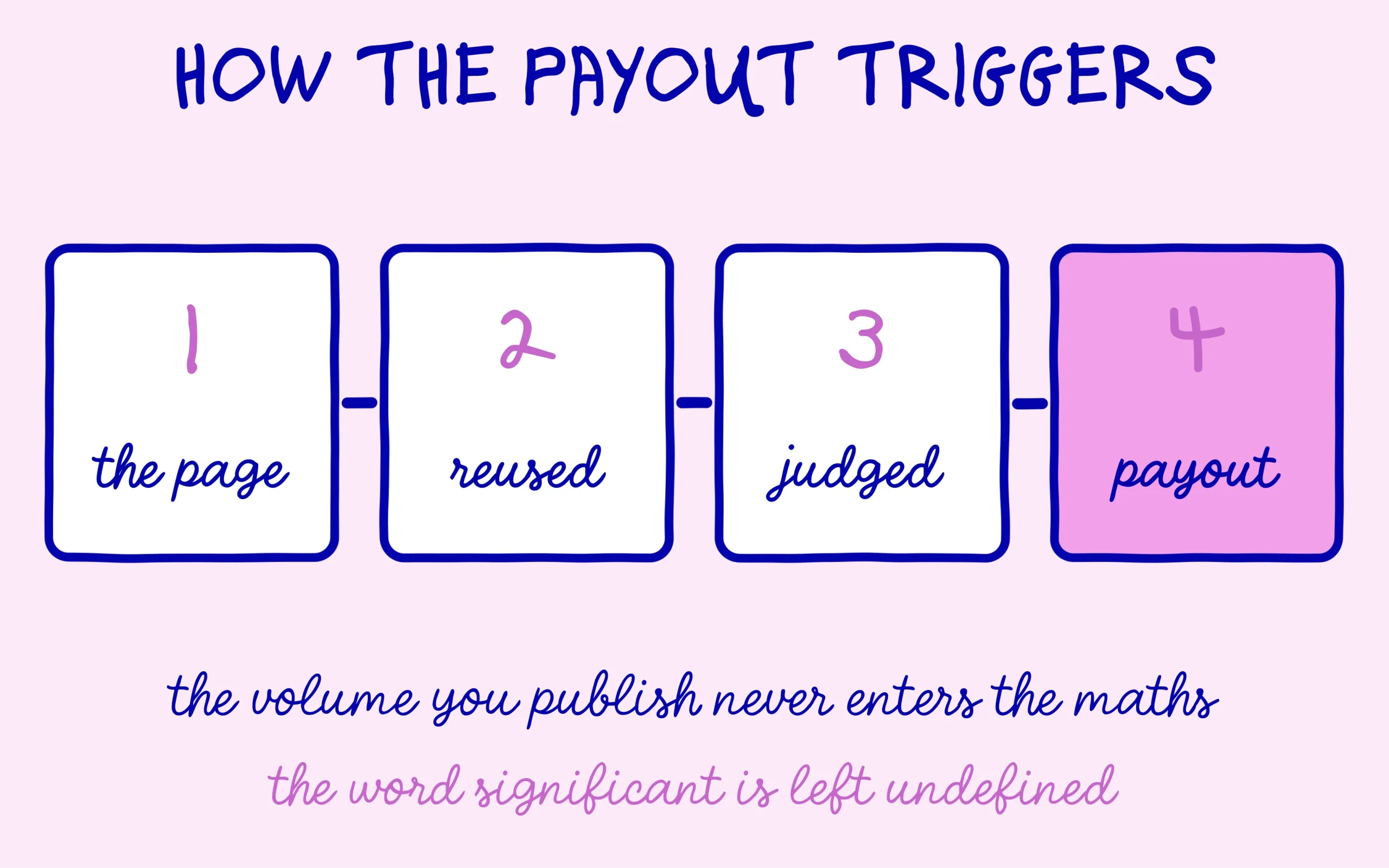
The mechanic is easy to state. An enrolled publisher signs up from Search Console and accumulates earnings when its content contributes significantly to an AI-generated answer in participating products. The three named surfaces are Gemini, the AI Overviews that sit above the classic blue links, and AI Mode, the conversational version of search. One word carries the entire weight of that sentence, which is “significantly”, and it is exactly the word Google has left undefined in public.
Barry Schwartz broke the story on 14 September in his write-up of the publisher payment pilot, building on Digiday reporting and a confirmation obtained from Google. The company’s own wording describes an early-stage learning pilot designed to test how best to reward high-quality content, on top of the traffic and tools it already provides. That closing clause matters as much as the headline: Google still holds that the traffic it sends is itself a form of payment, and positions cash as a supplement to that.
What separates AI Contribution from a standard licensing deal is its unit of account. A licensing contract buys access to a publisher’s archive for a negotiated sum, whatever use is eventually made of it. Here, payment tracks the contribution actually measured. A ten thousand page archive that never surfaces in a generated answer would earn nothing, while a handful of pages that keep getting pulled into responses could earn something. The shape is closer to a usage royalty than to a subscription, and that distinction will decide who benefits.
The gaps tell their own story. There is no published rate card, no figure has circulated for what a contribution is worth, and nothing explains how significance gets judged or who does the judging. Scope is vague too: dozens of publishers have reportedly been approached, with real appeal to small and mid-sized operations beyond news brands. AI Contribution currently looks like an experiment being assembled while it runs, which is more or less what Google says in its own description of it.
Discover the SEO Noobies agency

Why Google Moved Towards Paying at All
The last eighteen months explain the shift. Publishers watched generated summaries appear above their links, assembled from their pages, without the click that funded the work reliably following. Google’s first answer was technical: hand out settings. The control that governs inclusion in generative features reached every site worldwide at the end of August, letting any owner pull their pages out of AI surfaces from Search Console settings.
That setting ran into its own limits almost immediately. Opting out removes visibility along with the reuse, which makes it an expensive lever for a site that lives on its audience. We went through the arithmetic in our piece on what a site genuinely gives up by blocking AI answers, and the conclusion was blunt: the option exists, almost nobody has a reason to use it. Handing publishers an exit door never addressed the underlying question, which was payment.
Competitors were busy on a different front. OpenAI signed licensing agreements with news groups, and those agreements produced a measurable effect on how often those publishers turn up in answers, which we documented in our look at the citation gap between licensed and unlicensed publishers. An engine that pays its sources builds a structurally different relationship with them. Google now arrives somewhere the idea of paying has already stopped being unusual.
However, the pressure is not purely competitive. Audience figures published by publishers themselves have complicated the story in both directions, and not everyone reports the collapse the discourse predicted: our reading of one major newspaper’s audience after AI Overviews rolled out found a far more mixed picture than the headlines suggested. That ambiguity serves Google as much as its counterparts, and it may be part of why the company prefers a narrow pilot to an open programme.
What a Small Site Can Expect From It Today
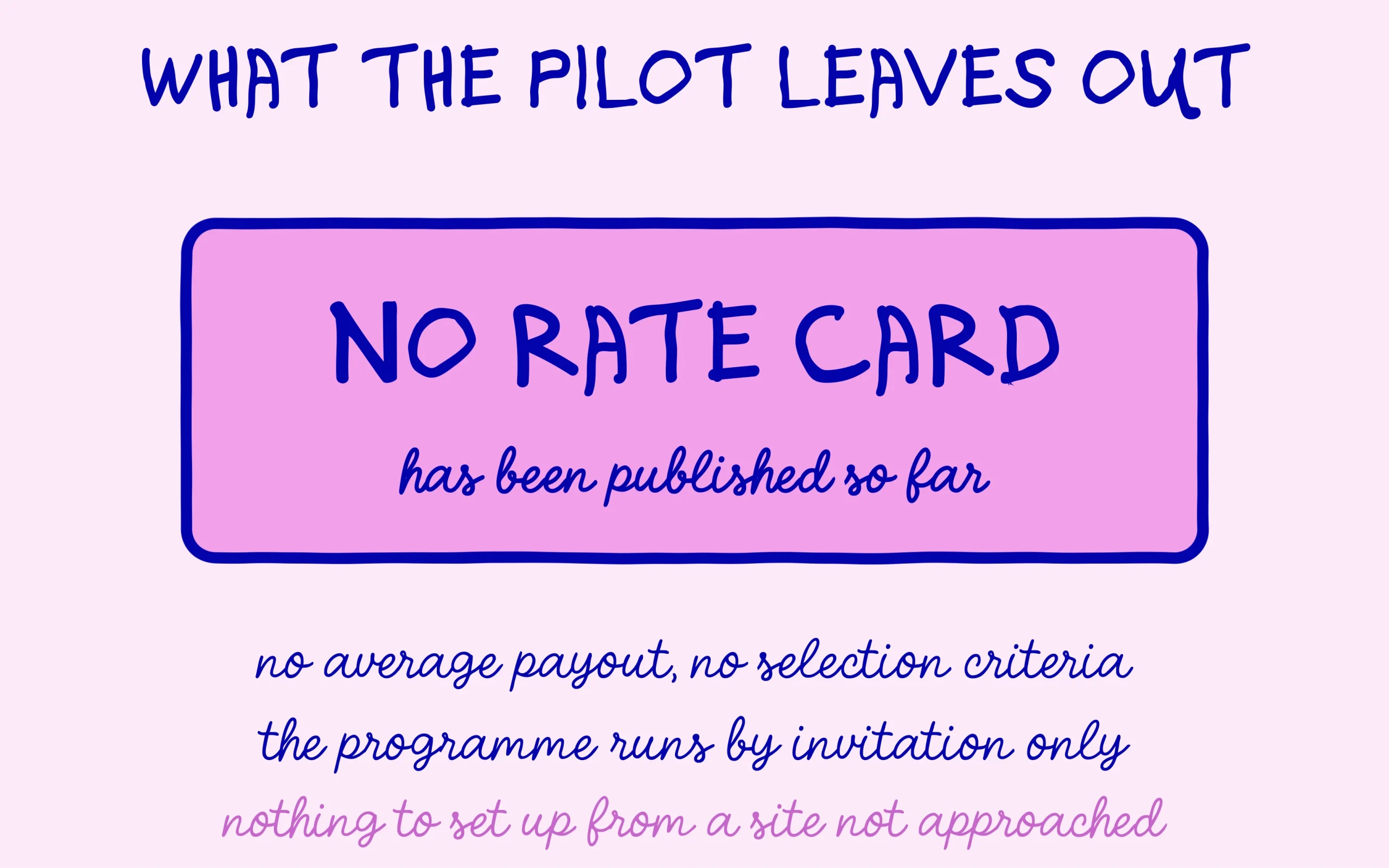
The honest answer is that there is nothing to act on. AI Contribution runs by invitation, the sign-up does not appear in an ordinary Search Console, and there is no application process. A site that started this year has no setting to change and no box to tick. The value of knowing about it is context: when the subject resurfaces in a few months, you will understand what is being negotiated and on whose terms.
The measurement tools, on the other hand, are open to everyone. The performance reports dedicated to generative features show how often links to your pages were displayed inside those surfaces. That is the one concrete number a site owner currently has for gauging their own exposure. Anyone who is eventually offered a payment scheme will need that history to judge whether the offer is any good, and it only accumulates if you start reading it now.
Caution applies to projections too. No public rate card supports any revenue forecast, and building an editorial plan around hypothetical payouts would be the worst possible reading of this news. Google runs a great many experiments, plenty end quietly, and this one is explicitly labelled a test. Following it from a distance is the right level of attention.
One question comes up whenever news like this circulates, which is whether to publish more in the hope of being picked up. The mechanic Google describes points the other way, because it rewards actual contribution to an answer rather than the volume of pages put online. Thirty thin posts on a subject already covered everywhere raise nobody’s odds of being the source an engine chooses. A page carrying data nobody else has, a method that can be checked, or a dated measurement stands a far better chance of landing in a generated answer, and that was true before money entered the conversation.
Underneath all of it sits the point that matters for a beginner. For twenty years the return on search visibility was the click, and that equation shaped the entire discipline. AI Contribution is the first public sign that Google is considering a second form of return, paid when content does the work without the visit happening. Limited and experimental as it is, that signal says something about the model being searched for. Content worth reusing keeps its value in both worlds, and that remains the steadiest compass while everything else shifts.
Keep learning on SEO Noobies.