
The discussions and forums box is that stretch of a Google results page where you see snippets of real conversations, questions asked by ordinary people, answers written on message boards, all grouped under their own heading in the middle of the regular links. Most people scroll past it without knowing it has a name. A new analysis from Ahrefs finally puts hard numbers on it, drawn from 145 million search results. The picture is stark: a handful of sites take almost all of it. Here is what the study found, why Google built the box in the first place, and what a small site can sensibly expect from it.
TL;DR
The discussions and forums box shows up in 11.7% of the results pages studied, roughly 17 million queries out of 145 million.
Reddit appears in 83.9% of them worldwide and 87.8% in the United States, averaging 1.29 links each time it shows up.
Three sites alone account for 76.75% of every appearance. The top thousand domains cover 96.81%.
Almost all of it sits on informational queries. Chasing a slot in that box is a poor use of a young site’s time.
Summarize This Article with AI
ChatGPTThree sites take three quarters of the discussions and forums box
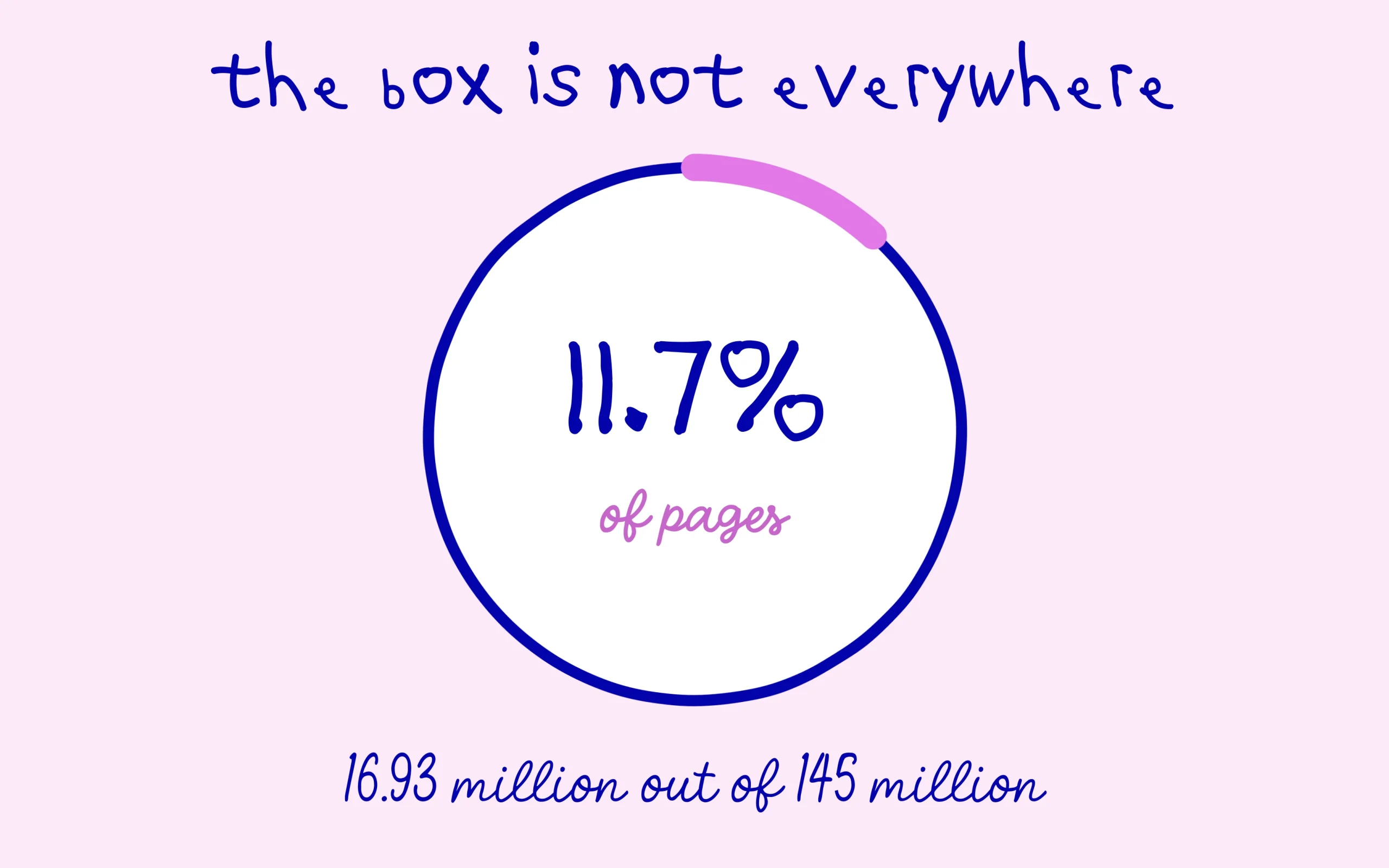
The work was done by Glen Allsopp, head of marketing strategy and research at Ahrefs, across 145 million United States search results, with data collected over two years up to August 2026. Start with the first number: this box is not everywhere. It shows up in 16.93 million results, or 11.7% of the total. Roughly one results page in nine carries a dedicated conversation area. That is far from trivial, and equally far from universal. The domain-by-domain breakdown sits in the full write-up published on the Ahrefs blog.
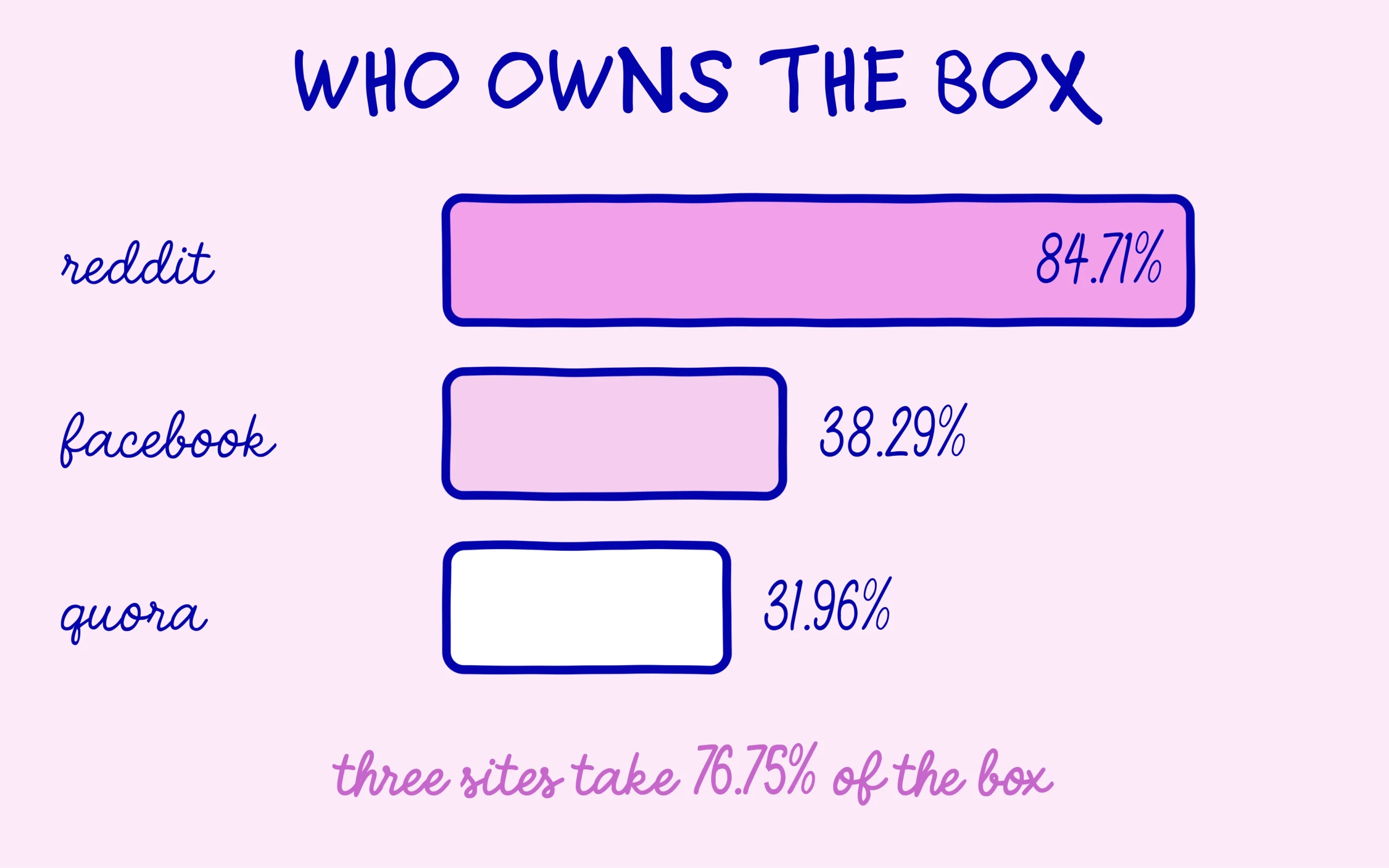
The split is where it gets striking. Reddit turns up in 21.77 million of those boxes, which is 84.71% of them, and the study separates 87.8% in the United States from 83.9% worldwide. When Reddit does appear, it rarely settles for one line: the average is 1.29 links per box, so several threads from the same site regularly sit side by side. Facebook follows with 38.29% of boxes and Quora with 31.96%. Put those three together and you get 76.75% of every appearance recorded. The top ten domains reach 84.87%, the top hundred 91.51%, and the top thousand 96.81%. Read those numbers in order and the conclusion writes itself: this box is a near-closed club.
One detail softens the picture, and it deserves a mention. Fourth on the list is JustAnswer at 8.16%, and fifth is Mayo Clinic at 3.26%. Mayo Clinic runs no forum at all, it is the site of an American medical institution. Its presence tells you Google does not strictly reserve the area for community platforms, and that a page answering a question the way a person would answer it can find its way in. The door is narrow, but it is not bolted shut by design. If the various zones of a results page are still a blur, our piece on how to read a search results page and its building blocks covers the ground.
Why Google leans this hard on community answers
The study carries one figure that explains a great deal: 98.7% of these appearances sit on informational queries. Not shopping searches, not brand lookups, not transactional intent. Questions. Someone wanting to know whether a treatment works, whether a piece of software earns its price, how other people solved the exact problem they are stuck on. Google took the view that on this kind of search, someone who has lived through the situation carries as much weight as a professional publisher.
The bet is not new. The box launched in 2022 and its rise drew plenty of comment across the search industry, along with a long list of publishers who watched informational traffic drain toward community threads. It fits a broader line Google has been open about, favouring lived experience and first-hand accounts wherever readers want something concrete. That said, the concentration measured here exposes the limit of the idea. When three sites hold better than three quarters of a space meant to reflect the breadth of online conversation, the breadth part becomes hard to defend.
The same dominance carries over into generative engines, which is where this stops being a Google-only story. Those community platforms feed AI answers heavily, to the point that AI tools cite Reddit and Wikipedia far more than established media. None of it is fixed, though. Inside ChatGPT, Reddit citations have collapsed over recent months. A single site can own one surface and lose its footing on another, which is a good reason to think twice before building a whole strategy on a platform you do not control.
What a young site can actually do with this
First practical conclusion, and it cuts against a lot of advice out there: trying to force your site into that area is a poor use of your hours. The numbers leave little room, since everything beyond the top thousand domains adds up to 3.19% of appearances. You have no direct lever on it either, no tag to add, no technical setting to switch on. That energy belongs in the regular results, where your page competes on fairer terms.
The type of query involved limits the damage, and that part is genuinely reassuring. Since the discussions and forums box fires on informational searches 98.7% of the time, it does not slide between you and a buyer ready to pay. If your site targets commercial queries, local searches or brand intent, the area barely touches you. The exposure sits with purely explanatory content answering a general question, and there specificity is your real defence. A page that handles one precise case with concrete detail holds value a generic thread never will.
Go and look at what actually happens on your own queries. Type the five or six searches that matter to your business and note which ones trigger the discussions and forums box. If none of them do, the question is settled and you can move on. If several do, look at where it lands on the page, what sits directly above it and directly below. A box tucked near the bottom eats nothing like the visibility of one placed third.
One indirect route is worth stating honestly. Taking part in those platforms under your own name, answering questions in your field, being useful without dropping a link into every reply, remains a slow way to build a presence where Google and generative engines go looking for material. It takes time and it backfires the moment it turns into disguised promotion. It replaces none of the work on your own site, and it should be seen for what it is: reputation building, never a shortcut into the discussions and forums box.

Keep learning on SEO Noobies.