
Update, 24 July 2026: it’s official, AI Overviews and AI Mode went live in France on 22 July 2026, ahead of the 23 September date initially communicated to publishers. Key points: the rollout covers desktop, mobile and the app; it was unlocked by a neighboring-rights deal with the press; it affects every site, not just news outlets. For the full picture and what to do, see our complete AI Overviews guide.
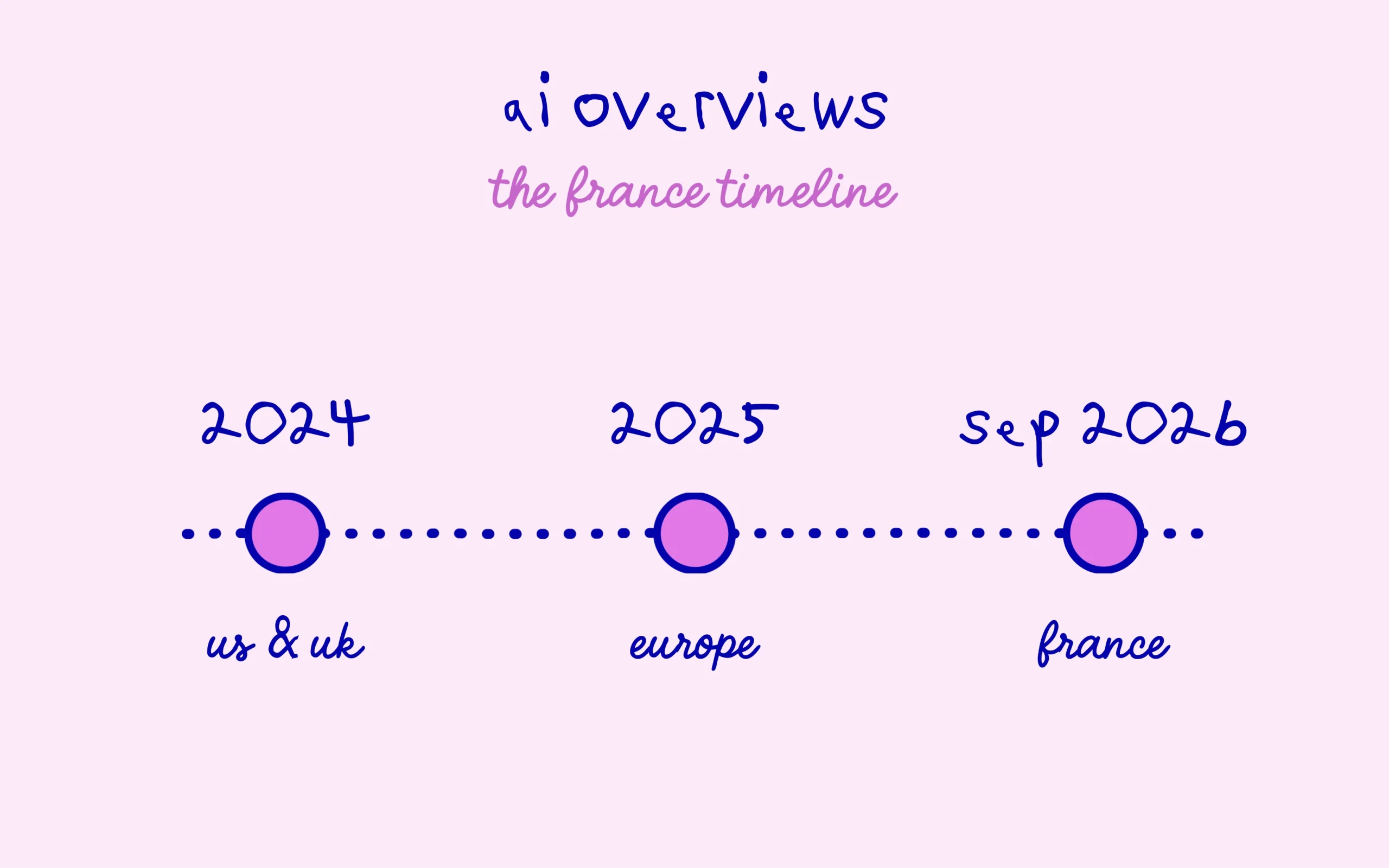
Google has set an official date for the AI Overviews launch in France: September 23, 2026. The information first surfaced through a Ouest-France investigation in mid-June, then got formalised on June 29 through a written letter Google addressed to French press publishers, as detailed in Abondance’s June 30 investigation into the French AI Overviews rollout. France is among the last markets to receive the feature, already available in more than 120 countries and 11 languages since May 2024. Two features arrive simultaneously: AI Overviews (the AI-generated summaries that appear at the top of search results) and AI Mode (a Gemini-powered conversational interface). For international sites that serve French audiences alongside English-speaking readers, this calendar reshuffles the traffic outlook within two months. Here is what the letter contains, what the US benchmarks suggest for the French rollout, and what a beginner SEO can prepare between now and September 23.
TL;DR
Google notified French press publishers on June 29, 2026 that AI Overviews and AI Mode will launch in France on September 23, 2026.
France is among the last major markets served, delayed by the EU Digital Markets Act and neighbouring rights negotiations with local publishers.
Google commits to three written guarantees: opt-out per publisher, distinct impression reporting for AI content, and additional compensation for the 450 publishers already covered by neighbouring rights.
For international sites serving French audiences, the priority action is to identify informational queries at risk and rework them to be quotable by AI Overviews rather than skipped.
Summarize This Article with AI
ChatGPTWhat the June 29 letter from Google actually says
The story broke in two stages. Ouest-France published a mid-June investigation revealing that a French rollout was in preparation. Google then sent a formal letter to French press publishers on June 29 confirming a launch date: September 23, 2026, with two features shipped together.
The first feature is the one most discussed publicly: AI Overviews. These are the automatically generated summaries that appear at the very top of search results, above the classic blue links. The second feature, quieter but potentially more disruptive, is AI Mode, a Gemini-powered conversational interface that lets users ask successive questions to Google in the same natural way they would query ChatGPT or Perplexity. Both go live on the same day, with no phased rollout announced.
Three written commitments are laid out for press publishers. First: each publisher can choose not to have their content appear in Google’s AI features. Second: a distinct reporting will be delivered, separating impressions generated by AI Overviews from impressions generated by classic search. Third: the 450 French publishers already covered by a neighbouring rights agreement will receive additional compensation for content accessed through AI Mode. These three commitments target press publishers only, not independent websites or personal blogs.
On the global rollout timeline, the French date lands late. AI Overviews has been live in the United States since May 2024 and now covers over 120 countries in 11 languages. The European delay comes from two regulatory frictions: the Digital Markets Act, which forces Google to guarantee non-discrimination, and neighbouring rights negotiations, which require the engine to strike a compensation deal with press publishers before quoting them in AI answers. September 23 marks the resolution of that stalemate.

What US and rollout benchmarks suggest for the French market
The US market, served for eighteen months, has produced numbers that start giving a real sense of the impact. The Pew Research study published in July 2025 measured that on queries triggering an AI Overview, only 8 % of users then click on an organic result, compared to 15 % on queries without an AI Overview. Ahrefs, on its side, documented an average 35 % click-through rate drop on the first organic position when an AI Overview appears above. These numbers vary by vertical, but the trend is clear.
Not every query triggers an AI Overview. Google reserves those AI summaries for complex informational queries (“how does X work”, “what is the difference between Y and Z”, “why does Z happen”). Purely transactional queries (“buy iPhone 17”, “book Paris Lyon train”) and navigational queries (“facebook”, “gmail login”) continue to display classic results with no AI layer on top. This split maps closely onto the geography of zero-click Google searches measured across Q1 2026, where informational intents concentrate most of the sessions that never lead to an outbound click. The real question is what share of a site’s target queries falls into the AI-triggering bucket. A transactional e-commerce site will absorb the shock better than an informational editorial blog.
Note also that the zero-click search phenomenon, well predating AI Overviews, was already teaching content creators that a share of impressions never converts to a click. Featured snippets, People also ask, Knowledge Graph panel: Google has captured attention ahead of the organic link for years. AI Overviews accelerates that phenomenon rather than inventing it. A site that had already worked on zero-click presence will be less exposed on September 23.
One unknown remains open for the French market: how AI Overviews will treat French-language content specifically. Google’s models were trained primarily on English content and the US studies cover English queries. Whether the same triggering thresholds apply to French queries, whether French-language sources get systematically cited when relevant, and whether the click-through drop matches the US baseline remain open questions. The first four weeks after September 23 will serve as an observation window for the whole French SEO market.
What a beginner SEO can prepare before September 23
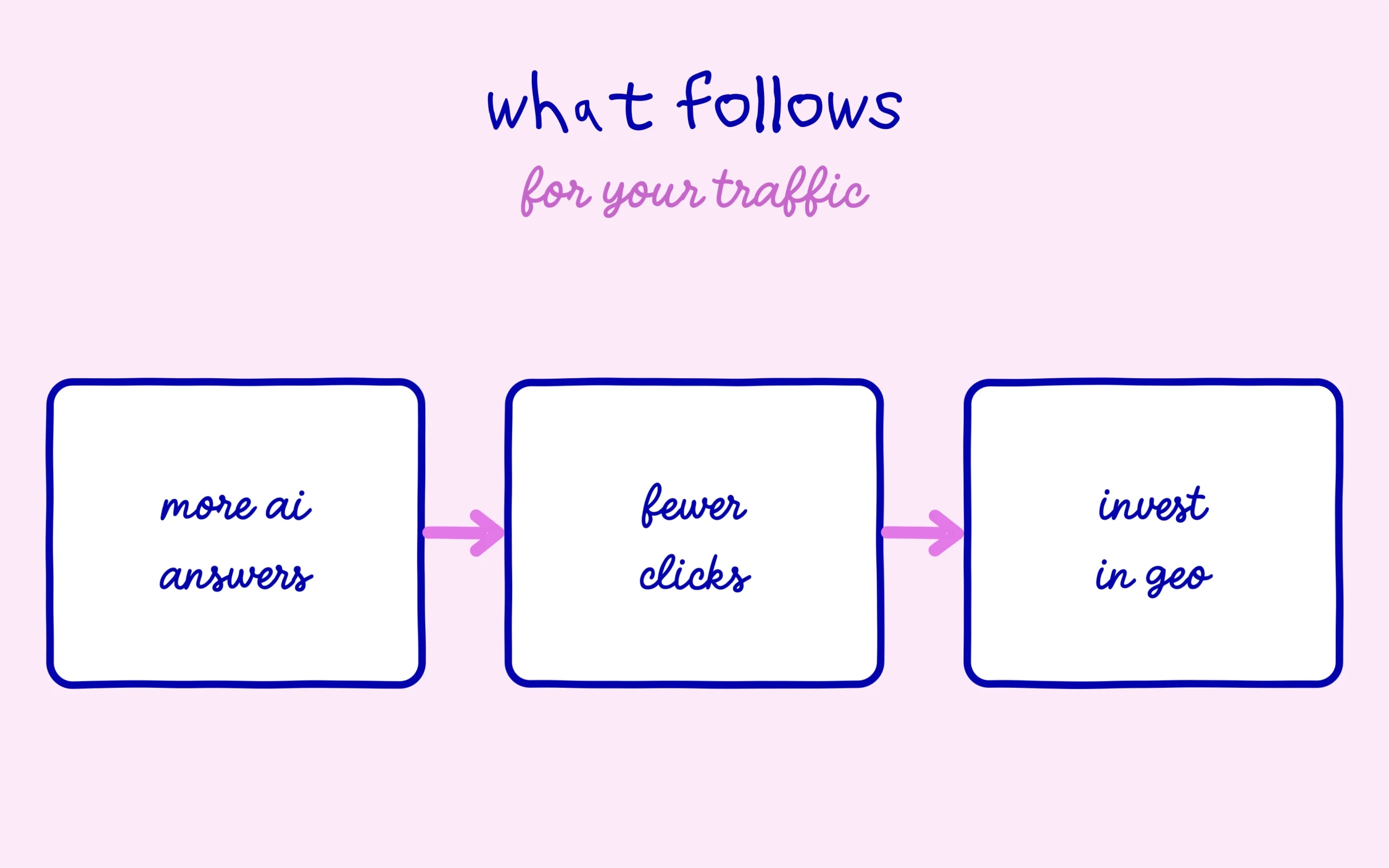
The official calendar leaves just over two months between announcement and launch. That is a short but workable window. First action: identify on your own site the pages that answer complex informational queries. These are the ones that will lose the most clicks on September 23. A quick audit inside Google Search Console is enough to list top-performing queries and flag the ones with high informational intent.
Second action: restructure those pages to maximise the odds of being quoted inside an AI Overview rather than skipped. The format that works in the US rests on three simple pillars: a direct and short answer to the question in the very first paragraph, an H2/H3 structure that mirrors natural sub-questions around the topic, and structured data (schema.org Article, FAQPage, HowTo depending on the content type) that helps engines identify directly quotable blocks. This work is clean SEO, there is no exotic GEO trick to add.
Third action: prepare the post-launch data analysis. Google promised press publishers a distinct reporting for AI Overviews impressions, but for independent sites and blogs, the measurement will likely have to happen by hand at first. Comparing impressions and clicks over the 30 days before September 23 and the 30 days after will give a direct reading of the real impact on each target page. That measurement is essential: without a before/after baseline, adjusting editorial strategy from November onwards becomes guesswork.
Finally, resist the panic and the technical hype. Many LinkedIn posts will push miracle “AI Overviews specific” solutions in the coming weeks: llms.txt files, dedicated markdown site versions John Mueller recently rejected, prompts optimised for Gemini. The official position from Google remains that the engine expects nothing more than clear, structured and verifiable content. The clean SEO fundamentals that please users are the same ones that please generative engines.
Keep learning on SEO Noobies.


[…] it is all covered in our complete guide to AI Overviews, and the precise launch timeline sits in our coverage of the AI Overviews rollout. The key takeaway from the timeline is that France is not living an isolated event, it is simply […]