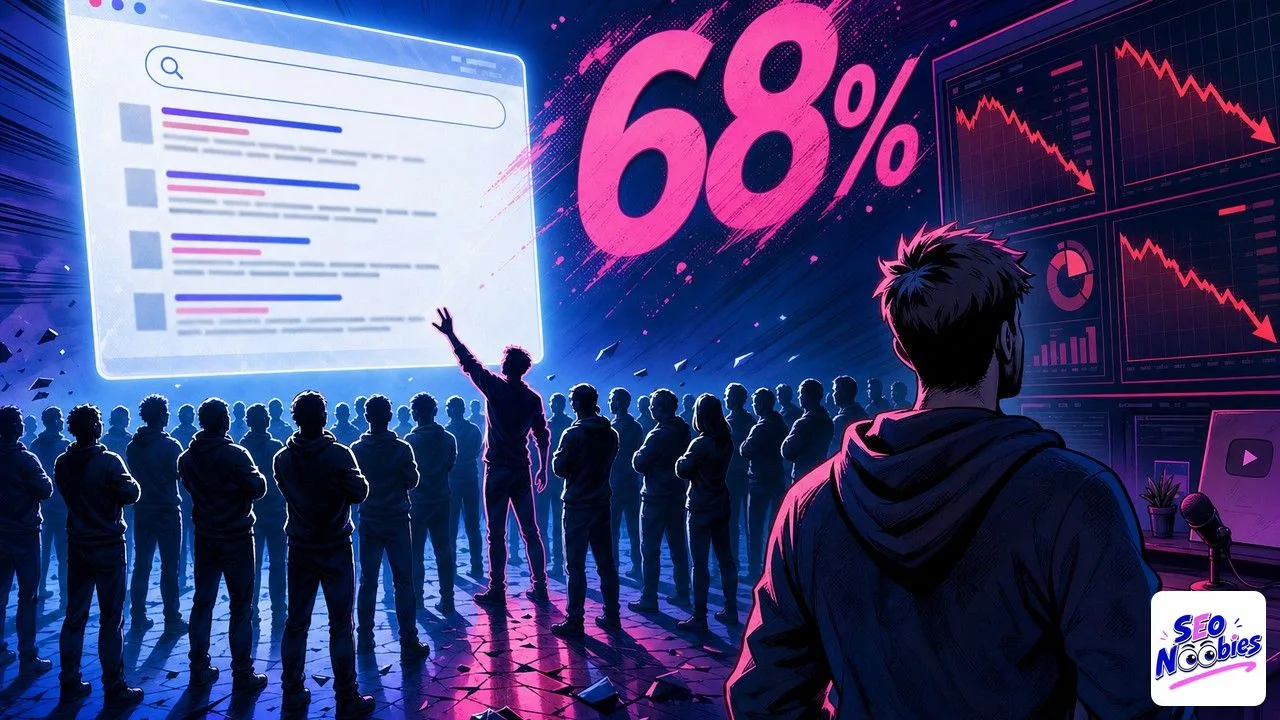
The zero-click number went viral across the search community this week. During the first quarter of 2026, 68% of Google searches made from the United States ended without a single click to an external site. The statistic comes from a Similarweb analysis picked up and put into context by a deep dive from Search Engine Journal on how to measure where search attention is going. Most articles frame the number as “SEO is dead”, which is a misleading shortcut. Here is what the figure actually means for a beginner who just launched a site and is trying to understand where the traffic went.
TL;DR
68% of Google searches made from the United States ended with no outbound click during Q1 2026 according to Similarweb.
The main driver is the expansion of AI Overviews, featured snippets and knowledge panels answering directly inside the results page. Google pushes back on the doom narrative, claiming AI Search sends billions of clicks.
Organic traffic did not vanish. It concentrated on transactional intents and long-tail queries where the answer cannot fit inside an in-page block.
The right move for a beginner is not to flee Google but to reshape editorial angles toward click-worthy intents and to measure exposure, not just visits.
Summarize This Article with AI
ChatGPTWhat the Similarweb data really says behind the zero-click 68%
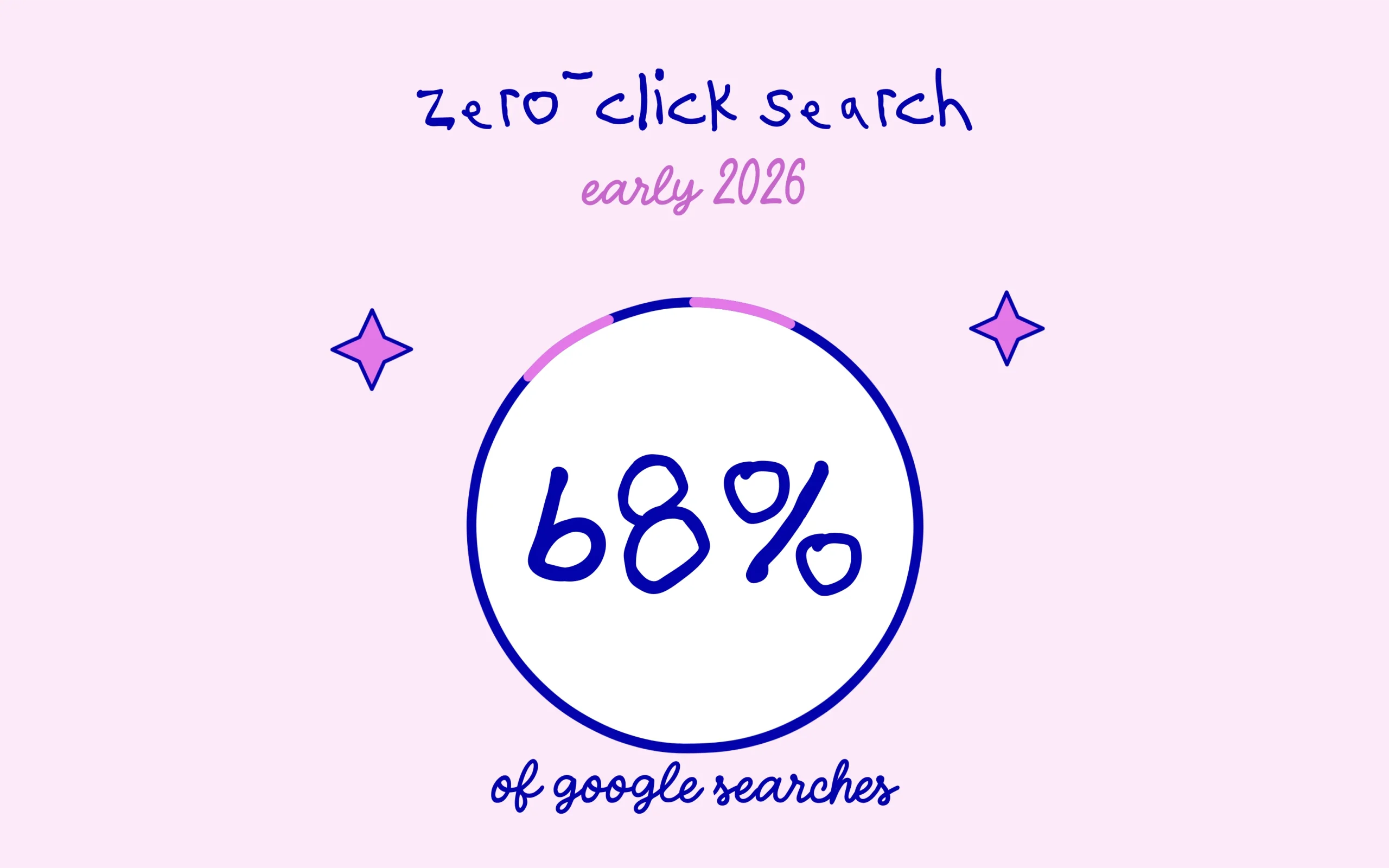
The figure covers searches made from US territory, all devices combined, during the first quarter of 2026. Similarweb counts as “zero-click” any search session that ends without an outbound click. That definition captures three very different behaviors. First case, the user finds the answer directly inside the results page through AI Overviews, a featured snippet or a Knowledge Graph panel. Second case, the user reformulates the query and starts a fresh search. Third case, the user closes the tab without doing anything else, often because the question had no clear web answer to begin with.
These three scenarios are all lumped into the 68% number, which is why the stat looks so dramatic. The shift is not new in absolute terms either. Rand Fishkin already reported 65% zero-clicks in the US back in 2020, then around 58% in 2024 based on the same Similarweb dataset he has repeatedly analyzed. The 2025-2026 acceleration is real but it does not come out of nowhere. It extends a six-year trend, sped up by the massive rollout of AI Overviews in 2024. The geographic angle also matters here: the US zero-click rate stays higher than the European one, largely because AI Overviews were deployed earlier and more broadly across the Atlantic, while France and neighboring markets still enjoy a window where the feature does not fire on every intent.
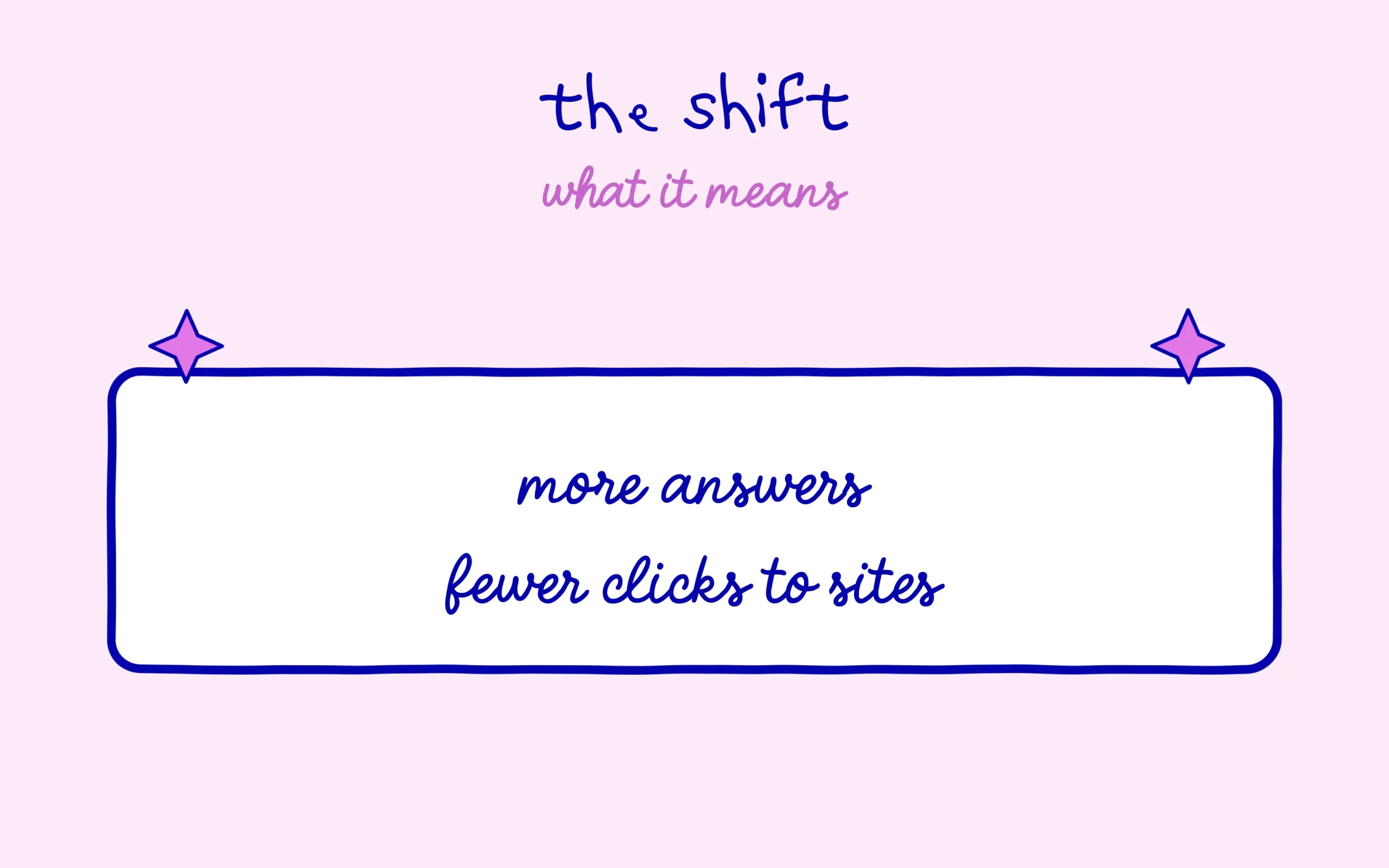
A point often forgotten in the press coverage: Google is not losing queries. The total search volume on the engine keeps growing year over year. What changes is the outbound click rate. The consequence for a beginner site is simple to state but hard to swallow. At equal query volume on a given topic, organic traffic will mechanically go down whenever the intent behind the query can be satisfied straight from the results page.
Why transactional intents stay almost fully click-worthy
A finer breakdown of the Similarweb data reprised by Search Engine Journal shows the zero-click rate varies sharply by intent type. On short informational queries like “what is link building”, the zero-click share nears 85% because Google now has the means to answer in one sentence directly inside a featured snippet or an AI Overview. However, as soon as we move to transactional or navigational queries like “buy Semrush”, “Ahrefs vs Semrush comparison 2026” or “WP Rocket review”, the outbound click rate stays overwhelmingly high.
The reason is mechanical. An AI Overview cannot sell in place of a merchant site, it cannot replace a product page, it cannot stand in for a review written by a human who actually tested the tool. Google knows this and increasingly pushes commercial intents toward dedicated blocks (Shopping, Popular Products, Reviews) that carry real outbound links. The click collapse mostly hits the pedagogical layer of the web: definitions, generic tip lists, “top 10” articles without a distinctive angle. Local intents follow a similar pattern where clicks stay strong because the searcher needs to reach a website, a booking page or a store map that an in-page block cannot fully replace.
Practically, for a beginner building a site in 2026, the editorial message shifts. A blog piling up posts like “what is SEO”, “how Google works” or “backlink definition” is going to take the zero-click wave head on. In contrast, a blog that builds sourced comparisons, hands-on testing, personal walkthroughs with screenshots, keeps pulling traffic because Google has nothing credible to put in an answer box for that kind of content. This editorial shift keeps moving value toward what requires a real human hand behind the keyboard.
What a beginner can do right now without rebuilding the whole site
The first action is an intent audit on the 20 most visible articles inside Google Search Console. For each URL, ask the question: does this page answer an intent Google can resolve inside a block, or an intent that requires reading the page? If the honest answer is “a block would be enough”, the page will suffer. The right reflex is either to rework the article and add a layer of value that cannot easily be summarized (a numbers-based comparison, a personal test, an interactive table) or to let it live without expecting priority traffic from it.
The second action is a rebalancing of the editorial calendar toward transactional topics and practical angles. An article like “best WordPress SEO plugins in 2026 tested on my own site” keeps ranking and driving clicks, while an article like “definition of a SEO plugin” is cannibalized by the SERP itself. This shift does not require rebuilding the site. It just requires picking upcoming topics with the criterion in mind that the question must demand an answer too long or too nuanced to fit inside an AI Overview.
The third action is about measurement. Google Analytics traffic no longer tells the full story, it only captures actual visits. Yet, being cited inside an AI Overview counts as brand visibility even without a click. The habit to build is to track in parallel Search Console impressions, mentions inside generative AI responses (ChatGPT, Perplexity, Claude) through tools like Otterly or Athena HQ, and to cross-reference with direct branded queries that rise when brand awareness grows. A beginner who skips this metric shift will read a GA4 dip as failure while the site may actually be progressing in exposure, authority and branded awareness, three signals that eventually bring back direct traffic and conversions later on.
The 68% figure is scary in a headline. It becomes far more manageable once we understand what it actually covers. SEO is not dying, it is moving toward zones where the answer cannot be industrialized by an LLM or a Google panel. This shift has been coming since AI Overviews were announced, and it is now materializing inside the data. For a beginner site, the fight over the next twelve months hinges less on pure SEO tactics than on angle quality and on the ability to pick topics where added human value stays visible.


[…] traffic measurement was already under pressure. Searches ending without any click at all reached 68% in the first quarter of 2026, and every change to the results page makes the numbers a little harder to read for a site that is […]
[…] That bouncing has a direct consequence for you. Ranking first no longer means being seen first, because a block placed above catches the eye before your listing does. Which is exactly why a growing share of searches ends without any click at all, something documented in the figures on zero-click Google searches. […]
[…] and it has become a visibility source worth watching. The shift goes hand in hand with the rise of zero-click searches, where the user gets their answer without visiting a single […]
[…] The mechanism is easy to grasp. When someone asks a question, the AI Overview serves a summary right at the top of the page, often enough to answer on its own. The user leaves satisfied without clicking through to any source. And the simpler the question, the more the summary stands on its own, which hits explainer content, definitions and short answers first. That is the well-documented rise of zero-click searches that now make up a heavy share of the total. […]
[…] cites Google before your brand ever gets the click. The move extends a trend already visible with the rise of Google searches that end without a click, where the answer is enough on its own and the user never needs to leave the […]
[…] continue to display classic results with no AI layer on top. This split maps closely onto the geography of zero-click Google searches measured across Q1 2026, where informational intents concentrate most of the sessions that never lead to an outbound click. […]