A company’s brand website has become one of the first places ChatGPT goes to check a fact. That is what an Ahrefs study published on October 12 shows, after going through 15 million searches that ChatGPT ran on its own to build its answers. When the AI decides to search inside a single site, it very often picks the company’s own website, and it goes there looking for prices, specs and terms. For anyone running a small business, that is a more concrete signal than most of the GEO advice going around right now. Here is what the study found, what it leaves out, and what I take from it for a small company’s site.
TL;DR
Ahrefs analyzed 66.6 million ChatGPT answers and the 15 million web searches the AI ran to write them, in August and September 2026.
When ChatGPT narrows a search to one site, 75.9% of the most common cases point at a brand website.
Searches about prices and reviews are growing fast, and 84.4% of the factual questions tested cite at least one official source.
The work that pays off: clear, dated pages for pricing, specs and terms that an AI can read in seconds.
Get an AI summary of this article
What 15 million ChatGPT searches reveal
It helps to start with what the study actually looks at. When ChatGPT needs a recent or precise piece of information, it adds to what it already knows by running one or more web searches, which specialists call fan-out queries. Those behind-the-scenes searches, which the user never sees, are what Louise Linehan and the Ahrefs team collected and sorted in their study of 15 million ChatGPT queries.
The scope is broad. The study covers 66.6 million answers from the free version of ChatGPT, used without an account, running the GPT-5.6 Luna model, in August and September 2026. Across all of them, only 14.4% of answers triggered a web search, roughly one in seven. When a search does happen, the AI runs about 1.6 queries per answer on average.
That first number puts things in perspective. Most ChatGPT answers are written from what the model already learned, without going to the web at all. Fan-out searches mostly kick in when the AI needs a current fact: a price, availability, a product detail, a piece of news. The mechanism looks a lot like what Google describes for its own engine, covered in the piece on query fan-out and why Google says it needs no special optimization.
Honestly, this is the kind of study GEO needs most right now. There are plenty of recipes out there, and very few observations of what the AI really does when it searches. Watching how the AI searches tells you more than guessing its tastes. The study has its limits, which I’ll come back to, and it has the merit of starting from real data.
The brand website is ChatGPT’s first stop when it searches a single site
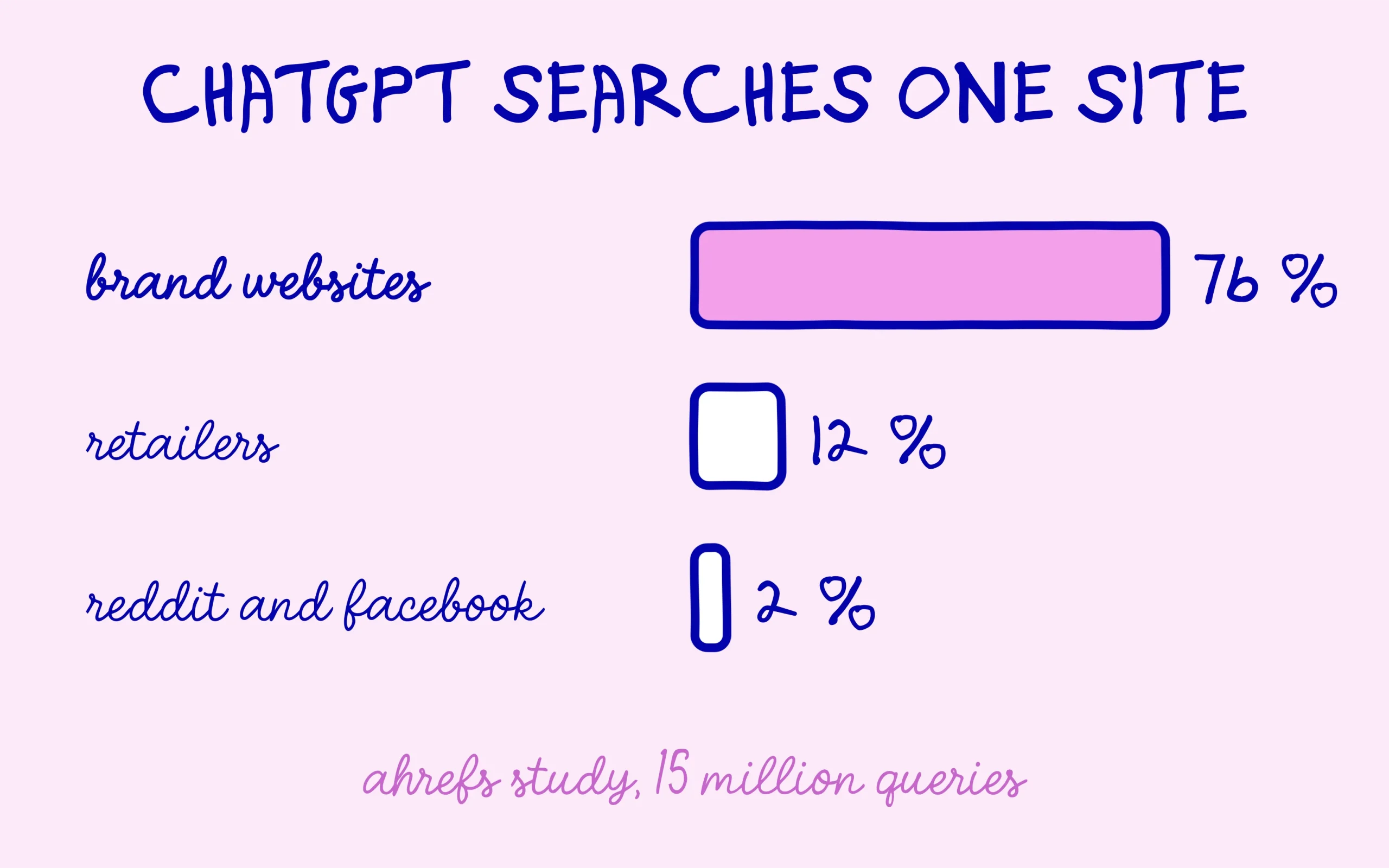
The key number is about one specific kind of search. In 6.8% of cases, ChatGPT uses the “site:” command, which limits a search to one website, much like typing a domain name followed by your question into Google. The study found around 116,000 different sites searched this way.
Among the sites searched most often, 75.9% are a brand website. Retailers account for only 11.9%, and Reddit and Facebook together for 1.9%. The top of the list reads apple.com, ikea.com, nike.com, adidas.com and samsung.com, and consumer brands take eight of the top ten spots. Put simply, when ChatGPT wants to confirm something about a product, it goes to the company that makes or sells it directly.
The wording of the searches backs this up. The word “official” appeared in 10.1% of English fan-out queries in August and in 13.1% in September. On sensitive topics, the ones that touch health, money or legal matters, public sites such as gov.uk, Brazil’s gov.br and France’s service-public.fr rank among the 150 most searched. The official source becomes the reference when an answer has to be right.
One point deserves some care. The study looks at the most searched brands, which means big names known around the world. Nothing in it proves that a plumber or a twenty-person company gets the same treatment, and I’d rather say that plainly. The logic still holds, though: to check a fact about a business, the AI looks for the source closest to that business. If your brand website doesn’t provide the information, it will take it from somewhere else.
The AI also has to recognize your brand website as the real one. For a small business, that comes down to very practical details: the same company name on the site, on the Google Business Profile and in directories, a domain name that matches that name, a complete legal or imprint page, and an about page that says clearly who you are and what you do. When those signals line up, your site becomes the obvious source to check. When they contradict each other, a well-kept directory listing can get there first.
Discover the SEO Noobies agency
Prices, reviews and specs: what ChatGPT comes looking for
The words inside these searches say a lot about what the AI is after. The word “price” went from 6.04% to 8.88% of fan-out queries between August and September, a 47% jump in a single month. Review searches grew by about a third, and “specifications” entered the top fifty words for the first time. Searches for meanings and definitions, on the other hand, fell by about a fifth.
Freshness matters too. The current year is the most common word in ChatGPT’s searches, and the share of searches that mention a year rose from 17.6% to 22.9% in one month. In practice, a pricing page that says “2026 pricing” and shows when it was last updated matches exactly what the AI types. A pricing page with no date, or with last year’s prices, is less likely to make the cut.
Ahrefs also tested 20,000 prompts from the US. For factual questions about a price, a product feature or a company detail, 84.4% of answers cited at least one official source, and 63.4% of citations pointed to official websites. For comparison questions, the “A or B” kind, the share drops to 68.3% of answers, and only 46.4% of citations go to official sites. Comparisons lean more on what other people write about you, which is the same mechanism covered in why brand mentions weigh more than backlinks in AI answers.
One last shift stands out, with some sources losing ground in citations. In March, about one answer in five cited Reddit, and only one in 43 by late September. Wikipedia went from one answer in seven to one in 35 over the same period. Sites that summarize other people’s work are slipping, while the sources that produce the information are gaining. First-hand sources are winning more of the citations.
What I take from it for a small business website
My reading is fairly simple, and mostly reassuring. The first GEO project for a small company is within reach of any owner, with no paid tool: publish on your brand website, in plain words, the facts a customer or an AI comes looking for. Your prices or at least a range, what is included, lead times, the areas you serve, product specs, warranty or return terms.
Format matters as much as content. Information buried in a PDF, an image or behind a quote form is hard for a crawler to read. A clear text page, with a heading that names the topic, sentences that give the number and a visible last-updated date, can be read in an instant. Ahrefs puts it its own way: the pages worth investing in are the ones only you can publish, such as your product facts or your own data. Your brand website should answer the factual questions about your business.
A ten-minute test tells you where you stand. Ask ChatGPT three or four factual questions about your business: your prices, your opening hours, what your main offer includes. Check whether the answer is right, and above all which sources it cites. The full method, with no paid tool, is in the guide to checking your AI citations for free. If the answer is wrong or comes from a directory, your site isn’t giving the information clearly enough.
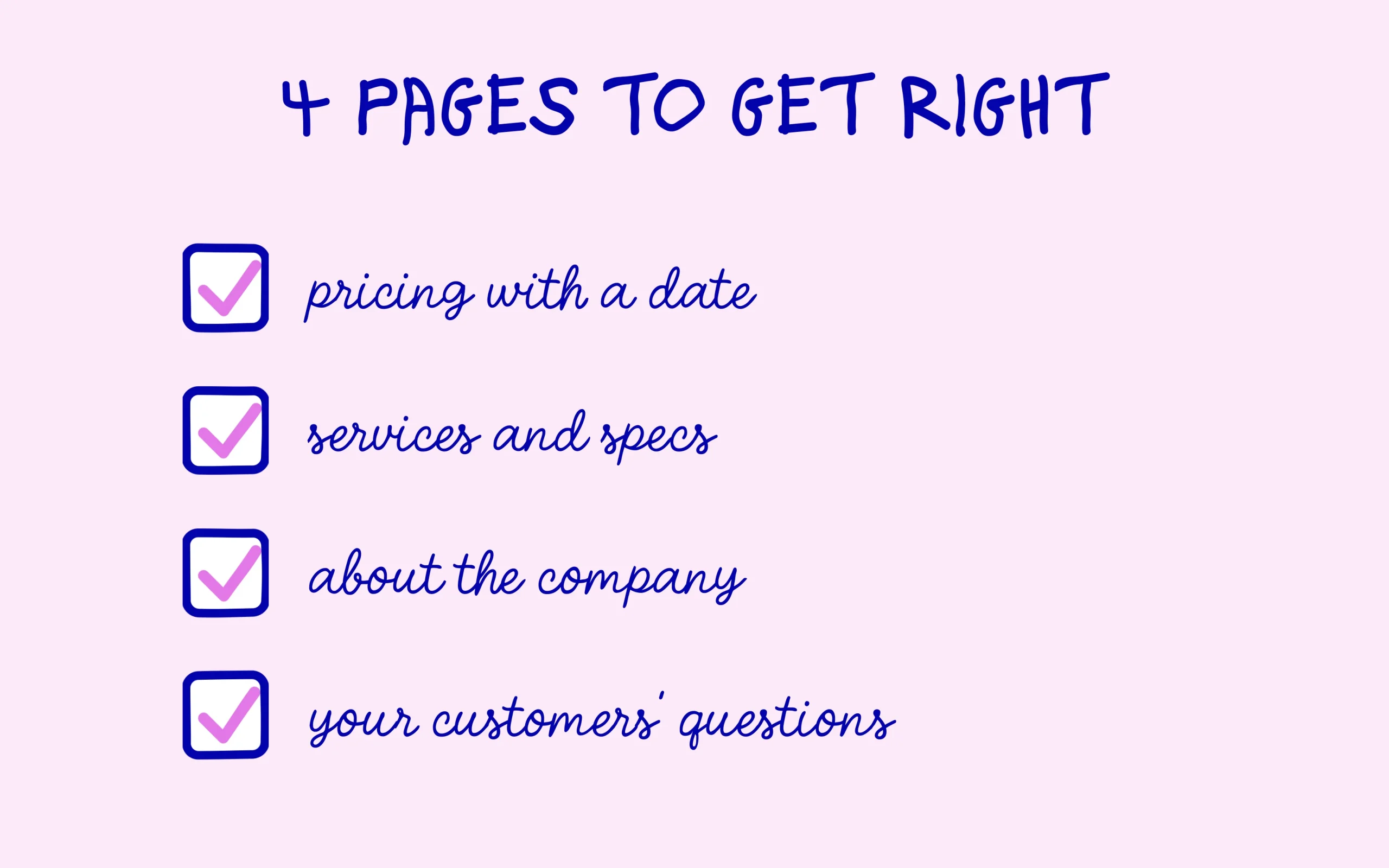
If I had to pick, I’d review four pages first on a small company’s brand website. The pricing page, with at least a range and what it covers. The service or product pages, with specs written out as text. The about page, with contact details, opening hours and the area you serve. And a FAQ page built from the real questions your customers ask, with short answers that include numbers where possible. Each one should show a last-updated date, since a year shows up in roughly one ChatGPT search in five.
The same reasoning applies to Google, which now shows its AI summary on most of the searches people run right before buying, as covered in the piece on AI Overviews now covering 88% of pre-purchase searches. In both cases, the AI is looking for precise answers about prices, reviews and comparisons. One solid pricing page serves both engines at once.
Some caution is still in order. The study captures a single model over two months, and Ahrefs itself notes that OpenAI keeps changing how ChatGPT retrieves information. I wouldn’t build an entire strategy on these percentages. That said, publishing accurate, dated, easy-to-find facts on your brand website is good practice that doesn’t depend on any model, and it helps your human visitors too.
Hand Your Brand Website Project to the Agency
If the ChatGPT test returns wrong answers or sources that aren’t yours, the SEO Noobies agency’s full package, from €2,499, takes the project on: a GEO strategy carried out on your site, a record of your AI citations and a measurement check after thirty days.
Keep learning on SEO Noobies.